Pharmacokinetics and Benzodiazepines: Introduction and
Overview:
5Overview:
Benzodiazepines have a prominent role in
anesthesia that only because of their amnestic effects but also
because of their anxiolytic actions.
They frequently prescribed benzodiazepine,
diazepam (Valium), was introduced over 40 years ago, whereas the
more water-soluble midazolam (Versed) product has been available
for about 25 years. Midazolam (Versed) exhibits excellent
anxiolytic and anterograde amnestic properties.
Benzodiazepines affect GABA-mediated
systems. The neurotransmitter GABA is an inhibitory
neurotransmitter and controls the state of a chloride ion
channel. Activation of this chloride ion channel results in
neuronal hyperpolarization (increased membrane potential in the
direction away from the threshold potential) and accounts for the
classification of the GABA system as "inhibitory".
Benzodiazepines increase the inhibitory action at the GABA
receptor.
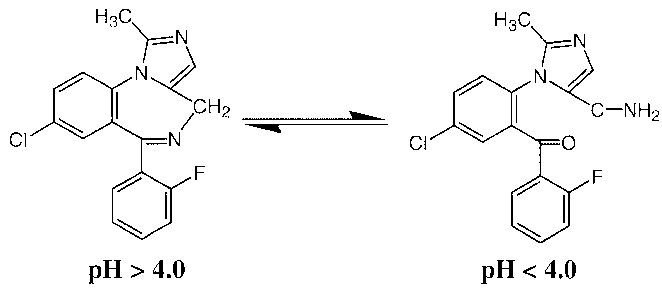
Midazolam (Versed) exhibits significant lipid
solubility, following injection, because the previously open
imidazole ring closes at physiological pH (7.4).
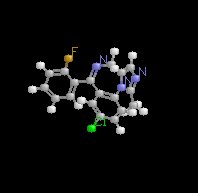
Midazolam (Versed)
5Pharmacokinetics:
In the anesthesia setting, benzodiazepine action
following single bolus injection is terminated by redistribution,
much in the manner of lipid-soluble barbiturates (e.g. thiopental
(Pentothal)). The mechanism is essentially the same in that
the lipid-soluble compound, e.g. midazolam (Versed), readily
enters the brain and that is subject to redistribution to other
tissues to receive a reduced percentage of cardiac output.
Ultimately, the benzodiazepines are metabolized
using the drug microsomal metabolizing system (P450) or the phase
I system as well as glucuronide conjugation, an example of a phase
II reaction.
An important consideration in understanding
benzodiazepine pharmacokinetics is that some benzodiazepines have
no active metabolites-here midazolam (Versed) is a good example;
however, diazepam (Valium) is metabolized to oxazepam (Serax) and
desmethyldiazepam, which themselves have sedative properties.
Therefore, midazolam (Versed) would be considered short-acting
[halftime between 1.5 and 3 hours] or is diazepam (Valium) is
long-acting, with a long elimination halftime [20-50 hours] in
part because of several active metabolites.
Despite similar degrees of protein binding and
comparable volumes of distribution, midazolam (Versed) has a
relatively high clearance -- 6-11 ml/kg/minute; by contrast,
diazepam (Valium) exhibits comparatively low clearance --
0.2-0.5 ml/kg/minute. Consequently, when redistribution
mechanisms are not prominent such as following repeated doses,
midazolam (Versed) blood levels will fall more rapidly
compared to diazepam (Valium) due to significantly higher
hepatic clearance.
5Benzodiazepine
pharmacology-- a summary of organ system and other effects:
CNS:
Benzodiazepines cause a
reduction in cerebral oxygen metabolism and blood flow.
Benzodiazepines appear to
protect against cerebral hypoxia and are very effective
anticonvulsant agents against local anesthetic-caused
seizures. Intravenous benzodiazepine administration,
such as IV diazepam (Valium), is very effective in terminating
many seizures including status epilepticus.
Pulmonary:
These drugs certainly can
depress respiration following administration by IV, although
generally respiratory depression is more typically associated
with barbiturates and opioids. Nevertheless midazolam
(Versed) for example can cause an increase in PaCO2
and respiratory depression is certainly important in the IV --intraoperative
setting with peak respiratory depression occurring
within three minutes {midazolam (Versed) at (0.1-0.2
mg/kg) and lasting for 1-2 hours.
Synergistic effects: In terms
of respiratory depression sedative-hypnotics would be
synergistic with opioids. Therefore increase respiratory
depression would be expected upon combination of opioids with
benzodiazepines.
Reversal of benzodiazepine effects:
A specific benzodiazepine
antagonist acting at the receptor can reverse excessive
sedation or respiratory depression due to benzodiazepine
effects.
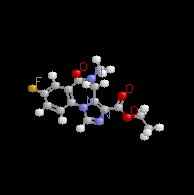
Flumazenil (Romazicon) is a
specific drug that acts by competitively blocking
benzodiazepine receptors thereby preventing benzodiazepine-receptor
interactions.
An important
pharmacokinetic aspect of flumazenil (Romazicon) is its
very short half-life [elimination halftime of 0.7-1.3
hours). Flumazenil (Romazicon)'s half-life is shorter
than those exhibited by benzodiazepines and as a result it
would be possible to reverse benzodiazepines-mediated
respiratory depression only to have it reoccur upon
flumazenil (Romazicon)'s elimination. Consequently
either repetitive flumazenil (Romazicon) dosing or
continues infusion (0.5-1 ug/kg/min.) may be required to
ensure sustained recovery from benzodiazepines mediated
effects. Two other points --
Flumazenil (Romazicon)
reversal tends to have a greater effect on respiratory
depression and sedation than on benzodiazepine
amnestic properties.
The requirement that
multiple flumazenil (Romazicon) doses may be required
to ensure sustained reversal of benzodiazepine
effects is similar to the requirement that multiple
doses of naloxone (Narcan) would be required to
ensure sustained reversal of opioid overdose
effects. This observation follows from the short
half-life associated with naloxone (Narcan) compared
to opioid half-lives.
1Katzung, B. G. Basic
Principles-Introduction , in Basic and Clinical
Pharmacology, (Katzung, B. G., ed) Appleton-Lange, 1998,
pp 1-33
2Benet, Leslie Z, Kroetz, Deanna
L. and Sheiner, Lewis B The Dynamics of Drug Absorption,
Distribution and Elimination. In, Goodman and Gillman's
The Pharmacologial Basis of Therapeutics,(Hardman, J.G, Limbird, L.E,
Molinoff, P.B., Ruddon, R.W, and Gilman, A.G.,eds) TheMcGraw-Hill Companies, Inc.,1996, pp. 3-27
3Correia, M.A., Drug
Biotransformation. in Basic and Clinical Pharmacology, (Katzung, B. G., ed) Appleton-Lange, 1998, pp 50-61.
4Stoelting, R.K.,
"Pharmacokinetics and Pharmacodynamics of Injected
and Inhaled Drugs", in Pharmacology and Physiology
in Anesthetic Practice, Lippincott-Raven Publishers,
1999, 1-17.
5Dolin, S. J. "Drugs and
pharmacology" in Total Intravenous Anesthesia, pp. 13-35 (Nicholas L.
Padfield, ed), Butterworth Heinemann, Oxford, 2000