Introduction to Medical Pharmacology
Ranolazine, Ivabradine & Other Newer Antianginal Agents
Module 5 of 7Nitrates, beta-blockers, and calcium channel blockers all reduce myocardial ischemia by altering one of the four hemodynamic levers introduced in Module 1: heart rate, preload, afterload, or contractility. Even on maximally tolerated combination therapy, a meaningful number of patients with stable angina continue to have symptoms, in part because every hemodynamic agent eventually runs into a dose-limiting side effect such as bradycardia or hypotension.
Ranolazine and ivabradine were developed to add anti-ischemic benefit through mechanisms that are either entirely non-hemodynamic or highly selective for a single hemodynamic target, allowing them to be layered onto existing therapy without compounding these dose-limiting effects.
Ranolazine's mechanism is unlike any other antianginal drug class covered so far. It does not reduce heart rate, blood pressure, or contractility at therapeutic doses, which is precisely what makes it useful as an add-on agent when those hemodynamic levers have already been maximized.
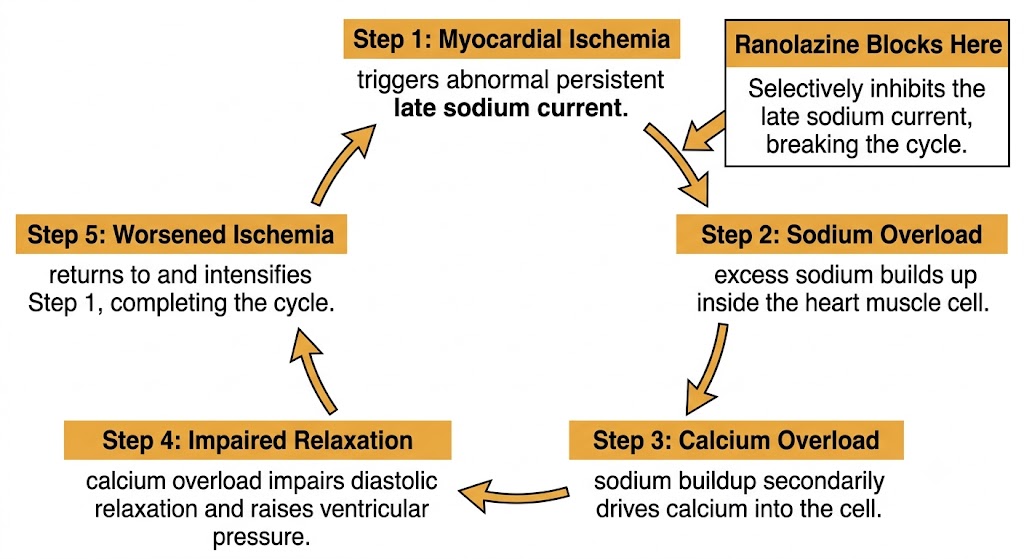
During normal heart function, sodium briefly enters cardiac muscle cells during each heartbeat and is quickly cleared. During myocardial ischemia, an abnormal "late" sodium current persists well beyond its normal brief window, allowing excess sodium to build up inside the cell. This sodium overload secondarily drives calcium into the cell as well, since the cell's normal mechanism for clearing calcium depends on a favorable sodium gradient that ischemia disrupts.
The resulting calcium overload impairs the heart muscle's ability to relax between beats, raises pressure inside the ventricle, and worsens the very ischemia that triggered the problem in the first place, a self-reinforcing cycle. Ranolazine selectively blocks this abnormal late sodium current, interrupting the cycle, improving diastolic relaxation, and reducing oxygen consumption without measurably affecting heart rate, blood pressure, or contractility.
Ranolazine is approved only as add-on therapy for patients with chronic stable angina who remain symptomatic despite adequate doses of a beta-blocker, calcium channel blocker, or nitrate. It is not used for acute angina relief, since the only available formulation is extended-release and acts too slowly. Because it has no hemodynamic effect, it is particularly useful in patients who cannot tolerate an additional heart-rate-lowering or blood-pressure-lowering agent.
Ranolazine produces mild prolongation of the corrected QT interval through weak blockade of a cardiac potassium channel, and this is the primary clinically significant adverse effect. Baseline electrocardiogram and corrected QT interval measurement are required before starting, and ranolazine is contraindicated in patients with significant baseline corrected QT interval prolongation.
Ivabradine reduces heart rate through a mechanism entirely distinct from beta-blockers or non-dihydropyridine calcium channel blockers, and its selectivity for a single site explains both its main advantage and its most important contraindication.
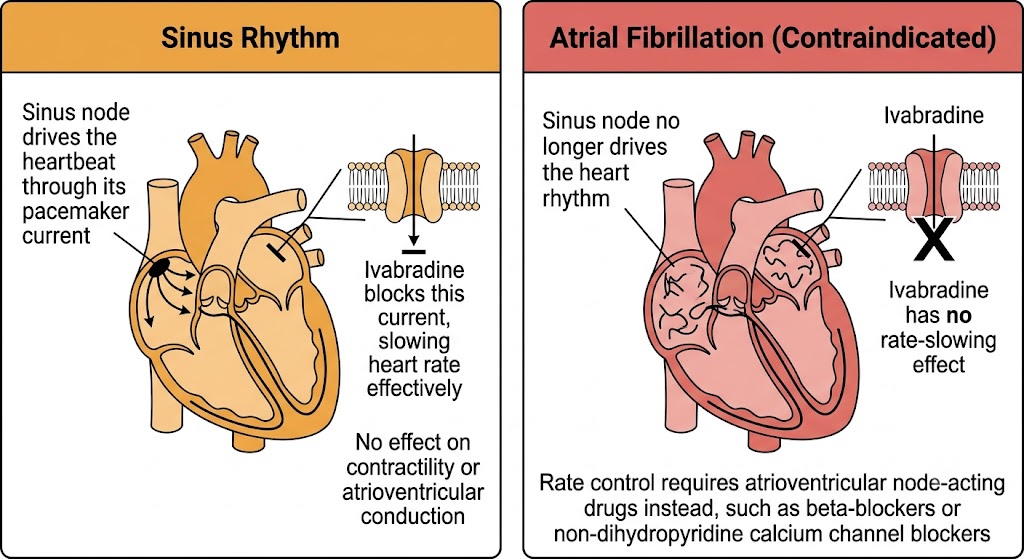
The sinoatrial node generates the heartbeat through a spontaneous, gradual depolarization driven largely by a current nicknamed the "funny current" because of its unusual electrophysiologic properties. The speed of this spontaneous depolarization determines how quickly the next heartbeat is triggered, and therefore determines heart rate.
Ivabradine selectively blocks this current within the sinoatrial node, slowing the rate of spontaneous depolarization and reducing heart rate. Because the funny current is concentrated almost entirely in the sinus node, ivabradine has no meaningful effect on contractility, blood pressure, or conduction through the atrioventricular node, unlike beta-blockers or non-dihydropyridine calcium channel blockers.
Ivabradine is contraindicated in atrial fibrillation. Because the drug acts specifically on the sinus node's pacemaker current, it has no rate-slowing effect when the sinus node is no longer driving the heart rhythm, as is the case in atrial fibrillation. Rate control in atrial fibrillation requires drugs that act on the atrioventricular node instead, such as beta-blockers or non-dihydropyridine calcium channel blockers. Confirmed sinus rhythm is required before starting ivabradine and should be reconfirmed at follow-up.
Ivabradine is used as add-on therapy for stable angina in patients in sinus rhythm with an elevated resting heart rate despite maximally tolerated beta-blocker therapy, or when beta-blockers cannot be used. The most distinctive adverse effect is visual phosphenes, transient bright flashes or halos of light, which occur because the same type of channel ivabradine blocks in the sinus node is also present in the retina. These effects are reversible with dose reduction or discontinuation, but patients should be counseled about them before starting therapy so that unexpected visual symptoms do not cause alarm.
Nicorandil and trimetazidine are two further antianginal agents with mechanisms distinct from the classes already covered. Neither is available in the United States, but both are used elsewhere and are worth recognizing conceptually.
Trimetazidine illustrates a third category of antianginal mechanism beyond hemodynamics and ion channels: cellular metabolism. The heart muscle normally relies heavily on fatty acid oxidation for energy, but this pathway consumes more oxygen per unit of energy produced than glucose oxidation does. Trimetazidine partially shifts cardiac metabolism toward glucose, making each unit of oxygen delivered to the heart go further, all without any effect on heart rate, blood pressure, or contractility.
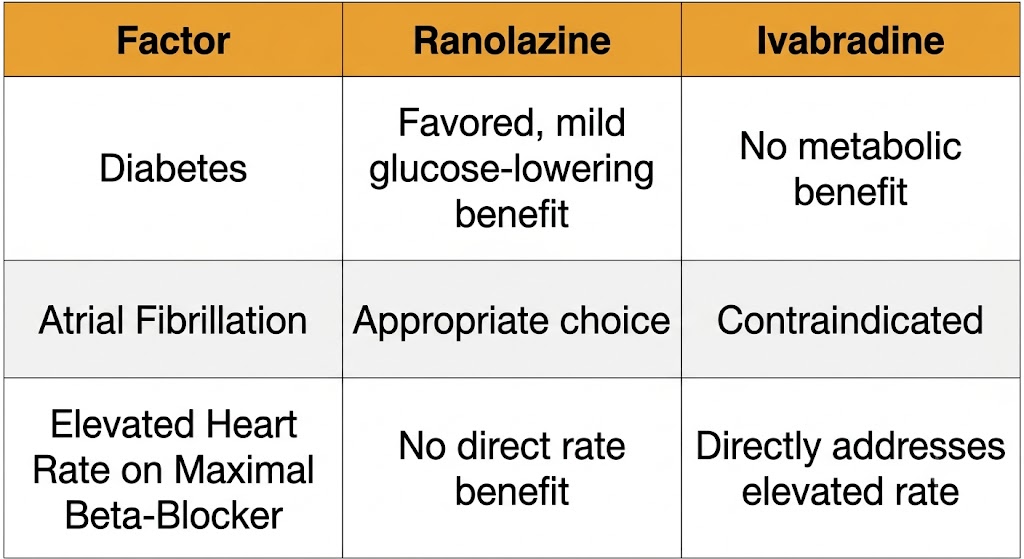
Ranolazine and ivabradine are both used as add-on therapy for stable angina, but they are not interchangeable. A few mechanistically grounded distinctions guide the choice between them.
| Factor | Favors Ranolazine | Favors Ivabradine |
|---|---|---|
| Diabetes | Yes — mild glucose-lowering benefit | No metabolic benefit |
| Atrial fibrillation | Appropriate choice | Contraindicated |
| Elevated resting heart rate on maximal beta-blocker | No direct rate benefit | Directly addresses elevated rate |
In practice, the two agents are not mutually exclusive: a patient in sinus rhythm with both diabetes and a persistently elevated heart rate despite maximal beta-blocker therapy could reasonably receive both, since their mechanisms do not overlap and neither compounds the other's effects.
| Author / Organization | Title | Source |
|---|---|---|
| Chaitman BR, Pepine CJ, Parker JO, et al. | Effects of ranolazine with atenolol, amlodipine, or diltiazem on exercise tolerance and angina frequency in patients with severe chronic angina (CARISA) | JAMA, 2004 |
| Stone PH, Gratsiansky NA, Blokhin A, et al. | Antianginal efficacy of ranolazine when added to treatment with amlodipine (ERICA trial) | Journal of the American College of Cardiology, 2006 |
| Knuuti J, Wijns W, Saraste A, et al. | 2019 ESC Guidelines for the diagnosis and management of chronic coronary syndromes | European Heart Journal, 2020 |
| Fihn SD, Gardin JM, Abrams J, et al. | 2012 ACCF/AHA Guideline for the diagnosis and management of patients with stable ischemic heart disease | Journal of the American College of Cardiology, 2012 |
| Fox K, Ford I, Steg PG, et al. | Ivabradine for patients with stable coronary artery disease and left-ventricular systolic dysfunction (BEAUTIFUL) | Lancet, 2008 |
| Fox K, Ford I, Steg PG, et al. | Ivabradine in stable coronary artery disease without clinical heart failure (SIGNIFY) | New England Journal of Medicine, 2014 |
| Swedberg K, Komajda M, Böhm M, et al. | Ivabradine and outcomes in chronic heart failure (SHIFT) | Lancet, 2010 |
| Ciapponi A, Pizarro R, Harrison J. | Trimetazidine for stable angina | Cochrane Database of Systematic Reviews, 2005 |
| IONA Study Group. | Effect of nicorandil on coronary events in patients with stable angina (IONA) | Lancet, 2002 |
| Belardinelli L, Shryock JC, Fraser H. | Inhibition of the late sodium current as a potential cardioprotective principle | Heart, 2006 |
| DiFrancesco D. | The role of the funny current in pacemaker activity | Circulation Research, 2010 |
| Morrow DA, Scirica BM, Karwatowska-Prokopczuk E, et al. | Effects of ranolazine on recurrent cardiovascular events in patients with non-ST-elevation acute coronary syndromes (MERLIN-TIMI 36) | JAMA, 2007 |