CHAPTER 37  ·  ANTIFUNGAL AGENTS
Section 1

Mechanisms of Antifungal Drug Interactions

Cytochrome P450 inhibition, enzyme induction, and P-glycoprotein effects

The azole antifungals are among the most pharmacokinetically interactive drugs in clinical medicine. Their interactions arise primarily from potent inhibition of cytochrome P450 (CYP) enzymes in the liver and intestinal wall, and from vulnerability to drugs that induce these same enzymes and reduce azole concentrations to subtherapeutic levels. Understanding the mechanistic basis of these interactions is essential for managing them safely.

CYP Enzyme Inhibition

The azoles inhibit CYP enzymes by coordinating their triazole nitrogen with the heme iron of the enzyme active site, blocking substrate access. This inhibition is rapid in onset — occurring within hours of the first dose — and largely reversible on drug discontinuation. Inhibition raises plasma concentrations of co-administered drugs that depend on the same CYP isoforms for metabolism, potentially producing toxicity at doses that are otherwise safe. The magnitude of any interaction depends on the potency of inhibition, the fraction of the victim drug metabolized by the inhibited enzyme, the therapeutic index of the victim drug, and whether alternative metabolic pathways can compensate. Drugs with narrow therapeutic indices and high fractional metabolism through the inhibited CYP carry the highest interaction risk.

CYP Isoform Selectivity Among Azoles

Different azoles inhibit overlapping but distinct sets of CYP isoforms. Voriconazole inhibits CYP2C19 (cytochrome P450 2C19), CYP2C9 (cytochrome P450 2C9), and CYP3A4 (cytochrome P450 3A4) with roughly comparable potency — the broadest CYP inhibitor profile in the antifungal class. Posaconazole inhibits CYP3A4 selectively with minimal effects on CYP2C19 or CYP2C9. Itraconazole inhibits CYP3A4 potently and is also a potent inhibitor of P-glycoprotein (P-gp), a drug efflux transporter that independently affects intestinal and hepatic drug disposition. Fluconazole inhibits CYP2C9 most potently and CYP3A4 to a lesser degree. Isavuconazole inhibits CYP3A4 moderately, with lower overall inhibitory potency than voriconazole or posaconazole. These differences mean that the two agents, despite sharing a class mechanism, have largely different drug interaction liabilities — clinicians must look up interactions for each specific azole rather than generalizing across the class.

CYP Enzyme Induction

While azoles inhibit CYP enzymes, azoles are themselves CYP substrates and are vulnerable to induction by drugs that upregulate CYP expression through nuclear receptor activation, principally the pregnane X receptor (PXR). CYP inducers increase enzyme synthesis over days to weeks, progressively reducing concentrations of CYP substrate drugs. The most potent inducers relevant to antifungal therapy are rifampin (rifampicin), which induces CYP3A4, CYP2C19, CYP2C9, and P-gp simultaneously; rifabutin, which has a similar but less potent profile; antiepileptic drugs including phenytoin, carbamazepine, and phenobarbital; and antiretrovirals including efavirenz and nevirapine. For most azoles, co-administration with rifampin reduces plasma concentrations so severely that therapeutic levels cannot be maintained even at maximal dose escalation, rendering the combination contraindicated. St. John's wort is contraindicated for the same reason.

Highest-Risk Interaction Pairs

Contraindicated with all azoles: rifampin, St. John's wort — both reduce azole concentrations to subtherapeutic levels. Contraindicated with voriconazole and posaconazole: sirolimus — exposure increases 500 to 1000 percent, producing severe toxicity at standard doses. Require proactive dose reduction and therapeutic drug monitoring (TDM): tacrolimus and cyclosporine with any azole. Require INR monitoring within three to five days: warfarin with fluconazole, voriconazole, or posaconazole.


Section 2

Azole Interactions by Drug Class

Immunosuppressants, anticoagulants, and other high-priority clinical interaction pairs

The clinical importance of an antifungal drug interaction is determined by whether the resulting change in drug exposure crosses the threshold for toxicity or subtherapeutic efficacy. This section reviews the major interaction categories by victim drug class, with emphasis on the pairs that cause the greatest harm and require the most systematic management.

Calcineurin Inhibitors

Tacrolimus and cyclosporine are metabolized primarily by CYP3A4 and transported by P-gp; both are inhibited by all azoles to varying degrees. Voriconazole and posaconazole produce the largest increases in calcineurin inhibitor concentrations — typically requiring tacrolimus dose reductions of 50 to 75 percent and cyclosporine reductions of 25 to 50 percent when an azole is initiated. Itraconazole elevates calcineurin inhibitor concentrations substantially through combined CYP3A4 and P-gp inhibition. Fluconazole has a more modest effect, typically requiring tacrolimus reductions of 25 to 50 percent. Isavuconazole elevates calcineurin inhibitor concentrations to a lesser degree than voriconazole or posaconazole, but dose reduction and monitoring are still required. These reductions must be made proactively before the azole reaches steady state — reactive adjustment after the calcineurin inhibitor trough rises risks nephrotoxicity and neurotoxicity from supratherapeutic exposure.

Sirolimus and Everolimus

Sirolimus is an mammalian target of rapamycin (mTOR) inhibitor used in renal transplantation and as anti-graft-versus-host disease (GVHD) therapy. It is metabolized almost exclusively by CYP3A4 and has a narrow therapeutic index. Voriconazole and posaconazole increase sirolimus area under the concentration-time curve (AUC) by approximately 500 to 1000 percent — from therapeutic to profoundly toxic — making co-administration categorically contraindicated with both agents. Isavuconazole produces a substantial but smaller increase and requires careful TDM with dose reduction if the combination must be used. Everolimus has a similar but somewhat less extreme interaction profile and requires TDM whenever used with any azole.

Warfarin

Warfarin is metabolized by CYP2C9 (the more pharmacologically active S-warfarin enantiomer) and CYP3A4 (R-warfarin). Fluconazole and voriconazole are the most potent inhibitors of CYP2C9 among the azoles and significantly elevate the international normalized ratio (INR) by reducing S-warfarin clearance — increases of two to three-fold are reported within days of starting the azole. INR monitoring within one to two weeks of starting or stopping an azole is mandatory, and warfarin dose reductions of 25 to 50 percent are commonly required. Posaconazole affects warfarin primarily through CYP3A4 inhibition; the interaction is clinically significant but typically less severe than with fluconazole or voriconazole. Direct oral anticoagulants (DOACs) — including rivaroxaban and apixaban — are cytochrome P450 3A4 and P-glycoprotein substrates and are also affected, with exposure potentially increasing to hemorrhage-risk concentrations when combined with potent azoles.

Statins and Central Nervous System Agents

Simvastatin and lovastatin are highly dependent on CYP3A4 for first-pass and systemic metabolism; itraconazole and other potent CYP3A4 inhibitor azoles increase plasma concentrations dramatically, elevating the risk of myopathy and rhabdomyolysis. These combinations are contraindicated; pravastatin or rosuvastatin should be substituted. Midazolam and other CYP3A4-metabolized benzodiazepines may reach dangerous concentrations with azole co-administration, particularly in perioperative and intensive care unit (ICU) settings. Fentanyl and oxycodone are also CYP3A4 substrates and can accumulate to respiratory-depression concentrations when potent CYP3A4 inhibitor azoles are co-administered.
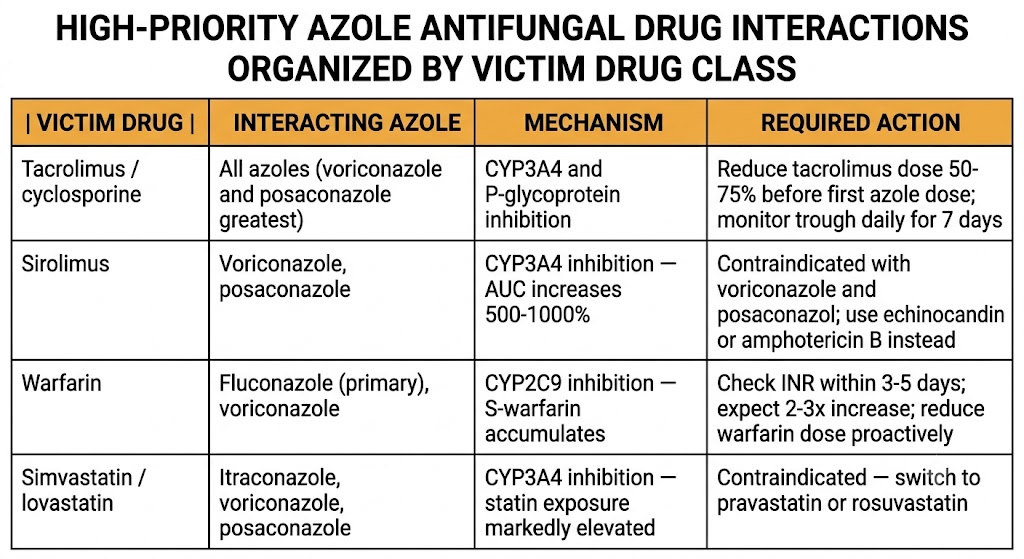
Reference table of high-priority azole drug interactions by victim drug class, showing four rows: tacrolimus and cyclosporine with all azoles requiring 50 to 75 percent dose reduction before first azole dose; sirolimus contraindicated with voriconazole and posaconazole due to 500 to 1000 percent AUC increase; warfarin requiring INR check within 3 to 5 days when combined with fluconazole or voriconazole; and simvastatin and lovastatin contraindicated with potent CYP3A4 inhibitor azoles.
High-priority azole antifungal drug interactions by victim drug class: mechanisms and required clinical actions. Gemini-generated figure.
Azole-Antiretroviral Interactions

Efavirenz reduces voriconazole concentrations by approximately 77 percent and is listed as contraindicated with standard voriconazole dosing; the voriconazole maintenance dose must be doubled and efavirenz reduced if the combination is unavoidable. Ritonavir simultaneously induces CYP2C19 (reducing voriconazole) and inhibits CYP3A4 (raising voriconazole) — the net effect is unpredictable; avoid this combination. Lopinavir and other protease inhibitors inhibit CYP3A4 and increase isavuconazole exposure, requiring TDM. Fluconazole is generally the safest azole for use with antiretrovirals given its simpler CYP interaction profile.

Section 3

Calcineurin Inhibitor Management with Antifungals

Proactive dose adjustment protocols, monitoring timelines, and the most dangerous combinations

The interaction between azole antifungals and calcineurin inhibitors is the most consequential and most frequently encountered pharmacokinetic interaction in transplant medicine. Failure to anticipate and proactively manage it is a leading cause of preventable calcineurin inhibitor toxicity in solid organ and hematopoietic stem cell transplant (HSCT) recipients.

Mechanism and Magnitude by Azole

Tacrolimus is metabolized by CYP3A4 in the intestinal wall and liver, and is a P-gp substrate that limits oral bioavailability. Azole inhibition of intestinal CYP3A4 and P-gp increases tacrolimus absorption from the gut, and inhibition of hepatic CYP3A4 slows its elimination — producing combined first-pass and systemic pharmacokinetic enhancement. The AUC increase follows the potency of the azole as a CYP3A4 inhibitor: voriconazole and posaconazole increase tacrolimus AUC by approximately three to five-fold; itraconazole produces a comparable or greater increase; fluconazole typically produces a two to three-fold AUC increase; isavuconazole produces approximately a 1.5 to two-fold increase. Cyclosporine is metabolized by CYP3A4 but is less sensitive to P-gp inhibition, and the magnitude of interaction is generally somewhat smaller than for tacrolimus but clinically significant for all azoles.

Dose Adjustment Protocol

When initiating an azole in a transplant recipient receiving a calcineurin inhibitor, the calcineurin inhibitor dose must be empirically reduced before the first azole dose is given — not after the trough rises. For tacrolimus with voriconazole or posaconazole, reduce to approximately one-third of the current dose. With fluconazole, reduce to approximately one-half. With isavuconazole, reduce to approximately two-thirds. For cyclosporine with voriconazole or posaconazole, reduce by approximately 25 to 50 percent. Tacrolimus trough levels should then be measured daily for the first five to seven days after azole initiation as the full pharmacokinetic interaction develops. When the azole is discontinued, the reverse process occurs: calcineurin inhibitor concentrations fall as CYP3A4 inhibition reverses, requiring prospective dose escalation and daily monitoring for five to seven days.

The Sirolimus Problem

Sirolimus represents a special category because its extreme CYP3A4 sensitivity makes safe co-administration with potent azoles effectively impossible at standard doses. When a patient on sirolimus develops an invasive fungal infection requiring voriconazole or posaconazole, the preferred approach is to transition the patient from sirolimus to an alternative immunosuppressant before starting the azole, or to select a non-azole antifungal — an echinocandin or amphotericin B formulation — where clinically appropriate. If isavuconazole must be used with sirolimus, sirolimus doses typically need to be reduced to 20 to 40 percent of the standard dose, with close TDM of both drugs.

Tacrolimus Protocol When Starting an Azole

Step 1: Reduce tacrolimus dose before the first azole dose — not reactively. Voriconazole or posaconazole: reduce to approximately one-third of current dose. Fluconazole: reduce to approximately one-half. Isavuconazole: reduce to approximately two-thirds. Step 2: Measure tacrolimus trough daily for days one through seven after azole initiation. Step 3: Adjust tacrolimus to re-establish target trough. Step 4: When the azole is stopped, increase tacrolimus dose prospectively and monitor daily for five to seven days. Sirolimus plus voriconazole or posaconazole: contraindicated — transition patient off sirolimus before starting these azoles.


Section 4

Principles of Therapeutic Drug Monitoring

When TDM delivers clinical benefit, and why voriconazole is the strongest case for routine monitoring

Therapeutic drug monitoring (TDM) measures drug concentrations in patient plasma to verify that dosing achieves exposure ranges associated with efficacy while avoiding supratherapeutic concentrations linked to toxicity. TDM is not universally applicable — its value is greatest when specific pharmacokinetic and pharmacodynamic conditions are met simultaneously.

Criteria That Justify TDM

Four conditions must be present for TDM to deliver meaningful clinical benefit: demonstrable exposure-response relationships for both efficacy and toxicity; a narrow therapeutic index; high interpatient pharmacokinetic variability; and non-linear or unpredictable pharmacokinetics. Voriconazole satisfies all four with exceptional force. The published coefficient of variation for voriconazole trough concentrations at standard doses exceeds 80 percent — driven by cytochrome P450 2C19 (CYP2C19) genotype, comedications, hepatic function, and severity of illness. Two patients receiving identical doses may have trough concentrations differing by a factor of ten or more. Without TDM, approximately 30 to 50 percent of patients will have subtherapeutic concentrations and another 20 to 30 percent will have supratherapeutic concentrations.

Exposure-Response Evidence for Voriconazole

Multiple clinical studies have established concentration-outcome relationships for voriconazole. Trough concentrations below 1.0 to 1.5 mg/L are consistently associated with increased treatment failure in invasive aspergillosis. Conversely, trough concentrations above 5.0 to 5.5 mg/L are associated with hepatotoxicity, neurotoxicity (hallucinations, encephalopathy, delirium), and visual adverse effects. The therapeutic window of approximately 1.0 to 5.5 mg/L forms the basis of clinical TDM practice. Achieving this window cannot be reliably accomplished by dose adjustment alone without measured concentrations — the interpatient variability is simply too large.

Factors Driving Voriconazole Variability

The CYP2C19 genotype is the most important driver of voriconazole pharmacokinetic variability. Poor metabolizers (PM), who carry two loss-of-function CYP2C19 alleles, achieve plasma concentrations four to five times higher than normal metabolizers at the same dose. Ultrarapid metabolizers (UM) achieve concentrations up to 50 percent lower. Hepatic function significantly affects voriconazole clearance: Child-Pugh class B or C liver disease elevates concentrations substantially. Proton pump inhibitors such as omeprazole inhibit CYP2C19 and further elevate voriconazole concentrations. Inflammation and critical illness reduce CYP enzyme activity and can acutely increase exposure even without dose changes. The combination of these variables makes TDM at steady state — day five to seven of therapy — essential rather than optional in any patient receiving voriconazole for serious infection.


Section 5

TDM in Clinical Practice

Target concentrations, sampling methodology, and interpretation for voriconazole, posaconazole, and itraconazole

Practical implementation of antifungal TDM requires knowledge of target concentration ranges, correct sampling methodology, timing of steady state, and how to interpret concentrations in light of the clinical context.

Voriconazole TDM

Voriconazole TDM is measured as a trough concentration — the plasma concentration immediately before the next scheduled dose. Steady state is achieved at approximately day five to seven of consistent twice-daily oral dosing or after five to six IV doses when a loading dose has been given. The target trough range is 1.0 to 5.5 mg/L. A trough below 1.0 mg/L in a patient not responding to therapy warrants dose escalation; a trough below 0.5 mg/L in a non-responding patient on standard doses strongly suggests a pharmacokinetic problem (CYP2C19 ultrarapid metabolizer phenotype, concurrent inducer, or non-adherence to fasting requirements) that dose increase alone may not resolve without identifying the cause. A trough above 5.5 mg/L in a patient with new neuropsychiatric symptoms or hepatotoxicity warrants dose reduction. TDM should be repeated after any dose change, addition or removal of an interacting drug, change in hepatic function, or intercurrent illness.

Posaconazole TDM

Posaconazole TDM is most critical when the oral suspension is used, given that formulation's highly variable food-dependent absorption. Target trough concentrations are above 0.7 mg/L for prophylaxis and above 1.0 mg/L (with some authorities recommending 1.25 to 1.5 mg/L) for treatment of invasive infection. For prophylaxis with the delayed-release (DR) tablet, TDM is less urgent given the more consistent pharmacokinetics but remains advisable in patients with gastrointestinal (GI) dysfunction or significant drug-drug interactions. Steady state with either formulation is typically achieved by day five to seven.

Itraconazole TDM

Itraconazole TDM is recommended because of high interpatient pharmacokinetic variability and a narrow exposure window. Trough concentrations at steady state — typically after 14 days — should exceed 0.5 mcg/mL for prophylaxis and 1.0 mcg/mL for treatment of invasive fungal infections. Both itraconazole and hydroxy-itraconazole are measured together; some assays report combined concentrations while others report each separately, requiring careful interpretation. Concentrations above 10 mcg/mL are associated with increased toxicity.

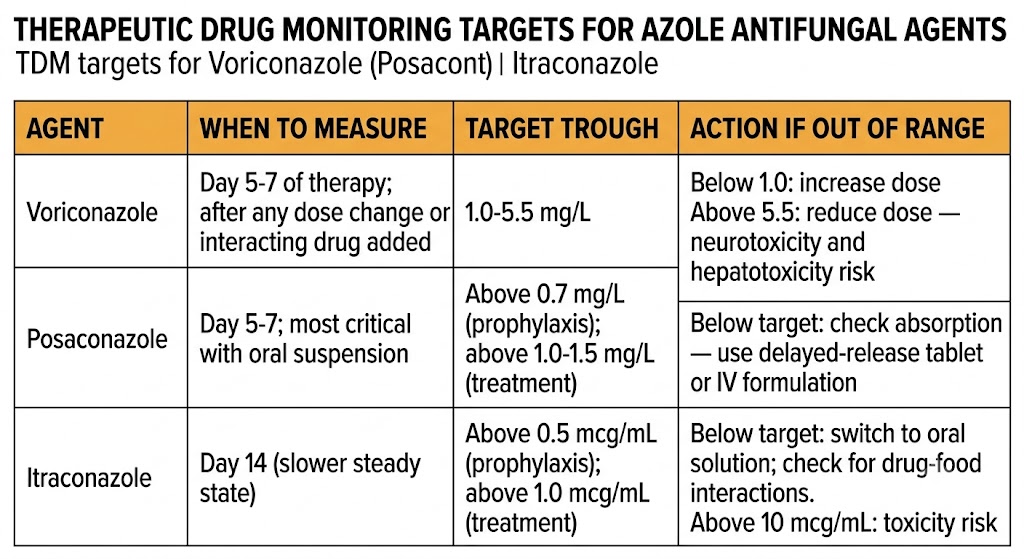
Reference table of therapeutic drug monitoring targets for three azole antifungals: voriconazole target trough 1.0 to 5.5 mg/L measured at day 5 to 7; posaconazole above 0.7 mg/L for prophylaxis and above 1.0 to 1.5 mg/L for treatment measured at day 5 to 7; itraconazole above 0.5 mcg/mL for prophylaxis and above 1.0 mcg/mL for treatment measured at day 14.
Therapeutic drug monitoring targets and clinical decision rules for voriconazole, posaconazole, and itraconazole. Gemini-generated figure.
TDM Target Summary

Voriconazole trough: target 1.0 to 5.5 mg/L; below 1.0 mg/L correlates with treatment failure; above 5.5 mg/L correlates with neurotoxicity and hepatotoxicity. Obtain at day five to seven. Posaconazole trough: target above 0.7 mg/L (prophylaxis); above 1.0 to 1.5 mg/L (treatment). TDM most critical with suspension; still advisable with delayed-release tablet in high-risk patients. Itraconazole trough: target above 0.5 mcg/mL (prophylaxis); above 1.0 mcg/mL (treatment). Obtain after 14 days. Isavuconazole: TDM not standardized — check in patients on CYP3A4 inducers or inhibitors and in breakthrough infections.


Section 6

Safe Antifungal Prescribing Framework

Systematic approach to interaction review, agent selection to minimize burden, and monitoring workflow

The complexity of antifungal drug interactions and TDM requirements can be managed systematically. The following framework integrates the preceding sections into a practical decision sequence for any patient requiring antifungal therapy.

Step 1 — Interaction Review Before Prescribing

Before prescribing any azole, review the patient's complete medication list against a validated drug interaction database — not memory. The three interaction pairs that most frequently produce serious harm and are most commonly missed are: azole plus calcineurin inhibitor (missed because the immunosuppressant dose is managed by a separate transplant team); azole plus sirolimus (missed because sirolimus is used intermittently and may not appear on the active medication list); and azole plus warfarin (missed because warfarin is prescribed by a primary care provider not involved in the antifungal decision). For any patient in a transplant program, the antifungal prescriber must notify the transplant pharmacist before administering the first azole dose so that calcineurin inhibitor dose adjustment is coordinated.

Step 2 — Agent Selection to Minimize Interaction Burden

When more than one antifungal agent is clinically appropriate for the indication, choose the agent with the lowest interaction burden for that patient's specific drug regimen. For invasive candidiasis in a transplant patient on cyclosporine: an echinocandin (micafungin or anidulafungin) avoids the CYP interaction entirely and is first-line anyway. For Aspergillus prophylaxis in a patient on warfarin: posaconazole (CYP3A4 inhibitor, less effect on CYP2C9) has a smaller warfarin interaction than voriconazole or fluconazole, though close INR monitoring is still required. For a patient on rifampin who requires an antifungal for mucormycosis: rifampin renders all azoles subtherapeutic — liposomal amphotericin B is the only appropriate choice and has no CYP interactions.

Step 3 — TDM Workflow

For any patient receiving voriconazole: obtain trough concentration at day five to seven, after any dose change, after any interacting drug is added or removed, and when hepatic function changes. For posaconazole suspension: obtain trough at day five to seven; repeat if GI function or absorption-affecting medications change. For itraconazole: obtain trough after 14 days of stable therapy; interpret combined itraconazole plus hydroxy-itraconazole concentration if the assay measures both. For echinocandins: TDM is not routinely indicated; focus monitoring on liver function tests, potassium, and magnesium. For liposomal amphotericin B: TDM is not performed; monitor creatinine, potassium, and magnesium with every infusion.

Module 5 Summary

Azole interactions arise through CYP enzyme inhibition (rapid onset, reversible) and vulnerability to CYP inducers (rifampin, anticonvulsants, efavirenz) that reduce azole concentrations to subtherapeutic levels. Fluconazole: primarily CYP2C9 (warfarin, phenytoin). Itraconazole and posaconazole: primarily CYP3A4 and P-gp (calcineurin inhibitors, statins). Voriconazole: CYP2C9 + CYP3A4 + CYP2C19. Calcineurin inhibitor rule: reduce tacrolimus dose before first azole dose; monitor daily for seven days. Sirolimus plus voriconazole or posaconazole: contraindicated. Voriconazole TDM target: 1.0 to 5.5 mg/L at steady state (day five to seven). Posaconazole TDM target: above 0.7 mg/L (prophylaxis), above 1.0 mg/L (treatment). Itraconazole TDM target: above 1.0 mcg/mL (treatment). Never generalize interactions across the azole class — look up each agent individually.

Suggested References
Author / Organization Title Source
Venkatakrishnan K, von Moltke LL, Greenblatt DJ Effects of the antifungal agents on oxidative drug metabolism: clinical relevance Clin Pharmacokinet. 2000;38(2):111-180
Gubbins PO, Amsden JR Drug-drug interactions of antifungal agents and implications for patient care Expert Opin Pharmacother. 2005;6(13):2231-2243
Dodds Ashley ES, Lewis R, Lewis JS, Martin C, Andes D Pharmacology of systemic antifungal agents Clin Infect Dis. 2006;43(Suppl 1):S28-S39
Saad AH, DePestel DD, Carver PL Factors influencing the magnitude and clinical significance of drug interactions between azole antifungals and select immunosuppressants Pharmacotherapy. 2006;26(12):1730-1744
Dodds-Ashley E Management of drug and food interactions with azole antifungal agents in transplant recipients Pharmacotherapy. 2010;30(8):842-854
Dolton MJ, Ray JE, Chen SC, Ng K, Pont L, McLachlan AJ Multicenter study of voriconazole pharmacokinetics and therapeutic drug monitoring Antimicrob Agents Chemother. 2012;56(9):4793-4799
Pasqualotto AC, Shah M, Wynn R, Denning DW Voriconazole plasma monitoring Arch Dis Child. 2008;93(7):578-581
Andes D, Pascual A, Marchetti O Antifungal therapeutic drug monitoring: established and emerging indications Antimicrob Agents Chemother. 2009;53(1):24-34
Bruggemann RJ, Alffenaar JW, Blijlevens NM, et al. Clinical relevance of the pharmacokinetic interactions of azole antifungal drugs with other coadministered agents Clin Infect Dis. 2009;48(10):1441-1458
Pappas PG, Kauffman CA, Andes DR, et al. Clinical practice guideline for the management of candidiasis: 2016 update by the Infectious Diseases Society of America Clin Infect Dis. 2016;62(4):e1-e50