CHAPTER 14  ·  GENERAL ANESTHESIA

Section 1

Introduction and the Concept of Balanced Anesthesia

The pharmacological goals of general anesthesia and why no single drug achieves them

General anesthesia is a pharmacologically induced, reversible state that suppresses consciousness to a degree sufficient to permit surgery. Four components define this state: unconsciousness, analgesia, amnesia, and skeletal muscle relaxation. No single drug reliably produces all four components at safe doses, which is why modern anesthetic practice almost always uses a combination of agents, each contributing one or more components. This strategy is called balanced anesthesia.

In a typical balanced anesthetic, a benzodiazepine or an intravenous hypnotic provides anxiolysis and amnesia before induction; an intravenous agent such as propofol or ketamine is used for rapid induction of unconsciousness; a volatile inhalational agent maintains the unconscious state during surgery; an opioid provides analgesia and blunts the hemodynamic response to surgical stimulation; and a neuromuscular blocking agent produces skeletal muscle relaxation for intubation and surgical access. Understanding each drug class and its specific contribution to this framework is the foundation of anesthesia pharmacology.


Section 2

Factors Influencing Speed of Inhalational Induction

How quickly an inhalational anesthetic reaches effective brain concentrations

The speed of inhalational induction depends on how quickly the partial pressure of the anesthetic rises in the alveolus and then equilibrates with the brain. Several pharmacokinetic factors determine this rate.

Blood:Gas Partition Coefficient

The blood:gas partition coefficient is the most important pharmacokinetic property of an inhalational anesthetic. It describes how readily the drug dissolves in blood relative to the alveolar gas. A high coefficient means the drug is highly soluble in blood — blood acts as a large reservoir that must be filled before alveolar partial pressure can rise, producing a slow induction. A low coefficient means the drug is poorly soluble — alveolar partial pressure rises quickly, the brain equilibrates rapidly, and induction is fast.

Desflurane and nitrous oxide have the lowest blood:gas coefficients (approximately 0.42 and 0.47, respectively) and the fastest inductions. Sevoflurane (approximately 0.65) is intermediate and widely used for pediatric inhalational induction. Isoflurane (approximately 1.4) and halothane (approximately 2.4) are more soluble and have slower inductions. The same principle governs emergence: agents with low solubility wash out rapidly, producing fast awakening.

Alveolar Ventilation

Increasing alveolar ventilation speeds induction by delivering more anesthetic to the alveolus faster, raising alveolar partial pressure. This effect is most pronounced for highly soluble agents, where blood uptake continuously drains the alveolus. Hyperventilation accelerates induction; hypoventilation delays it.

Cardiac Output

High cardiac output means more blood flows through the pulmonary capillaries per minute, removing more anesthetic from the alveolus and slowing the rise in alveolar partial pressure — thus slowing induction. Conversely, low cardiac output (as in hemorrhagic shock) reduces pulmonary blood flow, allows alveolar partial pressure to rise more rapidly, and can produce an unexpectedly fast induction with cardiovascular depression in an already compromised patient. This is an important clinical paradox: the sickest patients are at greatest risk of anesthetic overdose during inhalational induction.

Concentration Effect and Second Gas Effect

When a highly concentrated inspired mixture is used, alveolar partial pressure rises faster than simple diffusion alone would predict — this is the concentration effect. The second gas effect is an extension of this principle: when nitrous oxide is given simultaneously with a second volatile agent, the rapid absorption of the large volume of nitrous oxide augments delivery of the co-administered agent, accelerating its alveolar partial pressure rise. Both effects are most relevant when nitrous oxide is part of the induction mixture.
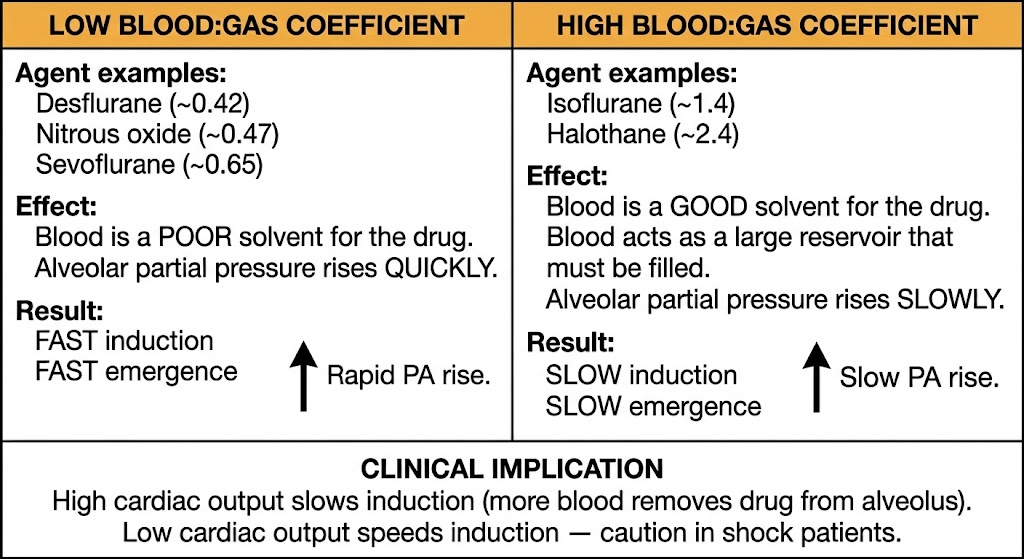
Two-panel diagram comparing low and high blood:gas partition coefficients, showing that low coefficients produce fast induction and emergence while high coefficients produce slow induction and emergence, with a clinical implication box noting cardiac output effects.
Blood:gas partition coefficient and speed of inhalational induction. Figure generated by Gemini AI.

Section 3

Minimum Alveolar Concentration: Measuring Anesthetic Potency

The standard pharmacodynamic measure that allows potency comparison across inhalational agents

Minimum alveolar concentration (MAC) is the alveolar concentration of an inhalational anesthetic, expressed as a percentage of one atmosphere, that prevents purposeful movement in response to a surgical skin incision in 50% of patients. It is the standard potency measure for inhalational agents — the lower the minimum alveolar concentration, the more potent the drug.

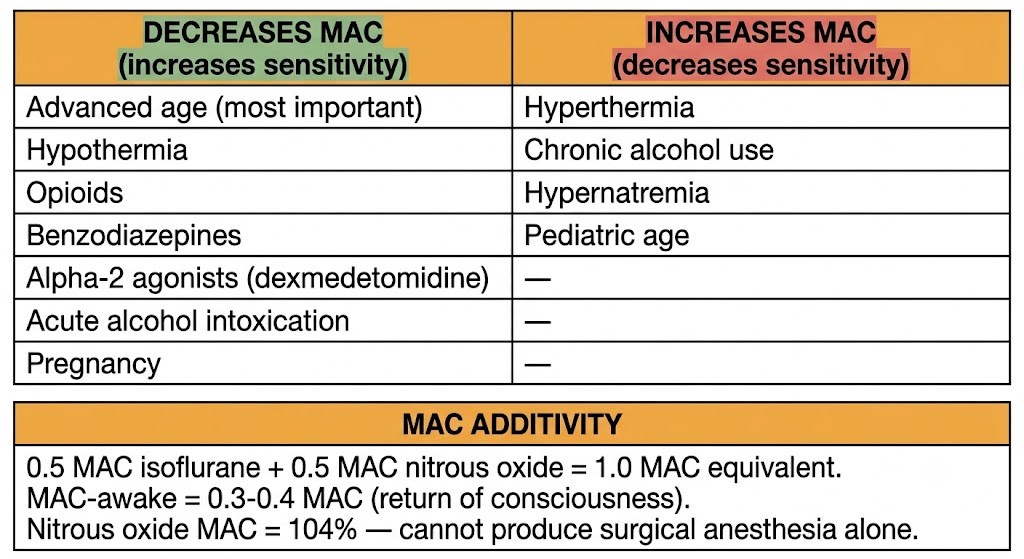
Minimum alveolar concentration values are additive across agents. If 0.5 minimum alveolar concentration of isoflurane is combined with 0.5 minimum alveolar concentration of nitrous oxide, the combination produces an effect equivalent to 1.0 minimum alveolar concentration of a single agent. This additivity is the pharmacological rationale for combining nitrous oxide with a volatile agent: nitrous oxide reduces the required concentration of the more potent volatile agent, allowing lower doses of each. Nitrous oxide has a minimum alveolar concentration of approximately 104%, meaning it cannot produce surgical anesthesia on its own at atmospheric pressure.

Factors That Alter Minimum Alveolar Concentration

Several factors shift minimum alveolar concentration in clinically important ways. Factors that decrease minimum alveolar concentration (potentiate anesthesia) include advanced age, hypothermia, opioids, benzodiazepines, alpha-2 agonists such as dexmedetomidine, and acute alcohol intoxication. Factors that increase minimum alveolar concentration (reduce anesthetic depth for a given concentration) include hyperthermia, chronic alcohol use, and hypernatremia.

The most clinically significant modifier is age: minimum alveolar concentration declines substantially with advancing age, so elderly patients require significantly lower anesthetic concentrations to maintain the same depth of anesthesia. Failing to adjust for age predisposes to overdose and cardiovascular depression.

Minimum Alveolar Concentration — Key Point

Minimum alveolar concentration is an effective dose 50 (the dose producing the desired effect in 50% of subjects) for the endpoint of immobility. A patient is not reliably unresponsive until well above 1.0 minimum alveolar concentration. MAC-awake — the concentration at which 50% of patients respond to verbal command — is approximately 0.3 to 0.4 minimum alveolar concentration.


Section 4

Diffusional Hypoxia

A hazard of nitrous oxide emergence that is reliably prevented by supplemental oxygen

Diffusional hypoxia (also called the Fink effect) occurs at the end of nitrous oxide anesthesia. When nitrous oxide administration is discontinued, the large amount of nitrous oxide dissolved in blood rapidly diffuses back into the alveoli. This outflux of nitrous oxide dilutes alveolar oxygen and carbon dioxide, transiently reducing the alveolar partial pressure of oxygen to levels that can cause clinically significant hypoxemia.

The effect is greatest in the first five to ten minutes following cessation of nitrous oxide and is reliably prevented by administering 100% oxygen for several minutes at the end of the anesthetic before allowing the patient to breathe room air. Failure to do so is a preventable cause of post-anesthetic oxygen desaturation. The mechanism is the reverse of the second gas effect: just as rapid nitrous oxide uptake concentrates other alveolar gases during induction, rapid nitrous oxide efflux dilutes them during emergence.


Section 5

Intravenous Anesthetic Agents

Mechanisms, advantages, and key adverse effects of the major intravenous agents used for induction and maintenance

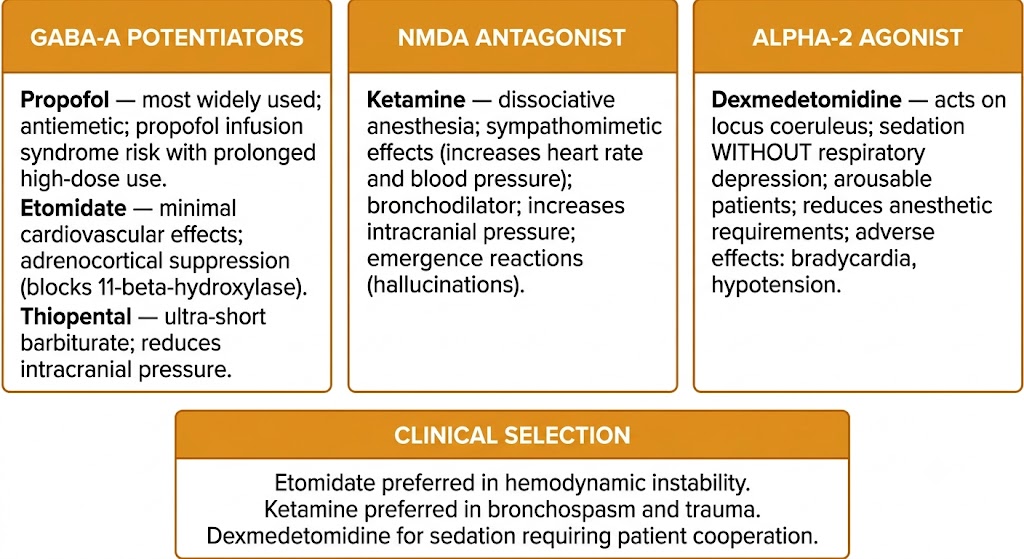
Intravenous anesthetics serve three roles: induction of anesthesia, maintenance as part of total intravenous anesthesia, and supplementation of inhalational techniques. Unlike inhalational agents, their pharmacokinetics follow multicompartmental distribution — rapid distribution to the brain produces fast onset, and redistribution away from the brain terminates the initial effect.

Two-column table of minimum alveolar concentration modifiers showing factors that decrease MAC on the left (advanced age, hypothermia, opioids, benzodiazepines, alpha-2 agonists, acute alcohol, pregnancy) and factors that increase MAC on the right (hyperthermia, chronic alcohol, hypernatremia, pediatric age), with a MAC additivity rule box below.
Factors that alter minimum alveolar concentration (MAC) and the principle of MAC additivity. Figure generated by Gemini AI.

Intravenous Agent

Propofol

  • Mechanism: gamma-aminobutyric acid type A receptor potentiation (enhances inhibitory chloride currents)
  • Fastest onset of intravenous agents; smooth, rapid emergence
  • Antiemetic properties — reduces postoperative nausea and vomiting
  • Preferred agent for total intravenous anesthesia; most widely used for induction worldwide
  • Adverse effects: pain on injection, hypotension, apnea at induction doses
  • Propofol infusion syndrome: rare but life-threatening — metabolic acidosis, rhabdomyolysis, cardiac failure with prolonged high-dose infusion (greater than 5 mg/kg/hr for more than 48 hours); avoid in pediatric intensive care unit sedation

Intravenous Agent

Etomidate

  • Mechanism: gamma-aminobutyric acid type A receptor potentiation
  • Defining advantage: minimal cardiovascular effects — preferred induction agent in hemodynamically unstable patients (cardiogenic shock, severe aortic stenosis)
  • Adverse effect: adrenocortical suppression — inhibits 11-beta-hydroxylase, blocking cortisol synthesis for 6 to 24 hours after a single induction dose
  • Not used for maintenance infusion due to cumulative adrenal suppression
  • Also causes myoclonus on induction and increased postoperative nausea and vomiting

Intravenous Agent

Ketamine

  • Mechanism: non-competitive antagonism of the N-methyl-D-aspartate (glutamate) receptor — produces dissociative anesthesia
  • Unique feature: sympathomimetic cardiovascular effects (increases heart rate, blood pressure, cardiac output) — useful in hemodynamically unstable and trauma patients
  • Potent bronchodilator — useful in patients with bronchospasm or reactive airways disease
  • Preserves pharyngeal and laryngeal reflexes to a greater degree than other agents
  • Increases cerebral blood flow and intracranial pressure — relatively contraindicated in head trauma with elevated intracranial pressure
  • Emergence reactions: vivid dreams, hallucinations, dysphoria — reduced by concurrent benzodiazepine

Intravenous Agent

Dexmedetomidine

  • Mechanism: highly selective alpha-2 adrenergic receptor agonist — acts on locus coeruleus to produce sedation; spinal alpha-2 receptors for analgesia
  • Distinctive feature: sedation without significant respiratory depression at standard doses
  • Patients are arousable and cooperative — useful for procedural sedation, awake intubation, and intensive care unit sedation
  • Reduces anesthetic requirements (decreases minimum alveolar concentration)
  • Adverse effects: bradycardia and hypotension from reduced sympathetic outflow
Three-panel diagram of intravenous anesthetic mechanisms: left panel shows GABA-A potentiators (propofol, etomidate, thiopental), center panel shows NMDA antagonist (ketamine) with dissociative anesthesia and sympathomimetic effects, right panel shows alpha-2 agonist (dexmedetomidine) with sedation without respiratory depression. A clinical selection box below summarizes preferred agents by clinical scenario.
Mechanisms of the major intravenous anesthetic agents and clinical selection guide. Figure generated by Gemini AI.
Barbiturates: Thiopental

Thiopental is an ultra-short-acting barbiturate that acts through gamma-aminobutyric acid type A receptor potentiation. It was the standard induction agent before propofol became widely available and remains relevant for its ability to rapidly reduce intracranial pressure, making it still used in some institutions for induction in patients with elevated intracranial pressure. Its main limitations are cardiovascular depression at induction doses, no antiemetic properties, and a prolonged hangover effect with repeated dosing as the drug accumulates in fat.

Total Intravenous Anesthesia

Total intravenous anesthesia uses propofol as the primary hypnotic agent combined with a short-acting opioid (typically remifentanil) and a neuromuscular blocking agent. It is preferred over volatile agents in patients at high risk for postoperative nausea and vomiting, in patients susceptible to malignant hyperthermia (where all volatile agents are contraindicated), and when intraoperative neurophysiological monitoring is required.


Section 6

Preanesthetic Medications

Drug classes used before induction to optimize the anesthetic and reduce perioperative risk

Preanesthetic medication serves several simultaneous goals: reduction of anxiety and facilitation of smooth induction, provision of baseline analgesia, reduction of postoperative nausea and vomiting risk, modification of autonomic reflexes, and reduction of gastric volume and acidity. No single agent accomplishes all these goals; contemporary premedication regimens are multimodal and patient-specific.

Sedatives and Anxiolytics

Benzodiazepines are the most widely used preanesthetic sedatives. Midazolam is the standard perioperative agent because of its rapid onset, short duration, reliable anterograde amnesia, and minimal cardiovascular effects at standard doses. In addition to anxiolysis and amnesia, midazolam reduces the minimum alveolar concentration of volatile agents, contributing to a smoother induction and lower maintenance requirements. Dexmedetomidine is increasingly used as an alternative premedication in patients for whom benzodiazepines are undesirable, such as those with obstructive sleep apnea or those at elevated risk for postoperative delirium.

Opioid Premedication

Opioids given before induction provide baseline analgesia and blunt the hemodynamic response to laryngoscopy and endotracheal intubation — the most stimulating part of the anesthetic induction sequence. Fentanyl administered intravenously in the pre-induction period is most commonly used because of its rapid onset and short duration. The main risks are respiratory depression and increased postoperative nausea and vomiting.

Antiemetic Premedication

Postoperative nausea and vomiting risk is stratified using the Apfel score, which assigns one point each for: female sex, non-smoker status, history of postoperative nausea and vomiting or motion sickness, and anticipated postoperative opioid use. Patients with three or four risk factors have a high risk of postoperative nausea and vomiting and warrant multimodal prophylaxis targeting multiple receptor systems.

Antiemetic Agent

Ondansetron

  • Mechanism: 5-hydroxytryptamine type 3 (serotonin) receptor antagonist — blocks serotonin signaling at vagal afferents and the chemoreceptor trigger zone
  • Given near end of surgery (4 mg intravenously); most effective against early postoperative nausea and vomiting

Antiemetic Agent

Dexamethasone

  • Mechanism: glucocorticoid — reduces central serotonin release, anti-inflammatory effects on vagal afferents
  • Given at induction (delayed onset of antiemetic effect); cost-effective postoperative nausea and vomiting prophylaxis

Antiemetic Agent

Droperidol

  • Mechanism: dopamine D2 receptor antagonist at the chemoreceptor trigger zone
  • Effective antiemetic but carries a United States Food and Drug Administration black box warning for QT prolongation and risk of torsades de pointes
  • Use limited to low doses; requires electrocardiogram monitoring
Anticholinergic Premedication

Anticholinergic agents serve two distinct perioperative roles. Glycopyrrolate is used as an antisialagogue (drying agent for secretions) before airway procedures. Unlike atropine and scopolamine — which are tertiary amines and cross the blood-brain barrier, producing central nervous system effects including sedation and confusion — glycopyrrolate is a quaternary ammonium compound that does not cross the blood-brain barrier and is therefore free of central anticholinergic effects. Atropine is used to treat or prevent bradycardia, including the bradycardia that can occur following succinylcholine administration in pediatric patients. Scopolamine, applied as a transdermal patch, provides prolonged cholinergic blockade of the vomiting center and is particularly effective for postoperative nausea and vomiting prophylaxis in high-risk patients.

Aspiration Prophylaxis

Pulmonary aspiration of gastric contents causes chemical pneumonitis (Mendelson syndrome). The risk is determined by two independent factors: gastric volume and gastric acidity. Three classes of drugs address these factors pharmacologically.

Proton pump inhibitors (such as pantoprazole or omeprazole) and H2 receptor antagonists (such as famotidine) both reduce gastric acid production and raise gastric pH, but proton pump inhibitors provide more sustained and complete acid suppression. Sodium citrate given orally immediately before induction acts as a rapid buffer, directly neutralizing existing gastric acid; because it is non-particulate, it does not itself cause lung injury if aspirated. Metoclopramide accelerates gastric emptying and raises lower esophageal sphincter tone through dopamine D2 antagonism and serotonin 5-hydroxytryptamine type 4 receptor agonism in the gastrointestinal tract, reducing gastric volume in patients at risk of aspiration.


Suggested References
Author / Organization Title Source
Eger EI 2nd Anesthetic Uptake and Action Baltimore: Williams & Wilkins; 1974
Miller RD, ed. Miller's Anesthesia, 8th ed. Chapters 17, 27 Philadelphia: Elsevier; 2015
Malviya S, Lerman J The blood/gas solubilities of sevoflurane, isoflurane, halothane, and serum constituent concentrations in newborns and adults Anesthesiology. 1990;72(5):793–796
Stoelting RK, Hillier SC Pharmacology and Physiology in Anesthetic Practice, 4th ed. Philadelphia: Lippincott Williams & Wilkins; 2006
Apfel CC, et al. A simplified risk score for predicting postoperative nausea and vomiting Anesthesiology. 1999;91(3):693–700
Eger EI 2nd Age, minimum alveolar anesthetic concentration, and minimum alveolar anesthetic concentration-awake Anesth Analg. 2001;93(4):947–953
Fink BR Diffusion anoxia Anesthesiology. 1955;16(4):511–519
Epstein RM, et al. Influence of the concentration effect on the uptake of anesthetic mixtures: the second gas effect Anesthesiology. 1964;25:364–371
Eger EI 2nd, Saidman LJ, Brandstater B Minimum alveolar anesthetic concentration: a standard of anesthetic potency Anesthesiology. 1965;26:756–763
Gan TJ, et al. Consensus guidelines for the management of postoperative nausea and vomiting Anesth Analg. 2014;118(1):85–113
Flood P, Rathmell JP, Shafer SL, eds. Stoelting's Pharmacology and Physiology in Anesthetic Practice, 5th ed. Philadelphia: Wolters Kluwer; 2015
Marik PE Propofol: therapeutic indications and side-effects Curr Pharm Des. 2004;10(29):3639–3649
White PF, et al. Pharmacology of ketamine isomers in surgical patients Anesthesiology. 1980;52(3):231–239
Weerink MAS, et al. Clinical pharmacokinetics and pharmacodynamics of dexmedetomidine Clin Pharmacokinet. 2017;56(8):893–913