CHAPTER 16  ·  ANTIPSYCHOTIC DRUGS

Section 1

Mechanism of Action and Potency Framework

How D2 antagonism produces antipsychotic effect, and why milligram potency is not the same as clinical efficacy

First-generation antipsychotics — also called typical or conventional antipsychotics — work by blocking dopamine D2 receptors. They are competitive antagonists, meaning they occupy the D2 receptor and prevent dopamine from binding without activating the receptor themselves. Their diversity in dosing, from haloperidol at 2 to 20 milligrams to chlorpromazine at 200 to 1000 milligrams, reflects differences in receptor affinity, not differences in how well they work.

The Potency Concept

Potency in the first-generation antipsychotic class refers exclusively to the milligram dose required to achieve a therapeutic level of D2 receptor occupancy — approximately 65 to 80 percent. A high-potency agent such as haloperidol binds D2 receptors with very high affinity, so a small dose produces the occupancy needed for antipsychotic effect. A low-potency agent such as chlorpromazine binds D2 receptors with much lower affinity, so a much larger dose is needed to reach the same occupancy.

This is critical to understand: when haloperidol and chlorpromazine are each titrated to equivalent D2 occupancy, they produce equivalent antipsychotic effect. Potency does not predict how well a drug works. What it does predict is the adverse effect profile, because the dose required for low-potency agents is large enough to produce meaningful blockade at histamine H1, muscarinic M1, and alpha-1 adrenergic receptors — generating a very different side effect landscape than the more receptor-selective high-potency agents.

The Potency Trade-Off

High-potency agents achieve D2 blockade with minimal off-target receptor activity at clinical doses. The result is strong motor side effects — extrapyramidal symptoms and tardive dyskinesia — from selective nigrostriatal D2 blockade, with relatively little sedation, anticholinergic burden, or orthostatic hypotension. Low-potency agents must be given at doses that also block H1, M1, and alpha-1 receptors substantially. Their H1 and M1 activity partially offsets the nigrostriatal D2 blockade, reducing extrapyramidal symptom risk, but at the cost of significant sedation, anticholinergic effects, and orthostatic hypotension.

Neither profile is categorically preferable. The choice between a high-potency and low-potency agent depends on which adverse effect burden the individual patient is better positioned to tolerate.

The Potency Rule

High-potency first-generation antipsychotics (haloperidol, fluphenazine): low dose, selective D2 blockade, high extrapyramidal symptom risk, low sedation and anticholinergic burden.

Low-potency first-generation antipsychotics (chlorpromazine, thioridazine): high dose, broad receptor blockade (D2 + H1 + M1 + alpha-1), lower extrapyramidal symptom risk, high sedation, anticholinergic effects, and orthostatic hypotension.


Section 2

High-Potency First-Generation Agents

Haloperidol, fluphenazine, and perphenazine: profiles, formulations, and distinguishing clinical features

High-potency first-generation antipsychotics achieve therapeutic D2 occupancy at doses measured in single-digit to low double-digit milligrams. Their selectivity for D2 over other receptor types makes them the most motor-side-effect-prone agents in the class, but also the least sedating and the least anticholinergic — a profile that suits certain clinical settings well.
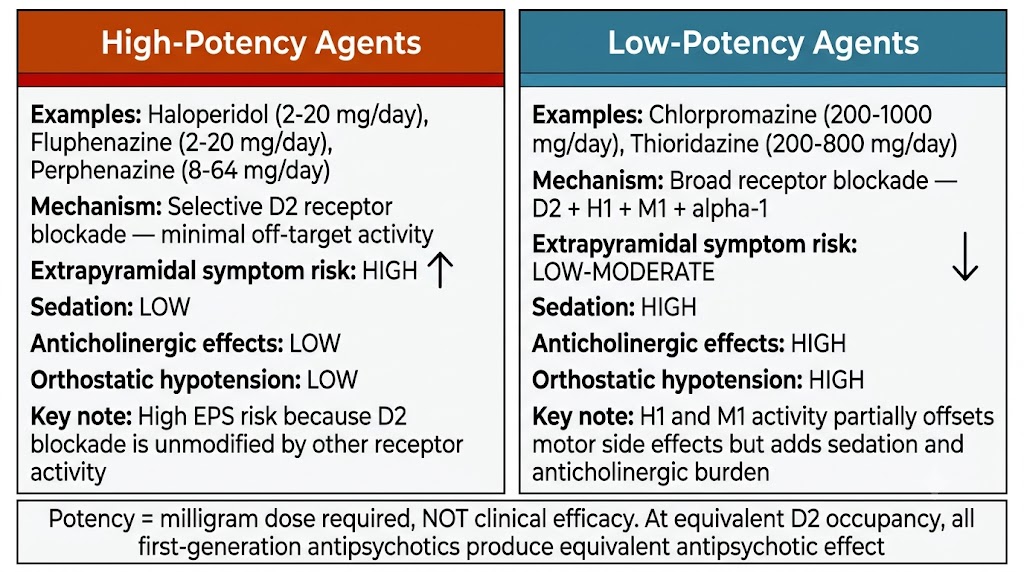
Two-panel comparison diagram showing high-potency first-generation antipsychotics (haloperidol, fluphenazine, perphenazine) with selective D2 blockade, high extrapyramidal symptom risk, and low sedation versus low-potency agents (chlorpromazine, thioridazine) with broad receptor blockade, lower extrapyramidal symptom risk, and high sedation and anticholinergic burden, with a shared rule box clarifying that potency refers to milligram dose required, not clinical efficacy.
High-potency versus low-potency first-generation antipsychotics: the trade-off between selective D2 blockade (high extrapyramidal symptom risk, low sedation) and broad receptor blockade (lower extrapyramidal symptom risk, high sedation and anticholinergic burden). Figure generated by Gemini AI.
Haloperidol

Haloperidol is the prototypical high-potency first-generation antipsychotic and one of the most widely used antipsychotics globally. It is a butyrophenone — chemically distinct from the phenothiazine subclass — with very high D2 affinity and minimal activity at H1, M1, or alpha-1 receptors at standard doses. The oral dose range for psychosis is typically 2 to 20 milligrams per day. A single oral dose once daily is sufficient for chronic management given its half-life of 12 to 36 hours.

Haloperidol is available in three formulations. The oral tablet is used for chronic outpatient management. The short-acting intramuscular formulation (haloperidol lactate) reaches peak plasma levels within 20 to 40 minutes and is a first-line agent for acute agitation in emergency settings, typically at 5 milligrams intramuscularly with repeat dosing as needed. The long-acting injectable formulation (haloperidol decanoate) is administered once monthly and is discussed in Section 4.

The trade-off for haloperidol's receptor selectivity is its high extrapyramidal symptom burden. Acute dystonia, akathisia, and drug-induced parkinsonism are common at doses above 5 milligrams per day in patients who have not previously received antipsychotics. Intravenous haloperidol — used in intensive care unit settings for delirium management — carries a higher risk of QTc interval prolongation than the oral or intramuscular routes and requires cardiac monitoring. Despite its side effect profile, haloperidol retains specific advantages: it has more pregnancy safety data than almost any other antipsychotic, is available in every resource setting globally, and is the best-studied agent for delirium in the medically ill.

Fluphenazine

Fluphenazine is a piperazine phenothiazine with potency and extrapyramidal symptom burden comparable to haloperidol. Its primary clinical role in contemporary practice is as the substrate for fluphenazine decanoate, a long-acting injectable formulation administered every 2 to 4 weeks. The oral form is less commonly chosen for new prescribing than haloperidol because haloperidol offers broader familiarity and more flexible dosing, but fluphenazine decanoate remains widely used for adherence management in chronic schizophrenia, particularly where the cost of newer second-generation long-acting injectables is prohibitive.

Perphenazine

Perphenazine occupies a mid-to-high potency position among the phenothiazines and has somewhat more H1 and alpha-1 activity than haloperidol, producing a marginally lower extrapyramidal symptom burden at equivalent antipsychotic doses at the cost of modest additional sedation. It gained renewed clinical attention after the Clinical Antipsychotic Trials of Intervention Effectiveness study, a large randomized trial that compared perphenazine directly against several second-generation antipsychotics including olanzapine, quetiapine, risperidone, and ziprasidone. Perphenazine performed comparably to these agents on the primary outcome of all-cause treatment discontinuation — a result that challenged the assumption that second-generation antipsychotics are categorically superior and positioned perphenazine as a cost-effective option when a second-generation agent offers no specific clinical advantage for a given patient.

Section 3

Low- and Mid-Potency First-Generation Agents

Chlorpromazine, thioridazine, and related agents: the trade-off between reduced motor side effects and a broader adverse effect burden

Low-potency first-generation antipsychotics require large doses to achieve therapeutic D2 occupancy, and at those doses they produce substantial blockade at histamine H1, muscarinic M1, and alpha-1 adrenergic receptors. This broad receptor blockade reduces motor side effects but generates a different and in some ways more burdensome adverse effect profile — heavy sedation, anticholinergic toxicity, and orthostatic hypotension.

Chlorpromazine

Chlorpromazine, introduced in 1952, was the first antipsychotic drug and the agent that gave rise to the entire field of biological psychiatry. It is an aliphatic phenothiazine with low D2 affinity, requiring doses of 200 to 1000 milligrams per day for antipsychotic effect. At these doses it produces significant blockade at H1 (sedation, weight gain), M1 (dry mouth, urinary retention, constipation, cognitive impairment), and alpha-1 adrenergic receptors (orthostatic hypotension, reflex tachycardia). Its extrapyramidal symptom burden is lower than haloperidol's because its anticholinergic activity partially offsets nigrostriatal D2 blockade.

Chlorpromazine has several unique adverse effects not shared by other first-generation antipsychotics to the same degree. It causes photosensitivity reactions with sun exposure. With prolonged high-dose use it produces a blue-gray pigmentation of sun-exposed skin and corneal-lenticular deposits detectable on slit-lamp examination — both dose and duration dependent. It lowers the seizure threshold more than most antipsychotics. Despite these limitations it remains in use in resource-limited settings and is effective for rapid sedation in acute agitation because its strong H1 and alpha-1 blocking activity produces reliable calming even at lower doses.

Thioridazine

Thioridazine shares chlorpromazine's broad receptor profile but carries a substantially more dangerous cardiac adverse effect. It is a potent blocker of the cardiac potassium channel responsible for cardiac repolarization (the hERG channel), producing dose-dependent QTc interval prolongation that can progress to torsades de pointes — a potentially fatal polymorphic ventricular tachycardia — at doses above 300 milligrams per day. This cardiac risk led regulatory agencies to restrict thioridazine to patients who have failed other antipsychotics, making it an agent of last resort in current practice.

Thioridazine also causes pigmentary retinopathy at doses exceeding 800 milligrams per day, a unique adverse effect within the antipsychotic class caused by melanin binding in the retinal pigment epithelium that can cause irreversible visual impairment. Its anticholinergic burden is the highest among commonly used first-generation antipsychotics. For these reasons, thioridazine has largely been displaced from routine prescribing and requires explicit informed consent and a baseline electrocardiogram before initiation.

Thioridazine — High-Yield Adverse Effects

QTc prolongation and torsades de pointes — from hERG potassium channel blockade. Dose-dependent. Most dangerous first-generation antipsychotic cardiac risk. Requires baseline electrocardiogram.

Pigmentary retinopathy — unique to thioridazine at doses above 800 milligrams per day. Irreversible. Caused by melanin binding in retinal pigment epithelium.

Together these two adverse effects make thioridazine a last-resort agent. Both are testable Step 1 items associated specifically with this drug.


Section 4

Pharmacokinetics and Long-Acting Injectable Formulations

Class pharmacokinetic features, the smoking-drug interaction, and the rationale for depot therapy

First-generation antipsychotics share several pharmacokinetic features as a class. All are highly lipophilic, extensively protein-bound, and subject to significant hepatic first-pass metabolism, which reduces and varies their oral bioavailability. Most are metabolized by cytochrome P450 enzymes, particularly cytochrome P450 2D6, 3A4, and 1A2. Understanding these pathways matters because drug interactions and individual metabolizer differences directly affect plasma levels and therefore clinical response and adverse effects.

The CYP1A2-Smoking Interaction

Cigarette smoking strongly induces the cytochrome P450 1A2 enzyme, which is a major metabolic route for chlorpromazine and several other phenothiazines. In heavy smokers, cytochrome P450 1A2 induction reduces plasma concentrations of these drugs by 30 to 50 percent compared with non-smokers at the same oral dose. This interaction has direct clinical consequences in both directions: a patient stabilized on chlorpromazine while smoking may lose antipsychotic effect if they stop smoking and their plasma levels rise; conversely, a smoking patient admitted to a smoke-free inpatient unit who effectively stops smoking during admission may develop toxicity from the same dose as plasma levels climb toward non-smoker pharmacokinetics.

The same cytochrome P450 1A2 interaction applies — with even greater clinical magnitude — to olanzapine and clozapine, which are second-generation antipsychotics covered in Module 3. Establishing a patient's smoking status at every visit is a pharmacokinetically relevant clinical step for any patient on a cytochrome P450 1A2-substrate antipsychotic.

Long-Acting Injectable Formulations: Rationale

Non-adherence to oral antipsychotics is among the most powerful predictors of relapse in schizophrenia. Studies consistently show that 40 to 60 percent of outpatients do not take their oral antipsychotics as prescribed within the first year of treatment. Long-acting injectable formulations address this by converting adherence from a daily behavior into a periodic clinical contact — each injection establishes a fixed pharmacokinetic profile that persists for weeks without requiring the patient to remember daily doses.

The two established first-generation antipsychotic long-acting injectable formulations are haloperidol decanoate and fluphenazine decanoate. Both are oil-based depot preparations that are slowly absorbed from the intramuscular injection site. Haloperidol decanoate is administered once monthly. Fluphenazine decanoate is administered every 2 to 4 weeks, allowing somewhat more frequent dose adjustment at the cost of more frequent clinic visits. An important pharmacokinetic note: a long-acting injectable formulation does not change the receptor-binding profile or adverse effect type of the underlying drug. A patient who experienced severe extrapyramidal symptoms on oral haloperidol will continue to be at risk for them on haloperidol decanoate. The depot formulation changes delivery kinetics, not pharmacodynamics.

Before Starting a Long-Acting Injectable

Establish tolerability of the oral form of the same drug before converting to a long-acting injectable. If a patient cannot tolerate oral haloperidol at 5 milligrams due to severe akathisia, haloperidol decanoate at the equivalent monthly dose will produce the same problem — with a much slower resolution time because the depot cannot be rapidly removed once injected. Oral tolerability testing first is a mandatory clinical step.


Section 5

Extrapyramidal Syndromes

Acute dystonia, akathisia, and drug-induced parkinsonism: time course, mechanism, and management of the three reversible motor syndromes

Extrapyramidal syndromes arise from D2 receptor blockade in the nigrostriatal pathway, which reduces dopaminergic tone in the striatum and disrupts the normal balance between dopamine and acetylcholine in the basal ganglia. Three reversible syndromes occur in the acute to subacute period — acute dystonia, akathisia, and drug-induced parkinsonism. A fourth syndrome, tardive dyskinesia, is a late and potentially irreversible complication covered in Section 6. Each reversible syndrome has a characteristic time course, presentation, and management approach.

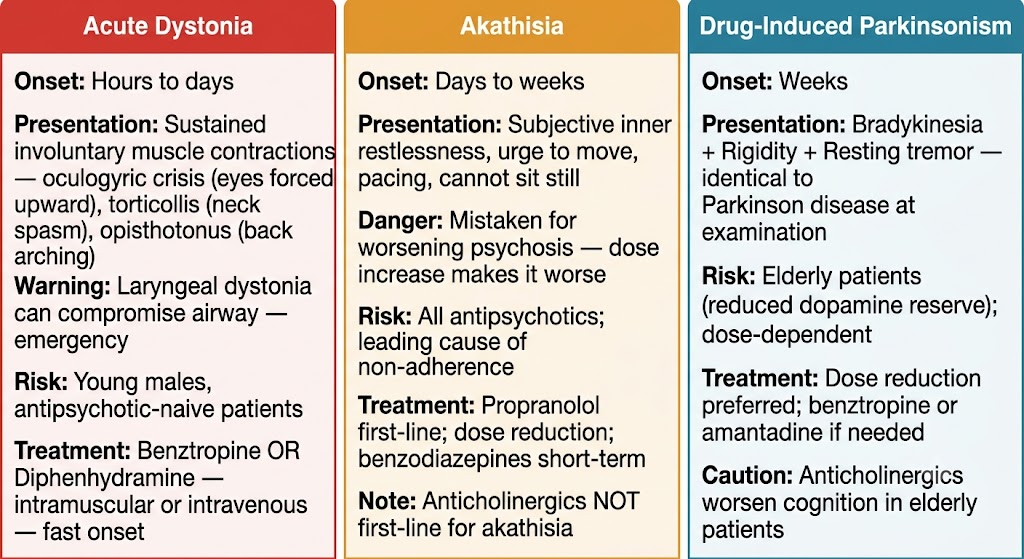
Three-panel diagram comparing the three reversible extrapyramidal syndromes: acute dystonia (onset hours to days, oculogyric crisis and torticollis, treated with benztropine or diphenhydramine), akathisia (onset days to weeks, inner restlessness mistaken for worsening psychosis, treated with propranolol), and drug-induced parkinsonism (onset weeks, bradykinesia and rigidity identical to Parkinson disease, treated with dose reduction or benztropine).
The three reversible extrapyramidal syndromes caused by antipsychotic D2 blockade in the nigrostriatal pathway, distinguished by time course, presentation, and management approach. Figure generated by Gemini AI.
Acute Dystonia

Acute dystonic reactions are sudden, sustained, and often painful involuntary muscle contractions producing abnormal postures. Common presentations include oculogyric crisis (forced upward deviation of the eyes), torticollis (neck muscle spasm with head rotation), and opisthotonus (arching of the back). Laryngeal or pharyngeal dystonia is the most dangerous form — it can compromise the airway and constitutes a medical emergency. Acute dystonia typically emerges within hours to five days of starting a high-potency first-generation antipsychotic or increasing its dose. Young males and patients who have never received antipsychotics before are at highest risk.

Treatment is immediate anticholinergic administration. Benztropine 1 to 2 milligrams or diphenhydramine 25 to 50 milligrams given intramuscularly or intravenously produces resolution within 15 to 30 minutes in most cases. The mechanism of both the dystonia and its treatment reflects the dopamine-acetylcholine balance in the striatum: acute D2 blockade reduces dopaminergic inhibition, leaving a relative excess of cholinergic tone that drives the abnormal muscle contractions. Anticholinergic drugs restore the balance by reducing cholinergic activity.

Akathisia

Akathisia is a syndrome of motor restlessness with a compelling subjective sense of inner tension and an irresistible urge to move. Patients pace, shift their weight repeatedly, or are unable to sit or stand still. The subjective distress can be severe — akathisia is one of the adverse effects most commonly cited by patients as the reason they stop taking their antipsychotic against medical advice. It typically emerges within days to weeks of starting treatment.

The most dangerous clinical error with akathisia is misidentifying it as worsening psychosis or agitation and responding by increasing the antipsychotic dose, which worsens the akathisia further. Any patient who becomes more agitated or restless after starting or increasing an antipsychotic should be evaluated specifically for akathisia before the dose is changed.

Management begins with dose reduction if clinically feasible. Propranolol — a non-selective beta-adrenergic blocker — at 30 to 80 milligrams per day is the most evidence-supported pharmacological treatment and is particularly effective for the subjective restlessness component. Anticholinergic agents are generally less effective for akathisia than for acute dystonia or drug-induced parkinsonism and are not the first choice. Benzodiazepines provide short-term relief but are not appropriate for long-term management.

Drug-Induced Parkinsonism

Drug-induced parkinsonism produces the classic triad of bradykinesia (slowness of movement), muscle rigidity, and resting tremor — clinically indistinguishable at examination from idiopathic Parkinson disease. It typically develops within days to weeks of starting an antipsychotic and is dose-dependent. Elderly patients are at substantially higher risk because they have reduced baseline dopaminergic reserve in the nigrostriatal pathway.

Management favors dose reduction or switching to a lower-potency or lower-extrapyramidal-symptom-risk agent as the primary strategy. When dose reduction is not feasible, anticholinergic agents — benztropine or trihexyphenidyl — reduce tremor and rigidity but carry their own burden of cognitive impairment, urinary retention, and constipation, particularly in elderly patients. Amantadine, which has dopaminergic and glutamatergic activity, is an alternative with a more favorable cognitive profile than anticholinergics and may be preferred when anticholinergic adverse effects are a concern.

Onset: Hours to Days

Acute Dystonia

  • Sustained muscle contractions, abnormal postures
  • Oculogyric crisis, torticollis, opisthotonus
  • Laryngeal dystonia — airway emergency
  • Highest risk: young males, antipsychotic-naive
  • Treatment: Benztropine or diphenhydramine intramuscularly or intravenously — rapid

Onset: Days to Weeks

Akathisia

  • Subjective inner restlessness, urge to move
  • Pacing, inability to sit still
  • Major cause of non-adherence
  • Danger: mistaken for worsening psychosis
  • Treatment: Propranolol first-line; dose reduction; benzodiazepines short-term

Onset: Weeks

Drug-Induced Parkinsonism

  • Bradykinesia, rigidity, resting tremor
  • Indistinguishable from Parkinson disease
  • Higher risk in elderly patients
  • Dose-dependent; reversible with dose reduction
  • Treatment: Dose reduction; benztropine or amantadine if needed

Section 6

Neuroleptic Malignant Syndrome and Tardive Dyskinesia

Two serious complications of antipsychotic therapy: one life-threatening and acute, one late-onset and potentially irreversible

Among the serious complications of first-generation antipsychotic therapy, neuroleptic malignant syndrome and tardive dyskinesia occupy different ends of the timeline but both demand systematic understanding. Neuroleptic malignant syndrome is rare, acute, and can be fatal without immediate intervention. Tardive dyskinesia is more common, develops over months to years, and may persist permanently even after the drug is stopped.

Neuroleptic Malignant Syndrome

Neuroleptic malignant syndrome is a rare but potentially fatal idiosyncratic reaction to antipsychotic medications. It is characterized by a tetrad of four findings that occur together: hyperthermia (often exceeding 40 degrees Celsius), severe generalized lead-pipe muscle rigidity, autonomic instability (fluctuating blood pressure, tachycardia, diaphoresis), and altered consciousness ranging from confusion to coma. It occurs in approximately 0.01 to 0.02 percent of patients exposed to antipsychotics, most commonly in the first weeks of therapy or after rapid dose escalation. Any dopamine-blocking antipsychotic can cause it, though high-potency first-generation agents are most frequently implicated.

Laboratory findings include markedly elevated creatine kinase — often above 10,000 units per liter — from rhabdomyolysis caused by the intense muscle rigidity, leukocytosis, and metabolic acidosis. The elevated creatine kinase is an important diagnostic clue and also signals the risk of myoglobinuria and acute kidney injury.

Neuroleptic malignant syndrome must be distinguished from serotonin syndrome, which is caused by serotonergic agents rather than antipsychotics. The key distinguishing feature is the nature of the muscle findings: neuroleptic malignant syndrome produces lead-pipe rigidity with slow onset over 24 to 72 hours and bradyreflexia, while serotonin syndrome produces hyperreflexia and clonus with rapid onset often within hours of a serotonergic drug change.

Management requires immediate discontinuation of all antipsychotics, aggressive supportive care including intravenous fluids and external cooling, and intensive care unit admission. Dantrolene — a muscle relaxant that reduces calcium release from the sarcoplasmic reticulum — reduces rigidity and hyperthermia. Bromocriptine and amantadine restore central dopaminergic tone. When antipsychotic therapy must be restarted after recovery, a minimum 2-week interval after full resolution is required, using the lowest-potency agent available at the lowest effective dose.

Tardive Dyskinesia

Tardive dyskinesia is a hyperkinetic movement disorder that develops after months to years of antipsychotic exposure. The movements are involuntary, repetitive, and purposeless. The orofacial region is most commonly affected — lip smacking, tongue protrusion, chewing movements, and facial grimacing are characteristic. Choreiform movements of the limbs and trunk rocking also occur. Unlike the acute extrapyramidal syndromes, tardive dyskinesia may persist indefinitely after the drug is stopped.

The underlying mechanism is dopamine receptor supersensitivity. Chronic D2 blockade causes postsynaptic D2 receptors in the striatum to upregulate in number and sensitivity as a compensatory response. When the antipsychotic level transiently falls — between doses, after dose reduction, or upon discontinuation — the supersensitive receptors are activated by endogenous dopamine, producing hyperkinetic movements. A clinically deceptive consequence of this mechanism is withdrawal-emergent tardive dyskinesia: the movements may first appear or worsen when the antipsychotic dose is reduced or stopped, because reducing the blockade unmasks the supersensitivity that was previously concealed. This can lead to the error of concluding that the dose reduction caused the dyskinesia, when the underlying supersensitivity had been developing throughout treatment.

Risk factors include older age, female sex, longer duration of antipsychotic exposure, higher cumulative dose, use of high-potency first-generation antipsychotics, and early appearance of extrapyramidal symptoms during treatment. The annual incidence with first-generation antipsychotics is approximately 5 percent per year, with cumulative risk approaching 20 to 30 percent after 5 years. Second-generation antipsychotics carry substantially lower but nonzero tardive dyskinesia risk.

Prevention is the most effective strategy — using the lowest effective dose for the shortest necessary duration and reassessing the ongoing need for antipsychotic therapy regularly. When tardive dyskinesia develops, the first step is to minimize antipsychotic dose or switch to an agent with lower tardive dyskinesia liability. Two vesicular monoamine transporter 2 inhibitors — valbenazine and deutetrabenazine — are approved specifically for tardive dyskinesia. These drugs deplete presynaptic dopamine stores, reducing the dopamine available to activate supersensitive striatal receptors. They represent the first pharmacological treatments with regulatory approval specifically for this condition and produce clinically meaningful reduction in involuntary movements without requiring discontinuation of the antipsychotic.

Neuroleptic Malignant Syndrome — High-Yield Recognition

Tetrad: Hyperthermia + Lead-pipe rigidity + Autonomic instability + Altered consciousness

Lab clue: Markedly elevated creatine kinase (rhabdomyolysis)

vs. Serotonin syndrome: Neuroleptic malignant syndrome has rigidity and bradyreflexia; serotonin syndrome has hyperreflexia and clonus

Treatment: Stop antipsychotic immediately + Dantrolene + Bromocriptine + Supportive care in intensive care unit


Section 7

Clinical Indications and Comparative Use

When first-generation antipsychotics remain appropriate, how to select among them, and their roles beyond schizophrenia

First-generation antipsychotics retain important clinical roles despite being largely superseded by second-generation agents for maintenance treatment of schizophrenia. Their D2-blocking properties are directly therapeutic in several conditions beyond psychosis, and in acute care settings their established pharmacokinetics and intramuscular availability make them indispensable tools.

Acute Agitation

In acute psychotic agitation requiring rapid behavioral control, haloperidol intramuscularly at 5 milligrams combined with lorazepam intramuscularly at 1 to 2 milligrams is among the most widely used protocols in emergency psychiatry and general hospital medicine. The combination produces faster and more reliable calming than either agent alone. Adding diphenhydramine to this combination reduces the risk of acute dystonia in patients who have not previously received antipsychotics. Intramuscular haloperidol is also used for delirium management in medically ill inpatients, where its lack of significant anticholinergic activity is an advantage over low-potency alternatives.

When First-Generation Agents Remain Appropriate for Maintenance

For maintenance treatment of chronic schizophrenia, the choice between a first-generation and second-generation antipsychotic requires individualized assessment. A patient who has responded to and tolerated a first-generation agent without significant extrapyramidal symptoms or tardive dyskinesia has no compelling pharmacological reason to switch. When adherence is a persistent challenge, the availability of inexpensive and well-established long-acting injectable formulations of haloperidol decanoate and fluphenazine decanoate may tip the balance toward a first-generation agent, particularly where cost prevents access to the newer second-generation long-acting injectables. The Clinical Antipsychotic Trials of Intervention Effectiveness finding that perphenazine performed comparably to several second-generation agents on all-cause discontinuation further supports the continued use of first-generation agents as a legitimate choice for appropriate patients.

Uses Beyond Schizophrenia

Several first-generation antipsychotics have well-established indications beyond psychotic disorders. Haloperidol and pimozide are used for Tourette syndrome, where D2 blockade in the striatum suppresses tics. The benefit-risk analysis must weigh chronic extrapyramidal symptom and QTc risks against the severity of the tic disorder. Prochlorperazine and promethazine — phenothiazine derivatives developed primarily as antiemetics — act through D2 blockade in the chemoreceptor trigger zone of the brainstem and are routinely used in emergency medicine for nausea, vestibular disorders, and migraine-associated nausea. These agents can produce extrapyramidal symptoms and should be used with the same awareness of motor side effects as for antipsychotic-dose phenothiazines.

Monitoring Requirements

Any patient initiated on a first-generation antipsychotic should have a baseline assessment of involuntary movements before starting treatment, because documenting pre-existing movements prevents confusion between drug-induced and pre-existing abnormalities. Patients on thioridazine or pimozide require a baseline electrocardiogram to document QTc before starting and periodic monitoring thereafter. Serum prolactin measurement is warranted if symptoms of hyperprolactinemia develop — galactorrhea, amenorrhea, sexual dysfunction, or gynecomastia. Metabolic monitoring, though less critical for first-generation agents than for clozapine or olanzapine, remains part of comprehensive long-term care for any patient on chronic antipsychotic therapy.


Suggested References
Author / Organization Title Source
Kapur S, Zipursky R, Jones C, Remington G, Houle S Relationship between dopamine D2 occupancy, clinical response, and side effects: a double-blind PET study of first-episode schizophrenia Am J Psychiatry. 2000;157(4):514–520
Stahl SM Stahl's Essential Psychopharmacology: Neuroscientific Basis and Practical Applications. 4th ed. Cambridge University Press; 2013:129–237
Metzger E, Friedman R Prolongation of the corrected QT and torsades de pointes cardiac arrhythmia associated with intravenous haloperidol in the medically ill J Clin Psychopharmacol. 1993;13(2):128–132
Lieberman JA, Stroup TS, McEvoy JP, et al Effectiveness of antipsychotic drugs in patients with chronic schizophrenia N Engl J Med. 2005;353(12):1209–1223
Reilly JG, Ayis SA, Ferrier IN, Jones SJ, Thomas SHL QTc-interval abnormalities and psychotropic drug therapy in psychiatric patients Lancet. 2000;355(9209):1048–1052
Lacro JP, Dunn LB, Dolder CR, Leckband SG, Jeste DV Prevalence of and risk factors for medication nonadherence in patients with schizophrenia: a comprehensive review of recent literature J Clin Psychiatry. 2002;63(10):892–909
Bhidayasiri R, Fahn S, Weiner WJ, et al Evidence-based guideline: treatment of tardive syndromes Neurology. 2013;81(5):463–469
Gurrera RJ, Caroff SN, Cohen A, et al An international consensus study of neuroleptic malignant syndrome diagnostic criteria using the Delphi method J Clin Psychiatry. 2011;72(9):1222–1228
Carbon M, Hsieh CH, Kane JM, Correll CU Tardive dyskinesia prevalence in the period of second-generation antipsychotic use: a meta-analysis J Clin Psychiatry. 2017;78(3):e264–e278
Hauser RA, Factor SA, Marder SR, et al KINECT 3: a phase 3 randomized, double-blind, placebo-controlled trial of valbenazine for tardive dyskinesia Am J Psychiatry. 2017;174(5):476–484
Martel ML, Klein LR, Rivard RL, Reing M, Cole JB A large retrospective cohort of patients receiving intravenous and intramuscular droperidol or haloperidol in the emergency department Acad Emerg Med. 2021;28(3):323–330