What Is a Seizure?
A seizure is the clinical expression of an abnormal, excessive, and hypersynchronous discharge of a population of neurons in the brain. The key word is synchronous: normal brain function depends on neurons firing in coordinated but varied patterns. A seizure occurs when a large group of neurons fire together in a self-reinforcing burst that overwhelms the brain's normal regulatory mechanisms.
At the cellular level, seizure generation reflects an imbalance between excitation and inhibition. The principal excitatory neurotransmitter in the central nervous system is glutamate, which depolarizes neurons and drives them toward firing. The principal inhibitory neurotransmitter is gamma-aminobutyric acid, which opens chloride channels, hyperpolarizes neurons, and opposes firing. When excitation outstrips inhibition — whether from increased glutamate activity, reduced gamma-aminobutyric acid function, or intrinsic changes in neuronal ion channels — the threshold for a seizure discharge is lowered.
This excitation-inhibition framework is not merely descriptive. It directly predicts the four major categories of anti-seizure drug mechanisms: drugs that reduce sodium channel-mediated excitation, drugs that reduce calcium channel-mediated excitation, drugs that enhance gamma-aminobutyric acid-mediated inhibition, and drugs that reduce glutamate-mediated excitation. Every anti-seizure drug in clinical use works through one or more of these four pathways.
A seizure is a single event — an abnormal neuronal discharge that may occur in any person under the right circumstances (fever, hypoglycemia, drug withdrawal, head trauma). Having one seizure does not mean a person has epilepsy.
Epilepsy is a chronic condition defined by a predisposition to recurrent unprovoked seizures. The diagnosis generally requires two unprovoked seizures more than 24 hours apart, or one unprovoked seizure with a high risk of recurrence based on brain imaging or electroencephalogram findings. Anti-seizure drugs are used to prevent recurrent seizures in epilepsy — they do not cure the underlying condition.
Seizure Classification
Seizure classification is the foundation of anti-seizure drug selection. Different seizure types arise from different brain regions and involve different neuronal circuits, which is why certain drugs work for some seizure types but not others — and why some drugs can actually worsen certain seizures. Understanding the classification system is therefore a prerequisite for understanding pharmacology.
The most important distinction is between focal onset and generalized onset seizures. A focal seizure begins in one hemisphere of the brain, in a localized network. A generalized seizure begins simultaneously across both hemispheres from the outset. This distinction is not merely anatomical — it determines which drugs are appropriate and which may be contraindicated.
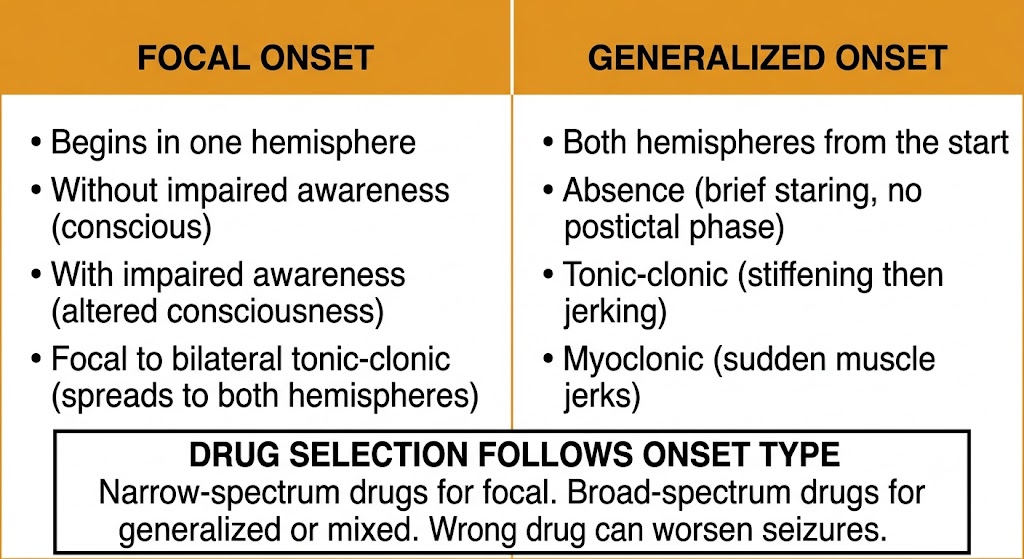
- Without impaired awareness — person remains conscious; formerly called simple partial
- With impaired awareness — consciousness is altered; formerly called complex partial
- Focal to bilateral tonic-clonic — begins focally, then spreads to both hemispheres; formerly called secondary generalization
- Absence — brief staring spells with sudden onset and offset; no postictal confusion
- Tonic-clonic — loss of consciousness with stiffening (tonic) then rhythmic jerking (clonic)
- Myoclonic — sudden, brief muscle jerks; consciousness often preserved
- Atonic — sudden loss of muscle tone; drop attacks
The awareness modifier is clinically important for focal seizures. A focal seizure with impaired awareness was previously called a complex partial seizure — the old terminology persists in clinical practice and in many textbooks, so recognizing both naming systems is useful.
The term focal to bilateral tonic-clonic replaces the older term secondarily generalized seizure. It describes a seizure that begins focally and then spreads to involve both hemispheres, producing the tonic-clonic pattern. This type responds to the same drugs used for primary generalized tonic-clonic seizures in many cases, but the focal origin means it may also respond to drugs that are specifically effective for focal seizures.
Several anti-seizure drugs that are effective for focal seizures and generalized tonic-clonic seizures can worsen absence seizures and myoclonic seizures. Carbamazepine, phenytoin, and gabapentin are the most important examples. Prescribing these drugs to a patient with absence epilepsy or juvenile myoclonic epilepsy can increase seizure frequency. Correct classification of seizure type before initiating therapy is therefore not optional — it is a patient safety issue.
Epilepsy Syndromes with Pharmacological Relevance
An epilepsy syndrome is a recognized cluster of features — seizure types, age of onset, electroencephalogram pattern, and sometimes genetic cause — that predicts which drugs will and will not work. Three syndromes are high-yield for pharmacology because each has a clearly preferred drug treatment that follows from the syndrome's seizure type.
Presents in children aged 4 to 10 years with frequent brief absence seizures — sudden staring episodes lasting 5 to 20 seconds with immediate return to full consciousness. No postictal confusion distinguishes absence from other seizure types. The electroencephalogram shows a classic three-per-second spike-and-wave pattern during attacks.
Drug of choice: Ethosuximide for pure absence epilepsy with no other seizure type. Valproate is used when absence coexists with other generalized seizure types, because ethosuximide has no efficacy against tonic-clonic or myoclonic seizures. Drugs that worsen absence seizures — carbamazepine, phenytoin, gabapentin — are contraindicated.
The most common generalized epilepsy syndrome in adolescents and young adults. Characterized by myoclonic jerks occurring predominantly in the morning shortly after waking, often accompanied by generalized tonic-clonic seizures and sometimes absence seizures. Sleep deprivation and alcohol are common triggers.
Drug of choice: Valproate is first-line because it has proven efficacy against all three seizure types that occur in juvenile myoclonic epilepsy. Lamotrigine and levetiracetam are alternatives, particularly in women of childbearing potential given valproate's teratogenic risk. Sodium channel blockers such as carbamazepine can worsen myoclonic seizures and are avoided.
The most common form of focal epilepsy in adults. Seizures typically begin with an aura (a subjective sensation such as an epigastric rising feeling, fear, or deja vu), followed by impaired awareness with automatisms — repetitive semi-purposeful movements such as lip smacking or hand fumbling. Secondary generalization to tonic-clonic seizures can occur.
Drug selection: Focal epilepsy drugs are appropriate — carbamazepine, lamotrigine, levetiracetam, and oxcarbazepine are all used. Carbamazepine is a traditional first-line choice for focal-onset seizures. Temporal lobe epilepsy is also the most common indication for epilepsy surgery when drug therapy fails.
Mechanisms of Anti-Seizure Drug Action
Anti-seizure drugs reduce seizure frequency by correcting the excitation-inhibition imbalance that allows seizures to occur. Every approved anti-seizure drug works through one or more of four mechanism categories. Understanding these categories at a conceptual level allows drug selection to be understood as logical rather than memorized as an arbitrary list.
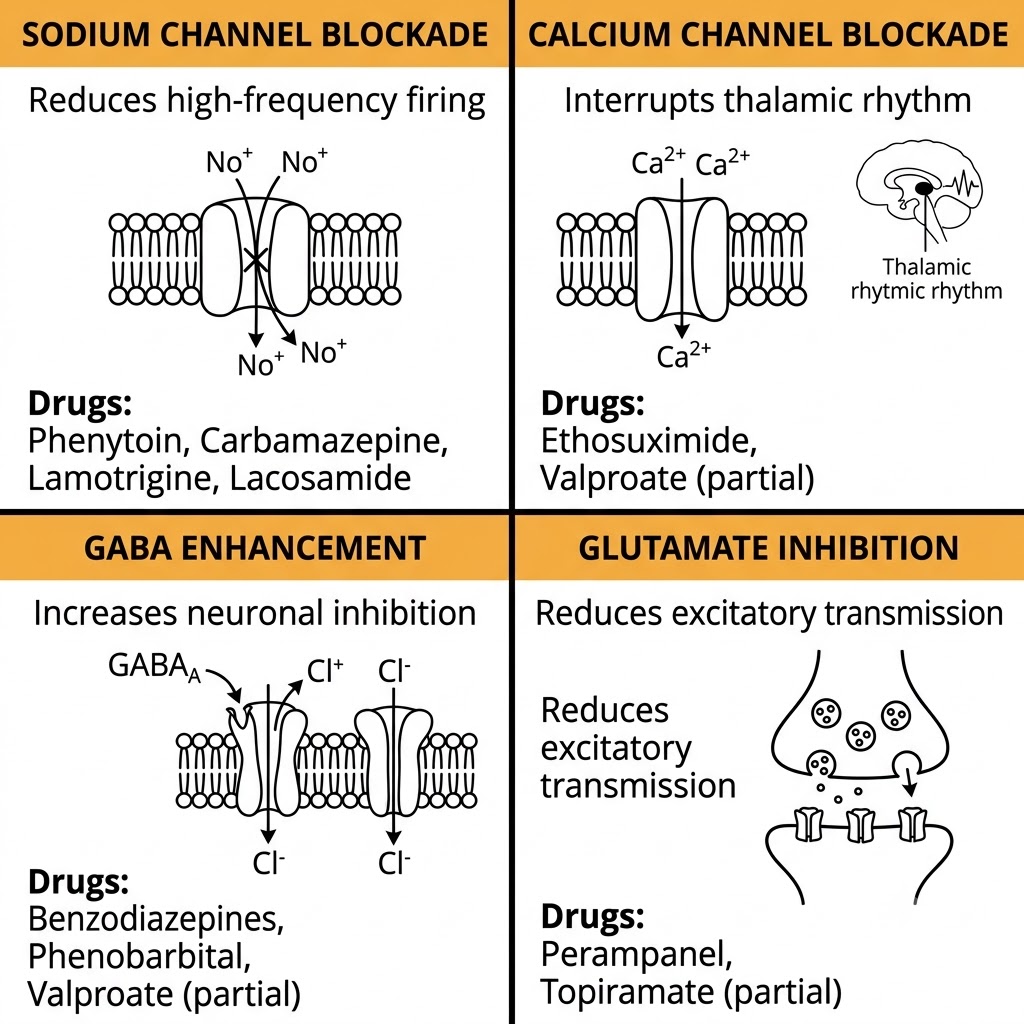
Blocks voltage-gated sodium channels, reducing the ability of neurons to fire repetitively at high frequency. Neurons firing at seizure rates are preferentially affected over normally firing neurons.
- Phenytoin, fosphenytoin
- Carbamazepine, oxcarbazepine
- Lamotrigine (also has other actions)
- Lacosamide (enhances slow inactivation)
Blocks T-type calcium channels in thalamic neurons, interrupting the rhythmic thalamocortical firing that generates absence seizures. This is a narrow mechanism relevant specifically to absence.
- Ethosuximide — selective T-type blocker, first-line for absence
- Valproate (partial T-type blockade, among other mechanisms)
Increases the effect of gamma-aminobutyric acid at its receptor (gamma-aminobutyric acid type A), enhancing chloride influx and neuronal inhibition. Different drugs act at different sites on the receptor.
- Benzodiazepines — increase frequency of chloride channel opening
- Phenobarbital — increases duration of chloride channel opening
- Valproate — inhibits gamma-aminobutyric acid breakdown (transaminase inhibition)
Reduces excitatory neurotransmission mediated by glutamate. This is the least common primary mechanism among currently used drugs but is the basis for several newer agents.
- Perampanel — blocks alpha-amino-3-hydroxy-5-methyl-4-isoxazolepropionic acid receptors
- Topiramate (partial glutamate antagonism, among multiple mechanisms)
- Felbamate (N-methyl-D-aspartate antagonism)
Some anti-seizure drugs work through mechanisms that do not fit neatly into these four categories. Levetiracetam binds synaptic vesicle protein 2A, a protein involved in neurotransmitter release, reducing excitatory output by a mechanism that does not involve ion channels directly. Gabapentin and pregabalin bind the alpha-2-delta subunit of voltage-gated calcium channels — they are named for gamma-aminobutyric acid but are not gamma-aminobutyric acid receptor agonists, a distinction that is frequently tested.
Narrow-spectrum agents are effective for specific seizure types and may worsen others. Ethosuximide works only for absence seizures. Carbamazepine and phenytoin are effective for focal and tonic-clonic seizures but worsen absence and myoclonic seizures.
Broad-spectrum agents have efficacy across multiple seizure types, including both focal and generalized seizures. Valproate, lamotrigine, levetiracetam, and topiramate are the principal broad-spectrum agents. When a patient has mixed seizure types, or when the seizure type is uncertain, a broad-spectrum agent is typically preferred.