CHAPTER 36  ·  ANTIVIRAL PHARMACOLOGY
1. HIV & ART · 2. NRTIs · 3. NRTI Toxicity & Resistance · 4. NNRTIs · 5. NNRTI Toxicity & Interactions ↑ Top
Module Contents
Section 1
HIV Biology and Combination ART
Viral lifecycle, drug targets, and why monotherapy always fails

HIV-1 is an RNA retrovirus that targets CD4+ T lymphocytes and uses reverse transcriptase to convert its RNA genome into DNA that integrates permanently into the host chromosome. This lifecycle provides multiple drug targets, and understanding it explains why combination antiretroviral therapy (ART) is obligatory.

HIV-1 enters cells by binding its envelope glycoprotein gp120 to the CD4 receptor, then to a co-receptor — either CCR5 (C-C chemokine receptor type 5) or CXCR4 (C-X-C chemokine receptor type 4). The viral RNA is then reverse transcribed into double-stranded DNA by reverse transcriptase (RT), an error-prone enzyme that lacks proofreading. This high error rate generates enormous viral diversity, including drug-resistant variants, before any drug is ever taken. The viral DNA integrates into host chromosomal DNA via integrase, forming the provirus, which serves as template for new viral RNA and proteins. Newly budded virions require protease cleavage of polyproteins to become infectious.

The error-prone RT explains why monotherapy always fails. Without treatment, HIV produces roughly 10 billion virions per day, and every possible single-point mutation exists in the viral population before treatment begins. A drug targeting only one viral protein rapidly selects for pre-existing resistant variants. Combination ART forces the virus to simultaneously carry resistance mutations at two or more independent targets, which is statistically improbable at achievable viral loads. The goal of ART is plasma HIV RNA below 50 copies/mL, which prevents new resistance mutations and preserves immune function.

Drug Classes and Their Targets

Nucleoside/nucleotide reverse transcriptase inhibitors (NRTIs) and non-nucleoside reverse transcriptase inhibitors (NNRTIs) both target reverse transcriptase but through different mechanisms. Protease inhibitors block viral maturation. Integrase strand transfer inhibitors (INSTIs) prevent chromosomal integration. Entry inhibitors block viral fusion or co-receptor binding. Current preferred first-line regimens combine two NRTIs with an INSTI.

Section 2
Nucleoside/Nucleotide Reverse Transcriptase Inhibitors
Prodrug activation, chain termination, and agent-specific properties
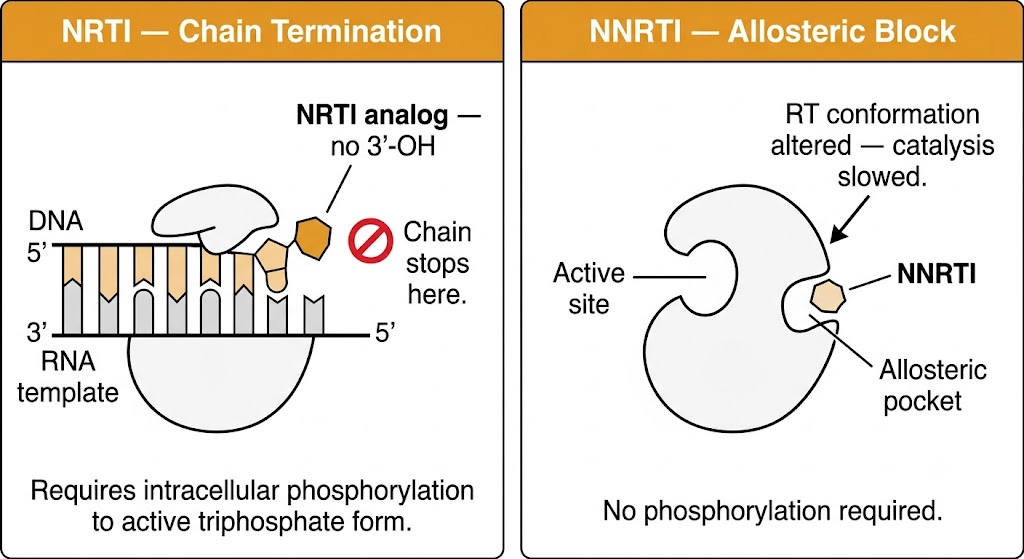
NRTI chain termination versus NNRTI allosteric block diagram

NRTIs are prodrugs requiring intracellular phosphorylation to their active triphosphate forms. Once activated, they act as obligate chain terminators: reverse transcriptase incorporates them into the growing viral DNA strand, then chain elongation stops because they lack the 3′-hydroxyl group needed to add the next nucleotide.

Because NRTIs are activated inside cells, plasma drug concentrations do not reflect the active intracellular drug. Intracellular triphosphate half-lives are much longer than plasma half-lives, enabling once-daily dosing even for agents with short plasma half-lives. Lamivudine (3TC) has a plasma half-life of about 5–7 hours but an intracellular triphosphate half-life of 10–19 hours. Emtricitabine (FTC) has an intracellular half-life of approximately 39 hours, the longest in the class.

Tenofovir exists as two prodrug formulations with distinct safety profiles. Tenofovir disoproxil fumarate (TDF) generates high plasma tenofovir concentrations, leading to renal proximal tubular toxicity and bone mineral density loss. Tenofovir alafenamide (TAF) is a phosphonamidate prodrug that delivers tenofovir preferentially into lymphocytes, achieving higher intracellular concentrations at roughly one-tenth the plasma tenofovir exposure of TDF. TAF causes substantially less renal and bone toxicity at equivalent antiviral efficacy. TAF is preferred when renal impairment or bone disease is a concern; TDF retains a role in certain pre-exposure prophylaxis (PrEP) regimens and some pregnancy contexts.

Abacavir (ABC) is a carbocyclic NRTI metabolized to carbovir triphosphate. Its most important feature is the risk of a potentially fatal hypersensitivity reaction (HSR) in patients carrying the HLA-B*57:01 allele (approximately 5–8% of patients). The HSR typically occurs within the first 6 weeks, causing fever, rash, and systemic symptoms. Rechallenge after a confirmed reaction is absolutely contraindicated. Prospective HLA-B*57:01 screening before prescribing abacavir is mandatory and virtually eliminates clinically diagnosed HSR.

Zidovudine (ZDV, formerly AZT) was the first antiretroviral approved and is now used mainly for prevention of mother-to-child transmission during labor and delivery. It causes bone marrow suppression (macrocytic anemia, neutropenia) and myopathy through inhibition of mitochondrial DNA polymerase gamma. Among currently used NRTIs, abacavir requires no renal dose adjustment (it is hepatically metabolized); TDF, FTC, 3TC, and ZDV all require dose adjustment with declining renal function.

Agent Activation Renal Adj? Key Toxicity
TDFIntracellular phosphorylation → TFV-DPYesNephrotoxicity, bone loss
TAFIntracellular phosphorylation → TFV-DPYes (<15 mL/min)Weight gain; less renal/bone toxicity than TDF
Emtricitabine (FTC)Intracellular phosphorylation → FTC-TPYesHBV flare on discontinuation in co-infected patients
Lamivudine (3TC)Intracellular phosphorylation → 3TC-TPYesWell tolerated; HBV flare on discontinuation
Abacavir (ABC)Intracellular phosphorylation → carbovir-TPNoFatal hypersensitivity (HLA-B*57:01 carriers)
Zidovudine (ZDV)Intracellular phosphorylation → ZDV-TPYes (severe CKD)Anemia, neutropenia, myopathy
Section 3
NRTI Toxicity and Resistance
Mitochondrial toxicity, HBV co-infection obligation, and the two resistance pathways

NRTI toxicity is mechanistically informative: the class-wide concern is off-target inhibition of mitochondrial DNA polymerase gamma, with risk varying substantially by agent. Hepatitis B virus (HBV) co-infection creates a critical safety obligation when discontinuing certain NRTIs. Resistance follows two mechanistically opposite pathways with directly opposing effects on drug susceptibility.

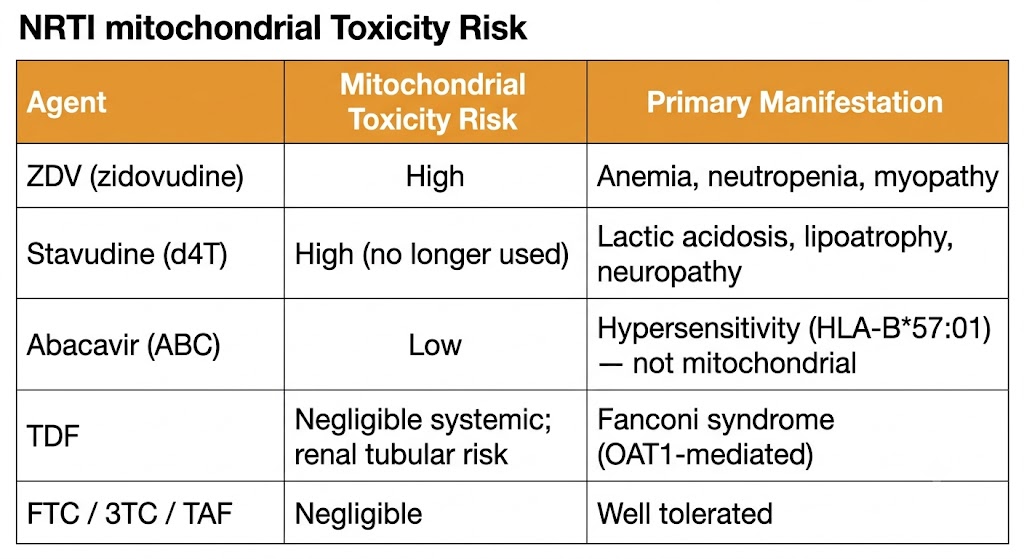
NRTI mitochondrial toxicity risk table

Mitochondrial toxicity arises because NRTIs can inhibit mitochondrial DNA polymerase gamma (pol-gamma), the enzyme that replicates mitochondrial DNA. Impaired mitochondrial function produces a spectrum of effects: lactic acidosis (most severe, potentially fatal), hepatic steatosis, peripheral neuropathy, and lipoatrophy. Risk is highest with ZDV and was greatest historically with stavudine (d4T) and didanosine (ddI), no longer used in resource-rich settings. TDF, FTC, and 3TC have negligible mitochondrial toxicity at therapeutic concentrations. TDF's renal proximal tubular toxicity is a distinct phenomenon: TDF accumulates in proximal tubular cells and impairs mitochondria locally, causing Fanconi syndrome (glucosuria without hyperglycemia, phosphaturia, proteinuria). TAF avoids this because plasma tenofovir concentrations are far lower.

Lamivudine and emtricitabine are active against HBV in addition to HIV. This creates two critical obligations. First, patients co-infected with HIV and HBV must receive an ART regimen containing TDF or TAF plus FTC or 3TC to treat both infections simultaneously. Second, abrupt discontinuation of 3TC or FTC in HBV co-infected patients can precipitate severe HBV flares with potentially fatal hepatic decompensation. Screen all patients for hepatitis B surface antigen (HBsAg) before starting ART and plan any future regimen changes accordingly.

HIV/HBV Co-infection Rule

Always include tenofovir (TDF or TAF) plus FTC or 3TC in any ART regimen for a patient co-infected with HIV and HBV. Never discontinue these agents without a plan to maintain HBV suppression — interruption risks fatal hepatic decompensation.

NRTI resistance follows two mechanistic pathways. Discrimination mutations alter the RT active site to exclude NRTI triphosphates. The most important is M184V, selected by 3TC or FTC, which causes high-level resistance to both agents but paradoxically increases susceptibility to ZDV and TDF. K65R, selected by tenofovir, confers resistance to TDF, TAF, and ABC while preserving ZDV susceptibility. Excision mutations — the thymidine analogue mutations (TAMs) — are selected by ZDV and enhance RT's ability to remove the incorporated NRTI, restoring chain elongation. TAMs accumulate over time and confer broad NRTI cross-resistance.

Section 4
Non-Nucleoside Reverse Transcriptase Inhibitors
Allosteric mechanism, HIV-1 selectivity, and agent-specific pharmacology

NNRTIs bind a hydrophobic allosteric pocket on HIV reverse transcriptase, distinct from the polymerase active site. They do not require intracellular activation and are not incorporated into viral DNA. They induce conformational changes that slow RT catalysis. This allosteric pocket is unique to HIV-1 RT — NNRTIs have no activity against HIV-2 and do not inhibit human DNA polymerases.

Because the allosteric pocket is structurally flexible, a single amino acid substitution at the binding interface can dramatically reduce NNRTI binding affinity — the genetic resistance barrier for first-generation agents is low. K103N is the most common transmitted HIV resistance mutation globally and causes high-level resistance to efavirenz and nevirapine while leaving rilpivirine and doravirine largely susceptible. This distinction drives the clinical preference for second-generation NNRTIs when possible.

Efavirenz (EFV) was the standard NNRTI for nearly two decades. It is a potent inducer of cytochrome P450 3A4 (CYP3A4) and cytochrome P450 2B6 (CYP2B6), and is itself metabolized primarily by CYP2B6. Because CYP2B6 is highly polymorphic — slow metabolizer variants are more common in individuals of African ancestry — some patients achieve plasma efavirenz concentrations 2–3 times higher than average, correlating with increased central nervous system (CNS) toxicity including vivid dreams, insomnia, dizziness, and depression. As a CYP3A4 inducer, efavirenz lowers concentrations of many co-medications including oral contraceptives, most protease inhibitors, and methadone.

Rilpivirine (RPV) is a second-generation NNRTI with better CNS tolerability. It is a CYP3A4 substrate without inducing or inhibiting activity. Two absolute requirements: it must be taken with a substantial meal (absorption requires gastric acidity and food), and proton pump inhibitors (PPIs) are contraindicated because they suppress gastric acid throughout the day and prevent adequate rilpivirine absorption regardless of timing. H2 blockers may be used with appropriate timing separation. Rilpivirine is contraindicated when pre-treatment viral load exceeds 100,000 copies/mL or CD4 count is below 200 cells/µL — higher virologic failure rates occur in these groups.

Doravirine (DOR) is the newest NNRTI and retains activity against the most common transmitted mutations including K103N. It is metabolized by CYP3A4 without significant induction or inhibition, has no food requirement, and has excellent CNS tolerability. Its key limitation is susceptibility to rifampin co-administration — rifampin reduces doravirine area under the concentration-time curve (AUC) by approximately 88%, making the combination contraindicated. Nevirapine, an older NNRTI, is associated with severe hepatotoxicity (highest risk in women with CD4 above 250 cells/µL and men with CD4 above 400 cells/µL at initiation) and Stevens-Johnson syndrome (SJS), and is rarely used in resource-rich settings today.

Agent Resistance Barrier K103N Active? CYP Effect Key Concern
EfavirenzLowNo3A4/2B6 inducerCNS toxicity; methadone; OCP interactions
RilpivirineLow-moderateYes3A4 substrate onlyFood/PPI requirement; VL >100K contraindicated
DoravirineModerateYes3A4 substrate onlyRifampin contraindicated (~88% AUC reduction)
NevirapineVery lowNo3A4 inducerHepatotoxicity (CD4-dependent); SJS
Section 5
NNRTI Toxicity and Drug Interactions
CYP induction consequences, the methadone interaction, and transmitted resistance

The most clinically significant NNRTI toxicities and interactions stem from CYP3A4 induction by efavirenz and nevirapine, which substantially lowers concentrations of many co-medications. Second-generation NNRTIs are CYP3A4 substrates without inducing activity, giving them a far cleaner interaction profile — a key practical advantage in polypharmacy patients.

Efavirenz CNS toxicity is the most common reason for regimen switching. Symptoms peak in the first 2–4 weeks and include vivid or disturbing dreams, insomnia, dizziness, and impaired concentration. Bedtime dosing reduces subjective severity. About 10–15% of patients have persistent symptoms at 6 months. Depression, suicidal ideation, and psychosis are rare but documented; efavirenz is relatively contraindicated in patients with pre-existing psychiatric illness. Efavirenz's historical Food and Drug Administration (FDA) Pregnancy Category D classification (based on primate neural tube defect data) has been substantially revised — current guidelines accept it throughout pregnancy when no preferred alternative is available, though INSTI-based regimens are preferred in pregnancy.

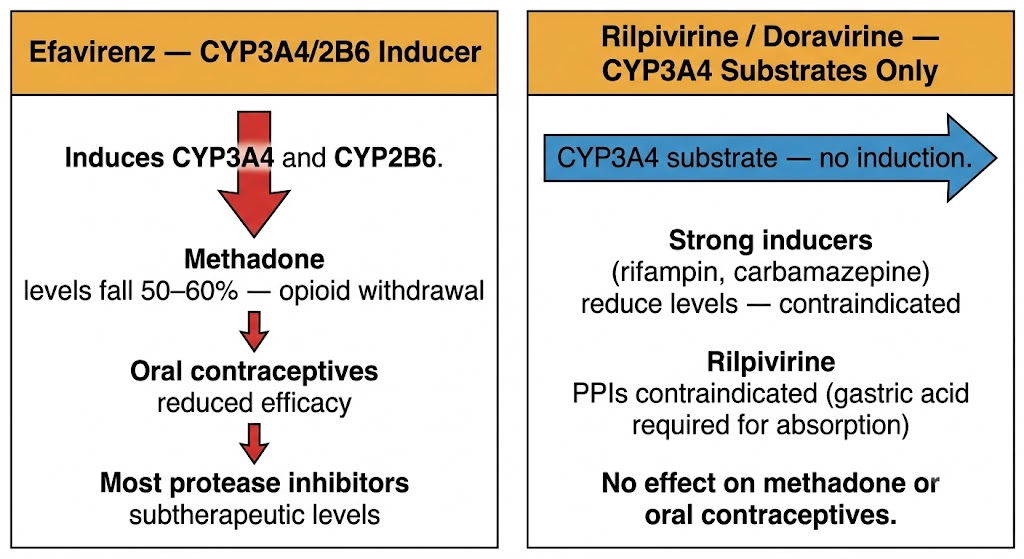
Efavirenz CYP inducer versus rilpivirine doravirine substrates diagram

The most clinically dangerous NNRTI interaction is efavirenz plus methadone. Efavirenz reduces methadone plasma concentrations by 50–60% through CYP3A4 and CYP2B6 induction, precipitating opioid withdrawal within 1–2 weeks of efavirenz initiation in patients on stable methadone maintenance. Coordinate with the methadone prescriber before starting efavirenz — dose escalation is routinely required. INSTI-based regimens have no clinically significant interaction with methadone and are strongly preferred in this population.

Efavirenz + Methadone

Efavirenz reduces methadone concentrations by 50–60% via CYP3A4 and CYP2B6 induction. Opioid withdrawal begins within days to weeks of efavirenz initiation. Always coordinate with the methadone prescriber before starting efavirenz, and warn the patient. An INSTI-based regimen is strongly preferred in any patient on methadone maintenance therapy.

Rilpivirine interactions are driven by its CYP3A4 substrate status. Strong CYP3A4 inducers — rifampin, carbamazepine, phenytoin, phenobarbital, and St. John's Wort — reduce rilpivirine to subtherapeutic levels and are contraindicated. For doravirine, rifampin and rifabutin are both contraindicated due to magnitude of AUC reduction. Both rilpivirine and doravirine are far better choices than efavirenz in patients on methadone or other drugs sensitive to CYP3A4 induction.

Transmitted resistance shapes NNRTI selection at diagnosis. K103N is present in approximately 2–8% of newly diagnosed treatment-naive patients in the U.S. This single mutation confers high-level resistance to efavirenz and nevirapine but not to rilpivirine or doravirine. Baseline genotypic resistance testing is therefore required before selecting an NNRTI. Patients with multiple NNRTI resistance mutations have compromised susceptibility across the entire class and should be treated with an INSTI-based regimen instead.

Visual Summary  ·  Module 1 of 8
NRTIs and NNRTIs — Visual Reference
Mechanisms, resistance, toxicity, and key interactions at a glance
Suggested References
Author(s) Title / Source Focus
Cihlar T, Ray AS Nucleoside and nucleotide HIV reverse transcriptase inhibitors: 25 years after zidovudine. Antiviral Res. 2010 NRTI mechanisms and clinical pharmacology
Mallal S et al. HLA-B*5701 screening for hypersensitivity to abacavir. N Engl J Med. 2008 Abacavir HSR and HLA-B*57:01 screening
de Bethune MP Non-nucleoside reverse transcriptase inhibitors: discovery, development, and use. Antiviral Res. 2010 NNRTI pharmacology and resistance
Clutter DS et al. HIV-1 drug resistance and resistance testing. Infect Genet Evol. 2016 Resistance mutation patterns and testing
DHHS Panel Guidelines for the Use of Antiretroviral Agents in Adults and Adolescents with HIV. AIDSinfo.nih.gov Current preferred regimens and clinical guidance
Back to top