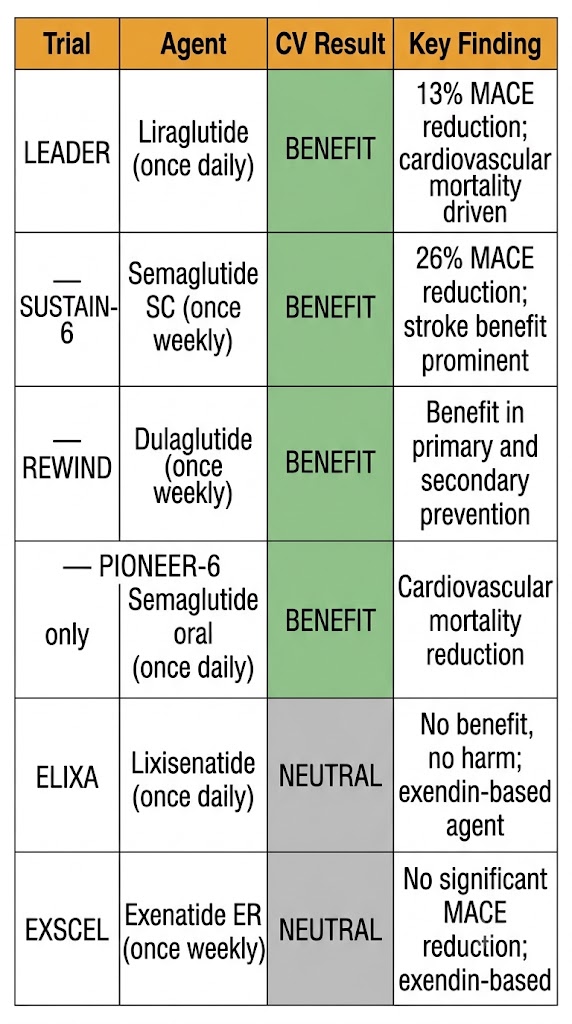
Glucagon-like peptide-1 receptor agonists mimic and greatly extend the action of the endogenous incretin hormone glucagon-like peptide-1. By binding the glucagon-like peptide-1 receptor — a G protein-coupled receptor expressed in pancreatic beta cells, the central nervous system, the gastrointestinal tract, the heart, and the kidney — they produce a remarkably broad range of effects that extend well beyond glucose lowering.
The glucagon-like peptide-1 receptor signals through Gs protein coupling, activating adenylyl cyclase, raising intracellular cyclic adenosine monophosphate, and activating protein kinase A. In pancreatic beta cells this amplifies glucose-stimulated insulin secretion — critically, in a glucose-dependent manner, meaning insulin secretion increases only when glucose is elevated and diminishes as glucose normalizes. The same signaling pathway simultaneously suppresses glucagon secretion from alpha cells when glucose is elevated. These two complementary effects — more insulin when glucose is high, less glucagon throughout — produce effective glucose lowering with very low monotherapy hypoglycemia risk.
Beyond the pancreas, glucagon-like peptide-1 receptors in the hypothalamus and brainstem reduce appetite and increase satiety, producing the substantial weight loss that distinguishes this class from most other antihyperglycemic agents. Glucagon-like peptide-1 receptor activation also slows gastric emptying, which reduces postprandial glucose excursions but also contributes to nausea. In the heart and vasculature, glucagon-like peptide-1 receptor signaling reduces inflammation, oxidative stress, and atherosclerotic plaque progression through mechanisms that appear partly independent of glucose lowering, forming the biological basis for the cardiovascular outcome trial benefits seen with several agents.
Glucose-dependent insulin secretion increase (safe — no hypoglycemia as monotherapy). Glucagon suppression. Gastric emptying slowed (reduces postprandial glucose but causes nausea). Hypothalamic appetite suppression (weight loss). Cardiovascular and renal protective effects via receptor signaling in those organs.
Glucagon-like peptide-1 receptor agonists fall into two structural classes based on their similarity to native glucagon-like peptide-1: exendin-4-based agents (exenatide, lixisenatide) derived from the Gila monster peptide with 53 percent homology to human glucagon-like peptide-1, and human glucagon-like peptide-1 analogs (liraglutide, semaglutide, dulaglutide, albiglutide) engineered from the native sequence with modifications that extend half-life.
Exenatide (twice daily injection) and lixisenatide (once daily) have short half-lives of 2 to 4 hours. Exenatide once weekly uses a microsphere depot formulation for sustained release. Liraglutide (once daily injection) achieves a 13-hour half-life through fatty acid acylation allowing albumin binding, similar in principle to insulin detemir. Semaglutide, the most potent agent in current clinical use, is available as a once-weekly subcutaneous injection and — uniquely in this class — as a once-daily oral tablet. The oral formulation uses an absorption enhancer (sodium N-[8-(2-hydroxybenzoyl)amino]caprylate) to facilitate peptide absorption across the gastric mucosa; it must be taken fasting with a small amount of water and no food for 30 minutes after. Dulaglutide (once weekly) is fused to an immunoglobulin fragment crystallizable region, extending its half-life to approximately 5 days.
All injectable agents are subcutaneous. None cross the blood-brain barrier in significant amounts — central nervous system effects are mediated through vagal afferents and circumventricular organs lacking the blood-brain barrier. Renal dose adjustment is generally not required except for exenatide twice daily (avoid if estimated glomerular filtration rate below 30) and the oral semaglutide formulation, which has limited data in severe renal impairment.
Twice daily: exenatide (Byetta).
Once daily injection: liraglutide (Victoza/Saxenda), lixisenatide (Adlyxin).
Once daily oral: semaglutide (Rybelsus) — take fasting, wait 30 minutes before eating.
Once weekly injection: semaglutide (Ozempic), dulaglutide (Trulicity), exenatide extended-release (Bydureon).
Once weekly injection for obesity (higher doses): semaglutide (Wegovy), liraglutide (Saxenda).
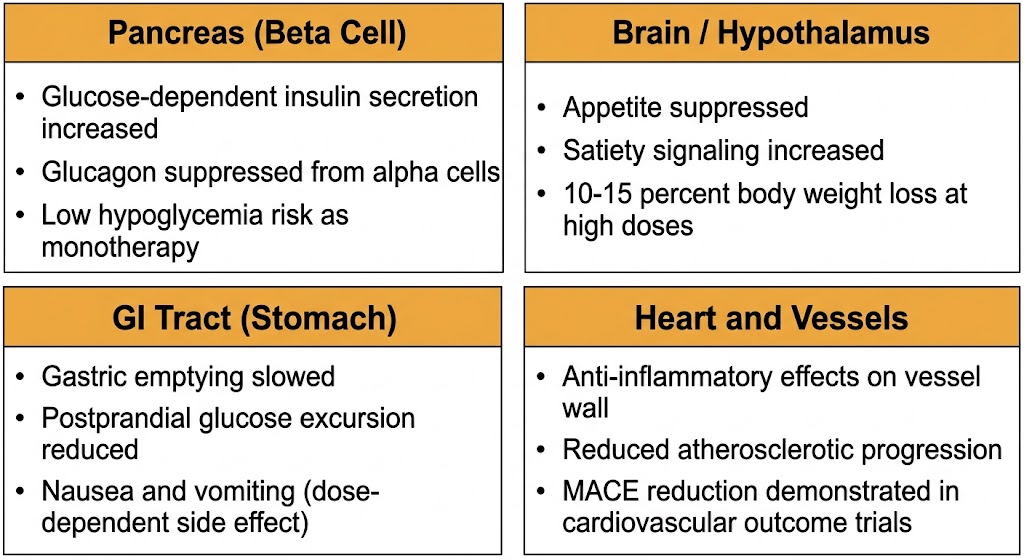
Multiple large cardiovascular outcome trials have demonstrated that certain glucagon-like peptide-1 receptor agonists reduce major adverse cardiovascular events in patients with type 2 diabetes mellitus and established atherosclerotic cardiovascular disease or high cardiovascular risk. This is a class effect seen predominantly with the human glucagon-like peptide-1 analog subclass — not with the shorter-acting exendin-based agents.
The LEADER trial (liraglutide versus placebo, over 9000 patients with high cardiovascular risk) demonstrated a significant 13 percent reduction in major adverse cardiovascular events — a composite of cardiovascular death, nonfatal myocardial infarction, and nonfatal stroke — driven primarily by a reduction in cardiovascular mortality. SUSTAIN-6 (semaglutide) showed a 26 percent reduction in major adverse cardiovascular events, with stroke reduction being particularly prominent. REWIND (dulaglutide) demonstrated benefit in a broader population that included patients without prior cardiovascular events, suggesting the benefit may extend to primary prevention in high-risk patients.
The ELIXA trial (lixisenatide) and EXSCEL trial (exenatide once weekly) showed cardiovascular neutrality — no benefit, no harm. This pattern supports the view that cardiovascular benefit is specific to the human glucagon-like peptide-1 analog subclass, possibly reflecting greater receptor engagement duration or structural differences in receptor activation. The mechanism of cardiovascular benefit is incompletely understood but involves anti-inflammatory and antiatherosclerotic effects beyond glucose lowering.
Benefit (major adverse cardiovascular event reduction): liraglutide (LEADER), semaglutide (SUSTAIN-6, PIONEER-6), dulaglutide (REWIND), albiglutide (HARMONY).
Neutral (no benefit, no harm): lixisenatide (ELIXA), exenatide once weekly (EXSCEL).
Guideline implication: in type 2 diabetes mellitus with established atherosclerotic cardiovascular disease, a glucagon-like peptide-1 receptor agonist with proven cardiovascular benefit is recommended independent of glycated hemoglobin level.
The gastrointestinal adverse effect profile — nausea, vomiting, diarrhea — is the primary limitation of glucagon-like peptide-1 receptor agonists and the most common reason for dose reduction or discontinuation. These effects are mechanistically linked to the slowing of gastric emptying and are dose-dependent, largely resolving with continued use as the gastrointestinal tract adapts.
Nausea occurs in 20 to 40 percent of patients starting treatment, peaks during dose escalation, and typically improves substantially after 4 to 8 weeks. Slow dose titration — starting at the lowest dose and increasing monthly — substantially reduces nausea severity. Vomiting and diarrhea are less common but occur. Patients should be counseled to eat smaller meals, avoid high-fat foods during initiation, and not lie down after eating.
Pancreatitis risk has been a longstanding concern with this class. Postmarketing cases have been reported, and the drug labels carry a warning. However, large cardiovascular outcome trials have not confirmed a statistically significant increase in pancreatitis incidence compared with placebo. Current guidance is to be alert for symptoms of pancreatitis and to discontinue the drug if acute pancreatitis is confirmed. A history of pancreatitis is a relative contraindication.
Personal or family history of medullary thyroid carcinoma: contraindicated. Multiple endocrine neoplasia type 2 (which includes medullary thyroid carcinoma): contraindicated. Both are based on rodent data showing thyroid C-cell tumors with glucagon-like peptide-1 receptor agonist exposure; human relevance is uncertain but the contraindication is retained.
Severe gastrointestinal disease (gastroparesis): worsened by gastric emptying slowing — avoid.
Pregnancy: insufficient safety data — switch to insulin.
Hypoglycemia: rare as monotherapy; risk increases significantly when combined with sulfonylureas or insulin — dose reduction of the secretagogue is often needed.
Glucagon-like peptide-1 receptor agonists have moved from second- or third-line agents to first-line therapy — ahead of or alongside metformin — in patients with type 2 diabetes mellitus and established atherosclerotic cardiovascular disease, high cardiovascular risk, or obesity. Their combination of glycemic efficacy, weight loss, and cardiovascular benefit makes them among the most versatile agents in the diabetes pharmacopeia.
Current American Diabetes Association guidelines recommend a glucagon-like peptide-1 receptor agonist with proven cardiovascular benefit as the preferred add-on when cardiovascular disease is present, regardless of glycated hemoglobin. For patients whose primary goal is weight loss, semaglutide and liraglutide at higher approved doses produce 10 to 15 percent body weight reduction and are approved for obesity management independent of diabetes. Combining a glucagon-like peptide-1 receptor agonist with a sodium-glucose cotransporter-2 inhibitor is an evidence-based and increasingly used combination that provides complementary cardiovascular and renal protection.
Glucagon-like peptide-1 receptor agonists can be combined with basal insulin; the combination reduces glycated hemoglobin more than either agent alone and attenuates the weight gain associated with insulin initiation. Fixed-ratio combination products (insulin degludec plus liraglutide as Xultophy, insulin glargine plus lixisenatide as Soliqua) simplify regimens. When adding a glucagon-like peptide-1 receptor agonist to a sulfonylurea regimen, the sulfonylurea dose should be reduced by 25 to 50 percent to reduce hypoglycemia risk.
| Author / Organization | Title | Source |
|---|---|---|
| Drucker DJ | Mechanisms of action and therapeutic application of glucagon-like peptide-1 | Cell Metab. 2018;27(4):740–756 |
| Baggio LL, Drucker DJ | Biology of incretins: GLP-1 and GIP | Gastroenterology. 2007;132(6):2131–2157 |
| Nauck MA, Meier JJ | The incretin effect in healthy individuals and those with type 2 diabetes: physiology, pathophysiology, and response to therapeutic interventions | Lancet Diabetes Endocrinol. 2016;4(6):525–536 |
| Lau J et al | Discovery of the once-weekly glucagon-like peptide-1 analogue semaglutide | J Med Chem. 2015;58(18):7370–7380 |
| Bucheit JD et al | Oral semaglutide: a review of the first oral glucagon-like peptide-1 receptor agonist | Diabetes Technol Ther. 2020;22(1):10–18 |
| Htike ZZ et al | Efficacy and safety of glucagon-like peptide-1 receptor agonists in type 2 diabetes: a systematic review and mixed-treatment comparison analysis | Diabetes Obes Metab. 2017;19(4):524–536 |
| Marso SP et al (LEADER) | Liraglutide and cardiovascular outcomes in type 2 diabetes | N Engl J Med. 2016;375(4):311–322 |
| Marso SP et al (SUSTAIN-6) | Semaglutide and cardiovascular outcomes in patients with type 2 diabetes | N Engl J Med. 2016;375(19):1834–1844 |
| Gerstein HC et al (REWIND) | Dulaglutide and cardiovascular outcomes in type 2 diabetes | Lancet. 2019;394(10193):121–130 |
| Drucker DJ et al (EXSCEL) | Exenatide once weekly versus twice daily for the treatment of type 2 diabetes | Lancet. 2008;372(9645):1240–1250 |
| Nauck MA et al | GLP-1 receptor agonists in the treatment of type 2 diabetes — state-of-the-art | Mol Metab. 2021;46:101102 |
| American Diabetes Association | Standards of Care in Diabetes—2024 | Diabetes Care. 2024;47(Suppl 1):S1–S321 |
| Kristensen SL et al | Cardiovascular, mortality, and kidney outcomes with GLP-1 receptor agonists in patients with type 2 diabetes: a systematic review and meta-analysis | Lancet Diabetes Endocrinol. 2019;7(10):776–785 |
| Pfeffer MA et al (ELIXA) | Lixisenatide in patients with type 2 diabetes and acute coronary syndrome | N Engl J Med. 2015;373(23):2247–2257 |
| Husain M et al (PIONEER-6) | Oral semaglutide and cardiovascular outcomes in patients with type 2 diabetes | N Engl J Med. 2019;381(9):841–851 |