CHAPTER 29  ·  DIABETES PHARMACOLOGY
Section 01
Mechanism: Proximal Tubule Glucose Reabsorption and Glycosuria
Sodium-glucose cotransporter-2 biology, the glycosuric mechanism, and downstream hemodynamic and metabolic effects

Sodium-glucose cotransporter-2 inhibitors lower blood glucose by blocking glucose reabsorption in the kidney, causing glucose to be excreted in the urine. This mechanism is entirely insulin-independent — it works regardless of beta cell function or insulin resistance — and produces a unique constellation of metabolic effects beyond glucose lowering that have transformed the management of heart failure and chronic kidney disease.

Under normal physiology, essentially all of the approximately 180 grams of glucose filtered daily by the glomeruli is reabsorbed in the proximal convoluted tubule. Sodium-glucose cotransporter-2 accounts for approximately 90 percent of this reabsorption in the S1 and S2 segments of the proximal tubule, co-transporting one glucose molecule with two sodium ions using the electrochemical gradient established by the basolateral sodium-potassium adenosine triphosphatase. The remaining 10 percent is handled by sodium-glucose cotransporter-1 in the S3 segment. Sodium-glucose cotransporter-2 inhibitors competitively block the cotransporter, reducing glucose reabsorption capacity from approximately 180 g/day to roughly 60 to 80 g/day. This causes osmotic glycosuria — glucose spilling into urine — and produces a caloric deficit of approximately 200 to 300 kcal per day, contributing to modest weight loss of 2 to 3 kg.

The glycosuric mechanism produces several downstream effects beyond glucose lowering. The osmotic diuresis from glycosuria reduces plasma volume, lowering blood pressure by 3 to 5 mmHg systolic. Natriuresis (sodium excretion accompanying glucose excretion) further reduces volume load. In the kidney, reduced proximal tubule sodium reabsorption increases sodium delivery to the macula densa, restoring tubuloglomerular feedback and reducing hyperfiltration — a mechanism thought to underlie the renoprotective effects of the class. Reduced insulin levels from improved glycemia lower uric acid reabsorption, mildly reducing serum uric acid. Mild osmotic diuresis and natriuresis also reduce cardiac preload and afterload, contributing to the heart failure benefits.

Why SGLT-2 Inhibitors Help Heart Failure (Beyond Glucose)

The heart failure benefit is largely glucose-independent and explained by hemodynamic and metabolic mechanisms: osmotic diuresis reduces preload, natriuresis reduces volume overload, tubuloglomerular feedback restoration reduces intraglomerular pressure, and shifts in myocardial substrate utilization toward ketone bodies (which are more oxygen-efficient than glucose) may improve cardiac energetics. These effects occur even in patients without diabetes.
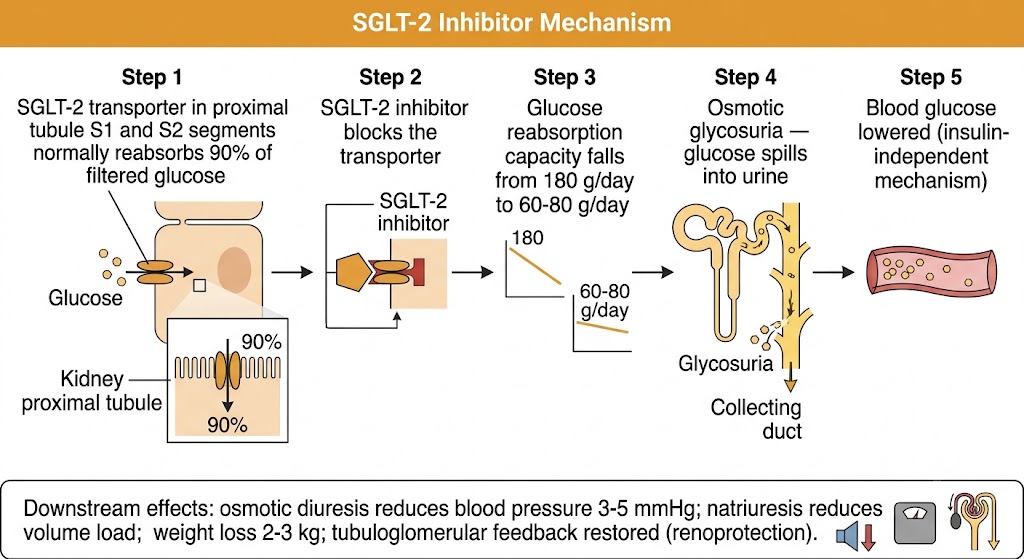
Flow diagram showing SGLT-2 inhibitor mechanism: Step 1, SGLT-2 transporter in proximal tubule S1 and S2 segments normally reabsorbs 90% of filtered glucose; Step 2, SGLT-2 inhibitor blocks the transporter; Step 3, glucose reabsorption capacity falls from 180 g per day to 60-80 g per day; Step 4, osmotic glycosuria — glucose spills into urine; Step 5, blood glucose lowered by an insulin-independent mechanism. Downstream effects box: osmotic diuresis reduces blood pressure 3-5 mmHg, natriuresis reduces volume load, weight loss 2-3 kg, tubuloglomerular feedback restored for renoprotection.
SGLT-2 inhibitor mechanism: proximal tubule glucose reabsorption block and downstream effects. Generated with Gemini AI for educational use.
Section 02
Agents: Canagliflozin, Dapagliflozin, Empagliflozin, and Ertugliflozin
Pharmacokinetic profiles, approved indications, and clinically relevant differences between agents

Four sodium-glucose cotransporter-2 inhibitors are approved in the United States: canagliflozin, dapagliflozin, empagliflozin, and ertugliflozin. All share the same proximal tubule mechanism but differ in their approved indications, cardiovascular and renal outcome trial data, and some pharmacokinetic properties.

All four agents are orally bioavailable, once-daily, and primarily metabolized by glucuronidation (not cytochrome P450 enzymes), giving them a clean drug interaction profile. All reduce glycated hemoglobin by approximately 0.5 to 1.0 percent, lower blood pressure by 3 to 5 mmHg systolic, and produce 2 to 3 kg weight loss. The key differences lie in their cardiovascular and renal outcome trial data and consequently their approved indications beyond glycemic control.

Empagliflozin has the broadest approved indication set: type 2 diabetes mellitus, heart failure with reduced ejection fraction, heart failure with preserved ejection fraction, and chronic kidney disease (based on EMPA-REG OUTCOME, EMPEROR-Reduced, EMPEROR-Preserved, and EMPA-KIDNEY trials respectively). Dapagliflozin is approved for type 2 diabetes mellitus, heart failure with reduced ejection fraction, and chronic kidney disease (DECLARE-TIMI 58, DAPA-HF, DAPA-CKD). Canagliflozin is approved for type 2 diabetes mellitus and chronic kidney disease (CANVAS, CREDENCE). Ertugliflozin is approved for type 2 diabetes mellitus only (VERTIS-CV showed cardiovascular safety but no superiority).

Renal Dosing Threshold

All sodium-glucose cotransporter-2 inhibitors lose glycemic efficacy as estimated glomerular filtration rate falls because the mechanism depends on filtered glucose load. At estimated glomerular filtration rate below 30 mL/min, glycemic benefit is negligible. However, the cardiovascular and renal protective effects persist at lower estimated glomerular filtration rate values — trials have enrolled patients with estimated glomerular filtration rate as low as 20 mL/min. Guidelines now support using these agents for cardiorenal protection even in moderate-to-severe chronic kidney disease where glucose lowering is minimal.

Section 03
Cardiovascular Outcome Trials
EMPA-REG OUTCOME, CANVAS, DECLARE-TIMI 58, and VERTIS-CV: cardiovascular mortality, heart failure hospitalization, and the class effect question

The sodium-glucose cotransporter-2 inhibitor cardiovascular outcome trials established this class as the first oral antihyperglycemic agents with robust evidence for reducing heart failure hospitalization across all trials, and for reducing cardiovascular mortality in the highest-risk populations.

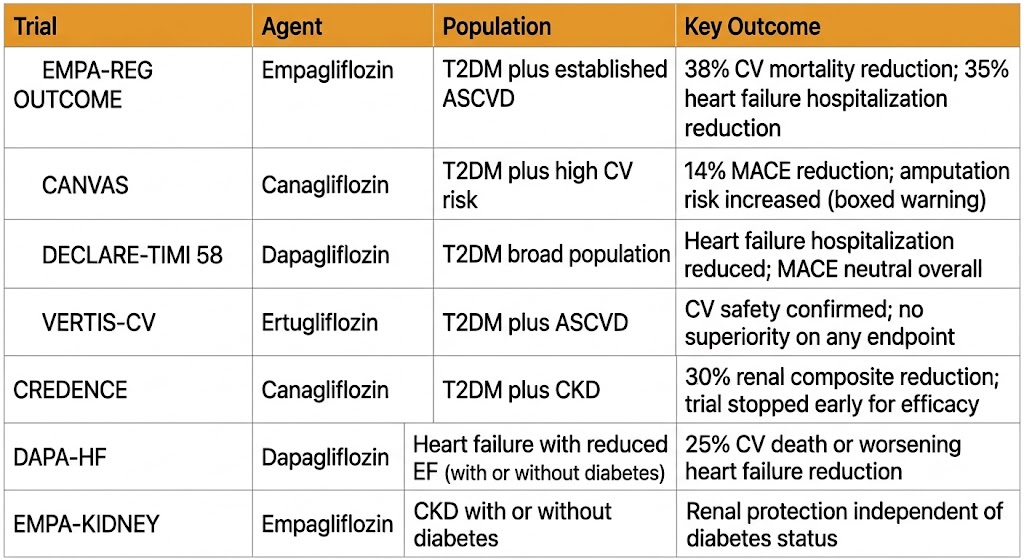
EMPA-REG OUTCOME (empagliflozin, 2015) was the landmark trial. In patients with type 2 diabetes mellitus and established cardiovascular disease, empagliflozin reduced major adverse cardiovascular events by 14 percent, cardiovascular mortality by 38 percent, and heart failure hospitalization by 35 percent — the most striking cardiovascular mortality reduction seen in a diabetes drug trial. CANVAS (canagliflozin, 2017) showed a 14 percent major adverse cardiovascular event reduction but also raised concern about lower extremity amputations (canagliflozin carries an FDA boxed warning). DECLARE-TIMI 58 (dapagliflozin, 2019) enrolled a broader population including patients without prior cardiovascular events and showed no significant major adverse cardiovascular event reduction in the overall population but robust heart failure hospitalization reduction. VERTIS-CV (ertugliflozin, 2020) showed cardiovascular safety but no superiority for any endpoint.

The Heart Failure Signal: A Class Effect

Heart failure hospitalization reduction was seen consistently across all four cardiovascular outcome trials — approximately 25 to 35 percent reduction — making this the most robust cardiovascular effect of the class. This signal appeared even in patients without prior heart failure at enrollment, suggesting a preventive effect. The mechanism is primarily hemodynamic (diuresis, natriuresis, preload reduction) rather than purely antihyperglycemic.

Reference table of SGLT-2 inhibitor outcome trials: EMPA-REG OUTCOME (empagliflozin, T2DM plus ASCVD, 38% CV mortality and 35% heart failure hospitalization reduction), CANVAS (canagliflozin, 14% MACE reduction, amputation risk increased), DECLARE-TIMI 58 (dapagliflozin, heart failure hospitalization reduced), VERTIS-CV (ertugliflozin, neutral), CREDENCE (canagliflozin, 30% renal composite reduction), DAPA-HF (dapagliflozin, 25% CV death or worsening heart failure), EMPA-KIDNEY (empagliflozin, renal protection independent of diabetes).
SGLT-2 inhibitor cardiovascular and renal outcome trial results by agent. Generated with Gemini AI for educational use.
Section 04
Heart Failure and Renal Outcome Trials
EMPEROR-Reduced, EMPEROR-Preserved, DAPA-HF, DAPA-CKD, CREDENCE, and EMPA-KIDNEY: benefits beyond type 2 diabetes mellitus

Following the cardiovascular outcome trial signals, dedicated heart failure and renal trials were conducted — many enrolling patients without diabetes — confirming that the benefits of sodium-glucose cotransporter-2 inhibitors extend far beyond their original antihyperglycemic indication.

In heart failure, DAPA-HF (dapagliflozin in heart failure with reduced ejection fraction) and EMPEROR-Reduced (empagliflozin in heart failure with reduced ejection fraction) both showed significant reductions in the composite of cardiovascular death or worsening heart failure, with approximately 25 percent relative risk reduction, in populations that included patients without diabetes (approximately 45 percent of enrolled patients). EMPEROR-Preserved and the DELIVER trial (dapagliflozin) extended these findings to heart failure with preserved ejection fraction — a population with very limited effective therapy options — establishing sodium-glucose cotransporter-2 inhibitors as the first class with evidence across the full spectrum of ejection fraction.

In chronic kidney disease, CREDENCE (canagliflozin) was stopped early for efficacy, showing a 30 percent reduction in the composite renal endpoint (doubling of serum creatinine, end-stage kidney disease, renal death) in patients with type 2 diabetes mellitus and proteinuric chronic kidney disease on maximum tolerated renin-angiotensin-aldosterone system blockade. DAPA-CKD (dapagliflozin) and EMPA-KIDNEY (empagliflozin) extended renal protection to patients without diabetes, establishing that renoprotection is a direct drug effect independent of glucose lowering. Current guidelines recommend adding a sodium-glucose cotransporter-2 inhibitor to renin-angiotensin-aldosterone system blockade in patients with proteinuric chronic kidney disease regardless of diabetes status.

Section 05
Safety Profile and Place in Therapy
Diabetic ketoacidosis, Fournier gangrene, urogenital infections, amputation risk, and guideline positioning

The safety profile of sodium-glucose cotransporter-2 inhibitors includes several distinctive adverse effects that reflect their glycosuric mechanism and require patient counseling. The most serious — euglycemic diabetic ketoacidosis — is rare but potentially fatal if not recognized promptly.

Genital mycotic infections (vulvovaginal candidiasis in women, balanitis in men) occur in 5 to 10 percent of patients and are the most common adverse effect, driven by the glucose-rich urine creating a favorable environment for fungal growth. Urinary tract infections are modestly increased. These effects are manageable and rarely cause discontinuation. Patients should be counseled on hygiene and prompt reporting of symptoms.

Euglycemic diabetic ketoacidosis is a rare but serious complication in which ketoacidosis develops at near-normal blood glucose levels, making it harder to recognize. The mechanism involves reduced insulin secretion (glycosuria lowers the glucose stimulus for insulin), increased glucagon, and a shift toward ketogenesis. It occurs more commonly in type 1 diabetes mellitus (where sodium-glucose cotransporter-2 inhibitors are used off-label) and in perioperative settings. Sodium-glucose cotransporter-2 inhibitors should be held 3 to 4 days before elective surgery. Any patient presenting with nausea, vomiting, or abdominal pain while on these agents should have ketones and arterial pH checked regardless of blood glucose.

Key Safety Signals

Euglycemic diabetic ketoacidosis: hold 3 to 4 days before surgery; check ketones if symptomatic regardless of glucose level. Fournier gangrene (necrotizing fasciitis of the genitalia and perineum): rare but potentially fatal; FDA warning across class; discontinue immediately if suspected. Canagliflozin lower extremity amputations: FDA boxed warning; caution in patients with peripheral vascular disease or prior amputation. Genital mycotic infections: common, manageable. Volume depletion and hypotension: monitor in elderly and those on diuretics.

Visual Summary
SGLT-2 Inhibitors: Mechanism, Trials, and Safety
Proximal tubule pharmacology, cardiovascular and renal outcome trial results, and safety profile
Suggested References
Author / OrganizationTitleSource
Vallon V, Thomson SCTargeting renal glucose reabsorption to treat hyperglycemia: the pleiotropic effects of SGLT-2 inhibitionDiabetologia. 2017;60(2):215–225
Cherney DZI et alRenal hemodynamic effect of sodium-glucose cotransporter 2 inhibition in patients with type 1 diabetes mellitusCirculation. 2014;129(5):587–597
Neal B et al (CANVAS)Canagliflozin and cardiovascular and renal events in type 2 diabetesN Engl J Med. 2017;377(7):644–657
Perkovic V et al (CREDENCE)Canagliflozin and renal outcomes in type 2 diabetes and nephropathyN Engl J Med. 2019;380(24):2295–2306
Packer M et al (EMPEROR-Reduced)Cardiovascular and renal outcomes with empagliflozin in heart failureN Engl J Med. 2020;383(15):1413–1424
Cannon CP et al (VERTIS-CV)Cardiovascular outcomes with ertugliflozin in type 2 diabetesN Engl J Med. 2020;383(15):1425–1435
Zinman B et al (EMPA-REG OUTCOME)Empagliflozin, cardiovascular outcomes, and mortality in type 2 diabetesN Engl J Med. 2015;373(22):2117–2128
Anker SD et al (EMPEROR-Preserved)Empagliflozin in heart failure with a preserved ejection fractionN Engl J Med. 2021;385(16):1451–1461
Wiviott SD et al (DECLARE-TIMI 58)Dapagliflozin and cardiovascular outcomes in type 2 diabetesN Engl J Med. 2019;380(4):347–357
McMurray JJV et al (DAPA-HF)Dapagliflozin in patients with heart failure and reduced ejection fractionN Engl J Med. 2019;381(21):1995–2008
Lopaschuk GD, Verma SMechanisms of cardiovascular benefits of sodium glucose co-transporter 2 inhibitorsJACC Basic Transl Sci. 2020;5(6):632–644
EMPA-KIDNEY Collaborative GroupEmpagliflozin in patients with chronic kidney diseaseN Engl J Med. 2023;388(2):117–127
Bersoff-Matcha SJ et alFournier gangrene associated with sodium-glucose cotransporter-2 inhibitorsAnn Intern Med. 2019;170(11):764–769
American Diabetes AssociationStandards of Care in Diabetes—2024Diabetes Care. 2024;47(Suppl 1):S1–S321
↑ Back to top