CHAPTER 27  ·  GASTROINTESTINAL PHARMACOLOGY
Section 1

Aminosalicylates

Sulfasalazine as a prodrug, mesalamine as the active moiety, formulation strategies for site-specific delivery, mechanism via cyclo-oxygenase inhibition and nuclear factor kappa-B suppression, and the clinical role in ulcerative colitis

The aminosalicylate drugs are the cornerstone of treatment for mild to moderate ulcerative colitis. Their therapeutic action is localized to the bowel mucosa. The primary challenge in their development has been delivering the active moiety to the inflamed segment without systemic absorption.

Sulfasalazine: The Original Prodrug

Sulfasalazine consists of mesalamine (5-aminosalicylic acid) linked by an azo bond to sulfapyridine, a sulfonamide carrier. Colonic bacteria cleave this azo bond, releasing mesalamine locally at the site of mucosal inflammation. The therapeutic activity resides entirely in the mesalamine component; sulfapyridine is merely a carrier that prevents premature absorption in the small intestine, but it is also responsible for most of the adverse effects.

Adverse effects attributable to sulfapyridine include nausea, headache, reversible oligospermia, and hemolytic anemia in patients with glucose-6-phosphate dehydrogenase deficiency. Sulfapyridine competitively inhibits intestinal folate absorption, so folic acid 1 milligram daily is required for all patients on sulfasalazine — particularly important in women of childbearing potential. Screen for glucose-6-phosphate dehydrogenase deficiency before starting.

Mesalamine Formulations

Mesalamine formulations were developed to deliver the active moiety without the sulfapyridine carrier. pH-dependent release coatings dissolve at specific luminal pH thresholds to target drug release to the terminal ileum and colon. Multi-matrix technology (once-daily tablets) releases mesalamine slowly throughout the entire colon and substantially improves adherence compared with older three or four times daily regimens. Rectal suppositories, enemas, and foam preparations deliver high local concentrations to the distal colon with minimal systemic absorption and are preferred for proctitis and left-sided disease.

For left-sided and extensive ulcerative colitis, combining oral plus rectal mesalamine produces higher mucosal drug concentrations and better remission rates than either route alone. This combination is first-line for mild to moderate active ulcerative colitis. The role of aminosalicylates in Crohn's disease is limited — they are not as effective as in ulcerative colitis and have no demonstrated benefit for preventing post-operative recurrence.

Mechanism of Action

Mesalamine inhibits cyclo-oxygenase enzymes, reducing prostaglandin synthesis at the mucosal level. It also suppresses nuclear factor kappa-B transcription factor activation in epithelial and immune cells, reducing expression of interleukin-1, interleukin-6, tumor necrosis factor-alpha, and other pro-inflammatory cytokines. Reactive oxygen species production by mucosal neutrophils is reduced. The net effect is attenuation of mucosal inflammation without the systemic immunosuppression of corticosteroids or immunomodulators.

Sulfasalazine: Two Pre-Treatment Checks

Screen for glucose-6-phosphate dehydrogenase deficiency before starting sulfasalazine — sulfapyridine can cause hemolytic anemia in deficient patients. Start folic acid 1 milligram daily simultaneously with sulfasalazine — sulfapyridine inhibits intestinal folate absorption and folate deficiency will develop without supplementation. Neither check is required for sulfapyridine-free mesalamine formulations.


Section 2

Corticosteroids in Inflammatory Bowel Disease

Induction of remission with oral prednisone, budesonide and its first-pass metabolism advantage, intravenous corticosteroids for severe ulcerative colitis, and the steroid-sparing imperative

Corticosteroids are highly effective inducers of remission in both ulcerative colitis and Crohn's disease, but they have no role in maintenance therapy. The single most important clinical concept regarding steroids in inflammatory bowel disease is that steroid dependence — inability to taper without relapse — is an indication to escalate to immunomodulators or biologics, not to continue steroids.

Oral Corticosteroids for Induction

Prednisone 40 to 60 milligrams daily induces remission in moderate to severe ulcerative colitis and Crohn's disease through broad genomic suppression of pro-inflammatory gene transcription, including suppression of nuclear factor kappa-B and activator protein-1. Despite their efficacy for induction, corticosteroids do not alter the natural history of inflammatory bowel disease, do not prevent relapse, and are not used for maintenance. A patient requiring corticosteroids more than once per year, or who cannot taper without relapse, has steroid-dependent disease and requires escalation.

Budesonide

Budesonide is a synthetic glucocorticoid with high topical anti-inflammatory potency that undergoes extensive first-pass hepatic metabolism by cytochrome P450 3A4, reducing oral systemic bioavailability to only 10 to 15 percent compared with approximately 80 to 100 percent for prednisone. This first-pass effect substantially reduces hypothalamic-pituitary-adrenal axis suppression, Cushingoid features, and bone density loss — though these effects are not entirely absent with prolonged use. Controlled ileal-release budesonide 9 milligrams daily is preferred over systemic prednisone for mild to moderate Crohn's disease involving the ileum or right colon. Multi-matrix budesonide formulations release drug throughout the colon and are approved for mild to moderate ulcerative colitis.

Because budesonide is metabolized by cytochrome P450 3A4, strong inhibitors such as azole antifungals, clarithromycin, and HIV protease inhibitors can markedly increase systemic budesonide exposure. The ileal-release formulation is not effective for colonic Crohn's disease because the drug is absorbed before reaching the colon.

Intravenous Corticosteroids for Severe Ulcerative Colitis

Patients with severe acute ulcerative colitis (marked by high stool frequency, systemic inflammation, and failure of oral therapy) require intravenous hydrocortisone 300 milligrams per day or intravenous methylprednisolone 40 to 60 milligrams per day. Response should be formally assessed at 3 days; patients who have not responded by day 3 should be considered for rescue therapy with intravenous cyclosporine or infliximab rather than continuing steroids beyond 5 to 7 days. Approximately 30 to 40 percent of patients admitted with severe acute ulcerative colitis will require colectomy during that hospitalization or within 12 months if rescue therapy also fails.

Budesonide vs. Prednisone: When to Choose Each

Budesonide controlled ileal-release 9 mg daily: mild to moderate ileocaecal or right-sided Crohn's disease; superior adverse effect profile due to first-pass metabolism. Not appropriate for severe or extensive colonic disease. Prednisone 40 to 60 mg daily: required for moderate to severe disease and for disease beyond the ileum and right colon. Taper over 8 to 16 weeks. Never use either for maintenance. Steroid dependence = escalate to immunomodulator or biologic.


Section 3

Thiopurines: Azathioprine and 6-Mercaptopurine

The thiopurine prodrug cascade and three competing metabolic pathways, thiopurine methyltransferase and NUDT15 pharmacogenomics as predictors of myelotoxicity, the allopurinol interaction, and the clinical role as steroid-sparing maintenance agents

Azathioprine and 6-mercaptopurine are the standard steroid-sparing maintenance agents for both ulcerative colitis and Crohn's disease. Their efficacy depends on accumulation of active thioguanine nucleotide metabolites, their toxicity depends on genetically determined enzyme activity, and their onset of action is too slow for induction — all three facts are clinically essential.
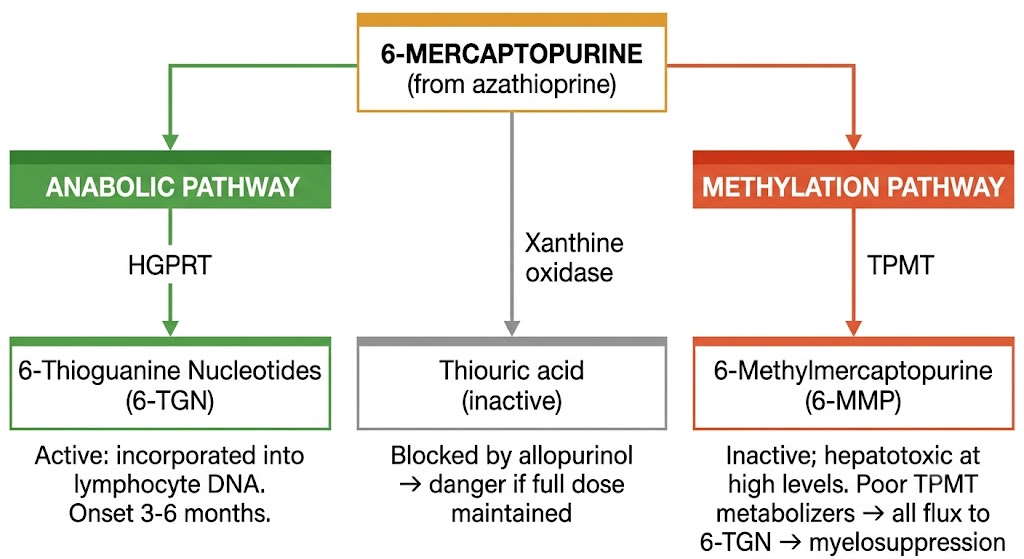
Flow diagram showing the three competing metabolic pathways of 6-mercaptopurine: the anabolic thioguanine nucleotide pathway, the xanthine oxidase catabolic pathway, and the thiopurine methyltransferase methylation pathway
6-mercaptopurine enters three competing pathways. Only the anabolic pathway via HGPRT produces the active 6-thioguanine nucleotides. Thiopurine methyltransferase activity determines how much drug is shunted away from the therapeutic pathway.
Prodrug Cascade and Metabolic Pathways

Azathioprine is non-enzymatically converted to 6-mercaptopurine, making the two drugs functionally equivalent at equivalent doses. 6-mercaptopurine then enters three competing metabolic pathways. The anabolic pathway via hypoxanthine-guanine phosphoribosyltransferase generates 6-thioguanine nucleotides — the active immunosuppressive metabolites incorporated into lymphocyte DNA, terminating proliferation and inducing apoptosis. The catabolic pathway via xanthine oxidase converts 6-mercaptopurine to inactive thiouric acid. A third pathway via thiopurine methyltransferase converts 6-mercaptopurine to 6-methylmercaptopurine, an inactive metabolite associated with hepatotoxicity at high concentrations.

Thiopurine Methyltransferase Pharmacogenomics

Thiopurine methyltransferase activity is genetically polymorphic. Approximately 89 to 94 percent of patients have normal activity; 6 to 11 percent are intermediate metabolizers; and 0.3 percent are poor metabolizers carrying two non-functional alleles. In poor metabolizers, the methyltransferase catabolic pathway is absent, channeling all 6-mercaptopurine through the anabolic hypoxanthine-guanine phosphoribosyltransferase pathway and generating extremely high thioguanine nucleotide concentrations that cause severe, potentially fatal myelosuppression at standard doses. Thiopurine methyltransferase phenotyping or genotyping is mandatory before starting azathioprine or 6-mercaptopurine. Poor metabolizers require approximately 10 percent of standard dosing or should avoid thiopurines. Intermediate metabolizers require dose reduction of 30 to 50 percent.

NUDT15 is a second pharmacogenomic predictor of thiopurine myelotoxicity independent of thiopurine methyltransferase, particularly important in East Asian populations where the NUDT15 R139C variant has an allele frequency of approximately 10 percent versus less than 0.2 percent in Europeans. The Clinical Pharmacogenomics Implementation Consortium guidelines recommend testing for both thiopurine methyltransferase and NUDT15 before initiating thiopurines, with dose adjustment or alternative drug selection based on results.

The Allopurinol Interaction

Allopurinol inhibits xanthine oxidase, the catabolic enzyme that converts 6-mercaptopurine to inactive thiouric acid. Co-administration of allopurinol at full-dose azathioprine or 6-mercaptopurine blocks the catabolic pathway and causes massive accumulation of thioguanine nucleotides, producing potentially fatal myelosuppression. This is one of the most dangerous drug interactions in gastroenterology. If allopurinol must be used in a patient on a thiopurine — for example as a rescue strategy to redirect metabolism toward thioguanine nucleotides in patients with high 6-methylmercaptopurine levels — the azathioprine dose must be immediately reduced to 25 to 33 percent of the original dose. Prescribing allopurinol for gout without checking for thiopurine co-therapy is a potentially lethal error.

Clinical Role and Onset

Thiopurines are steroid-sparing maintenance agents, not induction agents. Therapeutic thioguanine nucleotide accumulation takes 3 to 6 months, meaning thiopurines cannot rapidly control active disease. Corticosteroids or biologics are required for induction while thiopurines are co-initiated for long-term maintenance. Combining azathioprine with an anti-tumor necrosis factor biologic reduces formation of antibodies against the biologic and is more effective than either agent alone in Crohn's disease. White blood cell monitoring every 3 months is standard during maintenance therapy.

Allopurinol + Thiopurine: A Potentially Fatal Interaction

Allopurinol inhibits xanthine oxidase, which normally catabolizes 6-mercaptopurine. Co-prescribing allopurinol at full thiopurine doses causes massive thioguanine nucleotide accumulation and fatal myelosuppression. Always check for thiopurine use before prescribing allopurinol for gout or any other indication. If the combination is intentionally used (as a rescue strategy), immediately reduce azathioprine to 25 to 33 percent of the original dose and intensify blood count monitoring.

Section 4

Methotrexate in Inflammatory Bowel Disease

Folate antagonism and adenosine-mediated anti-inflammatory mechanism, preferred parenteral route and its pharmacokinetic basis, hepatotoxicity monitoring, teratogenicity, and positioning versus thiopurines

Methotrexate is the alternative immunomodulator for steroid-sparing maintenance in Crohn's disease when thiopurines have failed or are contraindicated. It has a clearly established efficacy signal in Crohn's disease but not in ulcerative colitis, and its teratogenicity requires mandatory contraception in all patients of reproductive potential.

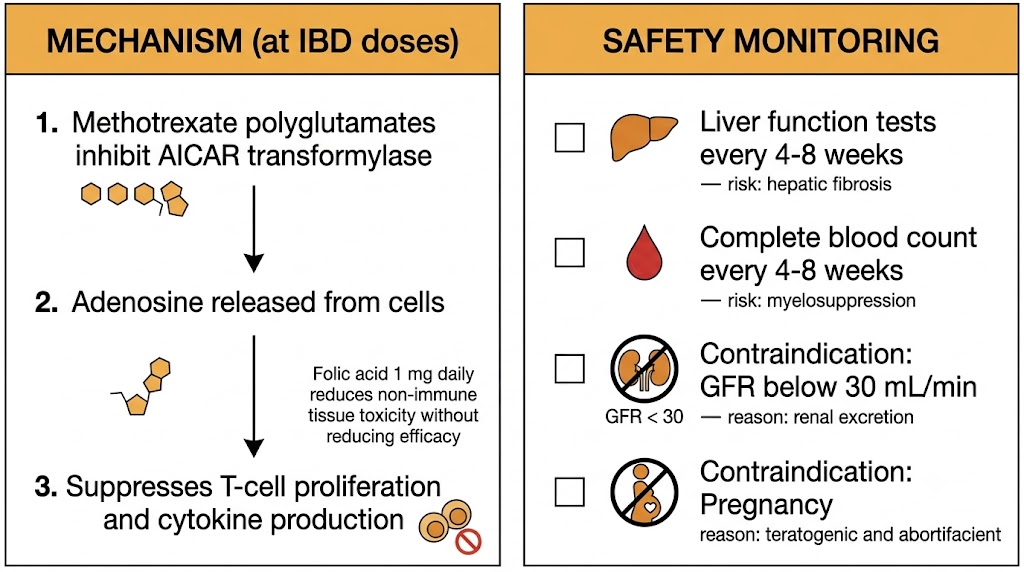
Two-panel summary diagram showing methotrexate mechanism of action and safety monitoring requirements in inflammatory bowel disease
Methotrexate at immunomodulatory doses suppresses inflammation through an adenosine-mediated mechanism. Mandatory monitoring includes liver function tests and complete blood count every 4 to 8 weeks.
Mechanism at Immunomodulatory Doses

Methotrexate inhibits dihydrofolate reductase, blocking tetrahydrofolate synthesis required for purine and thymidylate production. At the low doses used in inflammatory bowel disease — 15 to 25 milligrams once weekly — the dominant anti-inflammatory mechanism is intracellular accumulation of methotrexate polyglutamate forms, which inhibit an enzyme in the purine synthesis pathway and lead to adenosine release from cells. Adenosine then suppresses cytokine production, T-cell proliferation, and neutrophil function through adenosine receptors on immune cells. This adenosine-mediated mechanism explains why methotrexate is effective at doses far below those needed for cytotoxicity.

Route and Folic Acid Supplementation

Intramuscular or subcutaneous injection at 15 to 25 milligrams once weekly is preferred over oral administration because oral bioavailability is highly variable — ranging from 25 to nearly 100 percent — and decreases substantially at doses above 15 milligrams due to saturation of intestinal folate transporters. Parenteral dosing provides reliable, consistent systemic exposure. Folic acid 1 milligram daily (or 5 milligrams once weekly on a non-methotrexate day) is required to reduce mucositis, nausea, alopecia, and cytopenias without reducing anti-inflammatory efficacy, because these adverse effects arise from dihydrofolate reductase inhibition in rapidly dividing non-immune tissues while the anti-inflammatory effect operates through the adenosine mechanism.

Hepatotoxicity and Monitoring

Hepatic fibrosis is the most important chronic adverse effect at inflammatory bowel disease doses. Risk factors include pre-existing liver disease, obesity, type 2 diabetes, alcohol use, and cumulative dose exceeding 1.5 grams. Liver function tests should be checked at baseline and every 4 to 8 weeks during therapy. Persistent transaminase elevation greater than twice the upper limit of normal warrants dose reduction; persistent elevation despite reduction requires discontinuation. Complete blood count monitoring identifies myelosuppression, which is more likely in patients with renal impairment because methotrexate is predominantly renally excreted. Methotrexate is contraindicated when estimated glomerular filtration rate falls below 30 milliliters per minute per 1.73 square meters.

Teratogenicity

Methotrexate is absolutely contraindicated in pregnancy. It is teratogenic and abortifacient — it inhibits trophoblast proliferation and fetal folate metabolism, causing spontaneous abortion, fetal death, and major congenital malformations. Reliable contraception is mandatory during therapy and for at least 3 months after discontinuation in women. Men should also discontinue methotrexate at least 3 months before a partner attempts conception. This contraindication must be communicated and documented at initiation and at every prescription renewal.

Methotrexate in IBD
Key Clinical Points
  • Indicated for steroid-sparing maintenance in Crohn's disease when thiopurines fail
  • Evidence in ulcerative colitis is weak — thiopurines preferred for UC maintenance
  • Parenteral route (intramuscular or subcutaneous) preferred: more reliable absorption
  • Folic acid 1 mg daily required: reduces non-immune tissue adverse effects
  • Monitor liver function tests and complete blood count every 4–8 weeks
  • Contraindicated: glomerular filtration rate below 30 mL/min
Reproductive Safety
Absolute Contraindication in Pregnancy
  • Teratogenic and abortifacient at therapeutic doses
  • Reliable contraception mandatory during therapy
  • Women: stop at least 3 months before planned conception
  • Men: stop at least 3 months before partner attempts conception
  • Counsel and document at initiation and every refill
  • In women of reproductive age with Crohn's disease, consider thiopurine if family planning is a near-term priority

Suggested References
Author / Organization Title Source
Rubin DT et al. ACG clinical guideline: ulcerative colitis in adults Am J Gastroenterol 2019;114(3):384–413
Lichtenstein GR et al. ACG clinical guideline: management of Crohn's disease in adults Am J Gastroenterol 2018;113(4):481–517
Lennard L The clinical pharmacology of 6-mercaptopurine Eur J Clin Pharmacol 1992;43(4):329–339
Yang SK et al. A common missense variant in NUDT15 confers susceptibility to thiopurine-induced leukopenia Nat Genet 2014;46(9):1017–1020
Sparrow MP et al. Allopurinol safely and effectively optimizes tioguanine metabolites in inflammatory bowel disease patients not responding to azathioprine Aliment Pharmacol Ther 2005;22(5):441–446
Feagan BG et al. Methotrexate for the treatment of Crohn's disease N Engl J Med 1995;332(5):292–297
Greenberg GR et al. Oral budesonide for active Crohn's disease N Engl J Med 1994;331(13):836–841
Turner D et al. Response to corticosteroids in severe ulcerative colitis: a systematic review Clin Gastroenterol Hepatol 2007;5(1):103–110