CHAPTER 1 ยท GENERAL PRINCIPLES

Section 1

Drug Targets

The four receptor superfamilies and non-receptor targets through which drugs produce their effects

Pharmacodynamics describes what a drug does to the body. For the vast majority of drugs, the story begins at a molecular target — most commonly a receptor protein whose normal function is to respond to the body’s own chemical signals. Understanding what type of target a drug acts on immediately predicts the speed, mechanism, and reversibility of its effect.

G Protein-Coupled Receptors

G protein-coupled receptors are the largest and most pharmacologically important family of drug targets. They are membrane proteins with seven transmembrane segments that, when activated by a drug or endogenous ligand, couple to intracellular G proteins and initiate a cascade of intracellular signaling. The response takes seconds to minutes and is amplified through second messenger systems. An enormous range of drugs act at G protein-coupled receptors, including beta-blockers, opioids, antihistamines, and many others. Muscarinic receptors in the heart and smooth muscle are a familiar example: their activation by acetylcholine or muscarinic agonists slows the heart rate and contracts smooth muscle through G protein-mediated intracellular signaling.

Ligand-Gated Ion Channels

Ligand-gated ion channels are membrane proteins that open an ion-conducting pore directly upon ligand binding, without any intermediary signaling step. The response is almost instantaneous — measured in milliseconds — making these receptors the primary targets at fast synapses in the nervous system. The nicotinic acetylcholine receptor at the neuromuscular junction is the prototypical example: when acetylcholine binds, the channel opens and sodium ions flow in, depolarizing the muscle membrane and triggering contraction. Drugs that act at ligand-gated ion channels include neuromuscular blocking agents and benzodiazepines, which enhance the effect of gamma-aminobutyric acid at its ion channel receptor in the brain.

Enzyme-Linked Receptors

Enzyme-linked receptors are transmembrane proteins that have enzymatic activity on their intracellular side. The most common type is the receptor tyrosine kinase, which phosphorylates target proteins inside the cell when activated by a growth factor or cytokine binding to its extracellular domain. The response develops over minutes to hours. Insulin receptors are enzyme-linked receptors: insulin binding activates the receptor’s kinase domain, triggering a cascade of phosphorylation events that ultimately promotes glucose uptake into cells. Several cancer drugs target specific receptor tyrosine kinases that are overactive in tumor cells.

Nuclear Receptors

Nuclear receptors are intracellular proteins that act as transcription factors when activated by their ligands. Because they regulate gene expression, the response develops slowly — over hours to days — and persists long after the drug has been eliminated from the body. The ligands for nuclear receptors must be lipophilic enough to cross the cell membrane and reach the receptor in the cytoplasm or nucleus. Glucocorticoids, thyroid hormones, sex steroids, and vitamin D all act through nuclear receptors. This mechanism explains why corticosteroid anti-inflammatory effects take hours to develop and why abrupt discontinuation after prolonged use can cause serious problems: the drug has been suppressing gene expression, and the body needs time to restore normal transcriptional activity.

Non-Receptor Drug Targets

Not all drugs act through receptors. Many important drug classes target enzymes, ion channels directly, or membrane transporters. Angiotensin-converting enzyme inhibitors block the enzyme that converts angiotensin I to angiotensin II, reducing blood pressure. Proton pump inhibitors covalently inactivate the hydrogen-potassium adenosine triphosphatase enzyme in the stomach, blocking acid secretion. Statins inhibit the enzyme that controls cholesterol synthesis. Local anesthetics block voltage-gated sodium channels directly. Antidepressants of the selective serotonin reuptake inhibitor class block the transporter that removes serotonin from the synapse. In each case the drug produces its effect not by activating or blocking a receptor, but by interfering with a specific enzyme, channel, or transporter function.


Section 2

Agonists and Antagonists

How drugs are classified by what they do at the receptor, and how antagonists block agonist effects

A drug’s behavior at a receptor is determined by two independent properties: how strongly it binds, and what it does once it binds. Getting these two concepts straight — and keeping them separate — is the foundation for understanding all receptor pharmacology.

Affinity and Efficacy

Affinity describes how strongly a drug binds to its receptor. A drug with high affinity binds tightly and at low concentrations; a drug with low affinity requires higher concentrations to produce the same degree of receptor occupancy. Affinity alone says nothing about what the drug does once it has bound.

Efficacy describes what happens at the receptor after the drug binds. A drug that binds and activates the receptor has positive efficacy. A drug that binds but produces no activation has zero efficacy. A drug that binds and actively suppresses baseline receptor activity has negative efficacy. Two drugs can have identical affinity for the same receptor and completely different efficacy — one might be a full activator, the other an inert blocker.
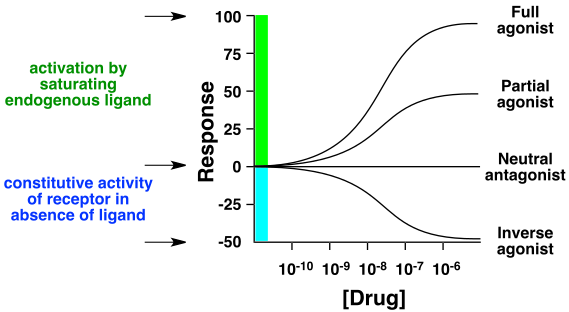
Dose-response curves showing full agonist, partial agonist, neutral antagonist, and inverse agonist
Dose-response curves for a full agonist, partial agonist, neutral antagonist, and inverse agonist. The full agonist reaches maximum response; the partial agonist plateaus below maximum; the neutral antagonist produces no change from baseline; the inverse agonist reduces activity below baseline. Source: Boghog, Wikimedia Commons, CC BY-SA 4.0.
Full Agonists, Partial Agonists, and Inverse Agonists

A full agonist binds to the receptor and produces the maximum possible response. Morphine acting at opioid receptors and epinephrine acting at adrenergic receptors are full agonists at their respective targets.

A partial agonist binds and activates the receptor but produces a submaximal response even when every receptor is occupied. This has a clinically important consequence: in the presence of a full agonist, a partial agonist can actually reduce the response by competing for receptor occupancy while producing less effect per receptor. Buprenorphine is a partial agonist at opioid receptors, which is precisely why it is used in opioid use disorder treatment — it produces a ceiling effect on respiratory depression while still reducing cravings.

An inverse agonist binds to the receptor and actively reduces activity below the receptor’s baseline level. This is only meaningful for receptors that have some constitutive (spontaneous) activity even without an agonist present. Some drugs previously classified as antagonists are now understood to be inverse agonists at their target receptors.

Competitive and Non-Competitive Antagonism

A competitive antagonist binds to the same site on the receptor as the agonist and blocks it. Crucially, this blockade is reversible: if enough agonist is present, it can displace the antagonist and restore the full response. Competitive antagonism shifts the dose-response curve to the right — more agonist is needed to achieve the same effect — but the maximum response is still achievable. Naloxone competitively antagonizes opioid receptors; atropine competitively antagonizes muscarinic receptors. In clinical overdose situations, administering a competitive antagonist can be overcome if the amount of agonist in the body is very large.

A non-competitive antagonist reduces the maximum response regardless of how much agonist is present. This can occur because the antagonist binds irreversibly to the receptor, or because it binds to a separate site that reduces the receptor’s ability to respond. The maximum achievable response is depressed, and adding more agonist cannot overcome this. Phenoxybenzamine, which irreversibly blocks alpha-adrenergic receptors, is a clinical example.

The Clinical Distinction That Matters

Competitive antagonism is surmountable with enough agonist. Non-competitive antagonism is not. This distinction is most clinically relevant in overdose management: naloxone can reverse opioid toxicity because it is a competitive antagonist, but its effect can be overwhelmed by very large opioid doses, requiring repeated dosing or infusion. An irreversible antagonist at the same receptor would produce a fixed ceiling that agonist could not overcome regardless of dose.


Section 3

Dose-Response Relationships and the Therapeutic Index

How drug effect changes with dose, and the ratio that defines the safety margin between therapeutic and toxic effects

The dose-response relationship is the quantitative backbone of pharmacodynamics. It describes how the effect of a drug changes as the dose increases, and it provides the conceptual framework for two of the most practically important pharmacological concepts: potency and efficacy.

Potency versus Efficacy

Potency refers to the dose or concentration of a drug required to produce a given effect. A more potent drug produces its effect at a lower dose than a less potent drug. On a dose-response curve, a more potent drug has its curve shifted to the left — the effect begins at lower concentrations. Potency determines how many milligrams of a drug need to be prescribed, but it says nothing about the maximum effect the drug can produce.

Efficacy refers to the maximum effect a drug can produce, regardless of dose. A drug with high efficacy produces a large maximum response. A drug with low efficacy produces a small maximum response no matter how high the dose is pushed. The distinction matters clinically: a highly potent drug is not necessarily a highly efficacious one. Morphine has higher efficacy as an analgesic than codeine, meaning it can control severe pain that codeine cannot, regardless of what dose of codeine is used. Aspirin has higher potency as an anti-inflammatory than acetaminophen (it works at lower doses), but both have similar ceiling effects for fever reduction.

Potency vs. Efficacy — The Step 1 Distinction

These two terms are commonly confused. Potency = how much drug is needed (lower dose = more potent). Efficacy = how large an effect the drug can produce (higher maximum = more efficacious). A drug can be highly potent but poorly efficacious (produces its small maximum effect at a very low dose) or weakly potent but highly efficacious (requires large doses but eventually produces a large effect). On dose-response curves: potency is read off the horizontal axis (left shift = more potent); efficacy is read off the vertical axis (higher plateau = more efficacious).

The Therapeutic Index

The therapeutic index is the ratio of the dose that produces toxicity to the dose that produces the desired therapeutic effect. A large therapeutic index means there is a wide margin between the dose needed for efficacy and the dose that causes harm — the drug is relatively safe to use across a range of doses. A small (narrow) therapeutic index means that therapeutic and toxic doses are close together, leaving little room for dosing error.

Narrow therapeutic index drugs require careful dosing, patient-specific adjustment, and often therapeutic drug monitoring. Digoxin, warfarin, lithium, phenytoin, and aminoglycoside antibiotics are classic examples. For these drugs, a dose that is just right for one patient may be subtherapeutic for another and toxic for a third, because of individual differences in pharmacokinetics. Recognizing a drug as having a narrow therapeutic index is a signal to monitor closely, adjust carefully, and check drug levels when indicated.


Section 4

Tolerance and Receptor Regulation

How repeated drug exposure changes the body’s response, and the clinical consequences of receptor adaptation

The drug-receptor relationship is not fixed. Repeated or prolonged exposure to a drug can change the number or sensitivity of its target receptors, producing either a diminished response to the same dose over time or an exaggerated response when the drug is stopped. These adaptive processes underlie some of the most clinically important phenomena in pharmacology.

Tachyphylaxis

Tachyphylaxis is a rapid decrease in response to a drug that develops within minutes to hours of repeated administration. It is most commonly seen with drugs that act by releasing a stored mediator: after repeated stimulation, the store is depleted and subsequent doses produce progressively less effect. Indirect-acting sympathomimetic drugs that release norepinephrine from nerve terminals show tachyphylaxis with repeated dosing because the releasable pool of norepinephrine is exhausted. Nitrate tolerance — the reduction in vasodilatory effect seen with continuous nitroglycerin exposure — is a clinically important example that requires nitrate-free intervals to restore responsiveness.

Receptor Down-Regulation

Prolonged exposure to an agonist can cause the cell to reduce the total number of available receptors, a process called down-regulation. With fewer receptors available, the same drug concentration produces a smaller effect — the maximum achievable response is reduced. This is the cellular basis for pharmacological tolerance: the patient requires progressively higher doses to achieve the same effect as the receptors available for activation decrease. Beta-adrenergic receptor down-regulation with chronic beta-agonist use in asthma is a well-recognized example, contributing to reduced bronchodilator response with prolonged therapy.

Receptor Up-Regulation and Withdrawal

The opposite process occurs when a receptor is blocked for a prolonged period. Deprived of normal stimulation, the cell compensates by increasing the number or sensitivity of receptors — a process called up-regulation. If the blocking drug is then abruptly stopped, the now up-regulated receptor system is suddenly exposed to normal levels of its endogenous ligand and responds with an exaggerated effect.

This is the cellular explanation for several clinically dangerous withdrawal syndromes. Patients taking beta-blockers chronically develop up-regulated beta-adrenergic receptors. If the beta-blocker is stopped abruptly, the up-regulated receptors respond to endogenous epinephrine and norepinephrine with exaggerated tachycardia and hypertension, potentially triggering myocardial ischemia. This is why beta-blockers must be tapered rather than stopped suddenly. The same principle applies to clonidine, benzodiazepines, and other drugs that act by suppressing receptor-mediated signaling.

The Clinical Rule: Taper, Do Not Stop

Any drug that acts by chronically blocking a receptor system should be tapered rather than abruptly discontinued. Beta-blockers, alpha-2 agonists such as clonidine, benzodiazepines, corticosteroids, and opioids all have potential withdrawal syndromes rooted in receptor up-regulation or related compensatory adaptations. The risk is proportional to the duration of use and the degree of receptor suppression. Recognizing which drug classes carry this risk — and building taper plans proactively — is a fundamental prescribing competency.


Suggested References
Author / Organization Title Source
Ritter JM, Flower R, Henderson G, Loke YK, MacEwan D, Rang HP Rang & Dale’s Pharmacology, 9th edition Elsevier, 2019
Brunton LL, Hilal-Dandan R, Knollmann BC, eds Goodman & Gilman’s The Pharmacological Basis of Therapeutics, 13th edition McGraw-Hill, 2018
Kenakin T Pharmacology in Drug Discovery and Development: Understanding Drug Response Academic Press, 2017
Limbird LE Cell Surface Receptors: A Short Course on Theory and Methods, 3rd edition Springer, 2004
Waller DG, Sampson AP Medical Pharmacology and Therapeutics, 5th edition Elsevier, 2018
Katzung BG, Trevor AJ, eds Basic and Clinical Pharmacology, 15th edition McGraw-Hill, 2021