CHAPTER 15  ·  LOCAL ANESTHETICS
Section 1

Chemical Classes — Amides and Esters

Two structural classes defined by their chemical linkage, with different metabolic pathways and allergy profiles

All local anesthetics share a common three-part structure: an aromatic ring, an intermediate chain, and an amine group. The nature of the chemical bond linking the aromatic ring to the intermediate chain defines the two major classes — amide local anesthetics and ester local anesthetics. This structural difference determines where and how the drug is metabolized, and which class is responsible for most allergic reactions.

Amide Local Anesthetics

Amide local anesthetics contain an amide linkage — a nitrogen-carbonyl bond (written as -NH-CO-) — between the aromatic ring and the intermediate chain. This linkage is chemically stable and resistant to hydrolysis in the bloodstream. As a result, amide local anesthetics must travel to the liver to be metabolized by hepatic enzymes. Onset is generally intermediate to slow compared to esters, and duration tends to be longer.

The amide class includes most of the agents in common clinical use today: lidocaine, bupivacaine, ropivacaine, mepivacaine, prilocaine, levobupivacaine, and etidocaine. A reliable mnemonic: all amide local anesthetics have the letter "i" appearing before the "-caine" suffix in their generic name — lidocaine, bupivacaine, ropivacaine, mepivacaine, prilocaine, etidocaine.

Ester Local Anesthetics

Ester local anesthetics contain an ester linkage — a carbonyl-oxygen bond (written as -CO-O-) — between the aromatic ring and the intermediate chain. This linkage is readily hydrolyzed in the plasma by pseudocholinesterase (also called plasma cholinesterase or butyrylcholinesterase — an enzyme circulating in the blood that breaks down ester bonds). Because metabolism occurs in the bloodstream rather than requiring hepatic processing, ester hydrolysis is generally rapid, which translates to shorter duration and lower systemic toxicity risk for most esters.

The ester class includes cocaine, procaine, chloroprocaine, tetracaine, and benzocaine. One product of ester hydrolysis is para-aminobenzoic acid, which is responsible for allergic reactions to ester local anesthetics — discussed in Section 2.

Chemical Class
Amide Local Anesthetics
  • Linkage: amide bond (-NH-CO-)
  • Metabolism: hepatic (liver enzymes)
  • Mnemonic: "i" before -caine suffix
  • Examples: lidocaine, bupivacaine, ropivacaine, mepivacaine, prilocaine
  • True allergy: extremely rare
Chemical Class
Ester Local Anesthetics
  • Linkage: ester bond (-CO-O-)
  • Metabolism: plasma pseudocholinesterase
  • Generally shorter duration, rapid hydrolysis
  • Examples: cocaine, procaine, chloroprocaine, tetracaine, benzocaine
  • Allergy: more common (para-aminobenzoic acid metabolite)
Mnemonic — Identifying Amides

Every amide local anesthetic has the letter "i" immediately before the "-caine" suffix: lidocaine, bupivacaine, ropivacaine, mepivacaine, prilocaine, etidocaine, levobupivacaine. If it has an "i" before "-caine," it is an amide. If it does not (cocaine, procaine, tetracaine, benzocaine, chloroprocaine), it is an ester.
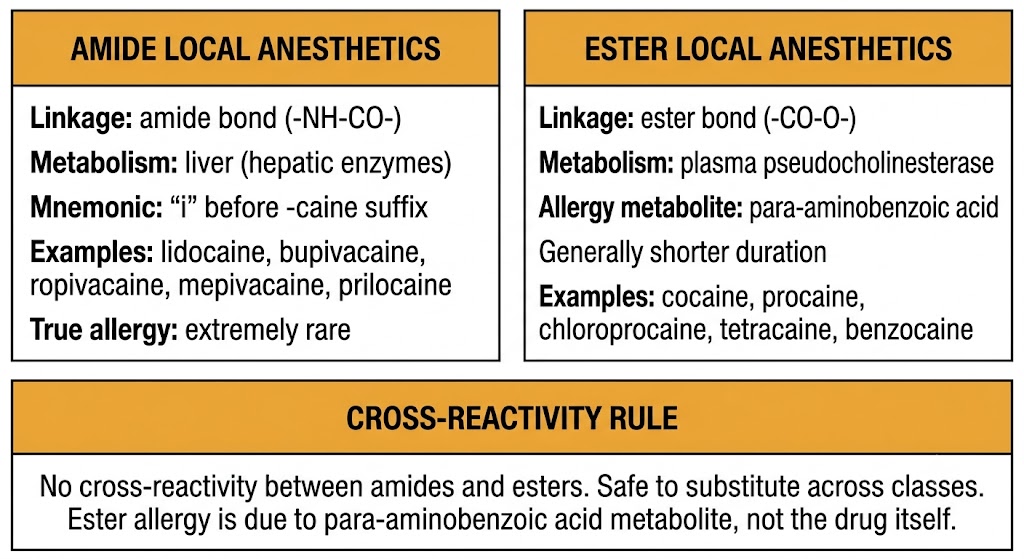
Two-panel diagram comparing amide local anesthetics (amide bond, hepatic metabolism, i-before-caine mnemonic) with ester local anesthetics (ester bond, plasma pseudocholinesterase metabolism, para-aminobenzoic acid allergy metabolite), with a shared Cross-Reactivity Rule box below.
Amide versus ester local anesthetics: structural linkage, metabolism, allergy profile, and cross-reactivity rule. Figure generated by Gemini AI.

Section 2

Allergic Reactions and Cross-Reactivity

Ester allergy is mediated by a metabolite; amide allergy is rare; the two classes do not cross-react

Allergic reactions to local anesthetics are a common concern in clinical practice, but true immunoglobulin E-mediated allergy is far less common than patients and clinicians often assume. Understanding which class is responsible, what drives the allergic response, and whether cross-reactivity between classes occurs has direct implications for safe drug selection.

Ester Allergy — Para-Aminobenzoic Acid

Allergic reactions to ester local anesthetics are more common than reactions to amides. The responsible antigen is not the ester drug itself but rather para-aminobenzoic acid — the product released when ester local anesthetics are hydrolyzed in the plasma. Para-aminobenzoic acid is a well-recognized allergen that can trigger immunoglobulin E-mediated hypersensitivity reactions ranging from urticaria (hives) to anaphylaxis.

Because all ester local anesthetics produce para-aminobenzoic acid on hydrolysis, cross-reactivity within the ester class is possible. A patient who has had an allergic reaction to procaine may react to tetracaine or chloroprocaine as well, since all three yield the same allergenic metabolite.

Amide Allergy — Rare, Often Preservative-Related

True immunoglobulin E-mediated allergy to amide local anesthetics is extremely rare. When a patient reports an adverse reaction after receiving an amide agent, the reaction is more often due to vasovagal syncope, anxiety, a systemic response to inadvertent intravascular injection of epinephrine (a drug sometimes added to local anesthetic solutions), or a reaction to the preservative in the multi-dose vial rather than to the amide itself.

The relevant preservative is methylparaben, which is structurally similar to para-aminobenzoic acid. Multi-dose vials of amide local anesthetics contain methylparaben as an antimicrobial preservative. A patient with ester allergy (and therefore para-aminobenzoic acid sensitivity) may react to methylparaben in a multi-dose amide formulation — not because the amide itself caused allergy, but because of structural similarity between methylparaben and para-aminobenzoic acid. The solution: use preservative-free single-dose vials of the amide agent in any patient with a history of ester allergy.

No Cross-Reactivity Between Classes

Amide and ester local anesthetics do not cross-react with each other. A patient with confirmed ester allergy can safely receive an amide local anesthetic (using a preservative-free formulation). A patient with a documented rare amide allergy can safely receive an ester agent. The two classes are pharmacologically distinct enough that allergy to one does not predict allergy to the other.

Allergy Summary — High-Yield Points

Ester allergy: caused by para-aminobenzoic acid metabolite. Cross-reactivity within ester class possible.

Amide allergy: true allergy extremely rare. Reactions often due to preservative (methylparaben) in multi-dose vials, not the amide itself. Use preservative-free formulations in at-risk patients.

Cross-reactivity between classes: does not occur. Safe to substitute across classes.


Section 3

Pharmacokinetic Determinants

Lipid solubility, protein binding, and pKa govern potency, duration, and onset

Three physicochemical properties predict the clinical behavior of a local anesthetic agent: lipid solubility determines potency and contributes to duration, protein binding determines duration, and the acid dissociation constant (pKa) influences speed of onset. Understanding these relationships allows you to predict why bupivacaine lasts longer than lidocaine, why chloroprocaine acts faster than tetracaine, and why cocaine behaves differently from all other local anesthetics.

Lipid Solubility — Potency and Duration

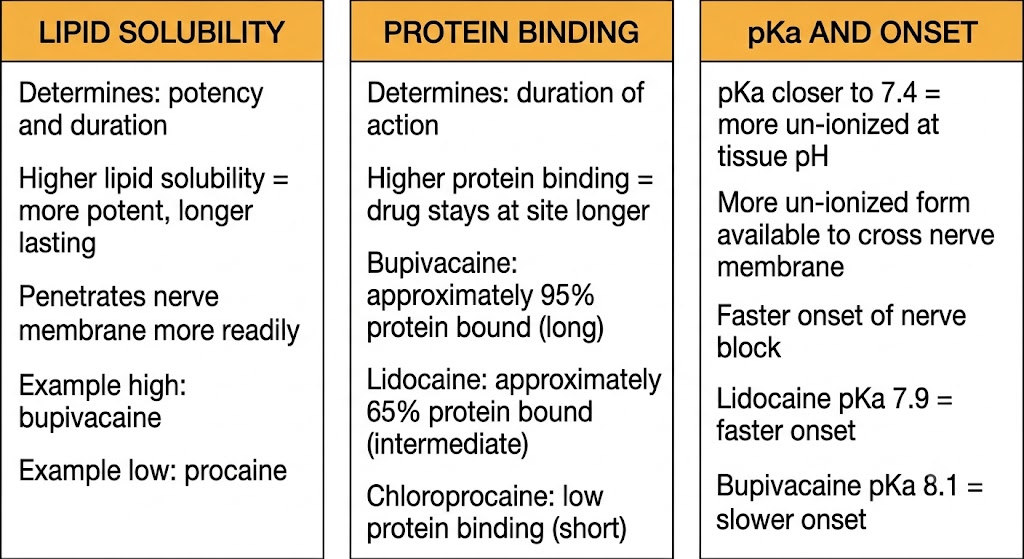
Local anesthetics with higher lipid solubility penetrate nerve membranes more readily and bind membrane proteins with greater affinity. Higher lipid solubility therefore correlates with higher intrinsic potency — less drug is needed to produce the same degree of blockade — and with longer duration of action, because the drug partitions into the lipid-rich myelin and membrane and is released slowly.

Bupivacaine is highly lipid-soluble and correspondingly potent and long-acting. Lidocaine is less lipid-soluble and produces intermediate potency and duration. Procaine is poorly lipid-soluble and is among the least potent and shortest-acting agents.

Protein Binding — Duration

Local anesthetics bind to plasma proteins — primarily alpha-1 acid glycoprotein — and to proteins within the nerve membrane itself. A drug with high protein binding remains at the site of action longer because it dissociates slowly from protein binding sites. This is the primary determinant of duration of action independent of lipid solubility.

Bupivacaine is approximately 95% protein-bound, which contributes to its long duration. Lidocaine is approximately 65% protein-bound, producing an intermediate duration. Chloroprocaine is poorly protein-bound and is hydrolyzed rapidly by plasma pseudocholinesterase — its duration is the shortest of any local anesthetic in clinical use.

pKa — Speed of Onset

The acid dissociation constant (pKa) of a local anesthetic determines how much of the drug exists in the un-ionized (membrane-crossing) form at physiological tissue pH of 7.4. Drugs with a pKa closer to 7.4 have a larger un-ionized fraction at tissue pH, meaning more drug is immediately available to cross the nerve membrane. This produces faster onset.

Lidocaine has a pKa of 7.9 — relatively close to physiological pH — and has a faster onset than bupivacaine, whose pKa of 8.1 means a smaller un-ionized fraction at the same pH. Chloroprocaine has a pKa of 8.7, which would predict slow onset — but in practice it is used in high concentrations, which overcomes the ionization disadvantage and produces rapid clinical onset despite the unfavorable pKa.

Vasodilatory Activity and the Cocaine Exception

Most local anesthetics cause vasodilation at clinical concentrations by relaxing vascular smooth muscle. Vasodilation increases blood flow at the injection site, accelerating systemic absorption of the drug and reducing the duration of local effect. This is why epinephrine (a drug that causes blood vessel constriction by activating alpha-1 receptors) is frequently added to local anesthetic solutions — it counteracts vasodilation, slows absorption, prolongs duration, and reduces peak plasma concentration.

Cocaine is the single exception among local anesthetics. Rather than causing vasodilation, cocaine produces vasoconstriction by blocking the reuptake of norepinephrine (a chemical messenger that stimulates blood vessels to contract) into nerve terminals, increasing norepinephrine concentration at vascular smooth muscle receptors. This intrinsic vasoconstrictive property makes cocaine uniquely useful for procedures involving nasal and pharyngeal mucosa, where simultaneous anesthesia and vasoconstriction reduce bleeding.

Property Higher value predicts Example (high) Example (low)
Lipid solubility Higher potency, longer duration Bupivacaine Procaine
Protein binding Longer duration Bupivacaine (~95%) Chloroprocaine (low)
pKa closer to 7.4 Faster onset Lidocaine (pKa 7.9) Bupivacaine (pKa 8.1)
Three-panel diagram showing lipid solubility determining potency and duration, protein binding determining duration of action with bupivacaine at 95% and lidocaine at 65%, and pKa relationship to onset speed with lidocaine pKa 7.9 faster than bupivacaine pKa 8.1.
Three pharmacokinetic determinants of local anesthetic clinical behavior: lipid solubility governs potency and duration; protein binding governs duration; pKa governs speed of onset. Figure generated by Gemini AI.

Section 4

Individual Agents — High-Yield Properties

Agent-specific facts that appear on course examinations and distinguish one drug from another

While all local anesthetics share the same sodium channel mechanism, several agents have properties that make them distinctly testable. The following profiles focus on the features that distinguish each agent from the class as a whole — the facts that explain clinical choices and examination questions.

Amide Agents
Amide — Most Widely Used
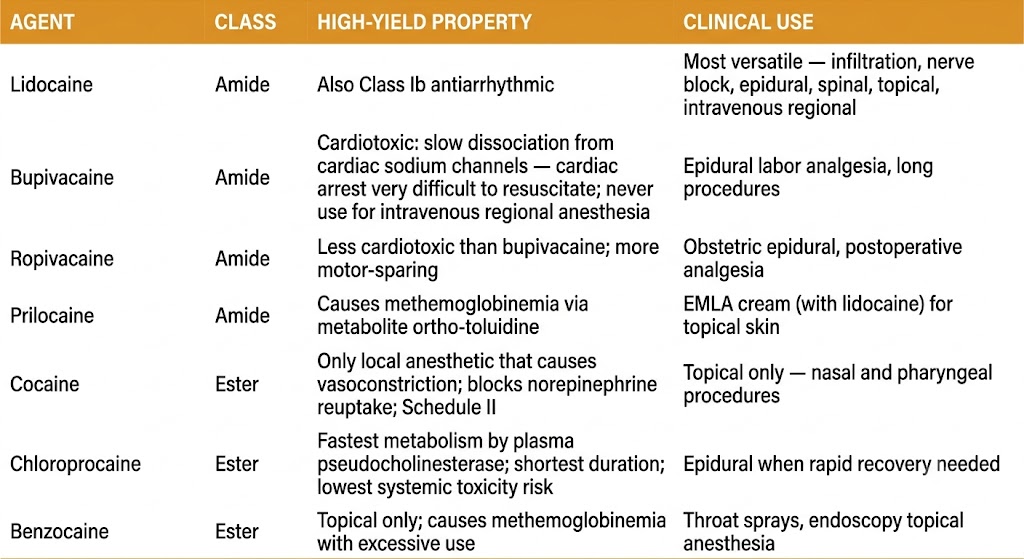
Lidocaine
  • Intermediate duration, intermediate lipid solubility
  • Most versatile local anesthetic — used for infiltration, nerve blocks, epidural, spinal, topical, and intravenous regional anesthesia
  • Also a Class Ib antiarrhythmic — blocks sodium channels in ventricular myocardium; used for ventricular arrhythmias
  • Dual identity (local anesthetic and antiarrhythmic) is high-yield
Amide — Long Duration, Cardiotoxic
Bupivacaine
  • High lipid solubility, ~95% protein-bound — long duration
  • Preferred for epidural labor analgesia and postoperative pain
  • Cardiotoxic: binds cardiac sodium channels tightly, dissociates very slowly ("fast in, slow out") — cardiac arrest from bupivacaine is extremely difficult to resuscitate
  • Never use for intravenous regional anesthesia (Bier block)
Amide — Long Duration, Less Cardiotoxic
Ropivacaine
  • Similar duration to bupivacaine
  • Less cardiotoxic than bupivacaine — preferred in obstetric epidural protocols and wherever long-acting block is needed with lower cardiac risk
  • More motor-sparing at lower concentrations — allows sensory block with preserved motor function
Amide — Methemoglobinemia Risk
Prilocaine
  • Can cause methemoglobinemia (oxidation of hemoglobin iron from ferrous to ferric state) — due to its metabolite ortho-toluidine
  • Used in EMLA cream (eutectic mixture of local anesthetics) combined with lidocaine for topical anesthesia of intact skin
  • Methemoglobinemia risk covered in detail in Module 4
Ester Agents
Ester — Unique Vasoconstrictor
Cocaine
  • Only local anesthetic that causes vasoconstriction
  • Blocks reuptake of norepinephrine and dopamine at nerve terminals
  • Used topically for nasal and pharyngeal procedures — provides simultaneous anesthesia and vasoconstriction to reduce bleeding
  • High abuse potential — Schedule II controlled substance
  • Not used by injection
Ester — Shortest Duration
Chloroprocaine
  • Metabolized extremely rapidly by plasma pseudocholinesterase — very short duration
  • Lowest systemic toxicity risk of any injectable local anesthetic
  • Used for epidural anesthesia when rapid recovery is needed
  • Fast onset despite high pKa due to high concentration used clinically
Ester — Long Duration, Spinal Use
Tetracaine
  • Long duration among ester agents
  • Used for spinal anesthesia and topical anesthesia of the eye
  • High lipid solubility among esters
Ester — Topical Only, Methemoglobinemia
Benzocaine
  • Topical use only — too poorly water-soluble for injection
  • Found in throat lozenges, topical sprays used during endoscopy and intubation
  • Can cause methemoglobinemia — significant risk with excessive use of benzocaine sprays
  • Along with prilocaine, the two agents most associated with drug-induced methemoglobinemia in the local anesthetic class
EMLA Cream — Eutectic Mixture

EMLA cream (eutectic mixture of local anesthetics) combines lidocaine and prilocaine in a 1:1 ratio. A eutectic mixture melts at a lower temperature than either component alone, producing a liquid at room temperature that penetrates intact skin. Applied under an occlusive dressing for 45 to 60 minutes, EMLA provides effective topical anesthesia for venipuncture, lumbar puncture, and minor dermatological procedures. The prilocaine component carries a small methemoglobinemia risk, which is clinically relevant in infants under three months of age.

Reference table listing seven local anesthetic agents with their class, high-yield property, and clinical use: lidocaine as Class Ib antiarrhythmic, bupivacaine cardiotoxicity, ropivacaine motor-sparing, prilocaine methemoglobinemia, cocaine vasoconstriction, chloroprocaine shortest duration, benzocaine topical only with methemoglobinemia risk.
High-yield local anesthetic agent profiles: class, distinguishing pharmacological property, and primary clinical use for seven agents. Figure generated by Gemini AI.

Suggested References
Author / Organization Title Source
Butterworth JF 4th, Strichartz GR Molecular mechanisms of local anesthesia: a review Anesthesiology. 1990;72(4):711–734
Covino BG, Wildsmith JAW Clinical pharmacology of local anesthetic agents. In: Cousins MJ, Bridenbaugh PO, eds. Neural Blockade in Clinical Anesthesia and Management of Pain. 3rd ed. Philadelphia: Lippincott-Raven; 1998:97–128
Lutfallah SC, Brown E, Spillers NJ, et al. Topical cocaine hydrochloride nasal solution: anesthetic and surgical considerations Cureus. 2023;15(8):e42804
Lofstrom JB 1984 Labat Lecture: The effect of local anesthetics on the peripheral vasculature Reg Anesth. 1992;17(1):1–11
Tanaka M, Nishikawa T Chloroprocaine vs lidocaine in epidural anesthesia for elective surgery: a comparative study Acta Anaesthesiol Scand. 1994;38(2):166–170
Ash-Bernal R, Wise R, Wright SM Acquired methemoglobinemia: a retrospective series of 138 cases at 2 teaching hospitals Medicine (Baltimore). 2004;83(5):265–273
Freedman JM, Li DK, Drasner K, et al. Transient neurologic symptoms after spinal anesthesia: an epidemiologic study of 1,863 patients Anesthesiology. 1998;89(3):633–641
Rosenberg PH, Veering BT, Urmey WF Maximum recommended doses of local anesthetics: a multifactorial concept Reg Anesth Pain Med. 2004;29(6):564–575
Camorcia M, Capogna G, Berritta C, Columb MO The relative potencies for motor block after intrathecal ropivacaine, levobupivacaine, and bupivacaine Anesth Analg. 2007;104(4):904–907
Clarkson CW, Hondeghem LM Mechanism for bupivacaine depression of cardiac conduction: fast block of sodium channels during the action potential with slow recovery from block during diastole Anesthesiology. 1985;62(4):396–405
Leone S, Di Cianni S, Casati A, Fanelli G Pharmacology, toxicology, and clinical use of new long acting local anesthetics, ropivacaine and levobupivacaine Acta Biomed. 2008;79(2):92–105
Eisenach JC, De Kock M, Klimscha W Alpha(2)-adrenergic agonists for regional anesthesia: a clinical review of clonidine (1984–1995) Anesthesiology. 1996;85(3):655–674
DiFazio CA, Carron H, Grosslight KR, Moscicki JC, Bolding WR, Johns RA Comparison of pH-adjusted lidocaine solutions for epidural anesthesia Anesth Analg. 1986;65(7):760–764
Pehora C, Pearson AM, Kaushal A, Crawford MW, Johnston B Dexamethasone as an adjuvant to peripheral nerve block Cochrane Database Syst Rev. 2017;11:CD011770