Introduction to Medical Pharmacology
Targeted tyrosine kinase inhibitors in leukemia and lung cancer
ONC2 — Module 1 of 4Section 1
From imatinib to asciminib — how each generation overcomes the last
Chronic myeloid leukemia is driven in more than 95% of cases by the Philadelphia chromosome, a translocation between chromosomes 9 and 22 that fuses the breakpoint cluster region gene with the Abelson tyrosine kinase gene. The resulting fusion protein is constitutively active and drives unregulated proliferation. Targeted inhibitors that block this kinase have transformed chronic myeloid leukemia into a manageable chronic disease for most patients.
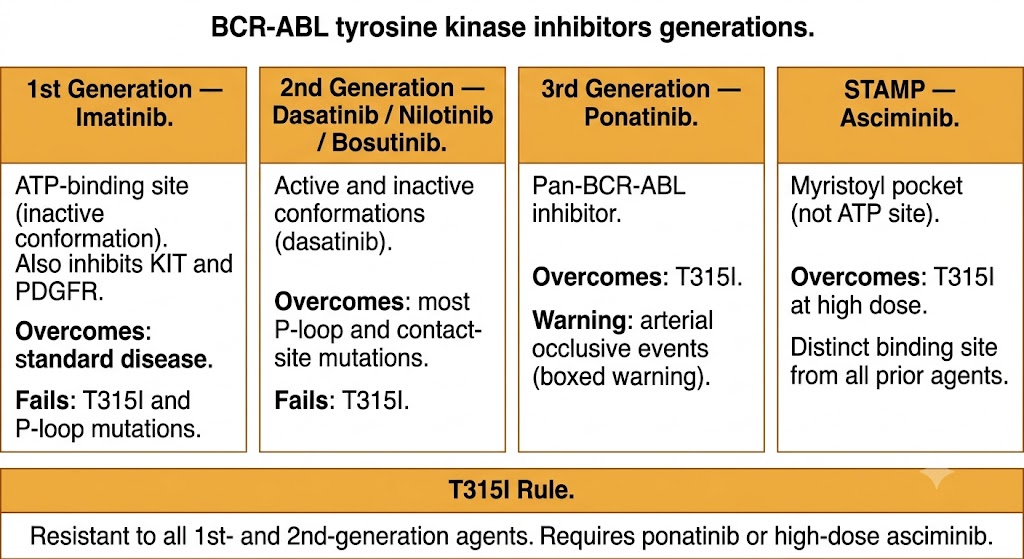
Imatinib was the first BCR-ABL tyrosine kinase inhibitor and remains the prototype of targeted cancer therapy. It binds the adenosine triphosphate-binding site of BCR-ABL in its inactive conformation, blocking phosphorylation of downstream signaling proteins. Imatinib also inhibits the KIT (stem cell factor receptor) kinase, making it effective in gastrointestinal stromal tumors driven by activating KIT mutations.
In chronic myeloid leukemia, response is assessed in three stages: complete hematologic response (normal blood counts), complete cytogenetic response (no Philadelphia chromosome-positive cells on bone marrow cytogenetics), and major molecular response (a 3-log reduction in BCR-ABL transcript levels by reverse transcription polymerase chain reaction). Most patients in chronic-phase disease achieve complete cytogenetic response and major molecular response on imatinib, but approximately one-third eventually develop resistance or intolerance.
The most clinically important resistance mechanism is the T315I point mutation in the BCR-ABL kinase domain, sometimes called the gatekeeper mutation. It eliminates a hydrogen bond critical for imatinib binding and adds steric hindrance, conferring resistance to all first- and second-generation tyrosine kinase inhibitors. Recognizing the T315I mutation is essential because it defines which agents remain active.
Other resistance mutations affect the P-loop (glycine-250 to glutamate, tyrosine-253 to histidine, glutamate-255 to lysine), the contact residues (phenylalanine-317 to leucine), and the activation loop (histidine-396 to arginine). BCR-ABL-independent mechanisms include gene amplification and activation of alternative pathways such as the RAS and SRC kinase cascades.
Dasatinib binds both the active and inactive conformations of BCR-ABL and is approximately 325-fold more potent than imatinib. It also potently inhibits SRC family kinases. Key adverse effects include pleural effusion (requiring dose interruption in severe cases) and pulmonary arterial hypertension with long-term use. Dasatinib is also active against most imatinib-resistant BCR-ABL mutations except T315I.
Nilotinib is highly selective for BCR-ABL in its inactive conformation. Its most important adverse effects are QTc prolongation, which requires baseline electrocardiogram and electrolyte monitoring, and a metabolic profile including hyperglycemia and hyperlipidemia. Peripheral arterial occlusive disease is a recognized long-term risk, especially in patients with pre-existing cardiovascular risk factors.
Bosutinib inhibits BCR-ABL and SRC family kinases and has a predominantly gastrointestinal adverse effect profile — diarrhea occurs in the majority of patients and is the leading cause of dose modification. It is minimally active against KIT and PDGFR (platelet-derived growth factor receptor), giving it a different safety profile from imatinib.
Ponatinib was designed specifically to overcome T315I resistance. It is a pan-BCR-ABL inhibitor active against native BCR-ABL and all known resistance mutations including T315I. Its use is limited by serious cardiovascular toxicity — arterial occlusive events (myocardial infarction, stroke, peripheral arterial disease) occur in a substantial proportion of patients, and it carries a boxed warning for this risk. It is reserved for T315I-positive disease or failure of two prior tyrosine kinase inhibitors.
Asciminib uses a completely different binding mechanism: it targets the myristoyl pocket of BCR-ABL rather than the adenosine triphosphate-binding site, classifying it as a STAMP inhibitor (specifically targeting the ABL myristoyl pocket). This distinct mechanism allows it to overcome resistance mutations that compromise adenosine triphosphate-site inhibitors, including T315I (with the asciminib 200-mg twice-daily dosing). Asciminib has shown superior major molecular response rates compared to bosutinib in patients who have failed two prior tyrosine kinase inhibitors.
Generation Summary
T315I Gatekeeper Mutation
Section 2
Oral bioavailability, CYP3A4 dependence, and clinically important interactions
All BCR-ABL tyrosine kinase inhibitors are orally administered and share reliance on cytochrome P450 3A4 for metabolism, creating a common set of drug interactions that apply across the class with agent-specific variations in magnitude and clinical impact.
Imatinib is well absorbed orally, with bioavailability exceeding 98%. It is metabolized primarily by cytochrome P450 3A4 and is itself an inhibitor of cytochrome P450 3A4, cytochrome P450 2D6, and cytochrome P450 2C9. This inhibitory profile means imatinib can increase plasma levels of drugs metabolized by these enzymes — a clinically relevant interaction with warfarin, which is metabolized by cytochrome P450 2C9 and cytochrome P450 3A4. Concurrent use with strong cytochrome P450 3A4 inducers (rifampin, carbamazepine, phenytoin) reduces imatinib exposure and risks therapeutic failure; concurrent use with strong inhibitors (azole antifungals, clarithromycin) increases exposure and toxicity risk. Imatinib should be taken with food and a large glass of water to reduce gastrointestinal adverse effects. The drug is primarily excreted in feces via biliary elimination.
Dasatinib has variable oral bioavailability that is sensitive to gastric acid; proton pump inhibitors reduce dasatinib absorption substantially and should be avoided. Antacids and histamine-2 blockers may also reduce exposure. Dasatinib is metabolized by cytochrome P450 3A4 and should be dose-adjusted with strong cytochrome P450 3A4 inhibitors or inducers.
Nilotinib requires fasting conditions for dosing — food increases nilotinib absorption significantly, raising the risk of QTc prolongation and other toxicities. It must be taken on an empty stomach (at least two hours after eating, with no food for at least one hour after the dose). Nilotinib is a substrate and inhibitor of cytochrome P450 3A4 and cytochrome P450 2C8. QTc monitoring is required at baseline, and nilotinib is contraindicated with other QTc-prolonging drugs and in patients with hypokalemia or hypomagnesemia.
Ponatinib and asciminib are also cytochrome P450 3A4 substrates; asciminib additionally inhibits cytochrome P450 2C8. All agents in this class require avoidance of concurrent strong cytochrome P450 3A4 inducers and caution with inhibitors.
All BCR-ABL tyrosine kinase inhibitors cause myelosuppression — neutropenia, thrombocytopenia, and anemia — most severely during the first months of therapy. Edema (periorbital, peripheral, and less commonly pleural or pericardial) is common with imatinib and reflects inhibition of platelet-derived growth factor receptor, which is involved in fluid homeostasis across tissue compartments. Nausea, muscle cramps, and elevated liver enzymes occur across the class. Hepatotoxicity requires monitoring of liver function tests throughout treatment.
Agent-Specific Toxicity Alerts
Dasatinib: Pleural effusion (monitor for dyspnea; treat with diuretics or dose interruption); pulmonary arterial hypertension with prolonged use.
Nilotinib: QTc prolongation — ECG required before starting; take on empty stomach; cardiovascular and metabolic toxicity (hyperglycemia, hyperlipidemia, peripheral arterial disease).
Ponatinib: Boxed warning for arterial occlusive events and heart failure; monitor cardiovascular status closely; highest risk in patients with pre-existing cardiovascular disease.
Bosutinib: Diarrhea in the majority of patients; dose interruption and antidiarrheal agents often required.
Section 3
Sensitizing mutations, generation-by-generation response, and acquired T790M resistance
The epidermal growth factor receptor (EGFR) is a transmembrane receptor tyrosine kinase whose activating mutations drive approximately 10 to 15 percent of non-small cell lung adenocarcinomas in Western populations and up to 50 percent in East Asian populations. Identifying the specific mutation guides which generation of EGFR inhibitor to use and predicts the likely resistance mechanism that will emerge.
The two most common sensitizing mutations are exon 19 deletions (removing a portion of the adenosine triphosphate-binding cleft) and the exon 21 L858R point mutation (leucine-to-arginine substitution at codon 858). Together, these classic mutations account for approximately 85 percent of all EGFR-mutant non-small cell lung cancer. Both mutations increase EGFR kinase activity and confer sensitivity to EGFR tyrosine kinase inhibitors. The exon 20 T790M substitution is an acquired resistance mutation rather than a sensitizing mutation and emerges in about 50 to 60 percent of patients who progress on first- or second-generation agents.
Erlotinib and gefitinib are reversible, competitive inhibitors of the EGFR adenosine triphosphate-binding site. Both are orally administered and metabolized by cytochrome P450 3A4. They produce high response rates (approximately 60 to 70 percent) in patients with classic sensitizing mutations. Median progression-free survival is approximately 9 to 13 months before resistance emerges, typically via T790M mutation. Both agents are now primarily used in settings where osimertinib cannot be given or as components of combination strategies.
Afatinib and dacomitinib are irreversible covalent inhibitors that bind not only EGFR but also the related receptor tyrosine kinases HER2 and HER4 (human epidermal growth factor receptor 2 and 4), making them pan-HER inhibitors. Irreversible binding prolongs receptor inhibition, and these agents are active against some uncommon exon 18 and exon 21 mutations that first-generation agents do not cover well. However, they do not overcome the T790M resistance mutation and produce more severe adverse effects — particularly diarrhea, acneiform rash, and mucositis — compared to first-generation agents.
Osimertinib is an irreversible, mutant-selective EGFR inhibitor that preferentially inhibits T790M-bearing EGFR with a much lower affinity for wild-type EGFR. This selectivity accounts for its improved tolerability compared to earlier generations. Osimertinib is now the preferred first-line agent for metastatic EGFR-mutant non-small cell lung cancer, having demonstrated superior progression-free and overall survival compared to erlotinib or gefitinib in the FLAURA trial (a randomized phase 3 study of osimertinib versus erlotinib or gefitinib as first-line therapy). It also has meaningful CNS (central nervous system) penetration, making it the preferred agent when brain metastases are present.
Resistance to osimertinib is heterogeneous. Unlike first- and second-generation resistance (which is dominated by T790M), osimertinib resistance involves diverse mechanisms including C797S mutation (which prevents covalent binding), MET (mesenchymal-epithelial transition factor receptor) amplification, HER2 amplification, and small cell lung cancer transformation. No single agent has yet demonstrated clear benefit in post-osimertinib resistance, making this an area of active investigation.
Section 4
Class-specific adverse effects, food interactions, and monitoring priorities
EGFR inhibitors share a class-based toxicity profile that reflects inhibition of EGFR in normal tissues, particularly skin and gastrointestinal epithelium. The severity varies by generation, with irreversible agents generally producing more prominent adverse effects.
Acneiform (papulopustular) rash is the most common and most visible adverse effect of EGFR inhibitors, occurring in 50 to 80 percent of patients. It appears predominantly on the face, scalp, neck, and trunk in a seborrheic distribution and typically begins within the first two weeks of treatment. A counterintuitive clinical observation is that rash severity correlates with treatment efficacy — patients who develop more severe rash tend to have better tumor response. This rash differs from acne vulgaris and does not respond well to typical acne treatments; tetracycline-class antibiotics (doxycycline or minocycline) are the preferred systemic treatment.
Paronychia (periungual inflammation) and dry skin are also common and can be debilitating with prolonged therapy. Topical emollients and nail care education are part of supportive management.
Diarrhea occurs in the majority of patients and is particularly severe with afatinib and dacomitinib due to their pan-HER inhibitory activity. Diarrhea results from EGFR inhibition in intestinal epithelium and responds to loperamide; dose reduction is required for persistent or severe diarrhea. Elevated liver enzymes are common and require periodic monitoring.
Interstitial lung disease is a rare but potentially fatal complication of EGFR inhibitors, occurring in approximately 1 to 3 percent of patients. It presents as new or worsening dyspnea and ground-glass opacities on chest imaging. EGFR inhibitor therapy must be stopped immediately and high-dose corticosteroids initiated. The incidence is higher in Japanese patients and in patients with pre-existing pulmonary fibrosis.
Erlotinib absorption is significantly enhanced by food — its bioavailability increases nearly threefold with a high-fat meal. It is recommended to take erlotinib at least one hour before or two hours after eating. Gefitinib absorption is not substantially affected by food. Both are metabolized by cytochrome P450 3A4 and cytochrome P450 1A2. Afatinib is a substrate of P-glycoprotein and breast cancer resistance protein transporters, and its absorption is reduced by strong P-glycoprotein inducers.
Osimertinib is well tolerated orally and can be taken with or without food. It is metabolized by cytochrome P450 3A4 and is an inhibitor of breast cancer resistance protein. Its active metabolites contribute to efficacy. Osimertinib has a half-life of approximately 48 hours, supporting once-daily dosing.
EGFR Inhibitor Class Toxicities
Osimertinib Advantages
Section 5
Crizotinib, alectinib, brigatinib, and lorlatinib in ALK-rearranged lung cancer
Rearrangements in the anaplastic lymphoma kinase (ALK) gene occur in approximately 3 to 5 percent of non-small cell lung cancers, predominantly lung adenocarcinomas. The echinoderm microtubule-associated protein-like 4 to ALK fusion (EML4-ALK) is the most common ALK rearrangement and creates a constitutively active fusion kinase that drives proliferation. ROS1 (ROS proto-oncogene 1 receptor tyrosine kinase) rearrangements are less common (1 to 2 percent of non-small cell lung cancer) but respond to the same class of inhibitors due to structural similarity of the kinase domains.
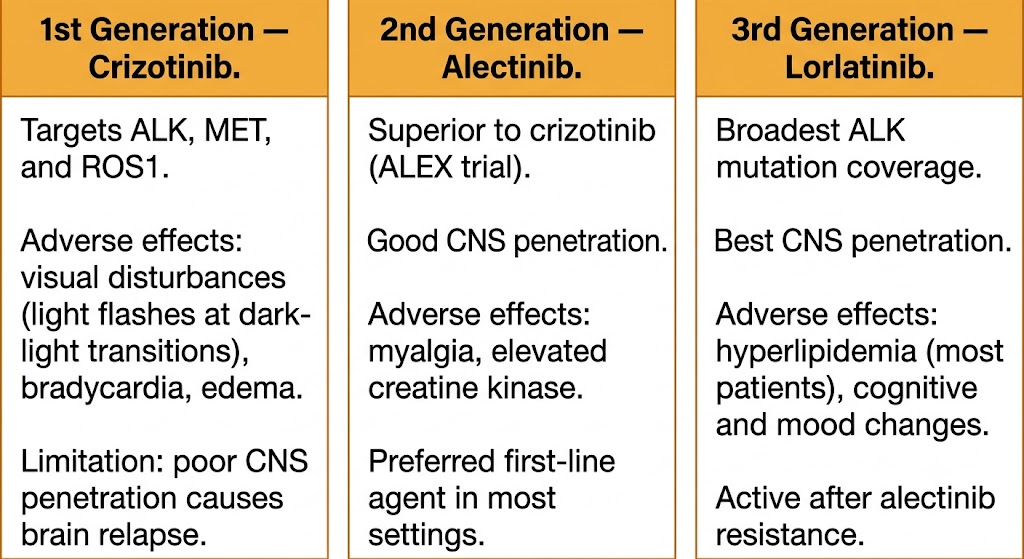
Crizotinib was the first approved ALK inhibitor and was originally developed as a MET (mesenchymal-epithelial transition) inhibitor before its ALK activity was recognized. It is active against ALK, ROS1, and MET receptor tyrosine kinases. Crizotinib produces objective response rates above 60 percent in ALK-rearranged non-small cell lung cancer with median progression-free survival of approximately 10 to 11 months. However, resistance invariably develops, most commonly through secondary mutations in the ALK kinase domain (L1196M, C1156Y, G1269A) and through central nervous system relapse due to poor blood-brain barrier penetration.
Adverse effects of crizotinib include visual disturbances (flashes of light and floaters, particularly at transitions between light and dark, due to unknown mechanism), nausea and vomiting, elevated liver enzymes, and peripheral edema. Bradycardia is a recognized adverse effect requiring heart rate monitoring. Crizotinib is primarily metabolized by cytochrome P450 3A4 and is itself a moderate cytochrome P450 3A4 inhibitor.
Alectinib was designed to overcome crizotinib resistance mutations and has superior central nervous system penetration compared to crizotinib. The ALEX trial (a randomized phase 3 study comparing alectinib to crizotinib) demonstrated that alectinib significantly outperformed crizotinib as first-line therapy in ALK-positive non-small cell lung cancer (median progression-free survival approximately 34 versus 11 months), establishing alectinib as the preferred first-line agent in most settings. Alectinib is generally well tolerated; myalgia, edema, and elevated creatine kinase are the most common adverse effects. It does not share crizotinib's visual adverse effects.
Brigatinib is active against a broader spectrum of ALK resistance mutations than alectinib and also has meaningful central nervous system activity. Its characteristic adverse effect is early-onset pulmonary toxicity — shortness of breath and hypoxia occurring within the first week of treatment in approximately 3 to 9 percent of patients; a reduced starting dose with escalation after a week is recommended. Ceritinib was an early second-generation agent but has largely been supplanted by alectinib and brigatinib due to its gastrointestinal toxicity profile.
Lorlatinib is a macrocyclic tyrosine kinase inhibitor with the broadest coverage of ALK resistance mutations and the best central nervous system penetration of the class. It is active against compound mutations (multiple simultaneous mutations in ALK) that develop after treatment with second-generation agents. The CROWN trial (a randomized phase 3 study comparing lorlatinib to crizotinib) demonstrated that lorlatinib improved progression-free survival compared to crizotinib as first-line therapy, with a particularly striking reduction in central nervous system progression. Adverse effects include hypercholesterolemia and hypertriglyceridemia (in most patients, often requiring statin therapy), central nervous system effects (cognitive impairment, mood changes, speech effects), and edema.
ROS1 Inhibition
ROS1 rearrangements in non-small cell lung cancer respond to crizotinib (approved indication) and entrectinib (also approved; has central nervous system activity). ROS1 and ALK share kinase domain homology, so some ALK inhibitors have anti-ROS1 activity. Lorlatinib also covers ROS1. Testing for ROS1 rearrangement is recommended in all patients with lung adenocarcinoma who lack other actionable driver mutations.
Section 6
Selecting the right kinase inhibitor — mutation testing, sequencing, and resistance management
The clinical use of kinase inhibitors in chronic myeloid leukemia and non-small cell lung cancer requires understanding the obligatory role of molecular testing before treatment selection. No kinase inhibitor should be started without confirmed molecular target identification.
First-line treatment of chronic-phase chronic myeloid leukemia typically uses imatinib, dasatinib, or nilotinib. The choice depends on patient comorbidities: dasatinib is avoided in patients with pleural disease or pulmonary arterial hypertension risk; nilotinib is avoided in patients with QTc prolongation, diabetes, or cardiovascular risk factors. At disease progression or failure to achieve response milestones, BCR-ABL kinase domain mutation testing guides the next choice. The T315I mutation mandates ponatinib or asciminib (at high dose) because all other available agents are inactive against it.
Response assessment follows standardized milestones: complete hematologic response within 3 months, complete cytogenetic response within 6 to 12 months, major molecular response within 12 to 18 months. Failure to achieve these milestones triggers mutation testing and consideration of agent change.
All patients with newly diagnosed lung adenocarcinoma or non-squamous non-small cell lung cancer should have molecular testing for EGFR mutations, ALK rearrangements, ROS1 rearrangements, and other driver alterations before initiating systemic therapy. For patients with classic EGFR sensitizing mutations (exon 19 deletion or L858R), osimertinib is the preferred first-line agent given its superior survival outcomes and central nervous system efficacy demonstrated in the FLAURA trial (a randomized phase 3 study of osimertinib versus erlotinib or gefitinib as first-line therapy). After progression on osimertinib, treatment options are limited because resistance is diverse and there is no single dominant acquired mutation to target.
Alectinib is the preferred first-line agent for ALK-positive non-small cell lung cancer in most patients, based on superior efficacy and tolerability compared to crizotinib in the ALEX trial. Lorlatinib may be preferred in patients with central nervous system metastases requiring aggressive central nervous system control. At resistance, molecular testing helps identify secondary ALK mutations that guide second-line choices. After alectinib resistance, lorlatinib is the most commonly used option given its broad mutation coverage.
Preferred First-Line Agents
Resistance Checkpoints
| Author / Organization | Title | Source |
|---|---|---|
| Rowley JD | A new consistent chromosomal abnormality in chronic myelogenous leukaemia identified by quinacrine fluorescence and Giemsa staining | Nature. 1973;243(5405):290-293 |
| Druker BJ, Talpaz M, Resta DJ, et al. | Efficacy and safety of a specific inhibitor of the BCR-ABL tyrosine kinase in chronic myeloid leukemia | N Engl J Med. 2001;344(14):1031-1037 |
| Hochhaus A, Larson RA, Guilhot F, et al. | Long-term outcomes of imatinib treatment for chronic myeloid leukemia | N Engl J Med. 2017;376(10):917-927 |
| Shah NP, Tran C, Lee FY, et al. | Overriding imatinib resistance with a novel ABL kinase inhibitor | Science. 2004;305(5682):399-401 |
| Cortes JE, Kim DW, Pinilla-Ibarz J, et al. | Ponatinib in refractory Philadelphia chromosome-positive leukemias | N Engl J Med. 2013;369(19):1783-1796 |
| Rea D, Mauro MJ, Boquimpani C, et al. | A phase 3, open-label, randomized study of asciminib, a STAMP inhibitor, vs bosutinib in CML after 2 or more prior TKIs | Blood. 2021;138(21):2031-2041 |
| Peng B, Lloyd P, Schran H | Clinical pharmacokinetics of imatinib | Clin Pharmacokinet. 2005;44(9):879-894 |
| Soria JC, Ohe Y, Vansteenkiste J, et al. | Osimertinib in untreated EGFR-mutated advanced non-small-cell lung cancer | N Engl J Med. 2018;378(2):113-125 |
| Ramalingam SS, Vansteenkiste J, Planchard D, et al. | Overall survival with osimertinib in untreated, EGFR-mutated advanced NSCLC | N Engl J Med. 2020;382(1):41-50 |
| Shaw AT, Kim DW, Nakagawa K, et al. | Crizotinib versus chemotherapy in advanced ALK-positive lung cancer | N Engl J Med. 2013;368(25):2385-2394 |
| Peters S, Camidge DR, Shaw AT, et al. | Alectinib versus crizotinib in untreated ALK-positive non-small-cell lung cancer | N Engl J Med. 2017;377(9):829-838 |
| Kalemkerian GP, Narula N, Kennedy EB, et al. | Molecular testing guideline for the selection of patients with lung cancer for treatment with targeted tyrosine kinase inhibitors | J Clin Oncol. 2018;36(9) |
| Hirsch FR, Varella-Garcia M, Bunn PA Jr, et al. | Epidermal growth factor receptor in non-small-cell lung carcinomas: correlation between gene copy number and protein expression and impact on prognosis | J Clin Oncol. 2003;21(20):3798-3807 |