CHAPTER 34  ·  ANTI-CANCER DRUGS PART 2

Section 1

Checkpoint Inhibitor Biology and Approved Agents

CTLA-4, PD-1, and PD-L1 — physiological roles, sites of action, and therapeutic exploitation

Immune checkpoint inhibitors (ICIs) are monoclonal antibodies that block co-inhibitory receptors on T cells or their ligands on tumor cells and antigen-presenting cells, releasing the brakes on the antitumor immune response. The distinction between CTLA-4 (cytotoxic T-lymphocyte antigen 4) and the PD-1 (programmed death 1)/PD-L1 (programmed death ligand 1) axis is not just mechanistic — it predicts clinical differences in toxicity, efficacy, and combination rationale that govern prescribing decisions across all tumor types.

CTLA-4 Biology and Ipilimumab

CTLA-4 is an inhibitory receptor expressed on activated T cells and constitutively on regulatory T cells (Tregs). During T-cell priming in lymph nodes, CTLA-4 competes with the co-stimulatory receptor CD28 (cluster of differentiation 28) for binding to B7 ligands on antigen-presenting cells (APCs); because CTLA-4 has higher affinity for B7 than CD28, its engagement suppresses the co-stimulatory signal required for full T-cell activation. Ipilimumab is a fully human IgG1 antibody targeting CTLA-4 that blocks this inhibitory interaction, amplifying T-cell priming and depleting intratumoral Tregs via ADCC (antibody-dependent cellular cytotoxicity). Because CTLA-4 acts at the priming phase in lymph nodes, ipilimumab produces broad immune activation affecting many T-cell clones — explaining its higher and more diverse immune-related adverse event rate compared to PD-1/PD-L1 inhibitors. Ipilimumab is approved for metastatic melanoma (as monotherapy and in combination with nivolumab), renal cell carcinoma (RCC), colorectal cancer with dMMR (mismatch repair deficiency), hepatocellular carcinoma (HCC), and non-small cell lung cancer (NSCLC) — all in combination with nivolumab.

PD-1 Biology and PD-1 Inhibitors

PD-1 is an inhibitory receptor expressed on effector T cells after antigen exposure in the tumor microenvironment (TME). PD-L1 (programmed death ligand 1), the primary PD-1 ligand, is expressed on tumor cells, tumor-associated macrophages, and other stromal cells in the TME; its expression is often induced by interferon-gamma (IFN-gamma) released by tumor-infiltrating T cells, creating a feedback loop that dampens the immune response against the tumor. Because PD-1 acts at the effector phase in the tumor rather than the priming phase in lymph nodes, PD-1 blockade is more tumor-localized in its immune activation and produces a narrower immune-related adverse event spectrum than CTLA-4 blockade.

Approved PD-1 inhibitors are nivolumab (IgG4), pembrolizumab (IgG4), and cemiplimab (IgG4). Nivolumab and pembrolizumab have the broadest indications, spanning melanoma, NSCLC, renal cell carcinoma, bladder cancer, head and neck squamous cell carcinoma (HNSCC), Hodgkin lymphoma, dMMR/MSI-H (microsatellite instability-high) solid tumors, gastric, esophageal, hepatocellular, and cervical cancers, among others. PD-L1 inhibitors — atezolizumab, durvalumab, and avelumab — block the PD-L1 ligand rather than the receptor, leaving PD-L2/PD-1 signaling intact; whether this distinction produces clinically meaningful differences in efficacy or toxicity remains debated. Durvalumab is approved for unresectable stage III NSCLC after chemoradiotherapy (PACIFIC trial), where consolidation durvalumab demonstrated landmark improvement in progression-free survival. All checkpoint inhibitors share the large-molecule pharmacokinetics described in Module 3 — no cytochrome P450 metabolism, catabolized to amino acids, long half-lives governed by FcRn recycling — with no hepatic or renal dose adjustments required.

Combination Checkpoint Inhibition

The combination of nivolumab plus ipilimumab (dual checkpoint blockade targeting both PD-1 and CTLA-4) produces superior response rates and survival compared to either agent alone in melanoma (CheckMate 067 trial), renal cell carcinoma (CheckMate 214 trial), NSCLC (CheckMate 227 trial), and hepatocellular carcinoma, at the cost of substantially higher rates of grade 3 and 4 immune-related adverse events. The mechanistic synergy is logical: CTLA-4 blockade amplifies the breadth of primed T-cell clones in lymph nodes, while PD-1 blockade restores effector function to exhausted tumor-infiltrating T cells. The combination is therefore more immunogenic at every step of the cancer-immunity cycle, producing deeper responses but also broader immune-related toxicity.

CTLA-4 vs PD-1/PD-L1 — Key Distinctions

  • CTLA-4: priming phase in lymph nodes → broader irAE spectrum
  • PD-1/PD-L1: effector phase in tumor → narrower irAE spectrum
  • CTLA-4 inhibitor: ipilimumab (IgG1)
  • PD-1 inhibitors: nivolumab, pembrolizumab, cemiplimab (all IgG4)
  • PD-L1 inhibitors: atezolizumab, durvalumab, avelumab

ICI Pharmacokinetics

  • All ICIs: monoclonal antibodies — no CYP metabolism
  • Half-life 14–27 days (FcRn recycling + target-mediated clearance)
  • No hepatic or renal dose adjustments
  • Cross placenta via FcRn — pregnancy risk
  • No CYP-based drug interactions

Section 2

Immune-Related Adverse Event Recognition and Management

Organ-specific steroid principles, infliximab versus mycophenolate, and permanent discontinuation criteria

Immune-related adverse events (irAEs) are the defining toxicity class of checkpoint inhibitors, arising when released T-cell activity damages normal tissues. irAEs can affect virtually any organ system; the most clinically consequential involve the gastrointestinal tract, liver, lungs, endocrine glands, and skin. The governing principle across all organ sites is the same: early recognition and prompt immunosuppression. Delayed treatment substantially increases morbidity and mortality from severe irAEs.

General irAE Management Principles

irAE severity is graded using NCI CTCAE (National Cancer Institute Common Terminology Criteria for Adverse Events) criteria. The general management algorithm follows severity: grade 1 (mild, no functional limitation) — continue ICI with close monitoring; grade 2 (moderate, limiting instrumental activities of daily living) — hold ICI and initiate oral prednisone; grade 3 (severe, limiting self-care) — hold or permanently discontinue ICI and initiate intravenous methylprednisolone; grade 4 (life-threatening) — permanently discontinue ICI, initiate high-dose intravenous methylprednisolone, and escalate to steroid-sparing immunosuppression if no improvement within several days. Steroid tapering must be slow — over at least four to six weeks after symptom resolution — because premature taper reliably causes irAE flares. ICIs must not be rechallenged after grade 4 irAEs, or after grade 3 irAEs involving the heart (myocarditis), nervous system, or eye with vision loss.

Immune-Related Colitis

Diarrhea and colitis are the most common gastrointestinal irAEs, occurring most frequently with CTLA-4 inhibitors and less frequently with PD-1/PD-L1 inhibitors. Evaluation includes stool culture and Clostridium difficile testing to exclude infectious colitis; colonoscopy for severe or refractory cases shows diffuse mucosal edema and ulceration histologically resembling inflammatory bowel disease. Management follows the general grading algorithm, with one critical escalation agent: infliximab (an anti-TNF [tumor necrosis factor] monoclonal antibody) is the preferred steroid-sparing agent for steroid-refractory grade 3 and 4 colitis, with high efficacy and rapid onset that does not appear to impair ICI antitumor activity.

Immune-Related Hepatitis

ICI-associated hepatitis presents as asymptomatic liver enzyme elevation discovered on routine monitoring before each infusion. Liver biopsy shows a pan-lobular hepatitis pattern with cytotoxic CD8-positive T-cell infiltration, distinguishing it from other causes of drug-induced liver injury. One critical distinction from colitis management: infliximab is contraindicated for immune-related hepatitis because it is itself hepatotoxic. Steroid-refractory hepatitis is managed with mycophenolate mofetil (an inhibitor of inosine monophosphate dehydrogenase that blocks lymphocyte proliferation), not infliximab.

Immune-Related Pneumonitis

ICI-associated pneumonitis is more common in patients with NSCLC and with combination nivolumab-ipilimumab than with PD-1 monotherapy. It presents from asymptomatic bilateral ground-glass opacities on CT (computed tomography) imaging to severe dyspnea and respiratory failure. Bronchoscopy with bronchoalveolar lavage is performed to exclude infectious pneumonia before attributing the finding to immune-related pneumonitis. Pneumonitis is the most common cause of ICI-related death; grade 3 or 4 pneumonitis requires permanent ICI discontinuation. When corticosteroid doses exceed 20 mg prednisone per day for more than four weeks, Pneumocystis jirovecii pneumonia (PJP) prophylaxis is recommended.

Immune-Related Endocrinopathies

Endocrine irAEs are unique in an important way: unlike colitis, hepatitis, and pneumonitis, most endocrine irAEs are permanent because the affected gland is destroyed and cannot regenerate. Corticosteroids may be used for the acute inflammatory phase but do not restore endocrine function. The main endocrinopathies are thyroid disorders (hypothyroidism most common, occurring in approximately 8 to 10 percent of patients on PD-1 monotherapy; managed with levothyroxine; ICI continued in most cases), hypophysitis (pituitary inflammation, more common with ipilimumab than PD-1/PD-L1 agents; presents with headache and fatigue; causes central deficiencies in thyroid, adrenal, and gonadal hormone axes; requires lifelong hormone replacement), primary adrenal insufficiency (fatigue, hypotension, hyponatremia, hyperkalemia; treated with lifelong hydrocortisone replacement), and type 1 diabetes mellitus (rare but dramatic; fulminant insulin-dependent diabetes with diabetic ketoacidosis presentation; requires lifelong insulin).

Adrenal crisis from ICI-related adrenal insufficiency is a medical emergency requiring immediate intravenous hydrocortisone before any diagnostic workup. When the presentation is subacute, cortisol and ACTH (adrenocorticotropic hormone) levels should be drawn before starting steroids to preserve diagnostic utility.

Infliximab vs. Mycophenolate — The Critical Distinction

Steroid-refractory colitis: infliximab is the agent of choice. High efficacy, rapid onset, does not impair ICI antitumor activity.

Steroid-refractory hepatitis: infliximab is contraindicated — it is itself hepatotoxic. Use mycophenolate mofetil instead.

Confusing these two agents in the hepatitis setting is a serious prescribing error. The organ determines the steroid-sparing agent.
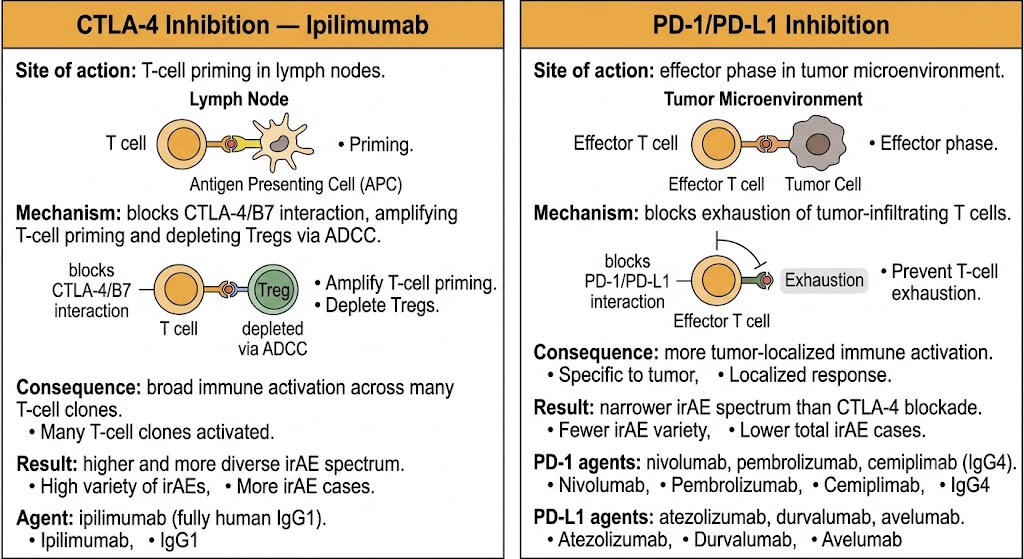
Two-panel comparison of CTLA-4 inhibition by ipilimumab (acting at T-cell priming in lymph nodes, producing broad immune activation and wider irAE spectrum) versus PD-1/PD-L1 inhibition (acting at the effector phase in the tumor microenvironment, producing more localized activation and narrower irAE spectrum).
CTLA-4 versus PD-1/PD-L1 inhibition: sites of action, mechanisms, and irAE spectrum differences. Source: Generated figure. Educational use.

Section 3

Predictive Biomarkers and Primary Resistance

PD-L1 TPS and CPS scoring, tumor mutational burden, MSI-H/dMMR, and mechanisms of resistance

Three companion diagnostic biomarkers are clinically validated for patient selection in checkpoint inhibitor therapy: PD-L1 (programmed death ligand 1) expression, tumor mutational burden (TMB), and mismatch repair deficiency (dMMR)/microsatellite instability-high (MSI-H) status. Each reflects a distinct biological rationale for immune responsiveness.

PD-L1 Expression: TPS and CPS Scoring

PD-L1 is quantified on tumor biopsies by IHC (immunohistochemistry) using validated companion diagnostic assays. The scoring methodology differs by tumor type and agent. TPS (tumor proportion score) counts PD-L1 staining on tumor cells only, expressed as a percentage of total tumor cells; it is used for NSCLC, where pembrolizumab as monotherapy requires a TPS of 50 percent or higher for first-line therapy without chemotherapy. CPS (combined positive score) counts PD-L1-positive tumor cells, lymphocytes, and macrophages relative to total tumor cells; it is used for gastric, esophageal, head and neck, cervical, and urothelial cancers. The specific companion diagnostic assay must match the drug and indication; assays are not interchangeable across agents. PD-L1 expression is an imperfect predictive biomarker: a meaningful proportion of PD-L1-low tumors respond to ICI therapy, and a similar proportion of PD-L1-high tumors are primary refractory, reflecting the fact that PD-L1 is a dynamic, inducible marker influenced by tumor heterogeneity and prior treatment.

Tumor Mutational Burden

TMB (tumor mutational burden) quantifies the total number of somatic mutations per megabase of coding genome, measured by comprehensive genomic sequencing panels. The rationale is that tumors with high mutational burden generate more neoantigens — novel peptides presented to T cells by MHC (major histocompatibility complex) molecules — making them more immunogenic and more susceptible to checkpoint-mediated T-cell killing. The FDA (Food and Drug Administration) has approved pembrolizumab for TMB-high solid tumors regardless of histology (a tumor-agnostic approval), though the predictive value of TMB varies substantially by tumor type. TMB-high and MSI-H overlap substantially in colorectal cancer because mismatch repair deficiency itself produces hypermutation, but in other tumor types they identify largely distinct patient populations.

MSI-H and dMMR: Tumor-Agnostic Biomarkers

The MMR (mismatch repair) system corrects DNA replication errors; deficiency in MMR proteins (MLH1, MSH2, MSH6, or PMS2) allows microsatellite instability (MSI) to accumulate throughout the genome. dMMR can be detected by IHC for loss of MMR protein expression; MSI-H can be detected by PCR (polymerase chain reaction) fragment analysis or next-generation sequencing (NGS). dMMR/MSI-H tumors have markedly elevated mutational burdens, generating abundant neoantigens and robust tumor-infiltrating lymphocyte infiltration that makes them highly responsive to checkpoint inhibition across all tumor types. Pembrolizumab was the first tumor-agnostic ICI approval — approved for any dMMR/MSI-H solid tumor regardless of histology. In Lynch syndrome (germline dMMR), colorectal, endometrial, gastric, and other cancers frequently exhibit MSI-H and are particularly ICI-responsive. Universal MMR testing is now recommended for all solid tumor patients given the tumor-agnostic pembrolizumab approval.

Primary and Acquired Resistance

Despite robust biomarker selection, a substantial proportion of patients with nominally favorable biomarkers exhibit primary resistance to ICI therapy, and most initially responding patients eventually develop acquired resistance. Tumor-intrinsic resistance mechanisms include loss of antigen presentation (loss of MHC class I expression or beta-2 microglobulin mutation), oncogenic pathway activation that suppresses immunogenicity (WNT/beta-catenin signaling, STK11/LKB1 mutations in NSCLC suppressing the STING pathway), and activation of alternative checkpoint pathways (LAG-3 [lymphocyte activation gene 3], TIM-3 [T-cell immunoglobulin and mucin domain 3], TIGIT [T-cell immunoreceptor with Ig and ITIM domains]). Tumor-extrinsic resistance mechanisms include immunosuppressive TME driven by Tregs and myeloid-derived suppressor cells (MDSCs), TGF-beta (transforming growth factor beta) secretion promoting immune exclusion, and metabolic competition through the IDO (indoleamine 2,3-dioxygenase) tryptophan depletion pathway. These resistance mechanisms define the rationale for next-generation combinations pairing ICIs with LAG-3 inhibitors (relatlimab, approved with nivolumab for melanoma), TIGIT inhibitors, and other emerging immunostimulatory agents.


Section 4

Prostate and Breast Cancer Hormonal Therapy

GnRH analogs, AR inhibitors, abiraterone, tamoxifen, aromatase inhibitors, and the CYP2D6 interaction

Hormonal therapy remains the backbone of treatment for hormone receptor-positive prostate and breast cancers, spanning four decades of development from early LHRH analogs to next-generation androgen receptor inhibitors and selective estrogen receptor degraders. Their pharmacology generates drug interactions and toxicity profiles encountered across all clinical specialties.

GnRH Agonists and Antagonists in Prostate Cancer

Medical castration is the foundation of androgen deprivation therapy (ADT) for advanced prostate cancer. GnRH agonists (LHRH [luteinizing hormone-releasing hormone] analogs; leuprolide, goserelin, triptorelin) initially cause a testosterone surge due to receptor stimulation before inducing receptor downregulation and castrate levels after two to four weeks. This initial testosterone flare can exacerbate bone pain, urinary obstruction, or spinal cord compression in patients with bulky metastatic disease and is prevented by concurrent antiandrogen administration (bicalutamide for the first four weeks). GnRH antagonists (degarelix; relugolix, the only oral GnRH antagonist) directly block pituitary GnRH receptors without initial stimulation, achieving rapid castration without testosterone flare — a pharmacologically important advantage in patients with high tumor burden or skeletal disease. ADT class toxicities include hot flashes, osteoporosis, muscle loss, and metabolic syndrome.

Next-Generation AR Inhibitors: Enzalutamide, Apalutamide, Darolutamide

Enzalutamide is an oral, non-steroidal androgen receptor (AR) inhibitor that provides more complete AR pathway suppression than older antiandrogens: it blocks testosterone and dihydrotestosterone (DHT) binding to AR, inhibits AR nuclear translocation, and prevents AR from binding DNA or recruiting co-activators. It is approved across the spectrum of prostate cancer from castration-sensitive to castration-resistant disease.

Enzalutamide is a strong inducer of cytochrome P450 3A4 (CYP3A4), cytochrome P450 2C9 (CYP2C9), and cytochrome P450 2C19 (CYP2C19) at therapeutic doses. This induction substantially reduces plasma concentrations of co-administered drugs metabolized by these enzymes — including warfarin (INR monitoring essential), direct oral anticoagulants, and multiple oncology agents. The full medication list must be reviewed before starting enzalutamide and after any dose change. CNS (central nervous system) toxicities include fatigue, dizziness, and rare but serious seizures attributed to GABA-A (gamma-aminobutyric acid type A) receptor antagonism; enzalutamide is avoided in patients with prior seizure history.

Darolutamide has a structurally distinct AR-binding domain that reduces CNS penetration, does not cause seizures at therapeutic doses, and has a more favorable cytochrome P450 induction profile compared to enzalutamide, making it preferred in patients with seizure history or extensive polypharmacy. Apalutamide has a similar mechanism and induction profile to enzalutamide with additional risks of skin rash and hypothyroidism.

Abiraterone: CYP17A1 Inhibitor and Mandatory Prednisone Co-Administration

Abiraterone acetate is an oral prodrug converted to abiraterone, a potent irreversible inhibitor of CYP17A1 (cytochrome P450 17A1; 17-alpha-hydroxylase/17,20-lyase) — the enzyme responsible for androgen synthesis in the adrenal glands and intratumoral tissues. By blocking CYP17A1, abiraterone suppresses androgen production from all sources, achieving more complete androgen deprivation than castration alone.

A mandatory co-administration requirement defines abiraterone prescribing: prednisone 5 mg twice daily throughout therapy. CYP17A1 inhibition in the adrenal cortex blocks cortisol synthesis, causing compensatory ACTH elevation that drives accumulation of mineralocorticoid precursors upstream of the blocked enzyme. These mineralocorticoids cause hypertension, hypokalemia, and fluid retention. Prednisone suppresses ACTH and replaces cortisol. Abiraterone must be taken on an empty stomach because food increases exposure substantially and unpredictably. Blood pressure and serum potassium monitoring is required.

Tamoxifen and the CYP2D6 Drug Interaction

Tamoxifen is a SERM (selective estrogen receptor modulator) that acts as a competitive antagonist at the estrogen receptor in breast tissue while functioning as a partial agonist in endometrium and bone. It is used as adjuvant therapy for estrogen receptor-positive early breast cancer and in premenopausal metastatic disease. Tamoxifen is a prodrug requiring cytochrome P450 2D6 (CYP2D6)-mediated conversion to its active metabolite endoxifen; patients with CYP2D6 poor metabolizer genotype generate substantially less endoxifen and may derive reduced benefit from tamoxifen.

Strong CYP2D6 inhibitors — most notably paroxetine and fluoxetine, commonly prescribed for hot flashes and depression in breast cancer patients — markedly reduce endoxifen levels by approximately 60 to 70 percent and should be avoided. When hot flash management is required in a tamoxifen-treated patient, venlafaxine (a serotonin-norepinephrine reuptake inhibitor with minimal CYP2D6 inhibition), gabapentin, or clonidine are appropriate alternatives. Tamoxifen additionally increases endometrial cancer risk approximately twofold and venous thromboembolism risk; annual gynecological evaluation is recommended for patients on long-term tamoxifen.

Aromatase Inhibitors, Fulvestrant, and Elacestrant

Aromatase inhibitors (AIs; letrozole, anastrozole, exemestane) suppress extragonadal estrogen synthesis by blocking aromatase (CYP19A1), which converts androgens to estrogens in adipose tissue, adrenal glands, and breast tissue. AIs are effective only in postmenopausal women (or premenopausal women on ovarian suppression) where extragonadal estrogen is the dominant source. Primary toxicities are musculoskeletal symptoms and accelerated bone loss requiring monitoring and bone-protective therapy.

Fulvestrant is a pure ER (estrogen receptor) antagonist and degrader (SERD; selective estrogen receptor degrader) with no agonist activity, administered as a monthly intramuscular injection. Elacestrant is an oral SERD approved for ESR1 (estrogen receptor 1 gene)-mutant metastatic breast cancer — ESR1 mutations are a common mechanism of acquired AI resistance and are detected by liquid biopsy (circulating tumor DNA). The combination of aromatase inhibitors or fulvestrant with CDK4/6 (cyclin-dependent kinase 4 and 6) inhibitors (palbociclib, ribociclib, abemaciclib) is now the standard approach for most patients with estrogen receptor-positive metastatic breast cancer, as covered in Module 2.

Tamoxifen + CYP2D6 Inhibitors — Avoid Paroxetine and Fluoxetine

Tamoxifen requires CYP2D6-mediated conversion to endoxifen for antitumor activity. Paroxetine and fluoxetine are potent CYP2D6 inhibitors that reduce endoxifen levels by approximately 60 to 70 percent — potentially diminishing tamoxifen efficacy. When hot flash management is required, prescribe venlafaxine, gabapentin, or clonidine. This interaction also applies to any strong CYP2D6 inhibitor a patient may be taking for other indications.


Section 5

CAR-T Cell Therapy and Neuroendocrine Tumor Pharmacology

Manufacturing logistics, CRS and ICANS grading, tocilizumab versus dexamethasone, and somatostatin analogs

CAR-T (chimeric antigen receptor T-cell) therapy engineers a patient's own T cells to recognize and kill tumor cells expressing a specific surface antigen, representing a fundamentally different therapeutic modality from small molecules and conventional monoclonal antibodies. Its toxicity profile — cytokine release syndrome and neurotoxicity — requires a distinct pharmacologic management framework.

CAR-T Manufacturing and Approved Products

CAR-T manufacturing involves leukapheresis of the patient's T cells, ex vivo genetic engineering to introduce a chimeric antigen receptor (a fusion protein combining a single-chain variable fragment [scFv] antibody targeting a tumor antigen with intracellular T-cell signaling domains), expansion of the engineered cells in culture, and cryopreservation for shipping back to the treatment center. The manufacturing process takes two to six weeks; bridging therapy may be required. Before CAR-T infusion, patients receive a lymphodepleting conditioning regimen (typically fludarabine plus cyclophosphamide) to deplete competing endogenous lymphocytes and create the cytokine space that supports CAR-T expansion and persistence.

FDA-approved CAR-T products include agents targeting CD19 (cluster of differentiation 19, expressed on B cells and most B-cell malignancies): tisagenlecleucel for B-cell acute lymphoblastic leukemia (ALL) in pediatric and young adult patients and diffuse large B-cell lymphoma (DLBCL); axicabtagene ciloleucel and lisocabtagene maraleucel for DLBCL and other large B-cell lymphomas; and agents targeting BCMA (B-cell maturation antigen): idecabtagene vicleucel and ciltacabtagene autoleucel for relapsed or refractory multiple myeloma. All CAR-T products are administered under REMS (risk evaluation and mitigation strategy) programs at certified treatment centers only, given the risk of life-threatening toxicity.

Cytokine Release Syndrome (CRS)

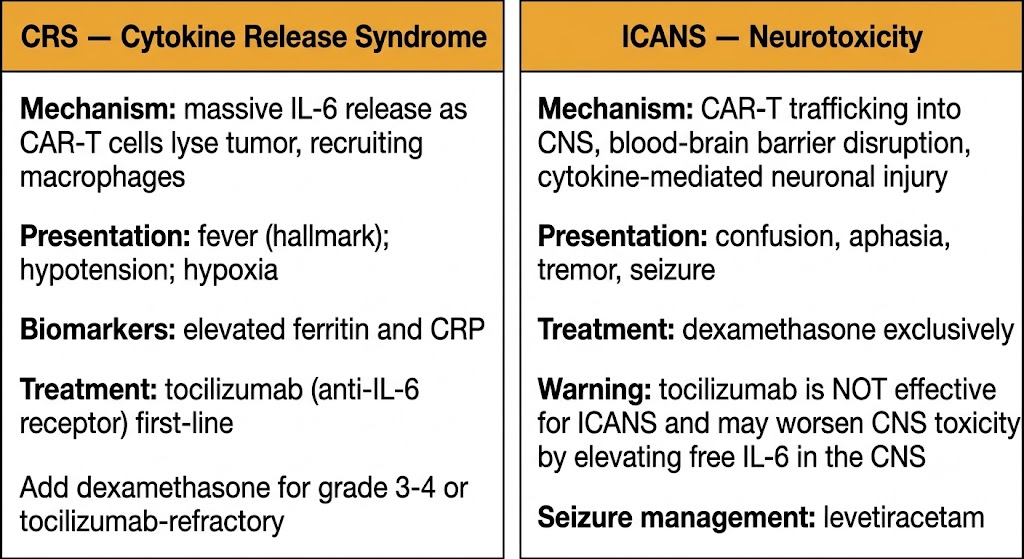
CRS (cytokine release syndrome) is the most common serious toxicity of CAR-T therapy, resulting from massive cytokine release — interleukin-6 (IL-6), interferon-gamma, and others — as CAR-T cells recognize and lyse tumor cells, recruiting macrophages and amplifying the inflammatory cascade. Fever is the hallmark of CRS; hypotension and hypoxia define severity. Biomarkers of severe CRS include markedly elevated ferritin and CRP (C-reactive protein). The key pharmacologic intervention is tocilizumab — an anti-IL-6 receptor monoclonal antibody — which is the first-line treatment for grade 2 and higher CRS. Tocilizumab works rapidly for CRS. Corticosteroids can impair CAR-T cell expansion and are therefore added after tocilizumab when possible, for grade 3 and 4 CRS or when tocilizumab alone is insufficient.

ICANS and the Tocilizumab Distinction

ICANS (immune effector cell-associated neurotoxicity syndrome) is a distinct neurological toxicity of CAR-T therapy, presenting as encephalopathy (confusion, disorientation), aphasia, tremor, and in severe cases cerebral edema, seizures, and coma. It typically overlaps with or follows CRS. The pathophysiology involves CAR-T cell trafficking into the CNS, blood-brain barrier disruption, and cytokine-mediated neuronal injury.

A critical pharmacologic distinction separates CRS from ICANS management: tocilizumab is not effective for ICANS and may actually worsen CNS toxicity by elevating free IL-6 that crosses the blood-brain barrier. Dexamethasone is the primary treatment for ICANS at all grades. Levetiracetam is the preferred anti-epileptic for seizure management in ICANS (phenytoin is avoided due to sedation and drug interactions). When both CRS and ICANS are present simultaneously, treat the more severe condition first and initiate both tocilizumab (for CRS) and dexamethasone (for ICANS).

Neuroendocrine Tumor Pharmacology: Somatostatin Analogs

Neuroendocrine tumors (NETs) of the gastrointestinal tract and pancreas frequently overexpress somatostatin receptors (SSTRs), particularly SSTR2 and SSTR5, which are the targets of somatostatin analog therapy. Octreotide and lanreotide are long-acting somatostatin analogs that suppress hormone secretion from functional NETs (reducing carcinoid syndrome symptoms including flushing, diarrhea, and bronchoconstriction) and provide antiproliferative effects in well-differentiated NETs. Both are administered by injection — octreotide as a monthly deep intramuscular injection, lanreotide as a monthly deep subcutaneous injection. Long-term use causes biliary sludge and gallstones. For SSTR-positive progressive NETs, everolimus (mTOR inhibitor), sunitinib (a VEGFR [VEGF receptor]/PDGFR tyrosine kinase inhibitor), and peptide receptor radionuclide therapy (PRRT) with lutetium-177 dotatate (which targets SSTR-expressing tumor cells with a radiopharmaceutical payload) provide additional antiproliferative options.

Two-panel comparison of CRS (cytokine release syndrome — fever, hypotension, hypoxia; treated with tocilizumab first-line) versus ICANS (neurotoxicity — confusion, aphasia, seizure; treated with dexamethasone exclusively; tocilizumab contraindicated for ICANS).
CAR-T cell toxicity: CRS versus ICANS — mechanisms, presentations, and the critical treatment distinction between tocilizumab and dexamethasone. Source: Generated figure. Educational use.

CRS vs. ICANS — Tocilizumab Treats CRS; Dexamethasone Treats ICANS

CRS: fever + hypotension/hypoxia after CAR-T → tocilizumab first; add dexamethasone for severe CRS or if tocilizumab insufficient. IL-6 (interleukin-6) drives CRS — blocking the IL-6 receptor works.

ICANS: confusion + aphasia + seizure after CAR-T → dexamethasone exclusively. Tocilizumab is ineffective for ICANS and may worsen it. IL-6 blockade elevates free IL-6 crossing the blood-brain barrier.

When both co-occur, use both agents simultaneously — one for each syndrome.


Section 6

Clinical Integration

irAE triage, endocrine emergencies, hormonal therapy drug interactions, and CAR-T toxicity recognition

This final section consolidates the highest-yield clinical decision points from Module 4, integrating checkpoint inhibitor toxicity management, hormonal therapy pharmacology, and CAR-T complication recognition across the full chapter.

irAE Recognition and Management Errors to Avoid

The most common irAE management errors are insufficient steroid dosing and premature taper. Both cause irAE relapse. Steroids must be tapered slowly over at least four to six weeks after symptom resolution, not stopped when symptoms improve. The second critical error is agent selection for steroid-refractory organ toxicity: infliximab for colitis, mycophenolate for hepatitis — never reversed. Giving infliximab for immune hepatitis risks additional hepatotoxicity on top of an already inflamed liver.

Endocrine irAE Distinctions

All endocrine irAEs require lifelong hormone replacement even after ICI discontinuation because gland damage is permanent. Adrenal crisis from ICI-related hypophysitis or primary adrenal insufficiency is a medical emergency: intravenous hydrocortisone must be given immediately when suspected, without waiting for laboratory confirmation. ICI-induced thyroiditis presents as a transient hyperthyroid phase (released thyroid hormone from destroyed colloid) followed by hypothyroidism; the hyperthyroid phase is managed with beta-blockers alone and typically resolves within four to eight weeks. ICI-induced type 1 diabetes presents with fulminant diabetic ketoacidosis (DKA) and requires immediate insulin therapy; it is not treated with corticosteroids.

Hormonal Therapy Interaction Priorities

Four hormonal therapy drug interactions are highest-yield. First, enzalutamide is a strong cytochrome P450 3A4 inducer — it dramatically reduces plasma levels of warfarin, direct oral anticoagulants, docetaxel, and most other oncology agents metabolized by this enzyme; the full medication list requires review before starting and after any dose change. Second, tamoxifen and CYP2D6 inhibitors — paroxetine and fluoxetine reduce endoxifen levels substantially; substitute venlafaxine or gabapentin for hot flash management. Third, abiraterone requires concurrent prednisone to suppress ACTH-driven mineralocorticoid accumulation and must be taken on an empty stomach to avoid large unpredictable increases in exposure. Fourth, GnRH agonist initiation in patients with high-burden skeletal metastases requires antiandrogen co-prescription (bicalutamide for four weeks) to prevent the testosterone flare from precipitating spinal cord compression or urinary obstruction.

ICI Special Populations and Contraindications

Active autoimmune disease requiring systemic immunosuppression is a relative contraindication to ICI therapy; patients can receive ICI with careful monitoring but require proactive irAE management. Solid organ transplant recipients face a high risk of allograft rejection from PD-1/PD-L1 blockade. Patients on chronic corticosteroids at prednisone-equivalent doses above 10 mg per day have attenuated ICI response in retrospective data; steroid tapering before ICI initiation is recommended when feasible. Live vaccines must not be administered during ICI therapy; inactivated vaccines are safe but immunogenicity may be reduced.

High-Stakes Clinical Rules

  • irAE steroid taper: slow (≥ 4–6 weeks) — premature taper causes relapse
  • Colitis steroid-refractory: infliximab
  • Hepatitis steroid-refractory: mycophenolate (NOT infliximab)
  • Adrenal crisis: IV hydrocortisone immediately — do not wait for labs
  • All endocrine irAEs: lifelong hormone replacement
  • CRS: tocilizumab first
  • ICANS: dexamethasone only — tocilizumab contraindicated

Hormonal Therapy Drug Interactions

  • Enzalutamide: strong CYP3A4 inducer — review all co-medications
  • Tamoxifen + paroxetine or fluoxetine: reduces endoxifen — use venlafaxine instead
  • Abiraterone: prednisone co-administration mandatory; empty stomach required
  • GnRH agonist + bulky metastases: antiandrogen first to prevent testosterone flare

Suggested References
Author / Organization Title Source
Larkin J, Chiarion-Sileni V, Gonzalez R, et al. Five-year survival with combined nivolumab and ipilimumab in advanced melanoma N Engl J Med. 2019;381(16):1535-1546
Herbst RS, Baas P, Kim DW, et al. Pembrolizumab versus docetaxel for previously treated, PD-L1-positive, advanced non-small-cell lung cancer (KEYNOTE-010) Lancet. 2016;387(10027):1540-1550
Haanen J, Obeid M, Spain L, et al. Management of toxicities from immunotherapy: ESMO clinical practice guideline Ann Oncol. 2022;33(12):1217-1238
Delivanis DA, Gustafson MP, Bornschlegl S, et al. Pembrolizumab-induced thyroiditis: comprehensive clinical review J Clin Endocrinol Metab. 2017;102(8):2770-2780
Marabelle A, Fakih M, Lopez J, et al. Association of tumour mutational burden with outcomes in patients with advanced solid tumours treated with pembrolizumab (KEYNOTE-158) Lancet Oncol. 2020;21(10):1353-1365
Le DT, Durham JN, Smith KN, et al. Mismatch repair deficiency predicts response of solid tumors to PD-1 blockade Science. 2017;357(6349):409-413
Davis ID, Martin AJ, Stockler MR, et al. Enzalutamide with standard first-line therapy in metastatic prostate cancer N Engl J Med. 2019;381(2):121-131
Davies C, Pan H, Godwin J, et al. Long-term effects of continuing adjuvant tamoxifen to 10 years versus stopping at 5 years (ATLAS) Lancet. 2013;381(9869):805-816
Maude SL, Laetsch TW, Buechner J, et al. Tisagenlecleucel in children and young adults with B-cell lymphoblastic leukemia N Engl J Med. 2018;378(5):439-448
Strosberg J, El-Haddad G, Wolin E, et al. Phase 3 trial of 177Lu-dotatate for midgut neuroendocrine tumors N Engl J Med. 2017;376(2):125-135
Antonia SJ, Villegas A, Daniel D, et al. Overall survival with durvalumab after chemoradiotherapy in stage III NSCLC N Engl J Med. 2018;379(24):2342-2350
Neelapu SS, Locke FL, Bartlett NL, et al. Axicabtagene ciloleucel CAR T-cell therapy in refractory large B-cell lymphoma N Engl J Med. 2017;377(26):2531-2544
Reck M, Rodriguez-Abreu D, Robinson AG, et al. Pembrolizumab versus chemotherapy for PD-L1-positive non-small-cell lung cancer N Engl J Med. 2016;375(19):1823-1833