A dual-mechanism drug with a unique role in treating both early Parkinson's disease and levodopa-induced dyskinesias
Amantadine occupies a distinctive position in Parkinson's disease pharmacotherapy. Originally developed as an antiviral agent, it was discovered serendipitously to improve Parkinson's disease symptoms. It acts through two separate mechanisms — making it the only drug that can address both dopamine deficiency and the glutamate-driven dyskinesias that complicate long-term levodopa therapy.
Amantadine blocks N-methyl-D-aspartate receptors — glutamate-gated ion channels in the striatum and elsewhere in the brain. In the context of Parkinson's disease, this is relevant for two reasons. First, N-methyl-D-aspartate receptor overactivity in the basal ganglia contributes to the abnormal motor patterns that produce dyskinesias; blocking these receptors dampens this hyperexcitability. Second, N-methyl-D-aspartate antagonism has a modest antiparkinsonian effect in its own right by modulating basal ganglia circuit activity.
Amantadine also enhances dopamine release from surviving presynaptic terminals and may inhibit dopamine reuptake. This dopaminergic effect is modest but contributes to symptomatic improvement in early disease when enough dopaminergic neurons remain to respond.
In early, mild Parkinson's disease, amantadine provides modest symptomatic benefit through its dopaminergic mechanism. It is not as effective as levodopa or dopamine agonists and is generally not used as primary therapy in patients with significant functional impairment.
Its most clinically distinctive use is for levodopa-induced dyskinesias. Amantadine is the only drug with established efficacy for reducing peak-dose dyskinesias without worsening motor control. This application — treating a complication of levodopa therapy rather than Parkinson's disease itself — reflects its N-methyl-D-aspartate antagonist mechanism rather than its dopaminergic effect.
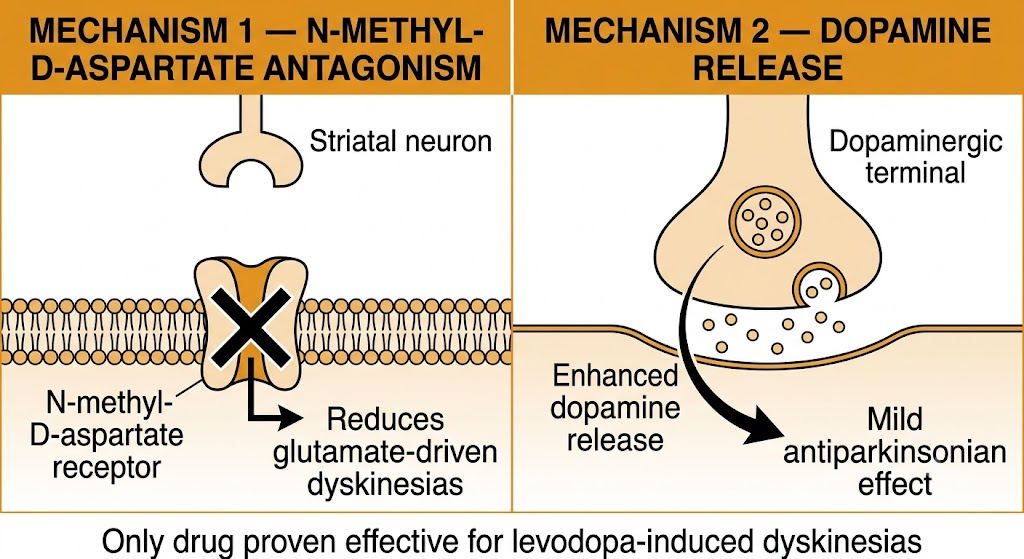
Amantadine is the only drug with established efficacy specifically for levodopa-induced dyskinesias. This is mediated by N-methyl-D-aspartate receptor antagonism in the striatum, which reduces the glutamatergic hyperexcitability that drives involuntary movements. No other antiparkinson drug has this property, which makes amantadine irreplaceable in the management of advanced Parkinson's disease motor complications.
A distinctive adverse effect profile that includes livedo reticularis, edema, and dose-dependent neuropsychiatric effects
Amantadine is generally well tolerated at standard doses, but it has a set of adverse effects that are distinctive enough to be high-yield for Step 1. Several of these are visually striking or clinically memorable and should be associated specifically with amantadine rather than with the dopaminergic class as a whole.
Livedo reticularis is a mottled, net-like purplish discoloration of the skin, most prominent on the legs. It is caused by amantadine-induced changes in cutaneous blood flow and appears in a substantial proportion of patients on long-term therapy. It is benign and reversible upon discontinuation. Livedo reticularis is the most distinctive and Step 1-testable adverse effect of amantadine — it is not associated with levodopa, dopamine agonists, or any other antiparkinson drug class.
Ankle edema commonly accompanies livedo reticularis and reflects the same peripheral vascular mechanism. Both effects are more prominent in women. Neuropsychiatric effects — including confusion, hallucinations, and agitation — occur particularly in elderly patients and at higher doses. Amantadine requires dose reduction in patients with renal impairment because it is excreted unchanged by the kidneys; accumulation in renal failure significantly increases the risk of neuropsychiatric toxicity.
Reducing striatal acetylcholine activity to restore the dopamine-acetylcholine balance — with narrow clinical indications
Anticholinergic drugs were the mainstay of Parkinson's disease treatment before levodopa became available. They act by blocking muscarinic acetylcholine receptors in the striatum, reducing the relative cholinergic excess that results from dopamine deficiency and partially restoring the dopamine-acetylcholine balance. Their use is now limited by a narrow therapeutic profile and a problematic adverse effect burden, particularly in elderly patients.
As covered in Module 1, Parkinson's disease creates a relative excess of striatal acetylcholine activity because dopamine — which normally counterbalances acetylcholine interneuron activity — is depleted. Anticholinergic drugs block muscarinic receptors in the striatum, reducing this cholinergic excess and moving the neurotransmitter balance back toward normal. The effect is complementary to dopaminergic therapies: both strategies correct the same imbalance but from opposite directions.
Benztropine and trihexyphenidyl are the two anticholinergic agents used in Parkinson's disease. Both are centrally acting muscarinic antagonists. Benztropine has a longer duration of action and is available in injectable form, which is useful for acute situations such as drug-induced acute dystonia — a use that extends beyond Parkinson's disease management. Trihexyphenidyl is an oral agent used for chronic Parkinson's disease management.
Anticholinergic agents are most effective for tremor and, to a lesser extent, rigidity. They have little effect on bradykinesia — the most disabling feature of Parkinson's disease — which is driven primarily by dopamine deficiency rather than cholinergic excess. The practical result is that anticholinergic drugs are useful mainly in younger patients with tremor-predominant disease who cannot tolerate or do not yet require levodopa, and in patients whose tremor remains inadequately controlled despite optimal dopaminergic therapy.
Why anticholinergic drugs are limited to younger patients — and why they are contraindicated in the elderly
The adverse effect profile of anticholinergic drugs follows directly from blockade of muscarinic receptors throughout the body — not just in the striatum. The resulting peripheral and central effects are collectively significant enough to make these drugs inappropriate for most elderly patients and for anyone with several common comorbidities.
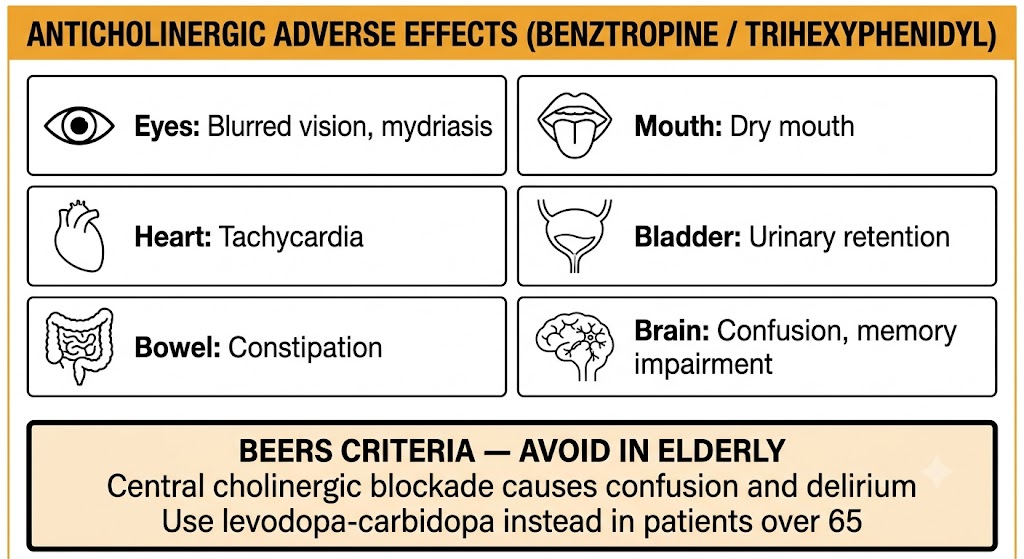
Blockade of peripheral muscarinic receptors produces the full spectrum of anticholinergic adverse effects: dry mouth, blurred vision, urinary retention, constipation, and tachycardia. These effects are dose-dependent and occur with both benztropine and trihexyphenidyl. Urinary retention is particularly problematic in men with benign prostatic hyperplasia. Constipation is an especially important consideration in Parkinson's disease patients, who already commonly suffer from gastrointestinal dysmotility as part of the disease itself.
Muscarinic receptor blockade in the brain impairs memory, attention, and cognitive processing. In younger patients with intact cognitive reserve, these effects are usually manageable. In elderly patients — particularly those with any degree of preexisting cognitive impairment — anticholinergic drugs can precipitate confusion, delirium, and accelerated cognitive decline. This is why anticholinergic agents for Parkinson's disease are listed on the Beers Criteria — the authoritative list of potentially inappropriate medications in older adults — and are generally contraindicated in patients over 65 to 70 years of age.
Narrow-angle glaucoma is a contraindication because anticholinergic-induced mydriasis can precipitate acute angle-closure glaucoma. Benign prostatic hyperplasia is a relative contraindication due to urinary retention risk. Tachyarrhythmias may be worsened by the chronotropic effect of muscarinic blockade on the heart.
Anticholinergic drugs for Parkinson's disease are listed on the Beers Criteria as potentially inappropriate medications in adults over 65. The primary concern is cognitive impairment — muscarinic blockade in the brain impairs memory and can precipitate delirium in vulnerable patients. In elderly patients who need antiparkinson therapy, levodopa-carbidopa is far safer. Reserve anticholinergic agents for younger patients with tremor-predominant disease who have not responded adequately to other approaches.
| Author / Organization | Title | Source |
|---|---|---|
| Katzung BG, Trevor AJ | Basic and Clinical Pharmacology, 15th edition | McGraw-Hill, 2021 |
| Brunton LL, Knollmann BC | Goodman and Gilman's The Pharmacological Basis of Therapeutics, 13th edition | McGraw-Hill, 2018 |
| Le T, Bhushan V | First Aid for the USMLE Step 1 | McGraw-Hill, current edition |
| Connolly BS, Lang AE | Pharmacological treatment of Parkinson disease: a review | JAMA, 2014 |
| American Geriatrics Society | American Geriatrics Society 2023 updated Beers Criteria for potentially inappropriate medication use in older adults | Journal of the American Geriatrics Society, 2023 |