Cystic fibrosis is caused by mutations in the gene encoding the cystic fibrosis transmembrane conductance regulator, a cyclic AMP-activated chloride and bicarbonate channel on airway and other epithelial surfaces. Modulator therapies do not repair the underlying genetic mutation — they rescue the defective protein at the folding, trafficking, or gating level, restoring partial or near-normal function in patients who carry at least one amenable mutation.
The cystic fibrosis transmembrane conductance regulator is composed of two membrane-spanning domains that form the channel pore, two nucleotide-binding domains that bind and hydrolyze adenosine triphosphate to gate the channel open and closed, and a regulatory domain whose phosphorylation by protein kinase A is required for channel activation. In normal airway epithelium, apical cystic fibrosis transmembrane conductance regulator activity drives chloride and water secretion into the airway lumen, maintaining the periciliary liquid layer that enables mucociliary clearance. Loss of cystic fibrosis transmembrane conductance regulator function produces dehydrated, viscous airway secretions that impair ciliary clearance, leading to chronic bacterial colonization, bronchiectasis, and progressive obstructive lung disease that accounts for over 80% of cystic fibrosis-related mortality.
Cystic fibrosis mutations are grouped into six classes based on the molecular mechanism of dysfunction, a taxonomy that directly predicts modulator eligibility. Class I mutations produce premature stop codons resulting in absent or severely truncated protein — the most difficult class to address pharmacologically. Class II mutations, the most common, cause protein misfolding; the mutant protein is recognized by endoplasmic reticulum quality control machinery and degraded before reaching the cell surface. The most prevalent Class II mutation, phenylalanine-508 deletion (F508del), is present on at least one allele in approximately 85 to 90 percent of patients with cystic fibrosis. Class III mutations produce a protein that reaches the membrane but cannot gate (open and close) normally. Class IV mutations affect ion conductance through the open channel. Class V mutations reduce the amount of normal protein produced. Class VI mutations reduce protein stability at the cell surface.
The pharmacological distinction between the two main modulator types maps directly onto this taxonomy. Correctors address the Class II problem: they assist protein folding and trafficking, enabling misfolded cystic fibrosis transmembrane conductance regulator to escape endoplasmic reticulum degradation and reach the cell surface. Potentiators address the Class III problem: they bind cystic fibrosis transmembrane conductance regulator at the cell surface and increase the probability of channel opening (gating), enhancing function of protein that has already reached the membrane.
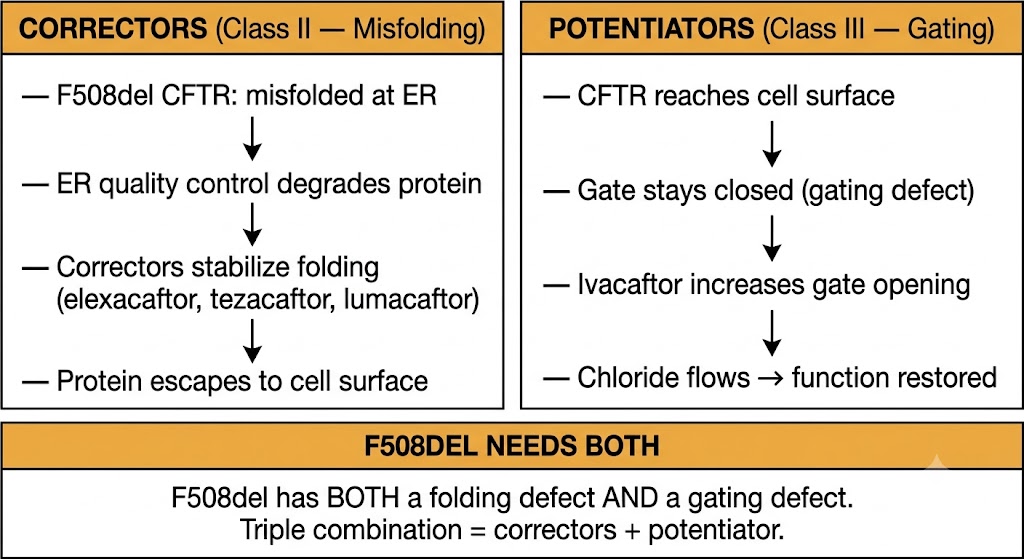
Correctors (lumacaftor, tezacaftor, elexacaftor): fix protein folding and trafficking — address Class II mutations. Get the protein to the cell surface.
Potentiators (ivacaftor): fix channel gating at the cell surface — address Class III mutations. Open the channel once it is there.
F508del produces both a folding defect (Class II) and a gating defect (Class III) — it requires both a corrector and a potentiator for meaningful restoration of function.
Ivacaftor was the first approved CFTR modulator and demonstrated for the first time that targeting the protein defect rather than the downstream consequences of ion channel dysfunction could produce dramatic clinical benefit in cystic fibrosis.
Ivacaftor binds directly to the cystic fibrosis transmembrane conductance regulator protein at the cell surface and increases the probability that the channel gate will open in response to protein kinase A phosphorylation. It does not correct misfolded protein or improve trafficking — it acts exclusively on protein already present at the apical membrane. This mechanism makes it effective only for mutations where the protein reaches the cell surface but gates abnormally, principally Class III gating mutations.
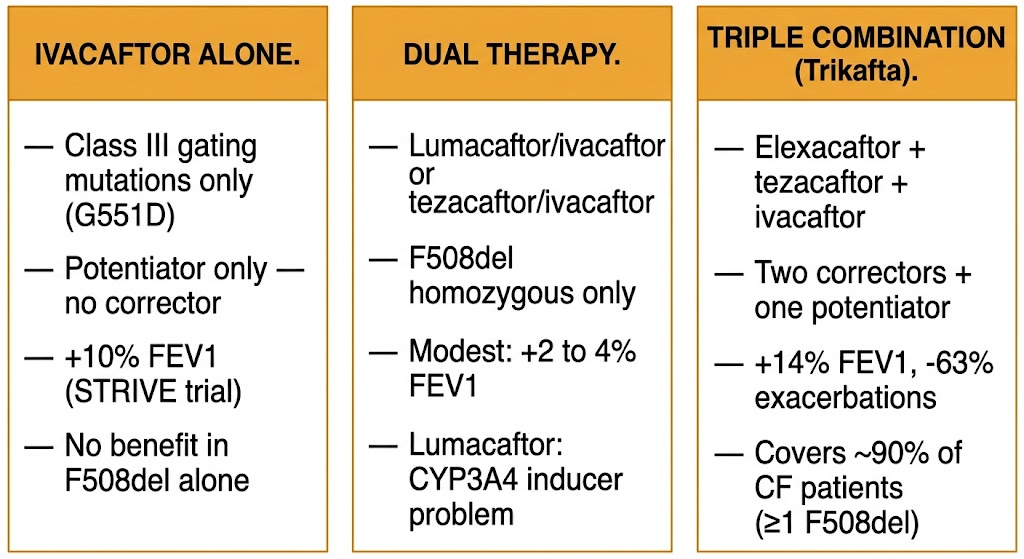
The original and prototypical indication is the G551D gating mutation, which is present in approximately 4 to 5 percent of patients with cystic fibrosis. In the STRIVE trial, ivacaftor produced a 10 percentage point improvement in forced expiratory volume in 1 second percent predicted, a 55% reduction in pulmonary exacerbations, dramatic reductions in sweat chloride concentration (the functional biomarker of cystic fibrosis transmembrane conductance regulator activity), and sustained weight gain — results that were unprecedented in the history of cystic fibrosis drug development at the time of publication. Ivacaftor has since been approved for use with more than 95 other rare gating and residual function mutations, substantially expanding its eligible patient population. It has no meaningful efficacy as monotherapy in F508del homozygous patients because F508del protein rarely reaches the cell surface in sufficient quantity without a corrector.
First-generation correctors lumacaftor and tezacaftor each assist cystic fibrosis transmembrane conductance regulator protein folding and trafficking but produce only modest improvements in function because F508del protein, even when partially rescued to the cell surface, retains a gating defect — necessitating combination with a potentiator.
Lumacaftor stabilizes the misfolded F508del protein during synthesis, enabling more of it to escape endoplasmic reticulum quality control and reach the apical membrane. Combined with ivacaftor to address the residual gating defect, lumacaftor/ivacaftor (Orkambi) was approved for patients aged 6 and older who are homozygous for F508del. Clinical benefit was real but modest: the TRAFFIC and TRANSPORT trials demonstrated approximately 2 to 4 percentage point improvements in forced expiratory volume in 1 second percent predicted and a 39% reduction in pulmonary exacerbations. A critical pharmacokinetic problem limits this combination: lumacaftor is a potent inducer of CYP3A4, the primary enzyme responsible for ivacaftor metabolism. Lumacaftor induces its own antidote — it dramatically reduces ivacaftor plasma concentrations, partially negating the dual-mechanism rationale and requiring higher ivacaftor doses. Lumacaftor/ivacaftor is associated with significant respiratory adverse events (chest tightness, dyspnea) particularly during initiation in patients with severe lung disease.
Tezacaftor is a second-generation corrector that is not a CYP3A4 inducer, eliminating the pharmacokinetic self-sabotage of lumacaftor. It improves cystic fibrosis transmembrane conductance regulator folding by a different molecular mechanism than lumacaftor and produces somewhat better F508del protein rescue with a cleaner drug interaction profile. Tezacaftor/ivacaftor (Symdeko) is approved for F508del homozygous patients aged 6 and older and for patients with certain residual function mutations. Clinical improvements are modest but slightly better tolerated than Orkambi, with lower rates of respiratory adverse events. Both combinations were substantially superseded by the triple combination for eligible patients when elexacaftor-tezacaftor-ivacaftor became available.
The combination of elexacaftor, tezacaftor, and ivacaftor (Trikafta in the United States) is the most significant pharmacological advance in cystic fibrosis history. By combining two correctors acting at distinct binding sites on the cystic fibrosis transmembrane conductance regulator protein with a potentiator, it produces protein rescue of sufficient magnitude to transform disease outcomes in the approximately 90 percent of patients who carry at least one F508del allele.
Elexacaftor is a next-generation corrector that binds the cystic fibrosis transmembrane conductance regulator protein at a different site than tezacaftor — specifically at membrane-spanning domain 1. The two correctors act at distinct binding sites and produce additive, cooperative stabilization of the misfolded F508del protein, enabling substantially greater protein rescue than either corrector alone. Tezacaftor contributes additional stabilization at nucleotide-binding domain 1. Ivacaftor then potentiates the gating function of the rescued protein at the cell surface. The result is a multi-point rescue of the F508del protein defect that achieves far greater cystic fibrosis transmembrane conductance regulator function restoration than any single-corrector combination.
The pivotal trial in F508del homozygous patients demonstrated a 14 percentage point improvement in forced expiratory volume in 1 second percent predicted at week 24 — more than three times the improvement seen with dual corrector/potentiator combinations — along with a 63% reduction in pulmonary exacerbations and a near-normalization of sweat chloride concentration. In patients with one F508del allele and one minimal function allele (for whom no previous modulator was effective), the triple combination also produced significant lung function improvements. Approval now covers patients aged 2 years and older with at least one F508del allele, encompassing approximately 90% of the cystic fibrosis population.
The triple combination is metabolized by CYP3A4 and is a moderate CYP3A4 substrate. Strong CYP3A4 inhibitors (azole antifungals, certain antiretrovirals) substantially increase elexacaftor and ivacaftor exposure and require dose reduction. Strong CYP3A4 inducers (rifampin, certain anticonvulsants) reduce drug levels and should be avoided. Hepatotoxicity has been reported, and transaminase monitoring is recommended, particularly during the first year of treatment.
Elexacaftor + tezacaftor: two correctors at distinct binding sites → additive F508del protein rescue.
Ivacaftor: potentiator → gates the rescued protein.
Eligible: at least one F508del allele (approximately 90% of patients with CF), age 2 and older.
Drug interactions: CYP3A4 substrate — avoid strong inducers; reduce dose with strong inhibitors. Monitor transaminases.
Even with transformative triple combination therapy, cystic fibrosis management requires ongoing attention to monitoring, residual disease, and non-modulator therapies. Modulators rescue cystic fibrosis transmembrane conductance regulator function but do not reverse existing structural lung damage or eliminate the need for airway clearance.
Sweat chloride concentration is the primary pharmacodynamic biomarker for cystic fibrosis transmembrane conductance regulator function. Normal sweat chloride is below 30 mmol/L; in untreated cystic fibrosis it is typically above 60 mmol/L. Effective modulator therapy — particularly triple combination — produces near-normalization of sweat chloride, confirming cystic fibrosis transmembrane conductance regulator rescue at the biochemical level. Sweat chloride testing is used both to confirm modulator eligibility (in patients with uncertain mutation class) and to verify treatment response. Liver function tests are monitored every three months for the first year and annually thereafter in patients on elexacaftor-tezacaftor-ivacaftor; transaminase elevations above three times the upper limit of normal warrant treatment interruption.
Modulator therapy does not reverse existing bronchiectasis, does not eliminate established Pseudomonas aeruginosa or Staphylococcus aureus colonization in patients who were colonized before starting treatment, and does not restore already-lost lung function. Airway clearance therapy — high-frequency chest wall oscillation, positive expiratory pressure devices, and active cycle of breathing — remains a cornerstone of daily management. Dornase alfa (recombinant human deoxyribonuclease) cleaves extracellular DNA released by degenerating neutrophils in the viscous airway secretions, reducing sputum viscosity and improving mucociliary clearance; it remains beneficial alongside modulator therapy. Hypertonic saline (7%) draws water into the airway lumen by osmosis, rehydrating the periciliary liquid layer and improving mucociliary transport. Inhaled antibiotics (tobramycin, aztreonam) are used to suppress chronic Pseudomonas aeruginosa infection in patients with established colonization.
At least one F508del allele (age ≥2): elexacaftor-tezacaftor-ivacaftor (Trikafta) — first choice for eligible patients.
Class III gating mutation, no F508del: ivacaftor (Kalydeco) monotherapy.
F508del homozygous where triple combination is not available: tezacaftor/ivacaftor (Symdeko) or lumacaftor/ivacaftor (Orkambi).
Class I (stop codon) or Class II without F508del: no approved modulator in most cases; investigational.
| Author / Organization | Title | Source |
|---|---|---|
| Rowe SM, Miller S, Sorscher EJ | Cystic fibrosis | N Engl J Med. 2005;352(19):1992–2001 |
| Welsh MJ, Smith AE | Molecular mechanisms of CFTR chloride channel dysfunction in cystic fibrosis | Cell. 1993;73(7):1251–1254 |
| Boyle MP, De Boeck K | A new era in the treatment of cystic fibrosis: correction of the underlying CFTR defect | Lancet Respir Med. 2013;1(2):158–163 |
| Ramsey BW, Davies J, McElvaney NG, et al | A CFTR potentiator in patients with cystic fibrosis and the G551D mutation | N Engl J Med. 2011;365(18):1663–1672 |
| Van Goor F, Hadida S, Grootenhuis PDJ, et al | Rescue of CF airway epithelial cell function in vitro by a CFTR potentiator, VX-770 | Proc Natl Acad Sci USA. 2009;106(44):18825–18830 |
| Lommatzsch ST, Taylor-Cousar JL | The combination of tezacaftor and ivacaftor in the treatment of patients with cystic fibrosis | Ther Adv Respir Dis. 2019;13:1753466619844424 |
| Wainwright CE, Elborn JS, Ramsey BW, et al | Lumacaftor-ivacaftor in patients with cystic fibrosis homozygous for Phe508del CFTR | N Engl J Med. 2015;373(3):220–231 |
| Taylor-Cousar JL, Munck A, McKone EF, et al | Tezacaftor-ivacaftor in patients with cystic fibrosis homozygous for Phe508del | N Engl J Med. 2017;377(21):2013–2023 |
| Heijerman HGM, McKone EF, Downey DG, et al | Efficacy and safety of the elexacaftor plus tezacaftor plus ivacaftor combination regimen in people with cystic fibrosis homozygous for the F508del mutation | Lancet. 2019;394(10212):1940–1948 |
| Middleton PG, Mall MA, Drevinek P, et al | Elexacaftor-tezacaftor-ivacaftor for cystic fibrosis with a single Phe508del allele | N Engl J Med. 2019;381(19):1809–1819 |