Pathophysiology, thyroid-stimulating immunoglobulins, extrathyroidal manifestations, and disease-specific implications
Hyperthyroidism has two major etiologies with distinct pathophysiology and different implications for pharmacological management: Graves’ disease, driven by autoimmune thyroid-stimulating immunoglobulins, and toxic nodular hyperthyroidism, driven by autonomously functioning thyroid nodules.
Graves’ disease is caused by thyroid-stimulating immunoglobulins that bind and chronically activate the thyroid-stimulating hormone receptor on thyroid follicular cells, producing unregulated thyroid hormone synthesis independent of pituitary control. Unlike thyroid-stimulating hormone, these immunoglobulins are not subject to negative feedback suppression, which is why the hyperthyroid state perpetuates until immunosuppression, ablation, or spontaneous remission occurs.
The extrathyroidal manifestations of Graves’ disease — ophthalmopathy (in 25–50% of patients), dermopathy, and acropachy — are driven by thyroid-stimulating hormone receptor expression in non-thyroidal tissues and do not occur in toxic nodular hyperthyroidism. Graves’ ophthalmopathy results from orbital fibroblast activation by the same autoimmune process, producing glycosaminoglycan deposition, orbital fat expansion, and extraocular muscle enlargement. Ophthalmopathy can worsen after radioactive iodine treatment, particularly in smokers, and this risk factors into therapy selection.
Toxic multinodular goiter and toxic adenoma arise from somatic mutations in the thyroid-stimulating hormone receptor or in downstream signaling components that constitutively activate cyclic adenosine monophosphate production, driving autonomous thyroid hormone secretion without thyroid-stimulating hormone stimulation. Unlike Graves’ disease, there is no autoimmune basis, thyroid-stimulating hormone receptor antibodies are negative, and spontaneous remission cannot occur. Thionamides suppress thyroid hormone synthesis but cannot induce remission; they are used primarily for pre-procedural control before definitive radioactive iodine or surgical ablation.
Thyroid-stimulating hormone receptor antibodies serve three roles: confirming Graves’ disease diagnosis when scintigraphy is unavailable; predicting relapse risk after thionamide discontinuation (persistently elevated at 12–18 months predicts 60–70% relapse within one year); and predicting neonatal Graves’ disease (maternal thyroid-stimulating immunoglobulins cross the placenta and can stimulate the fetal thyroid at concentrations above three times the upper reference limit).
Thyroid peroxidase inhibition, peripheral conversion blockade, titrate-to-block vs. block-and-replace, and remission pharmacology
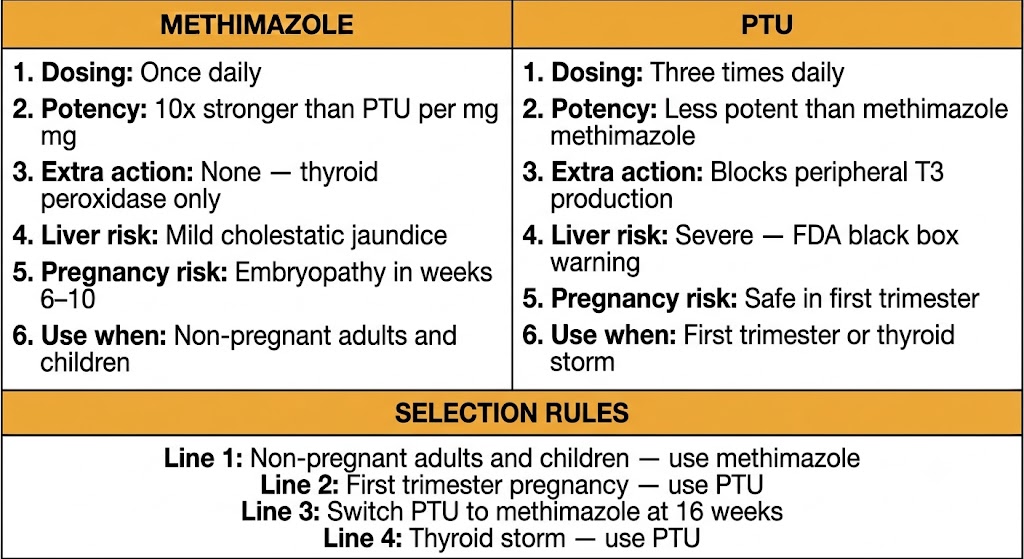
Methimazole and propylthiouracil are the two thionamide drugs available for hyperthyroidism. They share a primary mechanism but differ in potency, pharmacokinetics, adverse effects, and one critical additional action that determines drug selection in specific clinical situations.
Both thionamides inhibit thyroid peroxidase, blocking both organification of iodide and coupling of iodotyrosines within the thyroid follicular lumen. Methimazole is approximately 10 times more potent than propylthiouracil on a milligram basis. Neither drug blocks release of preformed thyroid hormone already stored in the follicular colloid as thyroglobulin — the thyroid gland stores a 2–3 month supply. Clinical improvement therefore requires 2–4 weeks as the existing hormone store depletes through ongoing secretion while new synthesis is blocked. Beta-blockade should be started simultaneously to control adrenergic symptoms during this lag.
Propylthiouracil has a second pharmacodynamic action not shared by methimazole: inhibition of type 1 deiodinase in peripheral tissues, reducing conversion of thyroxine to the more potent triiodothyronine by approximately 40%. This peripheral conversion blockade makes propylthiouracil specifically preferred in thyroid storm, where rapid reduction of triiodothyronine availability is critical.
The titrate-to-block approach starts at a moderately high dose and progressively reduces it as thyroid function normalizes, reaching a low maintenance dose. This minimizes risk of iatrogenic hypothyroidism but requires frequent monitoring. The block-and-replace strategy uses a high fixed thionamide dose to fully suppress thyroid hormone synthesis while simultaneously administering levothyroxine to maintain euthyroidism. This produces more stable free thyroxine levels and simplifies monitoring but exposes the patient to higher cumulative thionamide doses. Block-and-replace is contraindicated in pregnancy because thionamides cross the placenta more readily than levothyroxine at the doses required, risking fetal hypothyroidism.
Remission rates after 12–18 months of thionamide therapy in Graves’ disease range from 40–60%. Favorable predictors: small goiter, mild biochemical hyperthyroidism, and thyroid-stimulating hormone receptor antibodies normalizing during treatment. High relapse risk (60–70% within one year of stopping): large goiter, high initial antibody titers, persistent antibodies at end of treatment. When relapse occurs after a first course, a second course rarely achieves remission — definitive therapy should be recommended.
Methimazole vs. propylthiouracil: agranulocytosis, hepatotoxicity, teratogenicity, and the four selection rules
The choice between methimazole and propylthiouracil is governed by four clinical rules based on their differing adverse effect profiles and pharmacokinetics. Understanding these rules eliminates ambiguity in drug selection.
Methimazole has oral bioavailability of approximately 93% and a plasma half-life of 4–6 hours. It concentrates in thyroid tissue with a substantially longer intrathyroidal half-life, enabling once-daily dosing. Standard starting doses are 10–40 mg per day. Propylthiouracil has lower and more variable bioavailability (50–75%), a shorter plasma half-life of 1–2 hours requiring three-times-daily dosing, and approximately 80% plasma protein binding. Its lower placental transfer per milligram compared with methimazole is the pharmacokinetic basis for its first-trimester preference in pregnancy.
Agranulocytosis occurs in 0.1–0.5% of patients, typically within the first 90 days of treatment, presenting as abrupt fever and pharyngitis caused by immune-mediated destruction of granulocyte precursors. The reaction is idiosyncratic and cannot be reliably prevented by routine blood count monitoring. Every patient starting a thionamide must be instructed explicitly: stop the drug immediately and seek urgent evaluation if fever or sore throat develops. Do not wait for an appointment. Granulocyte colony-stimulating factor accelerates recovery. Agranulocytosis is a class effect — do not rechallenge with the other thionamide.
Methimazole produces a cholestatic pattern (elevated alkaline phosphatase and bilirubin) that is generally mild and reversible. Propylthiouracil produces idiosyncratic fulminant hepatic necrosis; the United States Food and Drug Administration issued a black box warning in 2010 after cases of liver failure, liver transplantation, and death, predominantly in children. This hepatotoxicity risk is the primary reason propylthiouracil is not recommended as a first-line agent outside its specific indications. Propylthiouracil also causes antineutrophil cytoplasmic antibody-associated vasculitis in up to 4% of long-term users, making it a poor choice for prolonged therapy.
Beta-blockers, iodide preparations, cholestyramine, and glucocorticoids
Several drugs serve as adjuncts to thionamides in hyperthyroidism, providing symptomatic relief, reducing circulating thyroid hormone levels by additional mechanisms, or preparing the gland for surgery. Their sequencing and rationale are as important as the drugs themselves.
Beta-adrenergic receptor blockers provide rapid relief of palpitations, tremor, anxiety, and heat intolerance while waiting for thionamide-driven hormone depletion over 2–4 weeks. Propranolol is the preferred agent and has the added benefit of inhibiting type 1 deiodinase at high doses (80–160 mg per day), reducing peripheral thyroxine-to-triiodothyronine conversion by approximately 10–20% — this dual action makes it particularly valuable in thyroid storm. Atenolol and metoprolol are cardioselective alternatives preferred in reactive airway disease. The target resting heart rate is below 90 beats per minute. Beta-blockers must be tapered gradually as thionamide control is established; abrupt discontinuation can cause rebound tachycardia.
Pharmacological iodide exploits two mechanisms: the Wolff-Chaikoff effect (high iodide transiently inhibits thyroid peroxidase-mediated organification within hours), and reduction of thyroid gland vascularity over 7–14 days. Lugol’s iodine solution (5–10 drops three times daily) and saturated solution of potassium iodide (1–5 drops three times daily) are the available preparations.
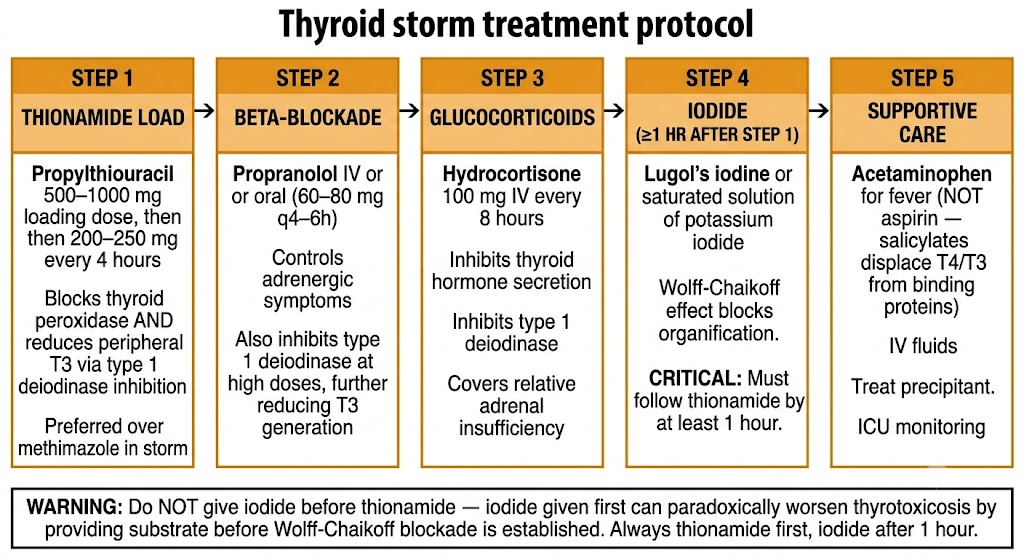
Iodide must never be given before thionamide loading. If iodide is administered first, the substrate can paradoxically increase thyroid hormone synthesis until the Wolff-Chaikoff effect is established. In thyroid storm, thionamide must precede iodide by at least one hour. The thyroid gland escapes Wolff-Chaikoff inhibition within days by downregulating the sodium-iodide symporter, so iodide is not a durable monotherapy.
Cholestyramine binds thyroid hormone in the intestinal lumen, interrupting enterohepatic recirculation and reducing the circulating hormone pool. It is used in severe or refractory cases as an adjunct to reduce thyroid hormone levels more rapidly. Glucocorticoids serve multiple roles in severe hyperthyroidism and thyroid storm: they inhibit thyroid hormone secretion, inhibit type 1 deiodinase to reduce triiodothyronine generation, and cover the risk of relative adrenal insufficiency under extreme physiological stress.
In any clinical situation where both a thionamide and iodide are being used — pre-operative preparation, thyroid storm, or iodine-excess thyrotoxicosis — the thionamide must be given first and allowed at least one hour to begin blocking thyroid peroxidase before iodide is administered. Giving iodide first provides substrate that can be incorporated into new thyroid hormone synthesis before the Wolff-Chaikoff effect is established, potentially worsening thyrotoxicosis acutely.
Burch-Wartofsky criteria, multi-drug protocol, mandatory sequencing, and pitfalls
Thyroid storm is a life-threatening decompensation of thyrotoxicosis with multi-organ dysfunction and mortality of 10–25% even with aggressive treatment. Management is a multi-drug protocol with mandatory sequencing — the order in which drugs are given is as important as which drugs are chosen.
The Burch-Wartofsky Point Scale scores thermoregulatory, cardiovascular (heart rate, atrial fibrillation, heart failure), central nervous system, and gastrointestinal-hepatic manifestations; a score above 45 is highly suggestive of storm, above 25 suggests impending storm. Thyroid hormone levels in storm are often only modestly elevated above baseline hyperthyroid values — storm is a systemic decompensation driven by adrenergic hyperactivation and end-organ susceptibility as much as by quantitative hormone excess. Common precipitants include infection, surgery, trauma, iodine loading (contrast agents, amiodarone), and abrupt thionamide discontinuation.
Step 1 — thionamide loading: propylthiouracil 500–1000 mg by mouth or nasogastric tube as a loading dose, then 200–250 mg every 4 hours. Propylthiouracil is preferred over methimazole in storm because of its type 1 deiodinase inhibitory activity. Step 2 — beta-blockade: propranolol intravenously (0.5–1 mg every 5 minutes under cardiac monitoring) or orally (60–80 mg every 4–6 hours) controls adrenergic hyperactivation and inhibits peripheral triiodothyronine generation. Step 3 — glucocorticoids: hydrocortisone 100 mg intravenously every 8 hours, or dexamethasone 2 mg intravenously every 6 hours, for secretion inhibition, type 1 deiodinase inhibition, and adrenal insufficiency coverage. Step 4 — iodide: at least one hour after thionamide loading, to block further hormone release via the Wolff-Chaikoff effect. Step 5 — adjuncts: cholestyramine 4 g four times daily in refractory cases; cooling with acetaminophen (not salicylates); intravenous fluids; thiamine supplementation.
Aspirin and other salicylates displace thyroxine and triiodothyronine from plasma binding proteins (thyroxine-binding globulin, transthyretin, albumin), acutely raising free hormone concentrations at a time when end-organ stress is already maximal. Use acetaminophen exclusively for fever and pain management in thyroid storm. This interaction can transiently worsen the storm at a physiologically critical moment.
Radioactive iodine preparation, ophthalmopathy considerations, surgical indications, and perioperative management
Thionamides control but rarely cure hyperthyroidism. Definitive therapy with radioactive iodine or thyroidectomy is required when thionamide therapy fails, relapse occurs, or remission is unlikely. The choice between modalities depends on goiter size, ophthalmopathy status, pregnancy plans, and patient preference.
Iodine-131 is concentrated by the sodium-iodide symporter and destroys thyroid tissue via beta particle emission over 6–12 weeks. The goal in Graves’ disease is complete ablation producing permanent hypothyroidism managed thereafter with levothyroxine. Methimazole is given for 4–8 weeks before treatment to normalize thyroid hormone levels, then stopped 5–7 days before iodine-131 administration because its presence impairs radioactive iodine uptake.
Radioactive iodine is associated with new development or worsening of Graves’ ophthalmopathy in 15–20% of patients, particularly smokers. In patients with mild ophthalmopathy, glucocorticoid prophylaxis (oral prednisone starting on the day of treatment, tapered over 3 months) reduces this risk to near that of thionamide therapy alone.
Total or near-total thyroidectomy is preferred over radioactive iodine in several situations: large goiters where radioactive iodine efficacy is reduced; coexisting nodules requiring pathological evaluation; significant ophthalmopathy with highly elevated thyroid-stimulating hormone receptor antibodies; women planning pregnancy within 6–12 months (radioactive iodine requires 6–12 months of contraception); and patients who decline radioactive iodine. Pre-operative preparation requires biochemical euthyroidism with methimazole plus Lugol’s iodine (5–10 drops three times daily for 7–10 days immediately pre-operatively) to reduce gland vascularity and intraoperative blood loss.
| Author / Organization | Title | Source |
|---|---|---|
| Ross DS et al. | 2016 ATA guidelines for diagnosis and management of hyperthyroidism and other causes of thyrotoxicosis | Thyroid. 2016;26(10):1343–1421 |
| Kahaly GJ et al. | 2018 European Thyroid Association guideline for the management of Graves’ hyperthyroidism | Eur Thyroid J. 2018;7(4):167–186 |
| Cooper DS | Antithyroid drugs | N Engl J Med. 2005;352(9):905–917 |
| Bahn Chair RS et al. | Hyperthyroidism and other causes of thyrotoxicosis: ATA and AACE management guidelines | Thyroid. 2011;21(6):593–646 |
| Akamizu T | Thyroid storm: a Japanese perspective | Thyroid. 2018;28(1):32–40 |
| Alexander EK et al. | 2017 ATA guidelines for thyroid disease during pregnancy and postpartum | Thyroid. 2017;27(3):315–389 |
| Haugen BR et al. | 2015 ATA management guidelines for thyroid nodules and differentiated thyroid cancer | Thyroid. 2016;26(1):1–133 |