CHAPTER 24  ·  VASOACTIVE PEPTIDE PHARMACOLOGY
Section 1
The Renin-Angiotensin-Aldosterone System Cascade
How the kidneys, lungs, and adrenal glands cooperate to regulate blood pressure through an enzymatic cascade from renin to aldosterone

The renin-angiotensin-aldosterone system is the body's primary hormonal mechanism for long-term blood pressure and sodium balance control. Understanding its three-step enzymatic cascade is the foundation for understanding how an entire family of cardiovascular drugs works.

Renin Release

Renin is a protease enzyme secreted from specialized cells in the kidney called juxtaglomerular cells, located in the wall of the afferent arteriole. Three signals trigger renin release: a fall in blood pressure sensed at the afferent arteriole, reduced sodium chloride delivery to the macula densa of the distal tubule, and stimulation of beta-1 adrenergic receptors on juxtaglomerular cells by the sympathetic nervous system. Once released, renin acts on angiotensinogen, a protein made continuously by the liver, to produce the inactive decapeptide angiotensin I.

Angiotensin-Converting Enzyme and Angiotensin II

Angiotensin-converting enzyme is a zinc-containing enzyme located on the surface of pulmonary vascular endothelium. As blood passes through the lungs, angiotensin-converting enzyme cleaves two amino acids from angiotensin I to produce angiotensin II, the active vasoactive peptide. This conversion is nearly complete in a single pulmonary pass. Angiotensin-converting enzyme has a second substrate: bradykinin. The same enzyme that generates angiotensin II also degrades bradykinin. This dual action is the mechanistic basis for the two most important adverse effects of angiotensin-converting enzyme inhibitors.

Angiotensin II acts primarily through type 1 (AT1) receptors on vascular smooth muscle and the adrenal cortex, producing two major effects: vasoconstriction, which raises blood pressure directly, and stimulation of aldosterone secretion from the adrenal zona glomerulosa.

Aldosterone and the Final Step

Aldosterone acts on the mineralocorticoid receptor in the collecting duct of the kidney to increase sodium reabsorption and potassium excretion. The net result of the entire cascade is elevated blood pressure, expanded plasma volume, and reduced potassium. In heart failure and chronic kidney disease, this system is pathologically overactivated, which is why drugs that suppress the cascade produce survival benefit in these conditions.
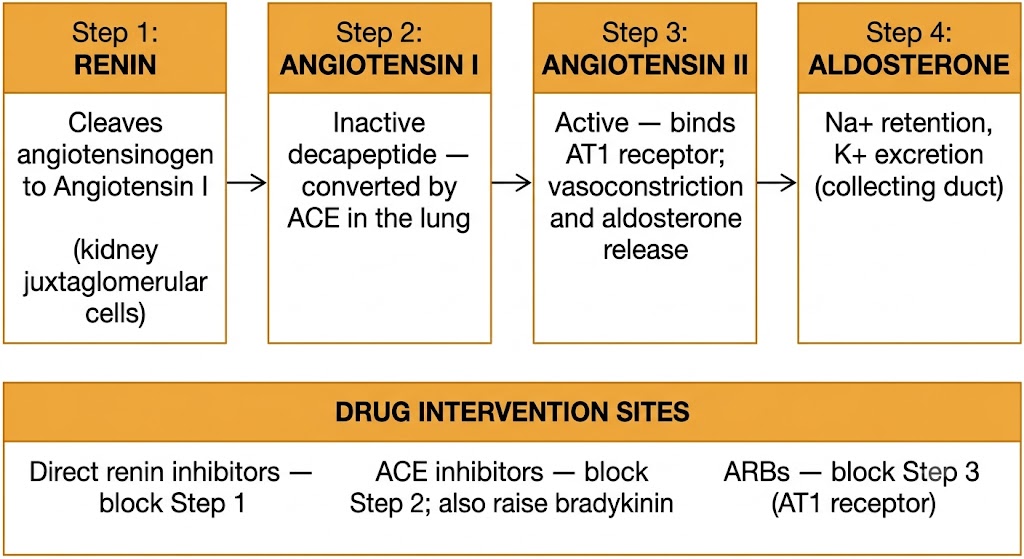
Flow diagram of the renin-angiotensin-aldosterone cascade showing four sequential steps: renin cleaves angiotensinogen to angiotensin I in the kidney, angiotensin-converting enzyme converts angiotensin I to angiotensin II in the lung, angiotensin II binds the AT1 receptor causing vasoconstriction and aldosterone release, and aldosterone causes sodium retention and potassium excretion in the collecting duct. A panel below identifies drug intervention sites for direct renin inhibitors, angiotensin-converting enzyme inhibitors, and angiotensin receptor blockers.
The renin-angiotensin-aldosterone cascade and sites of pharmacological intervention. Generated with Gemini AI for educational use.
Why This Cascade Matters for Drug Action

Three separate drug classes interrupt this cascade at different points. Angiotensin-converting enzyme inhibitors block the conversion of angiotensin I to angiotensin II. Angiotensin receptor blockers block the AT1 receptor directly. Direct renin inhibitors block the first step by inhibiting renin itself. All three reduce angiotensin II effects, but only angiotensin-converting enzyme inhibitors also raise bradykinin — the source of their unique adverse effects.

Section 2
ACE Inhibitor Mechanisms and Adverse Effects
How angiotensin-converting enzyme inhibitors block the active site of angiotensin-converting enzyme, and the two major adverse effects that follow directly from the dual substrate specificity of that enzyme

Angiotensin-converting enzyme inhibitors block the zinc active site of angiotensin-converting enzyme. Because angiotensin-converting enzyme processes both angiotensin I and bradykinin, blocking it produces two simultaneous consequences: less angiotensin II and more bradykinin. The therapeutic benefits come from the first; the most important adverse effects come from the second.

Mechanism of Action

All angiotensin-converting enzyme inhibitors present a zinc-chelating group that competitively occupies the enzyme's active site. This prevents the cleavage of angiotensin I to angiotensin II, reducing vasoconstriction and aldosterone secretion. At the same time, bradykinin — which would normally be degraded by angiotensin-converting enzyme — accumulates in tissues and plasma. The rise in bradykinin contributes to vasodilation and is responsible for the class's characteristic adverse effects.

Dry Cough

A dry, persistent, non-productive cough occurs in 5 to 20 percent of patients taking angiotensin-converting enzyme inhibitors. The mechanism is bradykinin accumulation in the pulmonary interstitium, which sensitizes airway sensory fibers and lowers the cough threshold. The cough does not respond to antihistamines or antitussives. Switching to an angiotensin receptor blocker, which does not affect bradykinin metabolism, resolves the cough in virtually all patients. This is one of the most common reasons patients are transitioned from an angiotensin-converting enzyme inhibitor to an angiotensin receptor blocker in clinical practice.

Angioedema

Angioedema is a serious, potentially life-threatening adverse effect occurring in roughly 0.1 to 0.7 percent of patients. Like the cough, it is driven by bradykinin accumulation — not by histamine — which makes it mechanistically distinct from allergic angioedema. The swelling characteristically involves the lips, tongue, and periorbital region. Laryngeal involvement occurs in a significant minority of cases and can compromise the airway.

Because this is a bradykinin-mediated reaction rather than a histamine-mediated one, antihistamines and corticosteroids are ineffective. Epinephrine may provide temporary relief in laryngeal involvement through vasoconstriction but does not treat the underlying mechanism. The primary intervention is immediate discontinuation of the angiotensin-converting enzyme inhibitor. Once a patient has experienced angiotensin-converting enzyme inhibitor-induced angioedema, the drug is absolutely contraindicated permanently, and angiotensin receptor blockers should be used cautiously (they do not raise bradykinin but may have a small independent risk).

Angioedema: The Key Distinction

Angiotensin-converting enzyme inhibitor angioedema is bradykinin-mediated, not histamine-mediated. It is non-pruritic, non-urticarial, and does not respond to antihistamines. Allergic angioedema is IgE-mediated and histamine-driven — it responds to antihistamines and epinephrine. Recognizing this distinction is essential for selecting appropriate emergency management.

Hyperkalemia

By suppressing aldosterone, angiotensin-converting enzyme inhibitors reduce potassium excretion in the renal collecting duct. This produces a tendency toward hyperkalemia, particularly in patients with chronic kidney disease, patients taking potassium-sparing diuretics, and patients on potassium supplements. Serum potassium monitoring is required at baseline and after initiation or dose changes.


Section 3
ACE Inhibitor Pharmacokinetics and Clinical Use
The prodrug concept, renal elimination, dose adjustment in kidney disease, and the major cardiovascular and renal indications supported by landmark trials

Most angiotensin-converting enzyme inhibitors are prodrugs that require hepatic conversion to their active forms, and virtually all are eliminated by the kidney. These two properties govern how the drugs are dosed — particularly in patients with renal impairment, the population in whom they are simultaneously most beneficial and most potentially harmful.

Prodrug Activation and Renal Elimination

Captopril and lisinopril are the two agents that are pharmacologically active as administered, requiring no biotransformation. All other angiotensin-converting enzyme inhibitors — including enalapril, ramipril, and perindopril — are ester prodrugs that undergo hepatic hydrolysis to release their active diacid forms. Active drug is eliminated primarily by the kidney across the entire class. This means dose reduction is required when kidney function is significantly impaired, typically when the glomerular filtration rate falls below 30 mL/min.

Fosinopril is the exception worth knowing: it has approximately equal hepatic and renal elimination of its active form, so it accumulates far less than other agents when kidney function declines. This makes fosinopril the preferred angiotensin-converting enzyme inhibitor in advanced chronic kidney disease.

Clinical Indications

Angiotensin-converting enzyme inhibitors have among the broadest evidence bases of any drug class in cardiovascular medicine. The four major indications are hypertension, heart failure with reduced ejection fraction, post-myocardial infarction left ventricular dysfunction, and diabetic nephropathy.

In heart failure with reduced ejection fraction, the CONSENSUS and SOLVD trials with enalapril established mortality benefit, making angiotensin-converting enzyme inhibitors foundational therapy. In patients following a myocardial infarction, the SAVE, AIRE, and TRACE trials demonstrated reduced mortality and reinfarction when angiotensin-converting enzyme inhibitors were started early and continued long-term, with greatest benefit in patients with anterior infarction or reduced ejection fraction.

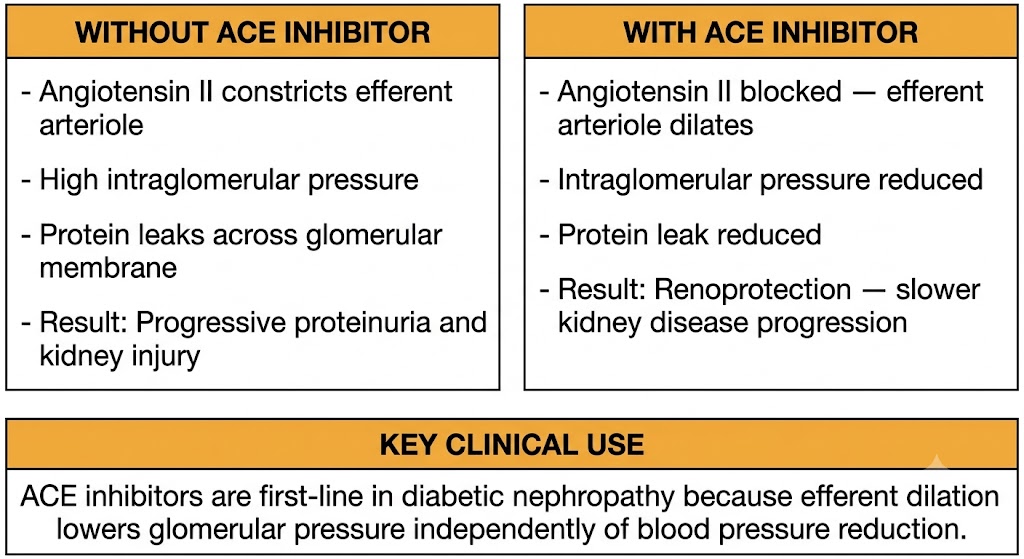
In diabetic nephropathy, the Lewis trial showed that captopril reduces proteinuria and slows progression to end-stage renal disease in type 1 diabetes. The renal protective mechanism is reduction of glomerular hypertension through efferent arteriolar dilation, which lowers the filtration pressure driving protein loss across the glomerular membrane. For this reason, angiotensin-converting enzyme inhibitors are considered first-line antihypertensive therapy in diabetic patients with proteinuria regardless of the underlying diabetes type.

Two-panel comparison diagram showing glomerular hemodynamics without and with an angiotensin-converting enzyme inhibitor. Left panel shows angiotensin II constricting the efferent arteriole, producing high intraglomerular pressure, protein leak, and progressive kidney injury. Right panel shows efferent arteriole dilation after angiotensin-converting enzyme inhibition, reduced intraglomerular pressure, reduced protein leak, and renoprotection. A shared panel below states that angiotensin-converting enzyme inhibitors are first-line in diabetic nephropathy.
Glomerular hemodynamics with and without angiotensin-converting enzyme inhibitor therapy, illustrating the mechanism of renal protection in diabetic nephropathy. Generated with Gemini AI for educational use.
Indications Summary
Major Clinical Uses of ACE Inhibitors
  • Hypertension — effective monotherapy, particularly in high-renin states
  • Heart failure with reduced ejection fraction — mortality benefit (CONSENSUS, SOLVD)
  • Post-myocardial infarction — reduces mortality and reinfarction (SAVE, AIRE, TRACE)
  • Diabetic nephropathy — reduces proteinuria and slows progression to end-stage renal disease
  • High cardiovascular risk without heart failure — ramipril reduced events in HOPE trial

Section 4
Contraindications and Drug Interactions
The mechanistically derived absolute contraindications to angiotensin-converting enzyme inhibitor therapy and the most clinically consequential drug interactions

The contraindications to angiotensin-converting enzyme inhibitors are not empirical — each one follows directly from the mechanism of action. Understanding why these contraindications exist is more useful than memorizing a list.

Absolute Contraindications

Bilateral renal artery stenosis is the most important mechanistic contraindication. When both renal arteries are narrowed, glomerular filtration depends on angiotensin II constricting the efferent arteriole to maintain filtration pressure despite reduced perfusion. Blocking angiotensin-converting enzyme removes this efferent arteriolar tone, causing the filtration pressure to collapse and precipitating acute kidney injury. The same physiology can occur in a patient with a single functioning kidney and unilateral renal artery stenosis. A rise in creatinine of up to 30 percent after starting an angiotensin-converting enzyme inhibitor is expected and acceptable; a rise beyond that, or a rapid rise, should prompt evaluation for renal artery stenosis or severe volume depletion.

Pregnancy is an absolute contraindication throughout all three trimesters. First-trimester exposure increases the risk of cardiovascular and central nervous system malformations. Second and third trimester exposure causes fetal renal tubular dysgenesis because the developing fetal kidney depends on its own renin-angiotensin-aldosterone system for normal development. The clinical consequence is oligohydramnios, fetal anuria, limb contractures, pulmonary hypoplasia, and potentially neonatal death. This fetal toxicity is shared by angiotensin receptor blockers.

History of angiotensin-converting enzyme inhibitor-induced angioedema is an absolute contraindication to further use of any drug in the class.

Key Drug Interactions

Nonsteroidal anti-inflammatory drugs, including ibuprofen, naproxen, and cyclooxygenase-2 inhibitors such as celecoxib, blunt the renal protective effects of angiotensin-converting enzyme inhibitors and increase the risk of acute kidney injury. The mechanism involves nonsteroidal anti-inflammatory drug inhibition of prostaglandin synthesis, which is required to maintain afferent arteriolar dilation and renal perfusion. When afferent dilation is lost at the same time that angiotensin-converting enzyme inhibition reduces efferent constriction, intraglomerular pressure can fall dramatically. This combination is particularly dangerous in elderly patients, patients with existing chronic kidney disease, and patients on diuretics.

Potassium-sparing diuretics — spironolactone, eplerenone, amiloride, and triamterene — combined with angiotensin-converting enzyme inhibitors produce additive suppression of potassium excretion, creating significant hyperkalemia risk. This combination is used intentionally in heart failure with reduced ejection fraction but requires close potassium monitoring.

Lithium levels rise when angiotensin-converting enzyme inhibitors are added because reduced aldosterone activity increases proximal tubular sodium reabsorption, and lithium is reabsorbed by the same mechanism. Lithium toxicity can result. Serum lithium levels must be monitored within one to two weeks of any angiotensin-converting enzyme inhibitor change in patients on lithium.

Absolute Contraindications
Do Not Use ACE Inhibitors In
  • Bilateral renal artery stenosis
  • Pregnancy (all trimesters)
  • Prior angiotensin-converting enzyme inhibitor angioedema
  • Concurrent sacubitril-valsartan use
Drug Interactions
High-Yield Interaction Pairs
  • Nonsteroidal anti-inflammatory drugs → acute kidney injury risk
  • Potassium-sparing diuretics → hyperkalemia
  • Potassium supplements → hyperkalemia
  • Lithium → lithium toxicity (elevated levels)

Section 5
Direct Renin Inhibitors
Aliskiren: the only available direct renin inhibitor, its mechanism at the first step of the renin-angiotensin-aldosterone cascade, and why combination with other renin-angiotensin-aldosterone blockers is contraindicated

Aliskiren is the only clinically available direct renin inhibitor. By targeting renin — the first and rate-limiting enzyme in the cascade — it blocks the generation of all downstream renin-angiotensin-aldosterone system components simultaneously. Despite logical positioning as a monotherapy antihypertensive, clinical trial evidence has limited its use by contraindicting its combination with angiotensin-converting enzyme inhibitors or angiotensin receptor blockers.

Mechanism

Aliskiren binds directly to the active site of renin, preventing renin from cleaving angiotensinogen to angiotensin I. With the first step blocked, all downstream products — angiotensin I, angiotensin II, and aldosterone — are reduced simultaneously. Unlike angiotensin-converting enzyme inhibitors, aliskiren does not affect bradykinin metabolism and therefore does not cause the cough or angioedema characteristic of that class.

Pharmacokinetics

Aliskiren has poor oral bioavailability (approximately 2 to 3 percent), largely due to limited gastrointestinal absorption. Despite this, once-daily dosing is sufficient because the drug binds renin with high affinity and has a long effective duration of action. Aliskiren is eliminated primarily via the hepatobiliary route as unchanged drug, with minimal renal excretion. This means it does not accumulate proportionally when kidney function declines — a pharmacokinetic advantage, though the pharmacodynamic risks of renin-angiotensin-aldosterone system blockade apply equally.

Combination Contraindication

The ALTITUDE trial tested aliskiren added to an angiotensin-converting enzyme inhibitor or angiotensin receptor blocker in patients with type 2 diabetes and chronic kidney disease or cardiovascular disease. The combination increased rates of acute kidney injury, hyperkalemia, and hypotension without reducing cardiovascular events or slowing kidney disease progression. Based on this evidence, the combination of aliskiren with angiotensin-converting enzyme inhibitors or angiotensin receptor blockers is contraindicated in patients with diabetes, and strongly discouraged in chronic kidney disease. More generally, dual blockade of the renin-angiotensin-aldosterone system at two different levels produces additive harm without additive benefit.

Aliskiren at a Glance

Drug: Aliskiren (Tekturna). Mechanism: Direct renin inhibitor — blocks the first step of the renin-angiotensin-aldosterone cascade. No bradykinin effect — no cough, no angioedema. Use: Monotherapy for hypertension. Do not combine with angiotensin-converting enzyme inhibitors or angiotensin receptor blockers in diabetes or chronic kidney disease (ALTITUDE trial evidence). Kinetics: Poor oral absorption; hepatobiliary elimination; once-daily dosing.


Suggested References
Author / Organization Title Source
Carey RM, Siragy HM Newly recognized components of the renin-angiotensin system: potential roles in cardiovascular and renal regulation Endocr Rev. 2003;24(3):261–271
Skidgel RA, Erdos EG Angiotensin converting enzyme (ACE) and neprilysin hydrolyze neuropeptides: a brief history, the beginning and follow-ups to early studies Peptides. 2004;25(3):521–525
Yancy CW, Jessup M, Bozkurt B, et al 2013 ACCF/AHA guideline for the management of heart failure J Am Coll Cardiol. 2013;62(16):e147–e239
Kostis WJ, Shetty M, Chowdhury YS, Kostis JB ACE inhibitor-induced angioedema: a review Curr Hypertens Rep. 2018;20(7):55
Shionoiri H Pharmacokinetic drug interactions with ACE inhibitors Clin Pharmacokinet. 1993;25(1):20–58
Yusuf S, Sleight P, Pogue J, et al Effects of an angiotensin-converting-enzyme inhibitor, ramipril, on cardiovascular events in high-risk patients (HOPE trial) N Engl J Med. 2000;342(3):145–153
Lewis EJ, Hunsicker LG, Bain RP, Rohde RD The effect of angiotensin-converting-enzyme inhibition on diabetic nephropathy N Engl J Med. 1993;329(20):1456–1462
ALLHAT Officers and Coordinators for the ALLHAT Collaborative Research Group Major outcomes in high-risk hypertensive patients randomized to angiotensin-converting enzyme inhibitor or calcium channel blocker vs diuretic JAMA. 2002;288(23):2981–2997
Cooper WO, Hernandez-Diaz S, Arbogast PG, et al Major congenital malformations after first-trimester exposure to ACE inhibitors N Engl J Med. 2006;354(23):2443–2451
Vaidyanathan S, Camenisch G, Schuetz H, et al Pharmacokinetics of the oral direct renin inhibitor aliskiren in combination with digoxin, atorvastatin, and ketoconazole in healthy subjects J Clin Pharmacol. 2008;48(11):1323–1338
Parving HH, Brenner BM, McMurray JJ, et al Cardiorenal end points in a trial of aliskiren for type 2 diabetes (ALTITUDE) N Engl J Med. 2012;367(23):2204–2213
Schoolwerth AC, Sica DA, Ballermann BJ, Wilcox CS Renal considerations in angiotensin converting enzyme inhibitor therapy Circulation. 2001;104(16):1985–1991