|
press  above to
begin the lecture above to
begin the lecture
-
Absorption
-
Routes of
Administration
-
First-Pass Effect
-
Pulmonary
Effects
-
Pharmacokinetics
|
-
Drug
Metabolism
-
Introduction
-
Phase
I and Phase II Reaction Overview:
-
Phase
I characteristics
-
Phase
II characteristics
-
Conjugates
-
Principal
organs for biotransformation
-
Bioavailability
-
Microsomal
Mixed Function Oxidase System and Phase I Reactions
-
Phase II Reactions
-
Individual
Variation in Drug Responses
-
Genetic
Factors in Biotransformation
-
Effects
of Age on Drug Responses
-
Drug-Drug
Interactions
Pharmacokinetics
and some IV Anesthetics Agents
-
Barbiturates
-
Benzodiazepines
-
Ketamine
and Etomidate
-
Propofol
-
Opioids
|
Pharmacokinetics
Apparent
Volume of Distribution
-
Vd is an apparent
volume of distribution, since Vd is
the volume needed to contain the amount of drug homogeneously
at the concentration found in the blood, plasma,
or plasma water.
Physical volumes
(L./kg body weight) for some body compartments
Water
|
Total Body Water (0.5-0.7 L/kg)
or about 35000 to 49000 ml (70 kg individual) |
Extracellular Water (0.2 L./kg) |
Blood (0.08 L./kg);
plasma (0.04 L./kg)
|
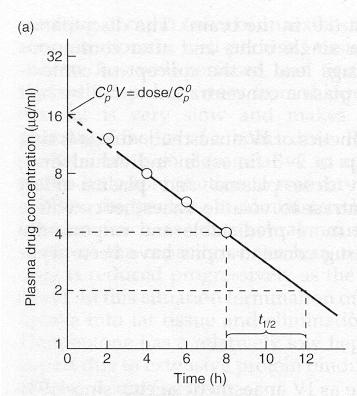
Semilogarithmic plot above
illustrates extrapolation to time 0 required to determine the volume
of distribution;Vd = dose/Co-
also note that the drug elimination halftime can be directly
calculated from the graph. This graph applied for a single
compartment model only. For multiple compartments which will
appear as a. non-linear relationship extrapolation back to t = 0
must be performed for each compartment separately. From Goodman Gilman, A, Rall T,
Nies, A, Taylor P, eds Goodman and Gillman: The
Pharmacological Basis of Therapeutics, 8th edn, Oxford: Pergamon,
1990

Clearance
-
Clearance of
a given drug is usually constant over the
therapeutic concentration range because:
-
Drug elimination systems
are not saturated -- therefore the
absolute rate of elimination is a linear
function of the drug's plasma
concentration.
-
Drug elimination is
therefore usually a first-order kinetic
process-- a constant fraction of the drug
is eliminated per unit time.
-
Some drugs (e.g.,
ethanol) exhibit zero order kinetics --
a constant amount of drug is eliminated
per unit time. {Clearance is variable}
-
Clearance: the drug's rate of elimination (by all routes)
normalized to the concentration of drug C in some
biological fluid:
-
CL
= Rate of elimination /
C
-
CL
= Vd x kel where Vd
= volume of distribution and kel is the elimination rate
constant
-
CL
= Vd x (0.693/t1/2) where
0.693 = ln2 and t1/2
is the drug elimination half-life
Clearances > 6
ml/min./kg -- including:
-
chlorpromazine:
(antipsychotic)
-
diltiazem: (Ca2+
channel blocker)
-
imipramine:
(tricyclic
antidepressant)
-
lidocaine:
(antiarrhythmic)
-
morphine: (opioid
analgesic)
-
propoxyphene:
(opioid
analgesic)
-
propranolol: (beta adrenergic receptor
blocker)
|
-
verapamil: (Ca2+
channel blocker)
-
meperidine:
(opioid analgesic)
-
desipramine:
(tricyclic
antidepressant)
-
amitriptyline:
(tricyclic
antidepressant)
-
isoniazid:
(anti-tuberculosis)
|
Holford, N. H.G. and Benet, L.Z.
Pharmacokinetics and Pharmacodynamics: Dose Selection and
the Time Course of Drug Action, in Basic and Clinical
Pharmacology, (Katzung, B. G., ed) Appleton-Lange, 1998,
pp 34-49.
Benet, Leslie Z, Kroetz, Deanna
L. and Sheiner, Lewis B The Dynamics of Drug Absorption,
Distribution and Elimination. In, Goodman and Gillman's
The Pharmacologial Basis of Therapeutics,(Hardman, J.G, Limbird, L.E,
Molinoff, P.B., Ruddon, R.W, and Gilman, A.G.,eds) The McGraw-Hill Companies, Inc.,1996, pp. 3-27
Stoelting, R.K.,
"Pharmacokinetics and Pharmacodynamics of Injected
and Inhaled Drugs", in Pharmacology and Physiology
in Anesthetic Practice, Lippincott-Raven Publishers,
1999, 1-17.
|
Half-life
|
Drug Accumulation
-
With repeating drug doses,
the drug will accumulate in the body until dosing
ceases.
-
Practically: accumulation
will be observed if the dosing interval is less
than 4 half-lives.
-
Accumulation: inversely
proportional to the fraction of the dose lost in
each dosing interval
-
For example, the
accumulation factor for a drug given once every
half-life: 1/0.5 equals 2.
Bioavailability
Holford, N. H.G. and Benet, L.Z.
Pharmacokinetics and Pharmacodynamics: Dose Selection and
the Time Course of Drug Action, in Basic and Clinical
Pharmacology, (Katzung, B. G., ed) Appleton-Lange, 1998,
pp 34-49.
Benet, Leslie Z, Kroetz, Deanna
L. and Sheiner, Lewis B The Dynamics of Drug Absorption,
Distribution and Elimination. In, Goodman and Gillman's
The Pharmacologial Basis of Therapeutics,(Hardman, J.G, Limbird, L.E,
Molinoff, P.B., Ruddon, R.W, and Gilman, A.G.,eds) TheMcGraw-Hill Companies, Inc.,1996, pp. 3-27
|
|