Introduction to Medical Pharmacology
Beta-Blockers in Angina
Module 3 of 7Beta-adrenergic receptor blockers remain first-line pharmacotherapy for stable exertional angina. Their anti-ischemic mechanism follows directly from which adrenergic receptors they block and where those receptors are located in the body.
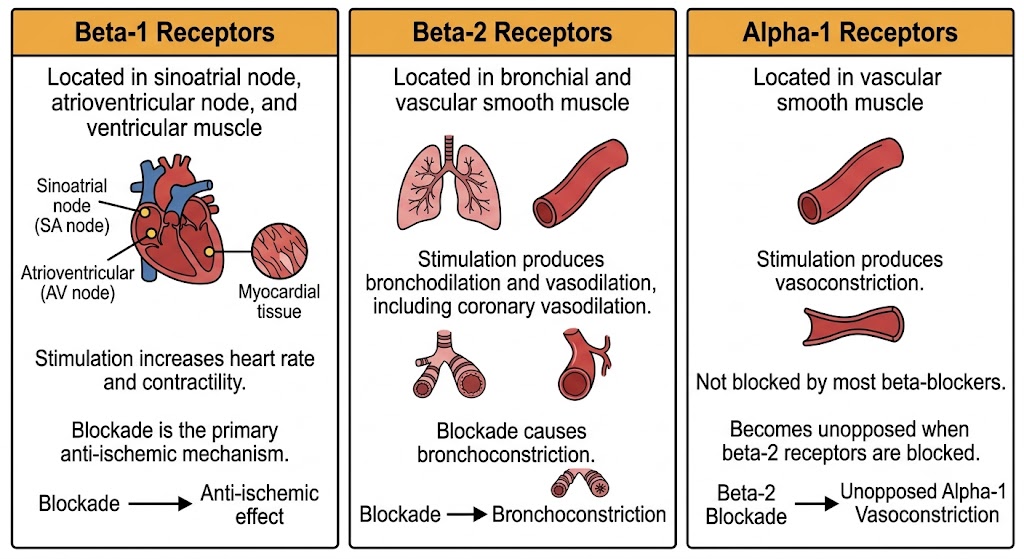
Cardioselective beta-blockers, such as metoprolol and bisoprolol, preferentially block beta-1 receptors over beta-2 receptors at standard doses, producing less bronchoconstriction and less interference with peripheral vasodilation. Non-selective agents, such as propranolol, block beta-1 and beta-2 receptors equally. Selectivity is relative rather than absolute: at high enough doses, cardioselective agents lose their selectivity and begin to block beta-2 receptors as well.
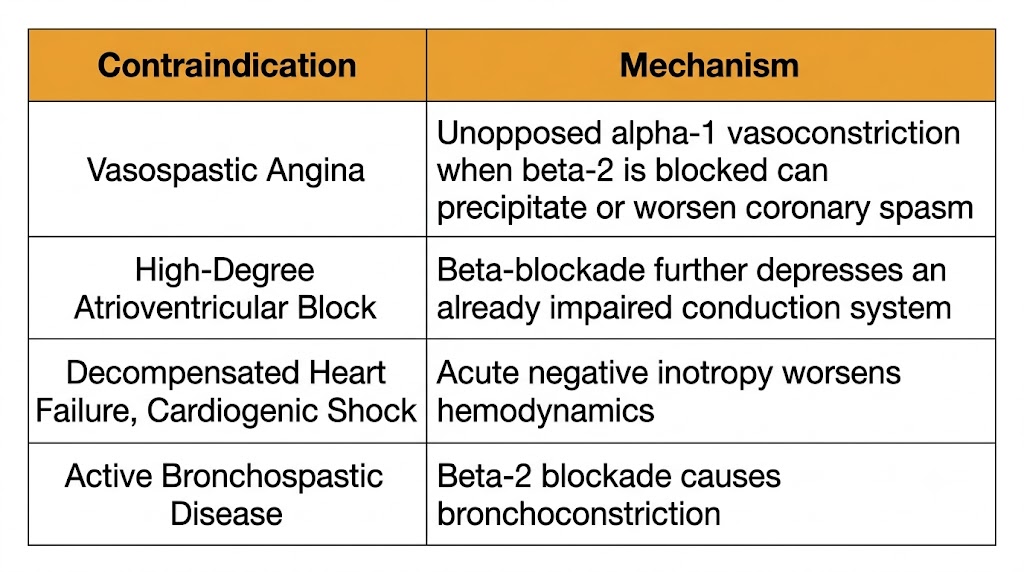
This is the same mechanism introduced in Module 1: blocking beta-2 receptors removes a normal coronary vasodilatory influence, leaving alpha-1-mediated vasoconstriction unopposed. In vasospastic angina this can precipitate or worsen spasm, and the effect applies to all beta-blockers, including cardioselective agents at typical doses.
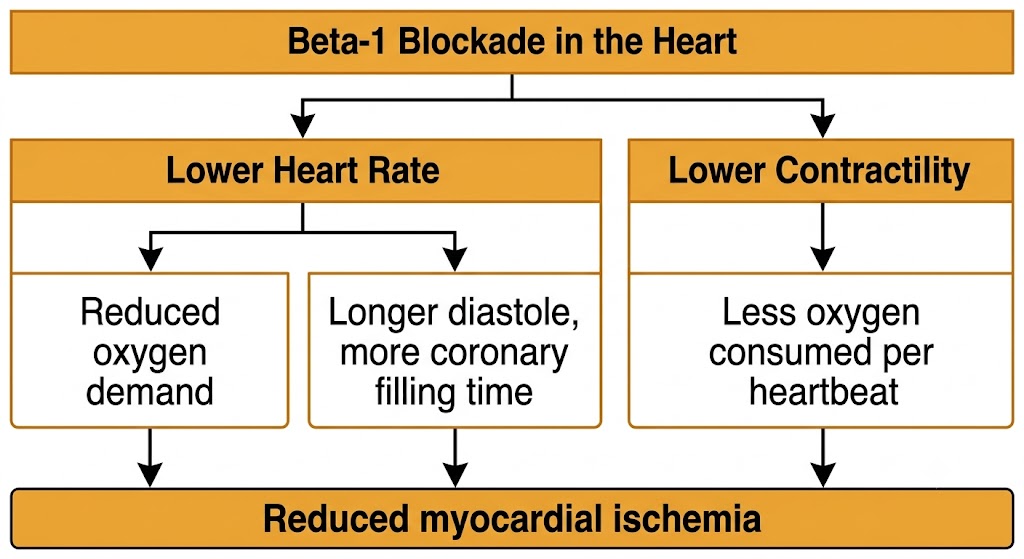
Beta-blockers are uniquely effective antianginal agents because beta-1 blockade simultaneously reduces oxygen demand and improves oxygen supply, addressing both sides of the supply-demand equation introduced in Module 1.
Beta-1 blockade in the sinoatrial node slows the heart's intrinsic pacemaker activity, lowering both resting and exertional heart rate. Heart rate is the single largest determinant of myocardial oxygen demand, so slowing it lowers demand at rest and prevents the sympathetically driven heart rate surge that would otherwise push a patient above their ischemic threshold during exertion.
Slowing the heart rate also improves oxygen supply. Coronary blood flow to the subendocardium occurs predominantly during diastole, since systolic compression of the coronary microvasculature limits flow during contraction. A slower heart rate lengthens the diastolic interval per cycle, increasing the time available for coronary filling.
Beta-1 blockade in the ventricular myocardium also reduces the force of each contraction. Lower contractility means less oxygen consumed per cardiac cycle, contributing a secondary reduction in myocardial oxygen demand alongside the dominant heart rate effect.
Both nitrates and dihydropyridine calcium channel blockers lower blood pressure, which triggers a baroreceptor-mediated reflex increase in heart rate that partially offsets their anti-ischemic benefit. Beta-blockers prevent this reflex from raising heart rate, which is the central rationale for combining a beta-blocker with either a nitrate or a dihydropyridine calcium channel blocker.
While all beta-blockers share the core mechanism described above, a handful of agents have additional pharmacological properties that distinguish them clinically.
| Property | Representative Agent | Clinical Relevance |
|---|---|---|
| Added alpha-1 blockade | Carvedilol | Additional peripheral vasodilation and afterload reduction |
| Nitric oxide-mediated vasodilation | Nebivolol | Less peripheral vasoconstriction than typical beta-blockers |
| High lipid solubility | Propranolol, metoprolol | Greater central nervous system penetration; more fatigue and sleep disturbance |
For routine stable angina, a cardioselective agent without these additional properties is typically sufficient. Carvedilol and nebivolol become more relevant when angina coexists with heart failure or when minimizing peripheral vasoconstriction is a priority.
Beta-blockers are not contraindicated in stable, well-compensated heart failure with reduced ejection fraction. In that setting, carefully initiated and slowly uptitrated beta-blockade is part of standard therapy and provides a survival benefit. The contraindication applies specifically to acute decompensation, not to chronic stable disease.
Beta-blockers should never be discontinued abruptly in a patient with coronary artery disease or angina. Stopping suddenly can produce a withdrawal syndrome that is sometimes more severe than the original symptoms the drug was prescribed to control.
Chronic beta-receptor blockade causes the body to compensate by increasing the number and sensitivity of beta-adrenergic receptors on cardiac tissue, a process called receptor upregulation. If the beta-blocker is stopped abruptly, this enlarged, more sensitive receptor population is suddenly exposed to the patient's normal circulating catecholamines.
The result is an exaggerated sympathetic response: rebound tachycardia and hypertension, a sharp rise in myocardial oxygen demand, and an increased risk of rebound angina that can be more severe than the patient's baseline symptoms, along with an elevated risk of myocardial infarction and dangerous arrhythmias.
Beta-blockers are always tapered, never stopped abruptly, in patients with known coronary artery disease. A gradual dose reduction over one to two weeks allows the upregulated receptor population time to return to its normal baseline sensitivity before the protective blockade is fully withdrawn.
| Author / Organization | Title | Source |
|---|---|---|
| Freemantle N, Cleland J, Young P, Mason J, Harrison J. | Beta blockade after myocardial infarction: systematic review and meta regression analysis | BMJ, 1999 |
| MERIT-HF Study Group. | Effect of metoprolol CR/XL in chronic heart failure (MERIT-HF) | Lancet, 1999 |
| CIBIS-II Investigators and Committees. | The Cardiac Insufficiency Bisoprolol Study II (CIBIS-II) | Lancet, 1999 |
| Packer M, Coats AJ, Fowler MB, et al. | Effect of carvedilol on survival in severe chronic heart failure (COPERNICUS) | New England Journal of Medicine, 2001 |
| Knuuti J, Wijns W, Saraste A, et al. | 2019 ESC Guidelines for the diagnosis and management of chronic coronary syndromes | European Heart Journal, 2020 |
| Fihn SD, Gardin JM, Abrams J, et al. | 2012 ACCF/AHA Guideline for the diagnosis and management of patients with stable ischemic heart disease | Journal of the American College of Cardiology, 2012 |
| Bangalore S, Steg G, Deedwania P, et al. | Beta-blocker use and clinical outcomes in stable outpatients with and without coronary artery disease | JAMA, 2012 |
| Salpeter SR, Ormiston TM, Salpeter EE. | Cardioselective beta-blockers for reversible airway disease | Cochrane Database of Systematic Reviews, 2002 |
| Lopez-Sendon J, Swedberg K, McMurray J, et al. | Expert consensus document on beta-adrenergic receptor blockers | European Heart Journal, 2004 |
| Poole-Wilson PA, Swedberg K, Cleland JGF, et al. | Comparison of carvedilol and metoprolol on clinical outcomes in patients with chronic heart failure (COMET) | Lancet, 2003 |
| Dargie HJ. | Effect of carvedilol on outcome after myocardial infarction in patients with left-ventricular dysfunction (CAPRICORN) | Lancet, 2001 |
| Flather MD, Shibata MC, Coats AJS, et al. | Randomized trial to determine the effect of nebivolol on mortality and cardiovascular hospital admission in elderly patients with heart failure (SENIORS) | European Heart Journal, 2005 |
| Devereaux PJ, Yang H, Yusuf S, et al. | Effects of extended-release metoprolol succinate in patients undergoing non-cardiac surgery (POISE trial) | Lancet, 2008 |