CHAPTER 9 ยท ANTIANGINAL DRUGS
Section 1
Mechanism of Action
Nitrates are nitric oxide donors that relax vascular smooth muscle, with effects that depend on dose.

Organic nitrates are prodrugs. Once administered, they are converted in the body to nitric oxide, the same signaling molecule that healthy blood vessel lining normally produces to keep vascular smooth muscle relaxed. This single mechanism explains every major effect of nitrates, from rapid relief of an angina attack to the precautions taken when prescribing them.

The Nitric Oxide–Cyclic GMP Pathway

After bioactivation, nitric oxide diffuses into vascular smooth muscle cells and activates an enzyme called soluble guanylyl cyclase, which raises intracellular levels of cyclic guanosine monophosphate. Cyclic guanosine monophosphate activates protein kinase G, which ultimately reduces the muscle's ability to maintain contraction. The result is vascular smooth muscle relaxation, which translates into vasodilation.

This pathway is identical to how endothelial cells normally signal blood vessels to relax. In patients with atherosclerosis, the diseased vessel lining often cannot produce enough nitric oxide on its own. Organic nitrates effectively supply this signal from the outside.

Dose-Dependent Selectivity: Veins, Arteries, and Coronaries

Nitrates do not affect every blood vessel equally, and which vessels respond depends on the dose. At low to standard doses, the large capacitance veins are the most sensitive target. Venodilation pools blood in the peripheral venous system, which reduces the volume of blood returning to the heart and lowers ventricular filling pressure. This is preload reduction, and it is the dominant effect of nitrates at typical doses.

At higher doses, arterial smooth muscle becomes affected as well, producing afterload reduction in addition to the venous effect. Coronary arteries, by contrast, are sensitive to nitrates at virtually any dose. This is why sublingual nitroglycerin works so reliably and so quickly in vasospastic angina, discussed in Module 1: it directly dilates the spastic epicardial coronary artery, independent of whatever else is happening with venous tone.

Connecting the Levers

Recall the four-lever framework from Module 1. Nitrates are the prototype preload-reducing agent at standard doses and contribute to coronary vasodilation at all doses, making them relevant to both stable and vasospastic angina through two different mechanisms.
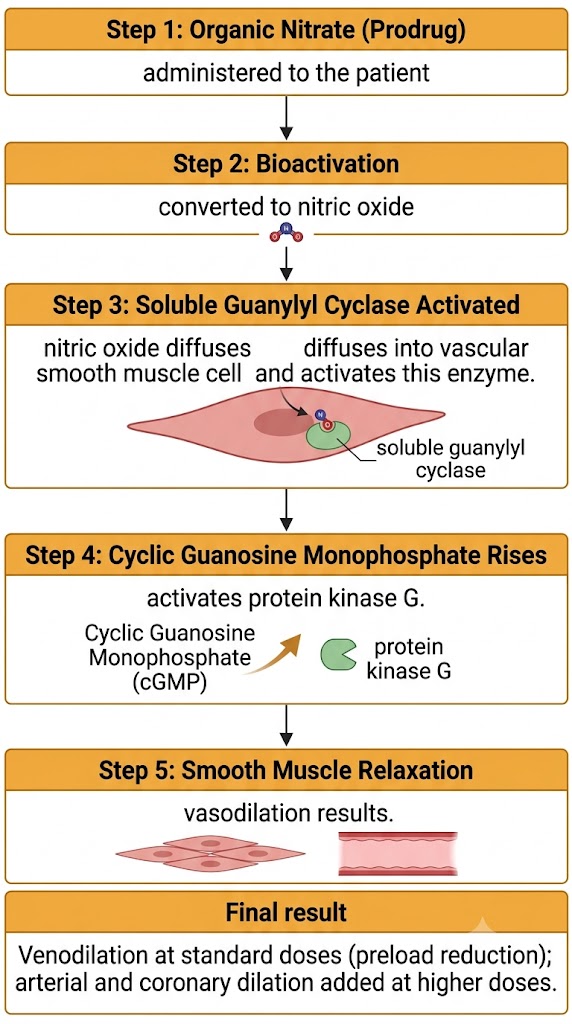
A flow diagram showing how organic nitrates are bioactivated to nitric oxide, which activates soluble guanylyl cyclase, raises cyclic guanosine monophosphate, and produces vascular smooth muscle relaxation.
The nitric oxide–cyclic guanosine monophosphate pathway.

Section 2
Formulations and Clinical Use
Matching the right nitrate formulation to acute relief versus chronic prevention.

The clinical usefulness of a given nitrate formulation depends almost entirely on how quickly it acts and how long that action lasts. Fast, short-acting formulations are used to treat an angina attack already in progress. Slower, longer-acting formulations are used to prevent attacks from happening at all.

Acute Relief: Sublingual Nitroglycerin

Sublingual nitroglycerin is absorbed directly into the systemic circulation across the oral mucosa, bypassing the liver entirely. This avoids the extensive first-pass hepatic metabolism that nitroglycerin undergoes when swallowed, and it is the reason sublingual nitroglycerin acts within minutes. It is the standard treatment for an angina attack already underway and can also be taken shortly before an activity known to provoke symptoms.

Chronic Prophylaxis: Oral and Transdermal Formulations

Long-acting oral nitrates and the transdermal nitroglycerin patch are used to prevent angina from occurring during everyday activity, not to treat an attack in progress, because their onset is too slow for acute relief. Long-acting nitrates reduce how often angina occurs and improve exercise tolerance, but they do not reduce mortality or the risk of myocardial infarction in stable coronary artery disease; their benefit is purely symptomatic.

Because nitrates alone tend to provoke a reflex increase in heart rate as the body compensates for vasodilation, long-acting nitrate therapy is almost always paired with a heart-rate-reducing agent such as a beta-blocker or a non-dihydropyridine calcium channel blocker.

Formulation Onset Primary Use
Sublingual nitroglycerinMinutesAcute angina relief
Oral isosorbide mononitrate30–60 minutesChronic prophylaxis
Transdermal nitroglycerin patch30–60 minutesChronic prophylaxis
Intravenous nitroglycerinImmediateAcute coronary syndrome, acute heart failure, hospital settings only
Intravenous Nitroglycerin

Intravenous nitroglycerin produces an immediate effect that resolves within minutes of stopping the infusion, making it titratable in real time. It is reserved for hospital settings: symptom control and hemodynamic stabilization in acute coronary syndrome, and rapid preload and afterload reduction in acute decompensated heart failure.


Section 3
Nitrate Tolerance
Continuous nitrate exposure blunts the drug's own effect — and a planned drug-free period restores it.

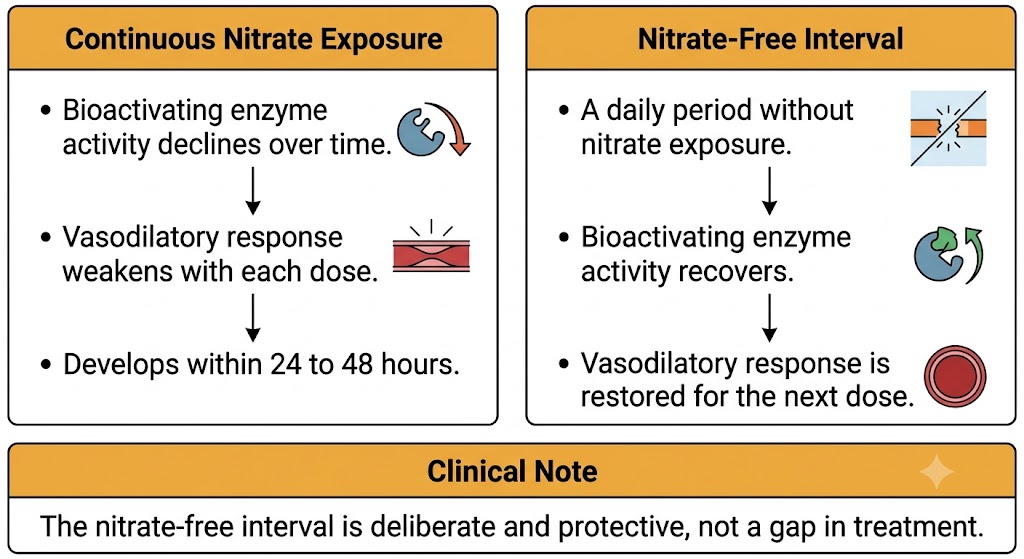
Nitrate tolerance is the loss of hemodynamic and anti-ischemic effect that develops when nitrates are given continuously, typically within twenty-four to forty-eight hours. It is one of the most clinically important and most frequently mismanaged aspects of nitrate therapy.

Why Tolerance Develops

Continuous nitrate exposure reduces the activity of the enzyme responsible for converting the prodrug into active nitric oxide. With less nitric oxide generated per dose, the vasodilatory response weakens even though the patient is taking the same amount of drug. Patients and clinicians sometimes mistake this attenuated response for worsening of the underlying coronary disease rather than recognizing it as a predictable pharmacologic phenomenon.

The Fix: A Nitrate-Free Interval

A daily period of several hours without nitrate exposure is the only reliably effective way to prevent and reverse tolerance. During this nitrate-free interval, the bioactivating enzyme recovers and the vasodilatory response to the next dose is restored. Every long-acting nitrate regimen is dosed specifically to build in this drug-free window, which is why long-acting nitrates are never dosed at evenly spaced intervals around the clock.

A two-panel diagram comparing continuous nitrate exposure, which causes tolerance through declining bioactivation, against a nitrate-free interval, which restores the vasodilatory response.
Nitrate tolerance and the nitrate-free interval.

Because the nitrate-free interval typically falls overnight, and overnight and early morning hours are already the period of highest circadian risk for angina, patients on long-acting nitrate therapy should also be maintained on a heart-rate-reducing agent that provides continuous protection independent of nitrate coverage.


Section 4
Adverse Effects
Most nitrate adverse effects are direct, predictable extensions of the vasodilatory mechanism itself.
Headache

Headache is the most common adverse effect of nitrate therapy, resulting from the same nitric oxide-mediated vasodilation acting on cerebral blood vessels. It typically improves within one to two weeks as a degree of tolerance develops in the cerebral vasculature faster than the desired hemodynamic tolerance develops elsewhere. Patients should be counseled that headache is an expected, non-dangerous effect, since unexplained headache is a common reason patients stop taking nitrates on their own.

Hypotension and Reflex Tachycardia

Because nitrates lower blood pressure through vasodilation, orthostatic hypotension can occur, particularly with the first dose. The resulting drop in blood pressure also triggers a baroreceptor-mediated reflex increase in heart rate, which raises myocardial oxygen demand and can partially offset the drug's own anti-ischemic benefit. This is the mechanistic reason long-acting nitrate therapy is paired with a heart-rate-reducing agent.

Phosphodiesterase Type 5 Inhibitor Interaction
Critical Contraindication

Phosphodiesterase type 5 inhibitors, used for erectile dysfunction, work by preventing the breakdown of cyclic guanosine monophosphate. Because nitrates raise cyclic guanosine monophosphate through the nitric oxide pathway, combining the two produces an exaggerated, potentially life-threatening drop in blood pressure. Nitrates are absolutely contraindicated within the window following recent phosphodiesterase type 5 inhibitor use, with the exact duration depending on the specific agent's half-life. Any patient presenting with chest pain should be asked directly about recent phosphodiesterase type 5 inhibitor use before any nitrate is administered.

Methemoglobinemia

At high doses, organic nitrates can oxidize hemoglobin into methemoglobin, a form that cannot bind oxygen effectively. This is rare and occurs primarily with prolonged high-dose intravenous nitroglycerin. It presents as cyanosis that does not improve with supplemental oxygen, since the underlying problem is the hemoglobin itself rather than oxygen delivery.


Section 5
Contraindications
A single mechanism — preload dependence — explains the three classic nitrate contraindications.

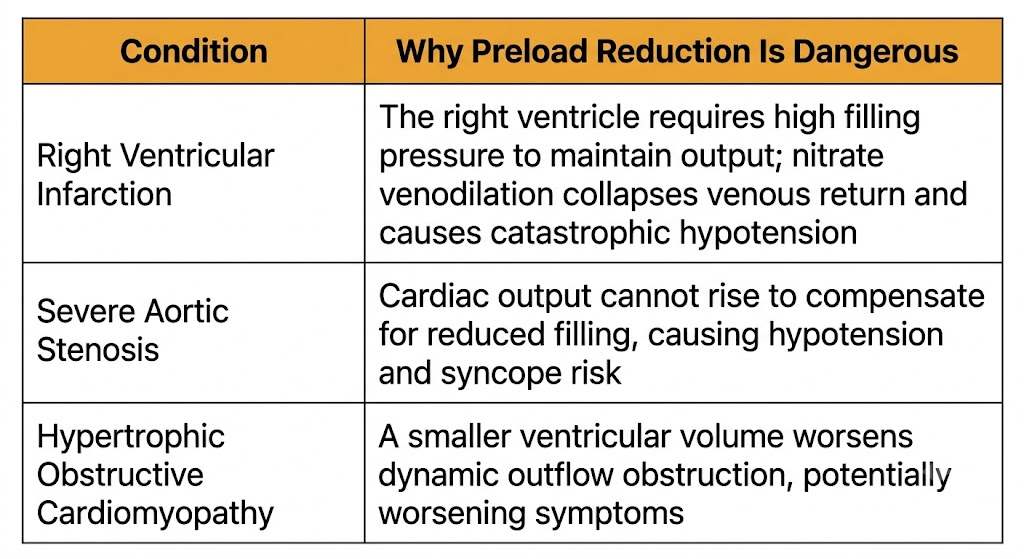
Because the dominant effect of nitrates at standard doses is venodilation and preload reduction, nitrates are dangerous in any condition where the heart depends on a high filling pressure to maintain adequate output. Three conditions illustrate this principle.

Preload-Dependent Right Heart
Right Ventricular Infarction
  • Right ventricle requires high filling pressure
  • Nitrate-induced venodilation collapses venous return
  • Result: catastrophic hypotension
Fixed Outflow Obstruction
Severe Aortic Stenosis
  • Cardiac output cannot rise to compensate
  • Preload reduction alone causes hypotension
  • Risk of syncope
Dynamic Outflow Obstruction
Hypertrophic Obstructive Cardiomyopathy
  • Smaller ventricular volume worsens obstruction
  • Preload reduction increases outflow gradient
  • Symptoms can worsen, not improve
A reference table listing the three preload-dependent contraindications to nitrate therapy: right ventricular infarction, severe aortic stenosis, and hypertrophic obstructive cardiomyopathy, with the mechanism explaining why each is dangerous.
The three preload-dependent contraindications to nitrate therapy.
A Common Thread

In each of these three conditions, the heart's ability to generate adequate output is already compromised in a way that depends on maintaining ventricular filling. Removing preload, the one parameter nitrates reliably reduce, removes the compensation the heart is relying on. The same logic explains why alcohol, which independently produces vasodilation and blunts the baroreceptor reflex, potentiates nitrate-induced hypotension and is generally avoided around the time of nitrate dosing.


Suggested References
Author / Organization Title Source
Brunton TL.Use of nitrite of amyl in angina pectorisLancet, 1867
Murrell W.Nitroglycerin as a remedy for angina pectorisLancet, 1879
Münzel T, Daiber A, Mülsch A.Explaining the phenomenon of nitrate toleranceCirculation Research, 2005
Chen Z, Stamler JS.Bioactivation of nitroglycerin by the mitochondrial aldehyde dehydrogenaseTrends in Cardiovascular Medicine, 2006
Parker JD, Parker JO.Nitrate therapy for stable angina pectorisNew England Journal of Medicine, 1998
Cohn JN, Franciosa JA.Vasodilator therapy of cardiac failureNew England Journal of Medicine, 1977
Amsterdam EA, Wenger NK, Brindis RG, et al.2014 AHA/ACC Guideline for the management of patients with non-ST-elevation acute coronary syndromesJournal of the American College of Cardiology, 2014
Beltrame JF, Crea F, Kaski JC, et al.International standardization of diagnostic criteria for vasospastic anginaEuropean Heart Journal, 2017
Ibanez B, James S, Agewall S, et al.2017 ESC Guidelines for the management of acute myocardial infarction in patients presenting with ST-segment elevationEuropean Heart Journal, 2018
Knuuti J, Wijns W, Saraste A, et al.2019 ESC Guidelines for the diagnosis and management of chronic coronary syndromesEuropean Heart Journal, 2020
Münzel T, Gori T, Bruno RM, Taddei S.Is oxidative stress a therapeutic target in cardiovascular disease?European Heart Journal, 2010
Cheitlin MD, Hutter AM Jr, Brindis RG, et al.Use of sildenafil (Viagra) in patients with cardiovascular diseaseJournal of the American College of Cardiology, 1999
Thadani U.Nitrate tolerance, rebound, and their clinical relevance in stable angina pectoris, unstable angina, and heart failureCardiovascular Drugs and Therapy, 1997