Clinically significant drug interactions, class-specific toxicities, dose adjustment in organ impairment, and use in pregnancy and pediatrics
ABAC · Module 12Section 1
Cytochrome P450-mediated pharmacokinetic interactions, QTc prolongation, and direct pharmacodynamic effects
Antibiotic drug interactions fall into two categories: pharmacokinetic interactions, in which one drug alters the metabolism or elimination of another, and pharmacodynamic interactions, in which two drugs act on the same physiological target or toxicity pathway. The most clinically consequential involve cytochrome P450 enzyme inhibition or induction, QTc prolongation, and additive organ toxicity.
Erythromycin and clarithromycin are potent inhibitors of cytochrome P450 3A4, the isoenzyme responsible for metabolizing a large proportion of commonly prescribed drugs including statins (simvastatin, lovastatin), calcineurin inhibitors (tacrolimus, cyclosporine), certain calcium channel blockers, benzodiazepines, and warfarin. Co-administration with simvastatin or lovastatin is contraindicated due to the risk of severe rhabdomyolysis from markedly elevated statin concentrations. Azithromycin is a much weaker cytochrome P450 3A4 inhibitor and carries substantially lower interaction burden, which partly explains its clinical dominance over erythromycin and clarithromycin for respiratory tract infections.
All fluoroquinolones chelate divalent and trivalent cations — calcium, magnesium, iron, zinc, and aluminum — dramatically reducing oral absorption when co-administered with antacids, calcium supplements, iron preparations, sucralfate, or dairy products. The fluoroquinolone must be taken at least two hours before or six hours after such agents. Ciprofloxacin is a significant inhibitor of cytochrome P450 1A2 and raises theophylline concentrations substantially through this mechanism, making the ciprofloxacin-theophylline combination potentially dangerous without close monitoring.
Fluoroquinolones prolong the QTc interval by a direct cardiac effect. This effect is most pronounced with moxifloxacin, intermediate with levofloxacin, and minimal with ciprofloxacin. Co-administration of fluoroquinolones with other QTc-prolonging agents — antiarrhythmics, antipsychotics, tricyclic antidepressants — requires electrocardiographic monitoring and should be avoided when alternatives exist.
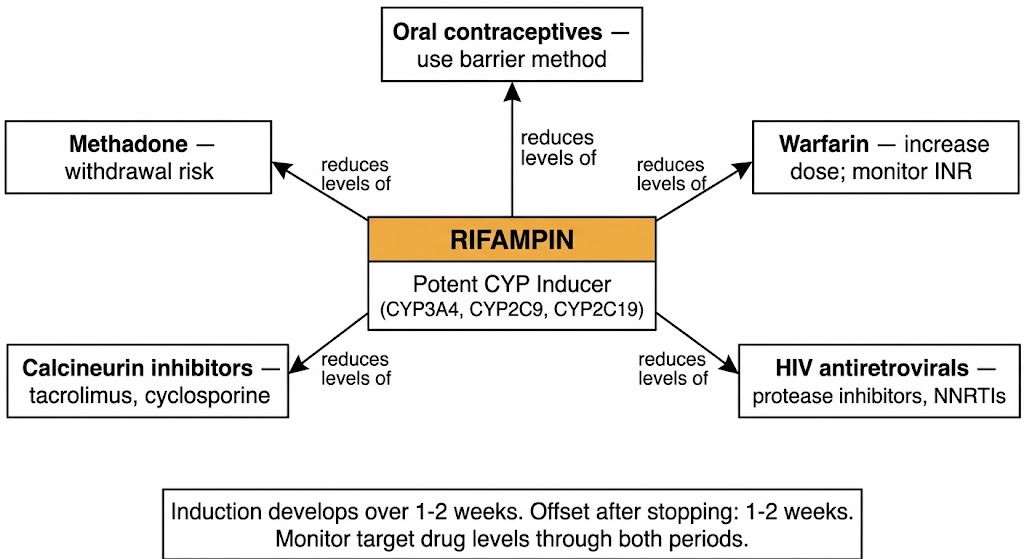
Rifampin is one of the most potent inducers of cytochrome P450 3A4 and multiple other metabolic pathways in clinical medicine. It dramatically reduces plasma concentrations of drugs metabolized by these enzymes, including oral contraceptives (requiring additional barrier contraception), warfarin (requiring substantially increased doses to maintain therapeutic anticoagulation), antiretrovirals (especially protease inhibitors and non-nucleoside reverse transcriptase inhibitors), calcineurin inhibitors, methadone, corticosteroids, and many antifungals. The induction effect takes one to two weeks to develop fully and similarly one to two weeks to resolve after discontinuation — requiring close monitoring of target drug concentrations through both the initiation and cessation periods.
Aminoglycosides and loop diuretics (furosemide, ethacrynic acid) both cause ototoxicity; their combination produces synergistic ototoxicity and should be avoided whenever possible. The combination of vancomycin with piperacillin-tazobactam has been associated with significantly increased rates of acute kidney injury compared to vancomycin alone. Tetracyclines can attenuate the bactericidal activity of penicillins by arresting bacterial growth — a pharmacodynamic antagonism most relevant in clinical scenarios where bactericidal activity is critical, such as bacterial meningitis.
Linezolid is a reversible, nonselective monoamine oxidase inhibitor. Its combination with serotonergic agents — selective serotonin reuptake inhibitors, serotonin-norepinephrine reuptake inhibitors, tricyclic antidepressants, tramadol, meperidine — can precipitate serotonin syndrome, manifesting as agitation, hyperthermia, myoclonus, tachycardia, and potentially life-threatening autonomic instability. Linezolid should be avoided with concurrent serotonergic drugs unless the benefit clearly outweighs the risk.
QTc-Prolonging Antibiotics — Check Before Prescribing
Before prescribing moxifloxacin, azithromycin, or clarithromycin, check: baseline QTc on electrocardiogram (avoid if QTc exceeds 500 ms); concurrent QTc-prolonging medications; electrolyte status (hypokalemia and hypomagnesemia lower the threshold for serious arrhythmia); and underlying cardiac disease. Congenital long QT syndrome and recent myocardial infarction are major additional risk factors.
Section 2
Class-specific toxicity profiles, recognition, and management principles
Class-specific toxicity profiles are determined by the mechanism of action, pharmacokinetic distribution, and off-target binding of each drug family. Recognizing class-specific adverse effect signatures enables earlier attribution and more appropriate management.
Beta-lactams are generally the safest antibiotic class in terms of direct organ toxicity, but hypersensitivity reactions are their most clinically important adverse effect. Immediate IgE-mediated reactions (urticaria, angioedema, bronchospasm, anaphylaxis) occur rarely. Penicillin skin testing is the gold standard for evaluating IgE-mediated penicillin allergy; patients who test negative can receive penicillins with normal risk. Cross-reactivity between penicillins and cephalosporins is approximately 1 to 2%, far lower than the frequently cited but outdated 10% figure, and is attributable to shared side chains rather than the beta-lactam ring itself. Carbapenems have very low cross-reactivity with penicillins and are generally safe in most penicillin-allergic patients.
Aminoglycosides carry two dose-dependent, cumulative toxicities requiring active monitoring. Nephrotoxicity results from drug accumulation in proximal tubular cells. Risk factors include pre-existing renal impairment, volume depletion, concurrent nephrotoxins, prolonged duration, and higher total daily doses. Extended-interval (once-daily) aminoglycoside dosing is now preferred for most indications because the prolonged drug-free interval allows tubular cells to clear the drug before the next dose, reducing cumulative cortical accumulation. Ototoxicity — both cochlear (sensorineural hearing loss) and vestibular (vertigo, ataxia) — is cumulative and frequently irreversible; audiometric monitoring is recommended for courses exceeding 14 days.
Fluoroquinolones carry a United States Food and Drug Administration black box warning covering five categories: tendinitis and tendon rupture (most commonly the Achilles tendon), peripheral neuropathy (may be permanent), central nervous system effects (psychosis, increased intracranial pressure, seizures), exacerbation of myasthenia gravis (contraindicated in known myasthenia gravis), and aortic aneurysm and dissection in high-risk patients. Current Food and Drug Administration guidance recommends reserving fluoroquinolones for serious infections when no safer alternative exists. Tendinopathy risk is substantially elevated in patients over 60 years, patients receiving concurrent corticosteroids, and patients with prior tendinopathy.
Tetracyclines cause photosensitivity through a phototoxic mechanism. Patients must use sunscreen and minimize sun exposure during therapy. Doxycycline causes esophageal ulceration if swallowed without adequate water or in the supine position; patients must remain upright for at least 30 minutes after dosing. Tetracyclines chelate calcium in developing bone and teeth, causing permanent yellow-gray staining and enamel hypoplasia in children under 8 and in fetuses after the first trimester — the basis for their contraindication in young children and pregnancy.
Vancomycin nephrotoxicity is monitored through area-under-the-curve-guided dosing using Bayesian methods, which replaced trough-only monitoring following the 2020 joint consensus guidelines. Red man syndrome — a non-IgE-mediated infusion reaction causing flushing, erythema, and pruritus of the head, neck, and upper torso — results from direct histamine release and is prevented by infusing the drug over at least 60 minutes. Daptomycin causes skeletal muscle toxicity through its membrane-disrupting activity; creatine phosphokinase must be monitored weekly, and daptomycin should be discontinued if creatine phosphokinase rises substantially. Daptomycin must never be used for pneumonia due to inactivation by pulmonary surfactant.
Section 3
Creatinine clearance-based dosing, renally eliminated antibiotics, hepatically metabolized agents, and augmented renal clearance
Approximately 75% of antibiotic dose adjustments in clinical practice are driven by renal impairment, because most antibiotics and their active metabolites are primarily renally eliminated. Failure to adjust doses risks drug accumulation and toxicity — which may itself worsen the organ impairment being managed.
Creatinine clearance estimated by the Cockcroft-Gault equation remains the standard metric for antibiotic renal dosing adjustment, because it was used in original pharmacokinetic studies of most established agents and incorporates body weight in addition to serum creatinine. In acutely ill patients with acute kidney injury, serum creatinine may lag behind the actual glomerular filtration rate by 24 to 48 hours. Augmented renal clearance — defined as creatinine clearance exceeding 130 mL/min, found in young, severely ill patients with high cardiac output states — poses the opposite problem: standard doses may produce subtherapeutic concentrations of renally cleared antibiotics, requiring dose escalation.
Most penicillins and cephalosporins require dose reduction at varying creatinine clearance thresholds. Ceftriaxone is a notable exception — it is primarily eliminated by biliary excretion and requires no renal dose adjustment even in patients on dialysis, making it a convenient choice when a third-generation cephalosporin is needed in severe kidney disease. Imipenem-cilastatin requires dose reduction in significant renal impairment to prevent seizures from drug accumulation. For time-dependent beta-lactams, extended or continuous infusion strategies can maintain adequate pharmacodynamic target attainment while limiting peak concentrations in renal impairment.
Aminoglycosides require the most careful renal dose adjustment of any antibiotic class. In patients with significant renal impairment, extended-interval dosing is replaced by multiple-daily dosing with therapeutic drug monitoring of peak and trough concentrations. Both aminoglycosides and vancomycin are significantly removed by hemodialysis and continuous renal replacement therapy, requiring supplemental post-dialysis doses. Vancomycin area-under-the-curve-guided dosing uses initial loading doses independent of renal function, followed by maintenance doses adjusted in proportion to creatinine clearance reduction.
Hepatically metabolized antibiotics require dose adjustment primarily in severe hepatic impairment. Metronidazole is extensively hepatically metabolized; its half-life may extend significantly in severe hepatic failure, requiring dose reduction and avoiding prolonged courses. Clindamycin requires dose reduction in severe hepatic impairment. Chloramphenicol accumulates in hepatic failure and in neonates with immature glucuronidation, causing gray baby syndrome through mitochondrial toxicity. Rifampin requires dose reduction in hepatic impairment and is itself hepatotoxic — liver function tests must be monitored during rifampin-based regimens.
Ceftriaxone — The Only Major Beta-Lactam Requiring No Renal Adjustment
Ceftriaxone is primarily eliminated by biliary excretion and requires no dose adjustment for any degree of renal impairment, including dialysis dependence. However, it is contraindicated in neonates with hyperbilirubinemia (competes with bilirubin for albumin binding), and its biliary elimination predisposes to biliary sludge and cholelithiasis with prolonged use.
Section 4
Fetal risk, placental transfer, breast milk excretion, and age-specific pharmacokinetic considerations in children
Antibiotic selection in pregnancy requires balancing the risk of untreated infection — which may pose a greater risk to mother and fetus than the drug — against teratogenic or fetotoxic potential. Prescribing in neonates and infants must account for the dramatic changes in pharmacokinetic parameters that occur in the first weeks and months of life.
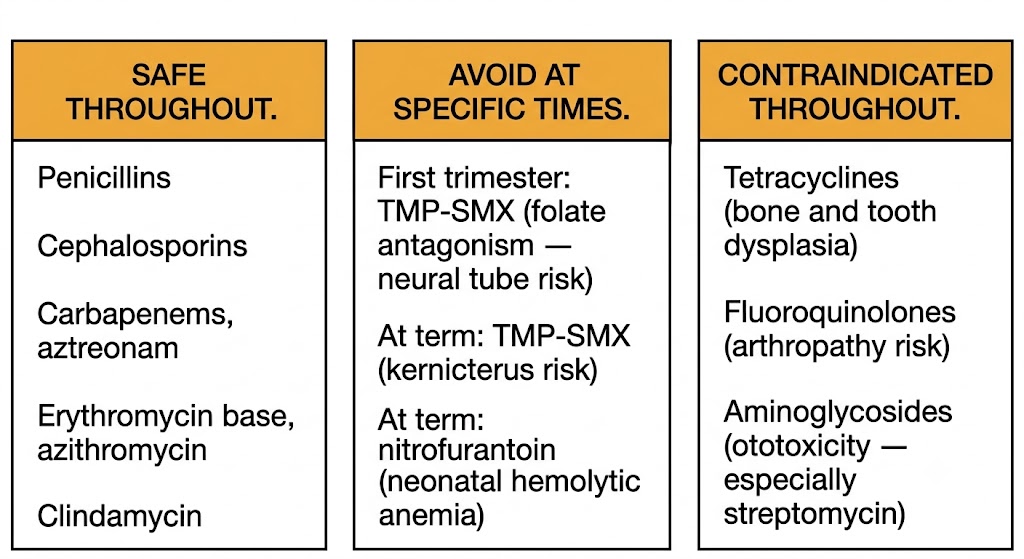
Beta-lactam antibiotics are the safest antibiotic class in pregnancy and are the agents of choice for most bacterial infections during pregnancy, including group B streptococcal prophylaxis in labor, urinary tract infections, and community-acquired pneumonia. Penicillins, cephalosporins, and carbapenems cross the placenta but have not been associated with fetal harm in large human epidemiological studies. Erythromycin base and azithromycin are acceptable for penicillin-allergic pregnant patients. Nitrofurantoin is used for uncomplicated lower urinary tract infection during pregnancy but is contraindicated at term due to the risk of neonatal hemolytic anemia in susceptible neonates.
Trimethoprim-sulfamethoxazole is avoided in the first trimester because trimethoprim inhibits dihydrofolate reductase and may contribute to neural tube defects, and at term because sulfonamides displace bilirubin from albumin, risking neonatal kernicterus.
Tetracyclines are contraindicated throughout pregnancy due to chelation of calcium in developing fetal bones and teeth, causing permanent enamel hypoplasia — a risk that is most pronounced after the first trimester when primary tooth calcification begins. Fluoroquinolones are generally avoided due to demonstrated arthropathy in immature animals and should not be used unless no safer alternative exists. Aminoglycosides cross the placenta and accumulate in fetal renal tissue and the inner ear; streptomycin has documented cases of fetal sensorineural hearing loss, and avoidance is warranted unless maternal infection risk outweighs fetal risk.
Antibiotic use during lactation is assessed by the relative infant dose — the infant's weight-adjusted dose as a percentage of the maternal weight-adjusted dose. A relative infant dose below 10% is generally considered acceptable. Beta-lactams achieve very low milk concentrations and relative infant dose values below 1%, making them compatible with breastfeeding. Tetracyclines are extensively chelated by calcium in milk, reducing infant absorption; short courses are generally considered acceptable during breastfeeding. Fluoroquinolones achieve variable milk concentrations; brief ciprofloxacin courses are generally considered compatible. Metronidazole is excreted into milk and achieves relative infant doses below 10% with standard dosing, which most authorities consider acceptable.
Neonates have a larger volume of distribution for water-soluble drugs, reduced plasma protein binding, immature renal filtration and tubular secretion, and immature hepatic cytochrome P450 enzyme activity. Hepatic cytochrome P450 enzyme activity is substantially reduced at birth and matures over the first months of life. As a result, aminoglycoside dosing intervals in neonates are substantially extended compared to older children, and the once-daily approach used in adults is replaced by age- and weight-specific protocols.
Chloramphenicol causes gray baby syndrome in neonates through accumulation due to immature glucuronidation, producing cardiovascular collapse — plasma concentration monitoring is mandatory if chloramphenicol must be used in this age group. Fluoroquinolones are generally restricted to carefully selected pediatric indications due to concerns about arthropathy. Weight-based dosing (mg/kg) is standard for children under 40 to 50 kg; maximum doses based on adult standard dosing must be applied to prevent inadvertent overdosing of larger children or adolescents. Therapeutic drug monitoring is particularly important in neonates and severely ill children, where pharmacokinetic variability is greatest.
Antibiotic Safety in Pregnancy — Practical Summary
Generally safe throughout: penicillins, cephalosporins, carbapenems, aztreonam, erythromycin base, azithromycin, clindamycin. Avoid in first trimester: trimethoprim-sulfamethoxazole (folate antagonism). Avoid at term: trimethoprim-sulfamethoxazole (kernicterus risk), nitrofurantoin (neonatal hemolytic anemia risk). Contraindicated throughout: tetracyclines (bone and tooth dysplasia), fluoroquinolones (arthropathy risk), aminoglycosides (ototoxicity risk).
Suggested References
| Author / Organization | Title | Source |
|---|---|---|
| Dresser GK, Spence JD, Bailey DG | Pharmacokinetic-pharmacodynamic consequences and clinical relevance of cytochrome P450 3A4 inhibition | Clin Pharmacokinet. 2000;38(1):41–57 |
| FDA Drug Safety Communication | FDA advises restricting fluoroquinolone antibiotic use for certain uncomplicated infections | US Food and Drug Administration. 2016; updated 2018 |
| Niemi M, Backman JT, Fromm MF, et al. | Pharmacokinetic interactions with rifampicin: clinical relevance | Clin Pharmacokinet. 2003;42(9):819–850 |
| Lodise TP, Patel N, Lomaestro BM, et al. | Relationship between initial vancomycin concentration-time profile and nephrotoxicity among hospitalized patients | Clin Infect Dis. 2009;49(4):507–514 |
| Wagen AZ, Dagan R, Solt I, et al. | Serotonin syndrome associated with linezolid: a clinical review | J Antimicrob Chemother. 2016;71(3):566–571 |
| Macy E, Romano A, Khan D | Practical management of antibiotic hypersensitivity in 2017 | J Allergy Clin Immunol Pract. 2017;5(3):577–586 |
| Rybak MJ, Le J, Lodise TP, et al. | Therapeutic monitoring of vancomycin for serious methicillin-resistant Staphylococcus aureus infections: a revised consensus guideline and review | Am J Health Syst Pharm. 2020;77(11):835–864 |
| Rybak MJ, Le J, Lodise TP, et al. | Therapeutic monitoring of vancomycin for serious methicillin-resistant Staphylococcus aureus infections: a revised consensus guideline and review | Clin Infect Dis. 2020;71(6):1361–1364 |
| Cunha BA | Minocycline and doxycycline: current and emerging clinical indications | Expert Rev Anti Infect Ther. 2012;10(6):731–742 |
| Aronoff GR, Bennett WM, Berns JS, et al. | Drug Prescribing in Renal Failure: Dosing Guidelines for Adults and Children. 5th ed. | Philadelphia: American College of Physicians; 2007 |
| Verbeeck RK | Pharmacokinetics and dosage adjustment in patients with hepatic dysfunction | Eur J Clin Pharmacol. 2008;64(12):1147–1161 |
| Bookstaver PB, Bland CM, Griffin B, et al. | A review of antibiotic use in pregnancy | Pharmacotherapy. 2015;35(11):1052–1062 |
| Hale TW | Medications and mothers milk | Planta Med. 2012;78(18):1837–1846 |
| Smits A, Kulo A, de Hoon JN, Allegaert K | Pharmacokinetics of drugs in neonates: pattern recognition beyond single-drug studies | Curr Pharm Des. 2012;18(21):3119–3146 |
| Gupta K, Hooton TM, Naber KG, et al. | International clinical practice guidelines for the treatment of acute uncomplicated cystitis and pyelonephritis in women: a 2010 update | Clin Infect Dis. 2011;52(5):e103–e120 |