The cephem scaffold, side chains, and pharmacodynamic basis of bactericidal activity
Cephalosporins are beta-lactam antibiotics built on the cephem scaffold—a beta-lactam ring fused to a six-membered dihydrothiazine ring. This structural difference from penicillins (which use a five-membered thiazolidine ring) allows greater side-chain diversity and greater stability against many beta-lactamases, forming the structural basis for the generational classification.
The two side chains attached to the cephem core determine the clinical properties of each cephalosporin: one governs antibacterial spectrum and beta-lactamase stability, and the other influences pharmacokinetic properties including protein binding, half-life, and route of elimination. Greater side-chain diversity compared to penicillins underlies the generational classification.
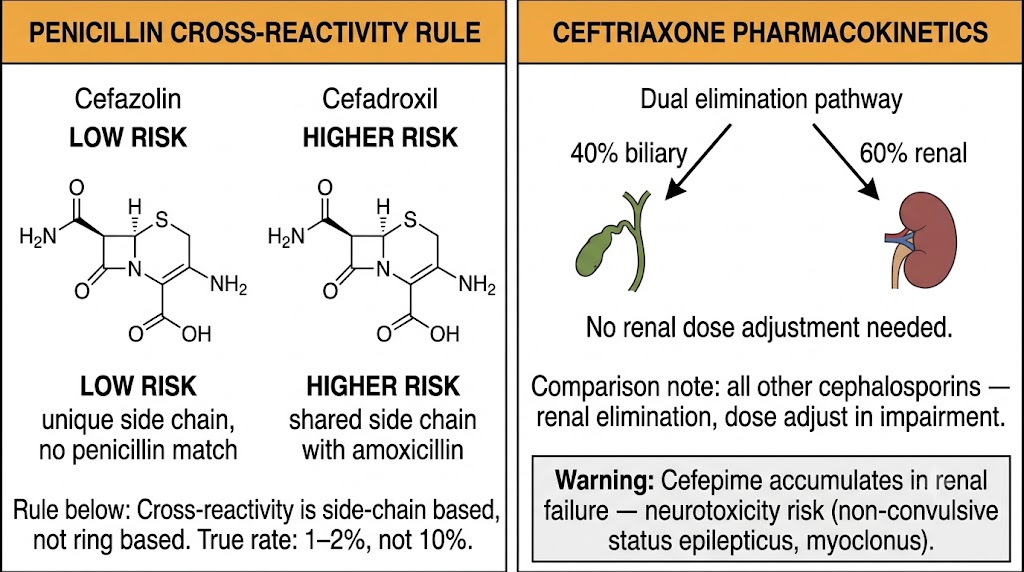
Cross-reactivity between penicillins and cephalosporins is determined primarily by similarity of these 7-position side chains—not by the shared beta-lactam ring structure. This principle governs safe prescribing in penicillin-allergic patients.
Cephalosporins act identically to penicillins: covalent inactivation of penicillin-binding protein transpeptidases, blocking peptidoglycan cross-linking, leading to bactericidal cell lysis. Killing is time-dependent. Ceftaroline (fifth-generation) uniquely binds penicillin-binding protein 2a, the low-affinity transpeptidase of methicillin-resistant Staphylococcus aureus, making it the only beta-lactam active against that organism.
Beta-lactamase stability improves across generations. First-generation agents are hydrolyzed by staphylococcal penicillinase and many gram-negative beta-lactamases. Third-generation agents resist common penicillinases but are hydrolyzed by extended-spectrum beta-lactamases. Fourth-generation cefepime has enhanced stability against chromosomal AmpC (Class C) enzymes but not against extended-spectrum beta-lactamases. Novel inhibitor combinations restore activity against extended-spectrum beta-lactamases and carbapenemases.
Ceftaroline is the only approved beta-lactam with activity against methicillin-resistant Staphylococcus aureus. It binds penicillin-binding protein 2a with sufficient affinity to block cell wall synthesis despite the low-affinity active site that confers resistance to all other beta-lactams. Approved indications are skin and soft tissue infections and community-acquired pneumonia. Use for methicillin-resistant Staphylococcus aureus bacteremia is off-label.
First through fifth generation: spectrum progression and key clinical agents
The generational classification reflects progressive broadening of gram-negative spectrum, accompanied by relative loss of gram-positive potency—with ceftaroline as the exception. Knowing the spectrum at the level of specific organisms, not just as a vague continuum, is what makes antibiotic selection rational.
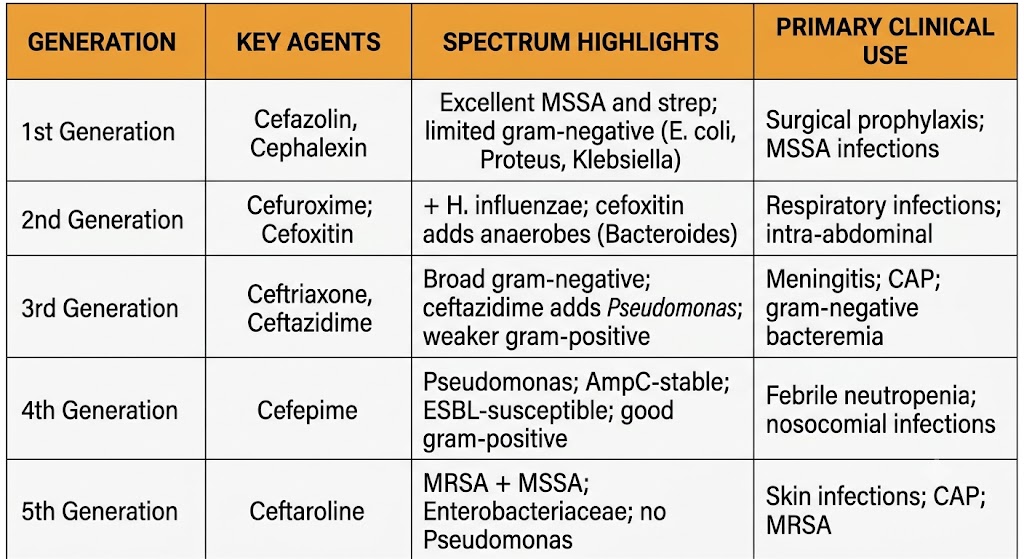
First-generation agents (cefazolin, cephalexin) have excellent activity against methicillin-susceptible Staphylococcus aureus and streptococci, with limited gram-negative coverage restricted to community-acquired Escherichia coli, Proteus mirabilis, and Klebsiella pneumoniae. No meaningful activity against Enterococcus, methicillin-resistant Staphylococcus aureus, Pseudomonas aeruginosa, or anaerobes.
Cefazolin is the preferred agent for surgical prophylaxis across most specialties and the drug of choice for methicillin-susceptible Staphylococcus aureus infections in patients who cannot tolerate antistaphylococcal penicillins. It has uniquely low cross-reactivity with penicillins because its 7-position side chain is structurally unrelated to any penicillin side chain. Cephalexin is the oral agent for outpatient skin infections.
Second-generation agents fall into two clinically distinct subgroups. The true cephalosporins (cefuroxime) extend coverage to Haemophilus influenzae and Moraxella catarrhalis while retaining gram-positive activity, and are used for outpatient respiratory infections. The cephamycins (cefoxitin, cefotetan) add anaerobic coverage including Bacteroides fragilis; they are used for intra-abdominal and gynecologic infections.
Third-generation agents (ceftriaxone, cefotaxime, ceftazidime) have substantially expanded gram-negative spectrum including most Enterobacteriaceae, Haemophilus influenzae, and Neisseria gonorrhoeae, at the cost of reduced antistaphylococcal potency compared to first-generation agents.
Ceftriaxone is the most clinically important: once-daily dosing (long half-life of approximately 8 hours), excellent cerebrospinal fluid penetration, and partial biliary elimination making it usable without dose adjustment in renal impairment. It is the standard of care for bacterial meningitis caused by susceptible organisms, community-acquired pneumonia requiring hospitalization, and most gram-negative bacteremias from susceptible organisms. Ceftazidime is the third-generation agent with antipseudomonal activity but weaker gram-positive coverage; it is now primarily used in the ceftazidime-avibactam combination for carbapenem-resistant organisms.
Cefepime is the only widely used fourth-generation agent. It has enhanced stability against chromosomal AmpC-producing organisms, covers Pseudomonas aeruginosa, and covers most Enterobacteriaceae. It retains gram-positive activity comparable to first-generation agents. It is a first-line empiric agent for febrile neutropenia and nosocomial infections where Pseudomonas is a concern. Cefepime is susceptible to extended-spectrum beta-lactamase hydrolysis.
Cefepime accumulates in renal impairment and can cause neurotoxicity: non-convulsive status epilepticus, myoclonus, and encephalopathy. Unexplained encephalopathy in a patient receiving cefepime warrants dose review and consideration of an alternative agent.
Ceftaroline covers methicillin-resistant Staphylococcus aureus, methicillin-susceptible Staphylococcus aureus, streptococci, and most Enterobacteriaceae, but lacks antipseudomonal and anaerobic coverage. Ceftolozane-tazobactam is a novel cephalosporin-inhibitor combination with enhanced antipseudomonal activity and stability against AmpC-overproducing Pseudomonas; it is not active against extended-spectrum beta-lactamase producers or carbapenem-resistant organisms.
Classical inhibitors and novel agents targeting carbapenem-resistant organisms
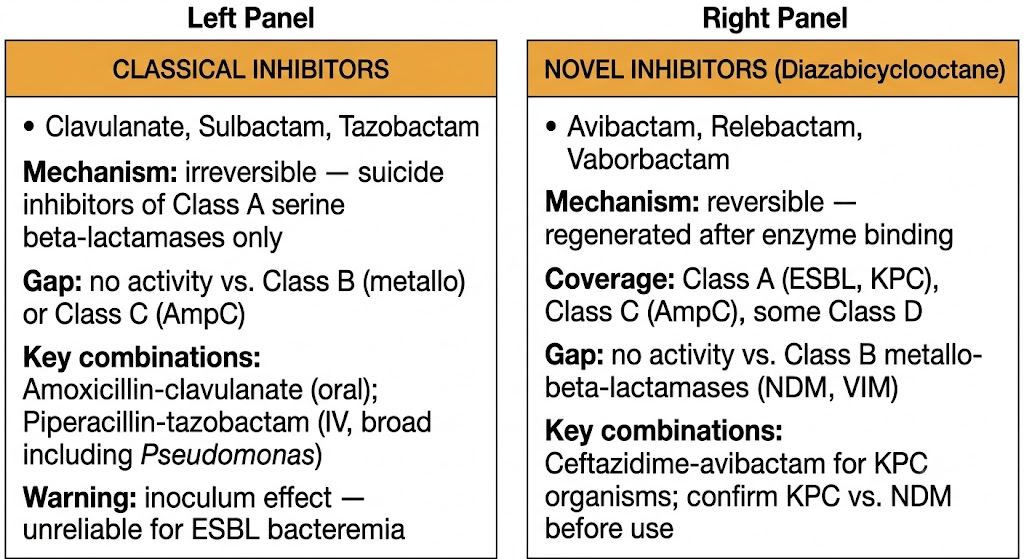
Beta-lactamase inhibitors inactivate beta-lactamase enzymes, restoring the antibacterial activity of the paired beta-lactam against organisms that would otherwise hydrolyze it. The distinction between classical inhibitors and the newer agents is clinically important: classical inhibitors work only against Class A enzymes, while the newer agents extend coverage to Class C, some Class D, and in some combinations Class B enzymes.
The three classical inhibitors are irreversible inhibitors that inactivate Class A beta-lactamases, restoring the antibacterial activity of the paired beta-lactam. They have no activity against Class B metallo-beta-lactamases or Class C AmpC enzymes.
Clavulanic acid, combined with amoxicillin (amoxicillin-clavulanate) for oral use, extends coverage to beta-lactamase-producing Haemophilus influenzae, Moraxella catarrhalis, Escherichia coli, and Klebsiella. Gastrointestinal side effects (nausea, diarrhea) and cholestatic hepatitis are recognized adverse effects of the clavulanate component. Tazobactam combined with piperacillin (piperacillin-tazobactam) is more potent than clavulanic acid and provides broad-spectrum coverage including Pseudomonas aeruginosa. Sulbactam has limited intrinsic antibacterial activity against Acinetobacter baumannii through direct penicillin-binding protein binding and is combined with durlobactam for Acinetobacter infections.
None of the classical combinations reliably treats bacteremia caused by extended-spectrum beta-lactamase-producing organisms even when in vitro testing shows susceptibility. High bacterial burden in the bloodstream overwhelms inhibitor capacity—the inoculum effect. Carbapenems remain the standard of care for serious extended-spectrum beta-lactamase infections.
The newer inhibitors extend activity beyond Class A enzymes to include Class C AmpC and some Class D serine beta-lactamases, and critically to Class A carbapenemases including Klebsiella pneumoniae carbapenemase—making them the primary treatment for carbapenem-resistant Enterobacteriaceae. Avibactam combined with ceftazidime is approved for complicated urinary tract infections, complicated intra-abdominal infections, and hospital-acquired pneumonia, and is a key agent for Klebsiella pneumoniae carbapenemase-producing organisms. Ceftazidime-avibactam is not active against metallo-beta-lactamases. Relebactam-imipenem-cilastatin and meropenem-vaborbactam target the same Klebsiella pneumoniae carbapenemase organisms.
Ceftazidime-avibactam covers Klebsiella pneumoniae carbapenemase-producing organisms but not metallo-beta-lactamase producers (New Delhi metallo-beta-lactamase, Verona integron-encoded metallo-beta-lactamase, imipenemase). Distinguishing Klebsiella pneumoniae carbapenemase from metallo-beta-lactamase by genotypic testing is essential before using this agent. Resistance can emerge on therapy.
Penicillin allergy assessment, elimination, central nervous system penetration, and clinical selection
Two practical questions govern cephalosporin selection beyond spectrum: can this agent be used safely in a penicillin-allergic patient, and does it reach adequate concentrations at the site of infection? The answers depend on side-chain structure and pharmacokinetics—not on oversimplified allergy rules or formulary defaults.
The historically cited 10% cross-reactivity rate between penicillins and cephalosporins is not supported by current evidence and should not guide prescribing decisions. Immunologic and clinical challenge data consistently show that true cross-reactivity is mediated by shared 7-position side chains, not by the shared beta-lactam ring. The actual cross-reactivity rate between structurally dissimilar penicillins and cephalosporins is approximately 1 to 2%.
Cephalosporins that share a 7-position side chain with amoxicillin (cefadroxil, cefprozil) carry meaningfully higher cross-reactivity risk in patients with documented amoxicillin allergy and should be avoided or used with caution. Cefazolin has the lowest penicillin cross-reactivity risk of any cephalosporin because its side chain is structurally unrelated to any penicillin; it may be used for surgical prophylaxis in most penicillin-allergic patients after appropriate allergy risk stratification.
Most cephalosporins are eliminated predominantly by renal excretion and require dose adjustment in renal impairment. Ceftriaxone is the major exception: approximately 40% is eliminated by biliary secretion, and the remainder renally. This dual elimination means ceftriaxone does not require dose adjustment in renal impairment and is preferred for gram-negative bacteremia in patients with acute kidney injury. Ceftriaxone should be avoided in neonates (risk of bilirubin displacement) and not co-administered with calcium-containing intravenous solutions due to precipitation.
Cerebrospinal fluid penetration is adequate for ceftriaxone, cefotaxime, and cefepime when meningeal inflammation is present, supporting use for bacterial meningitis caused by susceptible organisms. Ceftazidime also achieves adequate cerebrospinal fluid concentrations and can be used for gram-negative meningitis including Pseudomonas.
Cefepime accumulation in renal impairment causes dose-dependent neurotoxicity: non-convulsive status epilepticus, myoclonus, confusion, and impaired consciousness. Unexplained encephalopathy in a patient receiving cefepime should prompt dose review and electroencephalogram evaluation; discontinuation and substitution of an alternative agent is often required.
| Author / Organization | Title | Source |
|---|---|---|
| Blumenthal KG, Peter JG, Trubiano JA, Phillips EJ | Antibiotic allergy | Lancet. 2019;393(10167):183-198 |
| Kalil AC, Metersky ML, Klompas M, et al. | Management of adults with hospital-acquired and ventilator-associated pneumonia: 2016 clinical practice guidelines by the Infectious Diseases Society of America and the American Thoracic Society | Clin Infect Dis. 2016;63(5):e61-e111 |
| Bratzler DW, Dellinger EP, Olsen KM, et al. | Clinical practice guidelines for antimicrobial prophylaxis in surgery | Am J Health Syst Pharm. 2013;70(3):195-283 |
| Solomkin JS, Mazuski JE, Bradley JS, et al. | Diagnosis and management of complicated intra-abdominal infection in adults and children: guidelines by the Surgical Infection Society and the Infectious Diseases Society of America | Clin Infect Dis. 2010;50(2):133-164 |
| van de Beek D, Brouwer M, Hasbun R, Koedel U, Whitney CG, Wijdicks E | Community-acquired bacterial meningitis | Nat Rev Dis Primers. 2016;2:16074 |
| Zhanel GG, Chung P, Adam H, et al. | Ceftolozane/tazobactam: a novel cephalosporin/beta-lactamase inhibitor combination with activity against multidrug-resistant gram-negative bacilli | Drugs. 2014;74(1):31-51 |
| Drawz SM, Bonomo RA | Three decades of beta-lactamase inhibitors | Clin Microbiol Rev. 2010;23(1):160-201 |
| Temkin E, Torre-Cisneros J, Beovic B, et al. | Ceftazidime-avibactam as salvage therapy for infections caused by carbapenem-resistant organisms | Antimicrob Agents Chemother. 2017;61(2):e01964-16 |
| Tholakanahalli VN, Pottage JC, Stamos JK | Amoxicillin-clavulanate-induced cholestatic hepatitis | West J Med. 1996;165(3):202-203 |
| Harris PNA, Tambyah PA, Lye DC, et al. | Effect of piperacillin-tazobactam vs meropenem on 30-day mortality for patients with E coli or Klebsiella pneumoniae bloodstream infection and ceftriaxone resistance: a randomized clinical trial | JAMA. 2018;320(10):984-994 |
| Blumenthal KG, Shenoy ES, Wolfson AR, et al. | Addressing inpatient beta-lactam allergies: a multihospital implementation | J Allergy Clin Immunol Pract. 2017;5(3):616-625 |