CHAPTER 35  ·  ANTIBACTERIAL AGENTS
Section 1

Carbapenem Chemistry and Mechanism

Structural basis of broad-spectrum activity and beta-lactamase stability

Carbapenems are the broadest-spectrum beta-lactam antibiotics in clinical use, covering most gram-positive cocci, gram-negative rods including Pseudomonas aeruginosa (for most agents), and anaerobes. Their exceptional breadth stems from structural features that distinguish them from penicillins and cephalosporins and confer resistance to most clinically significant beta-lactamases.

Carbapenem Structure and Beta-Lactamase Stability

The carbapenem scaffold shares the beta-lactam ring of all beta-lactam antibiotics but has structural modifications that confer resistance to most clinically significant beta-lactamases, including the extended-spectrum beta-lactamases and AmpC enzymes that destroy penicillins and cephalosporins.

Carbapenems are hydrolyzed by two clinically important classes of enzymes: metallo-beta-lactamases including New Delhi metallo-beta-lactamase (Class B), which require zinc and are not inhibited by serine-based inhibitors; and certain Class A carbapenemases, principally Klebsiella pneumoniae carbapenemase. Class D OXA-type carbapenemases also hydrolyze carbapenems and are major drivers of resistance in Acinetobacter baumannii and Klebsiella pneumoniae.

Mechanism of Action

Like all beta-lactams, carbapenems covalently inactivate penicillin-binding protein transpeptidases, blocking peptidoglycan cross-linking and causing bactericidal cell lysis. They have no affinity for penicillin-binding protein 2a—the low-affinity transpeptidase encoded by mecA in methicillin-resistant Staphylococcus aureus—confirming that all carbapenems are inactive against methicillin-resistant Staphylococcus aureus. Killing is time-dependent; extended infusion strategies improve pharmacodynamic target attainment against organisms with elevated minimum inhibitory concentrations, particularly Pseudomonas aeruginosa.

Not All Carbapenem Resistance Is the Same

Selective resistance to imipenem in Pseudomonas aeruginosa caused by loss of a specific outer membrane porin—without carbapenemase production—often retains susceptibility to meropenem and doripenem and may respond to pharmacodynamic optimization. True carbapenemase production (Klebsiella pneumoniae carbapenemase, New Delhi metallo-beta-lactamase, OXA-48) confers broad resistance to all carbapenems and requires specifically tailored salvage therapy. Distinguishing these mechanisms by phenotypic testing or genotypic confirmation before committing to therapy is essential.


Section 2

Clinical Pharmacology of Individual Carbapenems

Imipenem-cilastatin, meropenem, ertapenem, and doripenem: spectrum and key differences

Four carbapenems are in widespread clinical use. While sharing a common mechanism, they differ in spectrum, central nervous system penetration, seizure risk, and renal dosing requirements in ways that govern agent selection for specific indications.

Imipenem-Cilastatin

Imipenem is always formulated with cilastatin, an inhibitor of a renal tubular enzyme that otherwise rapidly inactivates imipenem, preventing adequate systemic concentrations. Cilastatin has no antibacterial activity; it is a pharmacokinetic enabler. Imipenem has the broadest gram-positive spectrum of the carbapenems, including methicillin-susceptible Staphylococcus aureus, Streptococcus species, and Enterococcus faecalis, but lacks coverage of methicillin-resistant Staphylococcus aureus and Enterococcus faecium. Its Pseudomonas aeruginosa activity is inferior to meropenem.

The most clinically important adverse effect unique to imipenem is seizure, occurring in approximately 1–3% of patients—substantially more frequently than with other carbapenems. Seizure risk is highest with renal impairment (drug accumulation), high doses, and pre-existing central nervous system pathology. This seizure liability makes imipenem a poor choice for meningitis and contraindicated in patients with active seizure disorders.

Meropenem

Meropenem is the most widely used carbapenem and the reference agent for serious gram-negative infections. Unlike imipenem, meropenem is stable to renal tubular degradation and does not require a co-administered enzyme inhibitor. Meropenem has superior Pseudomonas aeruginosa and Acinetobacter baumannii activity compared to imipenem, achieves clinically adequate central nervous system penetration with inflamed meninges, and has substantially lower seizure potential. It is the carbapenem of choice for gram-negative meningitis and for extended-infusion therapy targeting Pseudomonas aeruginosa with elevated minimum inhibitory concentrations. Meropenem requires renal dose adjustment in significant renal impairment.

Ertapenem

Ertapenem is distinguished by one critical absence: it has no activity against Pseudomonas aeruginosa or Acinetobacter baumannii. This narrower gram-negative spectrum makes it a useful carbapenem-sparing agent for extended-spectrum beta-lactamase infections when Pseudomonas coverage is not required. Ertapenem has the longest half-life of the carbapenems (approximately 4 hours) due to extensive protein binding, enabling once-daily dosing—its principal pharmacokinetic advantage for outpatient parenteral antibiotic therapy. It is used for community-acquired extended-spectrum beta-lactamase infections, complicated urinary tract infections, and as step-down therapy from meropenem in extended-spectrum beta-lactamase bacteremia after clinical stability is achieved.

Doripenem

Doripenem has a spectrum similar to meropenem with antipseudomonal activity and low seizure potential. Its use in current practice has declined significantly relative to meropenem; it is approved for complicated urinary tract infections and complicated intra-abdominal infections but not for ventilator-associated pneumonia in the United States.
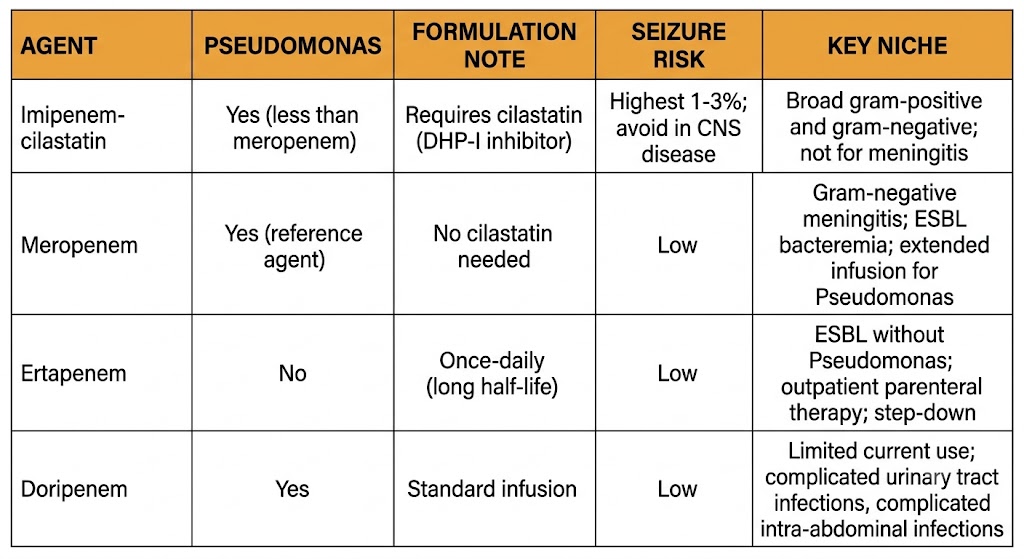
Comparison table of four carbapenems — imipenem-cilastatin, meropenem, ertapenem, and doripenem — showing Pseudomonas coverage, formulation notes, seizure risk, and key clinical niche.
Carbapenem comparison: spectrum, formulation, seizure risk, and clinical niche. Generated figure.

Section 3

Aztreonam and the Monobactam Class

Gram-negative-only coverage, penicillin allergy safety, and the role in carbapenem-sparing regimens

Aztreonam is the only monobactam in clinical use. Its monocyclic (single-ring) beta-lactam structure gives it a unique pharmacological profile: gram-negative-only activity, no cross-reactivity with penicillin allergy, and a key role in treating infections caused by metallo-beta-lactamase-producing organisms where all carbapenems fail.

Structure, Mechanism, and Spectrum

Aztreonam contains a single four-membered beta-lactam ring without a fused second ring—structurally distinct from the bicyclic scaffolds of penicillins, cephalosporins, and carbapenems. It binds penicillin-binding proteins of gram-negative bacteria with high selectivity, causing cell lysis. It has essentially no affinity for gram-positive or anaerobic penicillin-binding proteins, explaining its complete lack of activity against gram-positive cocci, anaerobes, and Listeria monocytogenes.

The gram-negative spectrum covers most Enterobacteriaceae, Pseudomonas aeruginosa (when susceptible), and Haemophilus influenzae, closely paralleling ceftazidime. Aztreonam is hydrolyzed by extended-spectrum beta-lactamases and AmpC (Class C) enzymes, so monotherapy is unreliable for extended-spectrum beta-lactamase-producing organisms. Aztreonam is not hydrolyzed by Class B metallo-beta-lactamases—this is the pharmacological basis of its role in treating New Delhi metallo-beta-lactamase-producing organisms.

Penicillin Allergy Safety

Because aztreonam's single-ring structure differs fundamentally from the bicyclic scaffolds of penicillins and cephalosporins, patients with documented severe penicillin allergy including anaphylaxis can safely receive aztreonam in most circumstances. The one exception: aztreonam and ceftazidime share an identical side chain, so patients with documented ceftazidime allergy may also react to aztreonam. For other penicillin-allergic patients, aztreonam is an important alternative for gram-negative coverage.

Aztreonam-Avibactam and the New Delhi Metallo-Beta-Lactamase Solution

New Delhi metallo-beta-lactamase-producing organisms resist virtually all beta-lactams including all carbapenems, ceftazidime-avibactam, and meropenem-vaborbactam. Aztreonam combined with avibactam exploits aztreonam's intrinsic resistance to metallo-beta-lactamase hydrolysis: avibactam inhibits the co-produced serine beta-lactamases (extended-spectrum beta-lactamases, AmpC, Klebsiella pneumoniae carbapenemase) that would otherwise destroy aztreonam, restoring activity against New Delhi metallo-beta-lactamase producers. This combination is available as a co-formulated product or as aztreonam administered alongside ceftazidime-avibactam.

Pharmacokinetics and Adverse Effects

Aztreonam is administered intravenously or intramuscularly and is primarily renally eliminated, requiring dose adjustment in significant renal impairment. An inhaled formulation (aztreonam lysine for inhalation) is approved for pulmonary use in patients with cystic fibrosis colonized with Pseudomonas aeruginosa. Adverse effects are uncommon. Aztreonam does not cause seizures, does not require a DHP-I (dehydropeptidase I) inhibitor, and has no significant nephrotoxicity.

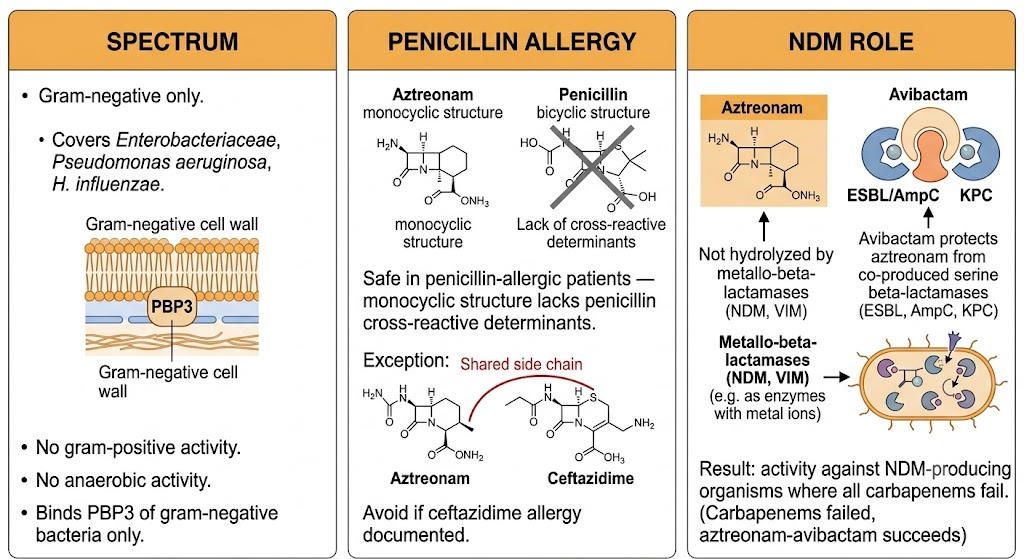
Three-panel diagram showing aztreonam's gram-negative-only spectrum and PBP3 binding, its penicillin allergy safety due to monocyclic structure with ceftazidime exception, and its NDM role with avibactam protecting it from co-produced serine beta-lactamases.
Aztreonam: spectrum, penicillin allergy safety, and role in NDM-producing organism therapy. Generated figure.

Section 4

Carbapenem Resistance and Emerging Therapies

Carbapenem-resistant Enterobacteriaceae mechanisms, novel combinations, and cefiderocol

Carbapenem-resistant Enterobacteriaceae (CRE) and carbapenem-resistant Acinetobacter baumannii represent two of the most clinically challenging resistance phenotypes in current practice. Their growing prevalence has driven development of novel beta-lactam combinations that have substantially expanded therapeutic options, though all carry important limitations and selection must be guided by the specific resistance mechanism.

Carbapenem-Resistant Enterobacteriaceae Mechanisms

Carbapenem resistance in Enterobacteriaceae arises through three mechanisms that may coexist. The first and most clinically significant is carbapenemase production: enzymatic hydrolysis by Klebsiella pneumoniae carbapenemase (Class A), metallo-beta-lactamases including New Delhi metallo-beta-lactamase (Class B), or OXA-48-type enzymes (Class D). The second is non-carbapenemase-mediated resistance: loss of outer membrane porins combined with upregulation of extended-spectrum beta-lactamases or AmpC, creating intermediate or low-level carbapenem resistance without a carbapenemase. The third is efflux pump upregulation, which contributes to but rarely causes high-level resistance alone.

Klebsiella pneumoniae carbapenemase-producing Klebsiella pneumoniae is the dominant epidemic strain in the United States and much of Europe. New Delhi metallo-beta-lactamase-producing organisms predominate in South Asia and are increasingly prevalent worldwide, spreading on mobile plasmids across diverse Enterobacteriaceae species.

Novel Combination Therapies for Carbapenem-Resistant Enterobacteriaceae

Three approved combinations specifically target carbapenem-resistant Enterobacteriaceae. Ceftazidime-avibactam (discussed in Module 2) covers Klebsiella pneumoniae carbapenemase, AmpC, and OXA-48 but not New Delhi metallo-beta-lactamase or Verona integron-encoded metallo-beta-lactamase. Meropenem-vaborbactam covers Klebsiella pneumoniae carbapenemase and AmpC but not New Delhi metallo-beta-lactamase or OXA-48. Imipenem-cilastatin-relebactam covers Klebsiella pneumoniae carbapenemase and AmpC and has enhanced anti-Pseudomonas aeruginosa activity.

None of these three combinations reliably treats New Delhi metallo-beta-lactamase-producing organisms. For New Delhi metallo-beta-lactamase producers, aztreonam-avibactam or aztreonam combined with ceftazidime-avibactam are the primary options; cefiderocol may be used as salvage therapy.

Cefiderocol

Cefiderocol is a novel cephalosporin that bypasses outer membrane permeability barriers, giving it activity against organisms with porin-loss resistance, and is stable against hydrolysis by all classes of beta-lactamases including metallo-beta-lactamases. It has demonstrated activity against carbapenem-resistant Acinetobacter baumannii, Pseudomonas aeruginosa, and metallo-beta-lactamase-producing Enterobacteriaceae in clinical trials. However, a higher all-cause mortality signal was observed in Acinetobacter baumannii infections in one trial compared to best available therapy, and clinical use should be guided by infectious disease consultation.

Carbapenem-Resistant Acinetobacter baumannii

Carbapenem-resistant Acinetobacter baumannii is designated a critical priority pathogen by the World Health Organization, reflecting near-total resistance of many isolates to conventional antibiotics. Resistance is driven predominantly by OXA-type Class D carbapenemases combined with porin loss and efflux pump upregulation. Sulbactam-durlobactam (sulbactam combined with a novel inhibitor that protects it from OXA-type carbapenemase hydrolysis) is the first specifically approved agent for carbapenem-resistant Acinetobacter baumannii and exploits sulbactam's intrinsic antibacterial activity against Acinetobacter through direct penicillin-binding protein binding.

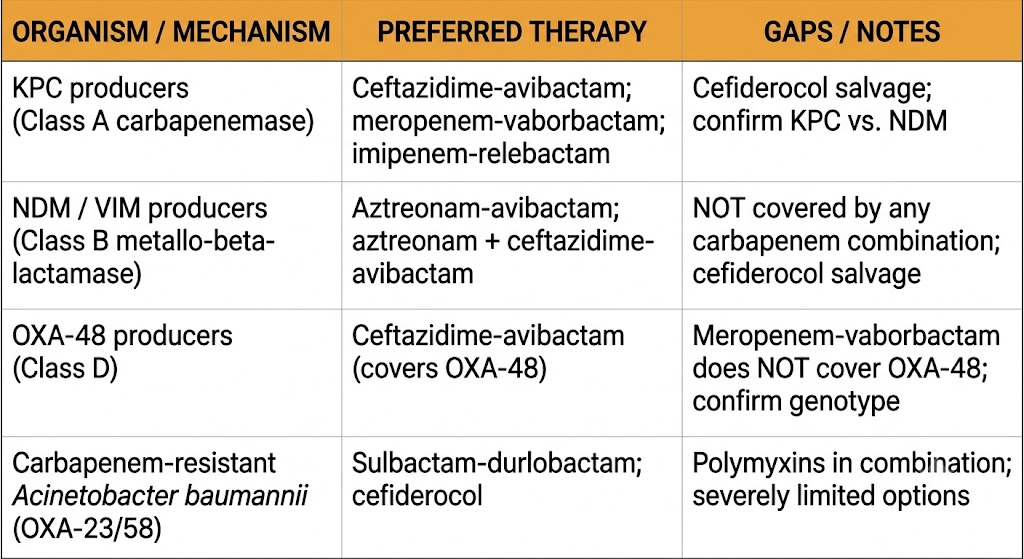
Carbapenem-Resistant Enterobacteriaceae Therapy: Genotype First

Klebsiella pneumoniae carbapenemase producers: ceftazidime-avibactam, meropenem-vaborbactam, or imipenem-relebactam.

New Delhi metallo-beta-lactamase producers: aztreonam-avibactam or aztreonam plus ceftazidime-avibactam; cefiderocol as salvage.

OXA-48 producers: ceftazidime-avibactam covers OXA-48 but not metallo-enzymes—confirm phenotype before relying on it.

Carbapenem-resistant Acinetobacter baumannii: sulbactam-durlobactam is the first approved targeted agent; cefiderocol is an alternative.

Reference table matching carbapenem-resistant organism type (KPC, NDM/VIM, OXA-48, carbapenem-resistant Acinetobacter baumannii) to preferred therapy and coverage gaps.
CRE therapy by resistance mechanism: genotype-guided agent selection. Generated figure.

Suggested References
Author / Organization Title Source
Papp-Wallace KM, Endimiani A, Taracila MA, Bonomo RA Carbapenems: past, present, and future Antimicrob Agents Chemother. 2011;55(11):4943-4960
Zhanel GG, Wiebe R, Dilay L, et al. Comparative review of the carbapenems Drugs. 2007;67(7):1027-1052
Craig WA Pharmacokinetic/pharmacodynamic parameters: rationale for antibacterial dosing of mice and men Clin Infect Dis. 1998;26(1):1-12
Patel G, Bonomo RA Stormy waters ahead: global emergence of carbapenemases Front Microbiol. 2013;4:48
Livermore DM, Sefton AM, Scott GM Properties and potential of ertapenem J Antimicrob Chemother. 2003;52(3):331-344
Swabb EA Review of the clinical pharmacology of the monobactam antibiotic aztreonam Am J Med. 1985;78(2A):11-18
Macy E, Romano A, Khan D Practical management of antibiotic hypersensitivity in 2017 J Allergy Clin Immunol Pract. 2017;5(3):577-586
Wenzler E, Deraedt MF, Harrington AT, Danizger LH Synergistic activity of ceftazidime-avibactam and aztreonam against serine and metallo-beta-lactamase-producing gram-negative pathogens Diagn Microbiol Infect Dis. 2017;88(4):352-354
Magiorakos AP, Srinivasan A, Carey RB, et al. Multidrug-resistant, extensively drug-resistant and pandrug-resistant bacteria: an international expert proposal for interim standard definitions for acquired resistance Clin Microbiol Infect. 2012;18(3):268-281
Kaye KS, Bhowmick T, Metallidis S, et al. Effect of meropenem-vaborbactam vs piperacillin-tazobactam on clinical cure or improvement and microbial eradication in complicated urinary tract infection: the TANGO I randomized clinical trial JAMA. 2018;319(8):788-799
Bassetti M, Echols R, Matsunaga Y, et al. Efficacy and safety of cefiderocol or best available therapy for the treatment of serious infections caused by carbapenem-resistant gram-negative bacteria (CREDIBLE-CR): a randomised, open-label, multicentre, pathogen-focused, descriptive, phase 3 trial Lancet Infect Dis. 2021;21(2):226-240
Tamma PD, Aitken SL, Bonomo RA, Mathers AJ, van Duin D, Clancy CJ Infectious Diseases Society of America 2022 guidance on the treatment of extended-spectrum beta-lactamase producing Enterobacterales, carbapenem-resistant Enterobacterales, and Pseudomonas aeruginosa with difficult-to-treat resistance Clin Infect Dis. 2022;75(2):187-212