Vancomycin, second-generation glycopeptides, and daptomycin: mechanisms, pharmacokinetics, monitoring, and resistance
ABAC · Module 9Section 1
D-Ala-D-Ala binding, steric blockade of cell wall cross-linking, Gram-positive spectrum, and the basis for activity against methicillin-resistant Staphylococcus aureus
Vancomycin is the prototypical glycopeptide antibiotic and the backbone of therapy for methicillin-resistant Staphylococcus aureus and other serious Gram-positive infections. Its mechanism is entirely distinct from beta-lactams, which is precisely why it retains activity where beta-lactams fail.
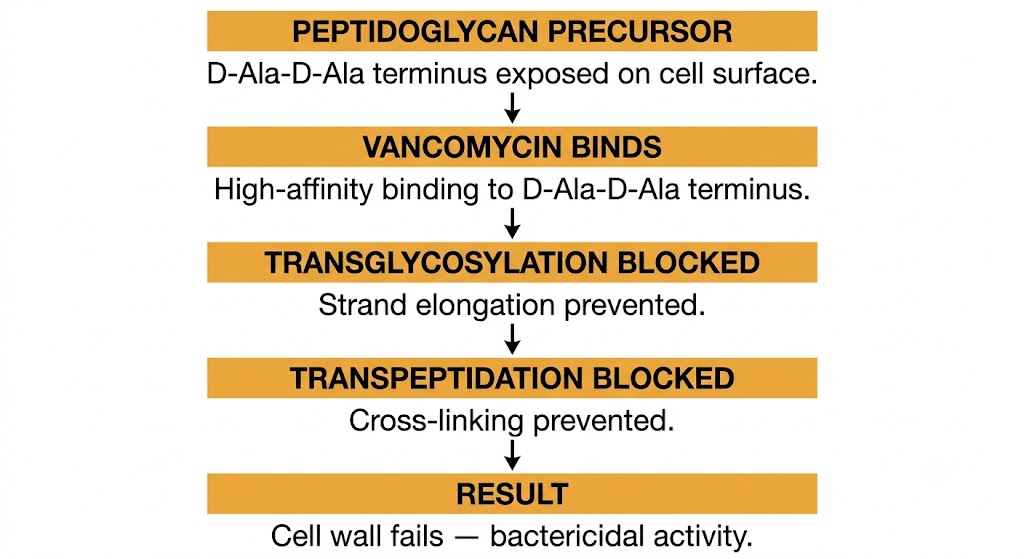
Vancomycin binds with high affinity to the D-alanyl-D-alanine terminus of peptidoglycan precursor units on the outer surface of the bacterial cell membrane. This steric blockade physically prevents transglycosylation and transpeptidation — the two enzymatic steps required to cross-link nascent peptidoglycan strands into a mechanically stable cell wall. The result is bactericidal activity through osmotic lysis.
Because vancomycin acts on a lipid-anchored substrate outside the cell rather than on an intracellular enzyme, it is unaffected by the penicillin-binding protein alterations that confer methicillin resistance. This is why vancomycin retains activity against methicillin-resistant Staphylococcus aureus while beta-lactams fail. Vancomycin's large molecular size prevents penetration through the Gram-negative outer membrane, explaining its absence of Gram-negative activity.
Vancomycin's spectrum is confined entirely to Gram-positive organisms. It is reliably active against methicillin-resistant Staphylococcus aureus, methicillin-susceptible Staphylococcus aureus, coagulase-negative staphylococci, Streptococcus pneumoniae (including penicillin-resistant strains), viridans streptococci, Streptococcus pyogenes, and Enterococcus faecalis. Enterococcus faecium is intrinsically less susceptible and may be vancomycin-resistant.
When given orally, vancomycin is not absorbed from the gastrointestinal tract and achieves extremely high intraluminal concentrations, making it one of the treatments of choice for severe or recurrent Clostridioides difficile infection. This is a pharmacokinetically distinct application — oral vancomycin acts entirely locally and does not contribute to systemic drug levels. Oral and intravenous routes are not interchangeable: intravenous vancomycin for systemic infections does not achieve meaningful intraluminal concentrations, and oral vancomycin for C. difficile produces no systemic levels.
Section 2
Renal elimination, volume of distribution, area-under-the-curve-guided dosing, and the shift away from trough-only monitoring
Vancomycin's pharmacokinetic complexity demands individualized dosing. Elimination is almost entirely renal, making dose adjustment essential in renal impairment. The shift to area-under-the-curve-guided therapeutic drug monitoring reflects recognition that trough-only monitoring was imprecise and associated with excess nephrotoxicity.
Vancomycin must be given intravenously for systemic infections — it is not absorbed orally. After intravenous infusion it distributes widely, with protein binding of approximately 50% primarily to albumin. Cerebrospinal fluid penetration is limited under normal conditions, improving somewhat with inflamed meninges. Elimination is almost entirely via glomerular filtration, with a half-life of approximately 4 to 8 hours in patients with normal renal function. In severe renal impairment or end-stage renal disease, the half-life can extend dramatically, necessitating marked dose interval prolongation.
The pharmacodynamic index that best predicts vancomycin efficacy is the ratio of the area under the concentration-time curve over 24 hours to the minimum inhibitory concentration. For methicillin-resistant Staphylococcus aureus infections, targeting a specific AUC/MIC ratio is associated with optimal clinical outcomes and is endorsed by current consensus guidelines. This replaced trough-only monitoring, which proved imprecise — many patients with troughs in the previously recommended range had AUC/MIC values that were either insufficient for efficacy or unnecessarily high, contributing to nephrotoxicity.
Area-under-the-curve-guided dosing is performed using Bayesian pharmacokinetic software with two timed serum samples, which allows individualization of the pharmacokinetic estimate for each patient. For organisms with elevated minimum inhibitory concentrations, achieving the target ratio without exceeding tolerable serum concentrations becomes problematic, and alternative agents should be considered.
Oral vs. Intravenous Vancomycin — Non-Interchangeable Routes
Oral vancomycin for C. difficile acts entirely locally and produces no systemic levels. Intravenous vancomycin for methicillin-resistant Staphylococcus aureus bacteremia does not achieve meaningful intraluminal concentrations. These are pharmacokinetically separate routes with non-overlapping applications.
Section 3
Nephrotoxicity, red man syndrome, ototoxicity, vancomycin-intermediate and vancomycin-resistant Staphylococcus aureus
Vancomycin's adverse effect profile centers on nephrotoxicity and infusion-related reactions. The shift to area-under-the-curve-guided monitoring was driven largely by recognition that trough-based monitoring was associated with excess nephrotoxicity without consistently improving efficacy. Resistance in Staphylococcus aureus emerges through two mechanistically distinct pathways with very different clinical implications.
Nephrotoxicity is the most clinically significant adverse effect of vancomycin. Risk is strongly associated with magnitude and duration of drug exposure. The combination of vancomycin with piperacillin-tazobactam has been associated with significantly increased rates of acute kidney injury compared to vancomycin alone or with other beta-lactams, prompting reconsideration of this combination in empiric regimens. Acute kidney injury from vancomycin is generally reversible upon dose reduction or discontinuation, but monitoring of serum creatinine is mandatory during therapy.
Red man syndrome is an infusion-related reaction caused by direct histamine release from mast cells, producing flushing, erythema, and pruritus predominantly over the face, neck, and upper torso. It is rate-dependent: slower infusion rates substantially reduce or eliminate the reaction. Red man syndrome is not an immunoglobulin E-mediated hypersensitivity reaction and does not predict anaphylaxis or contraindicate future vancomycin use. Pretreatment with diphenhydramine and extending infusion time to 90 to 120 minutes are the primary management strategies. Patients labeled as vancomycin-allergic due to red man syndrome are unnecessarily deprived of a critical antibiotic.
Ototoxicity, encompassing cochlear toxicity and vestibular toxicity, is a recognized but less common adverse effect. Historical data implicating vancomycin as a primary ototoxin were complicated by frequent concomitant aminoglycoside use. When vancomycin is used without aminoglycosides, ototoxicity risk appears low at standard dosing. Risk factors include prolonged high-dose therapy, renal impairment causing drug accumulation, and concomitant aminoglycoside use.
Vancomycin-intermediate Staphylococcus aureus strains emerge through gradual cell wall thickening, which increases the number of D-alanyl-D-alanine targets that must be saturated before effective cell wall inhibition is achieved. Vancomycin-intermediate Staphylococcus aureus frequently arises after prolonged vancomycin exposure.
Vancomycin-resistant Staphylococcus aureus strains acquire resistance via transfer from vancomycin-resistant enterococcus. These strains substitute D-alanyl-D-alanine with D-alanyl-D-lactate in the peptidoglycan precursor, eliminating vancomycin binding affinity and conferring high-level resistance. Vancomycin-resistant Staphylococcus aureus infections require alternative agents such as linezolid or daptomycin.
Section 4
Teicoplanin, dalbavancin, oritavancin, and telavancin: extended half-lives, single-dose regimens, and outpatient parenteral antibiotic therapy applications
Second-generation glycopeptides address the pharmacokinetic limitations of vancomycin, particularly its requirement for frequent intravenous dosing and intensive monitoring. Their markedly extended half-lives enable once-weekly or single-dose regimens that have transformed outpatient management of serious Gram-positive infections.
Teicoplanin is a naturally occurring glycopeptide that shares vancomycin's D-alanyl-D-alanine binding mechanism but adds a lipophilic side chain that anchors it to the bacterial membrane. Its half-life of approximately 70 to 100 hours permits once-daily intramuscular or intravenous dosing after an initial loading regimen — a significant convenience advantage over vancomycin. Teicoplanin is widely used in Europe but is not approved in the United States. Red man syndrome is less frequent than with vancomycin, and nephrotoxicity rates appear somewhat lower. Therapeutic drug monitoring remains recommended. Teicoplanin is susceptible to vanA-mediated resistance, unlike oritavancin.
Dalbavancin is a semisynthetic lipoglycopeptide with an exceptionally long half-life of approximately 14 to 15 days, enabling treatment of acute bacterial skin and skin structure infections caused by Gram-positive organisms including methicillin-resistant Staphylococcus aureus with a single dose or two doses one week apart. Its mechanism combines D-alanyl-D-alanine binding with membrane anchoring via a lipophilic side chain. Dalbavancin allows completion of a full treatment course with one or two infusions rather than 10 to 14 days of daily vancomycin, enabling earlier hospital discharge or avoiding hospitalization entirely. It does not require therapeutic drug monitoring and has no known clinically significant drug interactions.
Oritavancin has a triple mechanism of action: D-alanyl-D-alanine binding, inhibition of transglycosylation, and disruption of bacterial membrane integrity through its lipophilic tail. This triple mechanism produces rapid concentration-dependent bactericidal activity and retention of partial activity against vanA-expressing vancomycin-resistant enterococcus strains — unlike vancomycin and dalbavancin. A half-life of approximately 245 hours enables a single 1,200 mg dose to treat acute bacterial skin and skin structure infections. Oritavancin interferes with coagulation assays including activated partial thromboplastin time and prothrombin time for up to 120 hours after dosing, complicating anticoagulation monitoring in patients who require it.
Telavancin combines D-alanyl-D-alanine binding with membrane depolarization, producing rapid bactericidal activity. It is approved for hospital-acquired and ventilator-associated bacterial pneumonia caused by Gram-positive pathogens and for complicated skin and skin structure infections. Its half-life requires once-daily intravenous dosing. Telavancin carries a black box warning for nephrotoxicity, which occurs at rates higher than vancomycin in some clinical trials, limiting its use to situations where alternative agents are unsuitable. A negative pregnancy test is required before initiation in women of childbearing potential due to teratogenicity in animal studies. Like oritavancin, telavancin interferes with coagulation assays.
Second-Generation Glycopeptides at a Glance
Dalbavancin and oritavancin are the primary agents for outpatient parenteral antibiotic therapy simplification in acute bacterial skin and skin structure infections — neither requires therapeutic drug monitoring. Oritavancin's partial vanA activity and membrane-disrupting mechanism are additional differentiators. Teicoplanin is once-daily and widely used outside the United States. Telavancin is reserved for pneumonia or complicated skin and skin structure infections when alternatives are unsuitable, given its nephrotoxicity profile.
Section 5
Calcium-dependent membrane depolarization, spectrum against vancomycin-resistant organisms, pulmonary surfactant inactivation, and dosing
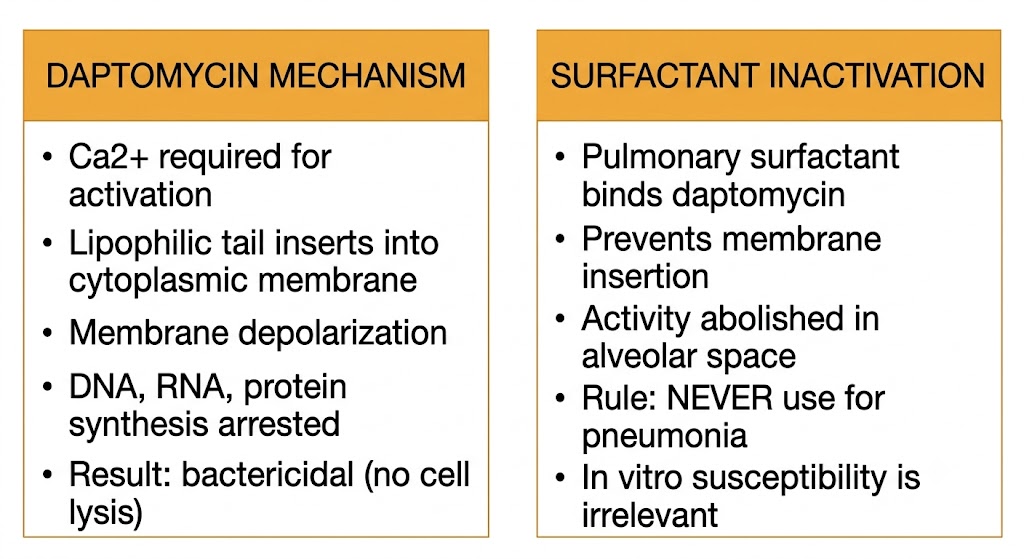
Daptomycin is the only approved lipopeptide antibiotic. Its mechanism — calcium-dependent membrane depolarization — is entirely distinct from all other antibacterials, making it effective against many glycopeptide-resistant organisms. A critical pharmacokinetic limitation, inactivation by pulmonary surfactant, absolutely prohibits its use for pneumonia regardless of in vitro susceptibility results.
Daptomycin requires calcium for activation. In the presence of physiologic calcium concentrations, the drug inserts into the bacterial cytoplasmic membrane, causing rapid depolarization and bactericidal activity. Because the mechanism targets the membrane directly rather than a biosynthetic enzyme, cross-resistance with cell wall agents or protein synthesis inhibitors is not expected at the mechanistic level, though acquired resistance can still emerge.
Daptomycin is active against methicillin-resistant Staphylococcus aureus, methicillin-susceptible Staphylococcus aureus, vancomycin-resistant enterococcus (both Enterococcus faecalis and Enterococcus faecium), vancomycin-intermediate Staphylococcus aureus, and many strains of vancomycin-resistant Staphylococcus aureus. It is one of the primary options for vancomycin-resistant enterococcus bacteremia and enterococcal endocarditis when vancomycin resistance precludes first-line therapy. Standard dosing is 6 mg/kg/day for bacteremia and right-sided endocarditis; higher doses have been used for more difficult infections.
Pulmonary surfactant components bind daptomycin and prevent its insertion into bacterial membranes, completely abolishing antibacterial activity within the alveolar space. This pharmacodynamic antagonism is absolute. A susceptibility report showing an methicillin-resistant Staphylococcus aureus isolate as daptomycin-susceptible does not change this: in vivo the drug will fail entirely if the infection is pulmonary. Linezolid or vancomycin remain the agents of choice for methicillin-resistant Staphylococcus aureus pneumonia.
Daptomycin and Pneumonia — An Absolute Contraindication
In vitro susceptibility to daptomycin is irrelevant for pulmonary infections. Surfactant inactivation abolishes daptomycin activity in the alveolar space regardless of the organism's minimum inhibitory concentration. Never use daptomycin for pneumonia.
Daptomycin is administered intravenously once daily. Protein binding is approximately 90 to 93%. Volume of distribution is low, reflecting limited extravascular distribution — an important consideration when treating infections in poorly perfused compartments. Elimination is primarily renal; dose adjustment is required when creatinine clearance falls below 30 mL/min.
Section 6
Skeletal muscle toxicity, creatine phosphokinase monitoring, statin interactions, and the vancomycin see-saw effect
Daptomycin's principal adverse effect is skeletal muscle toxicity, mechanistically linked to its membrane-disrupting activity. A clinically important resistance phenomenon — the see-saw effect — means that prior vancomycin exposure can compromise daptomycin's utility as salvage therapy before it has ever been used.
Daptomycin causes myopathy with elevation of creatine phosphokinase and, rarely, rhabdomyolysis with myoglobinuria and acute kidney injury. Creatine phosphokinase should be monitored weekly during therapy. Daptomycin should be discontinued if creatine phosphokinase rises above five times the upper limit of normal with symptoms, or ten times the upper limit of normal regardless of symptoms. Concomitant use of hydroxymethylglutaryl-coenzyme A reductase inhibitors (statins) increases myopathy risk; statin therapy should be suspended during daptomycin courses where possible. Peripheral neuropathy has been reported with prolonged use. Eosinophilic pneumonia — a paradoxical pulmonary toxicity distinct from the surfactant inactivation phenomenon — has been described and should be considered if a patient develops new pulmonary infiltrates and eosinophilia during therapy.
Daptomycin resistance emerges primarily through alterations in cell membrane composition that reduce drug affinity for its membrane target, decreasing the drug's ability to insert and depolarize the membrane.
A well-documented clinical phenomenon is the emergence of daptomycin non-susceptible methicillin-resistant Staphylococcus aureus following prolonged vancomycin exposure, even without prior daptomycin use. The cell wall thickening that characterizes vancomycin-intermediate Staphylococcus aureus simultaneously reduces daptomycin's ability to reach and insert into the cytoplasmic membrane. This see-saw effect — increasing vancomycin minimum inhibitory concentration paralleling increasing daptomycin minimum inhibitory concentration — means that heavily vancomycin-exposed patients may not be salvageable with daptomycin if their methicillin-resistant Staphylococcus aureus isolate has already developed intermediate vancomycin resistance. Susceptibility testing for daptomycin is essential before relying on it for salvage therapy after vancomycin failure.
Suggested References
| Author / Organization | Title | Source |
|---|---|---|
| Breukink E, de Kruijff B | Lipid II as a target for antibiotics | Nat Rev Drug Discov. 2006;5(4):321–332 |
| Fowler VG Jr, Boucher HW, Corey GR, et al. | Daptomycin versus standard therapy for bacteremia and endocarditis caused by Staphylococcus aureus | N Engl J Med. 2006;355(7):653–665 |
| Matzke GR, McGory RW, Halstenson CE, Keane WF | Pharmacokinetics of vancomycin in patients with various degrees of renal function | Antimicrob Agents Chemother. 1984;25(4):433–437 |
| Rybak MJ, Le J, Lodise TP, et al. | Therapeutic monitoring of vancomycin for serious methicillin-resistant Staphylococcus aureus infections: a revised consensus guideline and review | Am J Health Syst Pharm. 2020;77(11):835–864 |
| Sakoulas G, Alder J, Thauvin-Eliopoulos C, et al. | Induction of daptomycin heterogeneous susceptibility in Staphylococcus aureus by exposure to vancomycin | Antimicrob Agents Chemother. 2006;50(4):1581–1585 |
| Navalkele B, Pogue JM, Karino S, et al. | Risk of acute kidney injury in patients on concomitant vancomycin and piperacillin-tazobactam compared to those on vancomycin and cefepime | Clin Infect Dis. 2017;64(2):116–123 |
| Sivagnanam S, Deleu D | Red man syndrome | Crit Care. 2003;7(2):119–120 |
| Hidayat LK, Hsu DI, Quist R, et al. | High-dose vancomycin therapy for methicillin-resistant Staphylococcus aureus infections: efficacy and toxicity | Arch Intern Med. 2006;166(19):2138–2144 |
| Howden BP, Davies JK, Johnson PDR, et al. | Reduced vancomycin susceptibility in Staphylococcus aureus, including vancomycin-intermediate and heterogeneous vancomycin-intermediate strains: resistance mechanisms, laboratory detection, and clinical implications | Clin Microbiol Rev. 2010;23(1):99–139 |
| Zhanel GG, Calic D, Schweizer F, et al. | New lipoglycopeptides: a comparative review of dalbavancin, oritavancin and telavancin | Drugs. 2010;70(7):859–886 |
| Boucher HW, Wilcox M, Talbot GH, et al. | Once-weekly dalbavancin versus daily conventional therapy for skin infection | N Engl J Med. 2014;370(23):2169–2179 |
| Belley A, McKay GA, Arhin FF, et al. | Oritavancin disrupts membrane integrity of Staphylococcus aureus and vancomycin-resistant enterococci to effect rapid bacterial killing | Antimicrob Agents Chemother. 2010;54(12):5369–5371 |
| Steenbergen JN, Alder J, Thorne GM, Tally FP | Daptomycin: a lipopeptide antibiotic for the treatment of serious Gram-positive infections | J Antimicrob Chemother. 2005;55(3):283–288 |
| Silverman JA, Mortin LI, Vanpraagh AD, et al. | Inhibition of daptomycin by pulmonary surfactant: in vitro modeling and clinical impact | J Infect Dis. 2005;191(12):2149–2152 |
| Bhavnani SM, Rubino CM, Ambrose PG, Drusano GL | Daptomycin exposure and the probability of elevations in the creatine phosphokinase level: data from a randomized trial of patients with bacteremia and endocarditis | Clin Infect Dis. 2010;50(12):1568–1574 |