CHAPTER 35  ·  ANTIBACTERIAL AGENTS

Section 1

Metronidazole: Mechanism of Action and Pharmacokinetics

Reductive activation by anaerobic organisms, selective bactericidal activity, and pharmacokinetic advantages including exceptional central nervous system penetration

Metronidazole is a nitroimidazole with a uniquely selective mechanism: it requires reductive activation that occurs only in anaerobic or microaerophilic organisms, making it bactericidal for anaerobes and certain protozoal pathogens while inactive against aerobes. Combined with excellent tissue penetration and outstanding central nervous system access, these properties make it indispensable for anaerobic and protozoal infections.

Mechanism of Action

Metronidazole enters cells by passive diffusion. Within anaerobic organisms, the nitro group of the drug is reduced by anaerobic electron transport proteins, generating toxic metabolites that damage DNA — causing strand breakage and loss of the helical structure required for replication and transcription. The selectivity of this mechanism is absolute: reduction of the nitro group requires the low intracellular redox potential characteristic of anaerobic metabolism. Aerobic bacteria maintain a higher redox environment that does not reduce the nitro group, so the drug remains in its inactive prodrug form and exerts no antibacterial effect. This makes metronidazole one of the few antibiotics whose selectivity is based on the metabolic state of the target organism rather than a structural difference in a target enzyme.
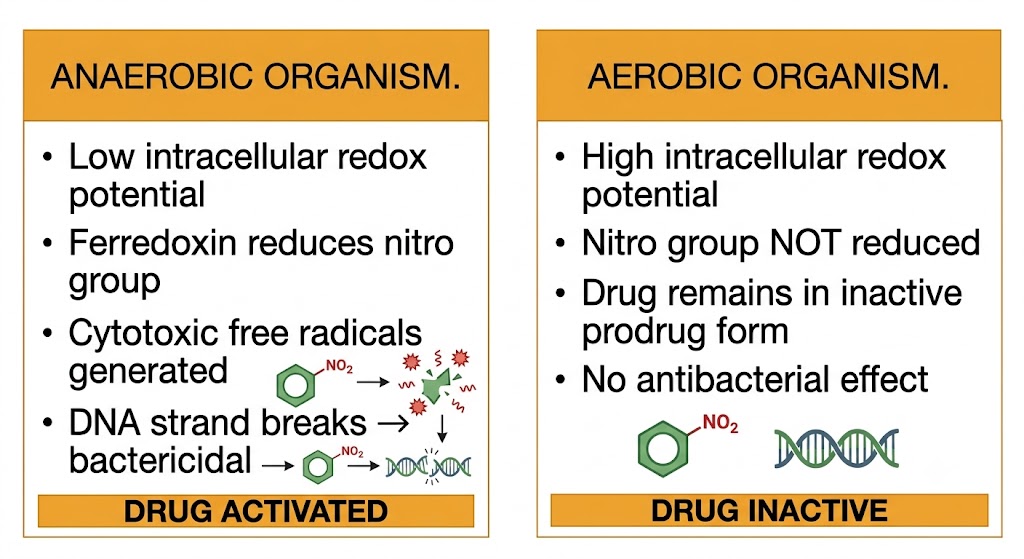
Two-panel diagram comparing metronidazole activation: left panel shows anaerobic organism where ferredoxin reduces the nitro group generating cytotoxic free radicals and DNA strand breaks — drug activated; right panel shows aerobic organism where nitro group is not reduced and drug remains inactive.
Figure 1. Metronidazole selective activation: reductive activation occurs only in anaerobic organisms. Generated with Gemini AI.
Antibacterial and Antiprotozoal Spectrum

Metronidazole is reliably active against virtually all clinically important anaerobes — Gram-negative anaerobes including Bacteroides fragilis and other Bacteroides species, Fusobacterium, and Prevotella species, as well as Gram-positive anaerobes including Clostridioides difficile, Clostridium perfringens, and Peptostreptococcus. Among protozoal pathogens, metronidazole is the drug of choice for Trichomonas vaginalis, Giardia lamblia, and Entamoeba histolytica. It has no activity against aerobic or facultatively anaerobic bacteria.

Pharmacokinetics

Oral bioavailability is approximately 80 to 100%, making oral and intravenous formulations essentially interchangeable in patients with functioning gastrointestinal tracts. Protein binding is low at approximately 10 to 20%, contributing to wide tissue distribution. Elimination is primarily hepatic; dose adjustment is not required for renal impairment, but dose reduction is warranted in severe hepatic impairment.

Central nervous system penetration is exceptional — metronidazole crosses the blood-brain barrier freely, achieving cerebrospinal fluid concentrations approaching plasma levels even without meningeal inflammation. This makes it one of the few oral agents capable of achieving therapeutic central nervous system concentrations for susceptible anaerobes, and underlies its use in brain abscess. It also achieves adequate concentrations in bile, vaginal secretions, and bone.

Oral Equals Intravenous

A patient who can swallow and absorb should receive oral metronidazole rather than intravenous. There is no pharmacokinetic rationale for maintaining intravenous metronidazole in a patient tolerating oral medications. Intravenous metronidazole is appropriate for patients who are not eating, have significant gastrointestinal malabsorption, or require rapid loading in severe infections.

Section 2

Metronidazole: Adverse Effects, Drug Interactions, and Clinical Use

Disulfiram-like reaction with alcohol, neurotoxicity with prolonged use, warfarin interaction, and key clinical indications

Metronidazole's adverse effect profile is manageable for short courses but includes clinically important drug interactions and dose-dependent neurological toxicities that constrain prolonged use. Its applications span intra-abdominal infections, brain abscess, bacterial vaginosis, pelvic inflammatory disease, and protozoal infections.

Disulfiram-Like Reaction with Alcohol

Metronidazole inhibits aldehyde dehydrogenase, the enzyme responsible for oxidizing acetaldehyde to acetate in ethanol metabolism, causing acetaldehyde accumulation when alcohol is consumed. The resulting reaction includes flushing, palpitations, nausea, vomiting, and headache — and in severe cases, hypotension and cardiovascular collapse. Patients must avoid all alcohol-containing beverages, foods prepared with wine or spirits, and alcohol-containing medications during therapy and for at least 48 hours after completing a course. This counseling must be explicit; patients frequently fail to recognize alcohol-containing sources such as certain mouthwashes or liquid medications.

Neurological Toxicity

Peripheral neuropathy is the most common neurological complication of metronidazole, manifesting as distal sensory numbness, tingling, and burning — particularly in the feet. It may be partially reversible after drug discontinuation but can be permanent with prolonged exposure. Central nervous system toxicity, while less common, includes cerebellar dysfunction (ataxia, dysarthria, nystagmus), encephalopathy, and seizures. Metronidazole-induced encephalopathy is reversible if the drug is promptly discontinued. Courses exceeding four weeks should be avoided where possible.

Drug Interactions

Metronidazole inhibits warfarin metabolism, resulting in clinically significant potentiation of anticoagulation. Patients on warfarin require close international normalized ratio monitoring when metronidazole is added, and warfarin dose reduction is frequently necessary. Metronidazole also reduces renal lithium clearance, increasing the risk of lithium toxicity. Common gastrointestinal effects include nausea, a metallic or bitter taste, and anorexia, which contribute to nonadherence in longer courses.

Clinical Indications

For intra-abdominal infections including complicated appendicitis, diverticulitis, and secondary peritonitis, metronidazole is combined with agents covering Gram-negative aerobes to provide comprehensive anaerobic and aerobic coverage. For brain abscess of odontogenic or sinogenic origin, where streptococci and anaerobes predominate, metronidazole combined with a third-generation cephalosporin is standard given its excellent central nervous system penetration. For bacterial vaginosis, oral metronidazole or vaginal gel is first-line treatment.

For Clostridioides difficile infection, oral vancomycin and fidaxomicin are now the preferred agents for all severity categories per current guidelines. Oral metronidazole is acceptable only when access to preferred agents is unavailable and must not be used for severe or complicated C. difficile infection.

C. difficile Treatment — Metronidazole No Longer First-Line

Current guidelines recommend oral vancomycin or fidaxomicin for all initial episodes of Clostridioides difficile infection, including non-severe cases. Metronidazole is a fallback only when preferred agents are unavailable. It must not be used for severe or complicated C. difficile infection under any circumstances.


Section 3

Clindamycin

50S ribosomal inhibition, toxin suppression, anaerobic and community-acquired methicillin-resistant Staphylococcus aureus coverage, C. difficile risk, and inducible macrolide-lincosamide-streptogramin B resistance

Clindamycin is a lincosamide antibiotic with two clinically distinct domains of value: anaerobic infections, where it provides excellent tissue penetration, and community-acquired methicillin-resistant Staphylococcus aureus skin and soft tissue infections, where it often remains susceptible and can be used orally. Its capacity to suppress bacterial toxin production at sub-inhibitory concentrations adds a mechanistically distinct benefit in severe toxin-mediated infections.

Mechanism of Action

Clindamycin binds the 50S ribosomal subunit, inhibiting protein synthesis. The binding site overlaps with those of macrolides and chloramphenicol, which has important cross-resistance implications. The drug is bacteriostatic at most clinical concentrations.

Beyond its antibacterial mechanism, clindamycin inhibits bacterial toxin production at sub-inhibitory concentrations by interfering with ribosomal translation of toxin genes. This is clinically exploited in severe toxin-mediated infections such as necrotizing fasciitis caused by Streptococcus pyogenes and toxic shock syndrome, where clindamycin is added specifically to suppress toxin synthesis even when the organism is being killed by a beta-lactam.

Spectrum

Clindamycin is active against methicillin-susceptible Staphylococcus aureus, many community-acquired methicillin-resistant Staphylococcus aureus strains, Streptococcus pyogenes, and viridans streptococci. For anaerobes, it covers most Gram-positive anaerobes including Clostridium species (excluding Clostridioides difficile, which is intrinsically resistant) and many Gram-negative anaerobes including Bacteroides fragilis, though resistance rates in B. fragilis now exceed 20 to 30% in many regions, limiting reliability as monotherapy for serious intra-abdominal infections. Clindamycin has no activity against aerobic Gram-negative bacteria or enterococci.

Pharmacokinetics

Oral bioavailability is approximately 90% and is not significantly affected by food. Distribution is excellent into bone, joints, lung, and soft tissue, with concentrations achieved within abscesses and phagocytes. Central nervous system penetration is poor and clindamycin is not appropriate for central nervous system infections. Elimination is primarily hepatic; no dose adjustment is required for renal impairment.

Adverse Effects

The most feared adverse effect of clindamycin is Clostridioides difficile infection. Clindamycin is among the antibiotics most strongly associated with C. difficile colitis, due to its profound disruption of normal colonic anaerobic flora that provides colonization resistance. Any patient who develops diarrhea during or after clindamycin therapy must be evaluated for C. difficile, even weeks after the course has been completed. Additional adverse effects include gastrointestinal upset, hepatotoxicity with elevated transaminases, and rare esophagitis if capsules are swallowed without adequate water.

Inducible Resistance — The D-Zone Test

The macrolide-lincosamide-streptogramin B resistance phenotype is the primary resistance mechanism relevant to clindamycin. The constitutive form confers high-level resistance to all three drug classes simultaneously. The inducible form presents a critical diagnostic challenge: organisms carrying an inducible resistance gene appear clindamycin-susceptible on routine disk diffusion. However, clindamycin therapy can induce resistance expression in vivo, leading to treatment failure.

The D-zone test detects inducible resistance: a blunted D-shaped zone of inhibition around the clindamycin disk in proximity to an erythromycin disk indicates inducible resistance, and clindamycin should be avoided despite apparent in vitro susceptibility. This test is essential before using clindamycin for methicillin-resistant Staphylococcus aureus when the isolate is erythromycin-resistant.

D-Zone Test — Always Check Before Using Clindamycin for Methicillin-Resistant Staphylococcus aureus

An methicillin-resistant Staphylococcus aureus isolate reported as clindamycin-susceptible and erythromycin-resistant should prompt D-zone testing. A positive D-zone test means the isolate has inducible resistance — clindamycin will select for resistant mutants during therapy and cause treatment failure. Confirm the susceptibility report explicitly states the inducible resistance screen was performed and is negative before prescribing clindamycin for methicillin-resistant Staphylococcus aureus.


Section 4

Fosfomycin, Nitrofurantoin, and Trimethoprim-Sulfamethoxazole

Urinary tract-focused agents and sequential folate blockade — distinct mechanisms, specific niches, and key adverse effects

Fosfomycin and nitrofurantoin are oral agents largely restricted to urinary tract infections by their pharmacokinetics. Trimethoprim-sulfamethoxazole has broader applications spanning urinary tract infections, Pneumocystis jirovecii pneumonia prophylaxis and treatment, methicillin-resistant Staphylococcus aureus skin infections, and several other indications.

Fosfomycin

Fosfomycin inhibits an early step in peptidoglycan biosynthesis. This mechanism is entirely distinct from beta-lactam, glycopeptide, and all other cell wall agents, so fosfomycin retains activity against many organisms resistant to other cell wall-active drugs including extended-spectrum beta-lactamase-producing strains. In the United States, fosfomycin is available as a single 3-gram oral dose for uncomplicated lower urinary tract infection due to Escherichia coli and Enterococcus faecalis. It achieves extremely high urinary concentrations but inadequate systemic concentrations for infections outside the urinary tract. The single-dose regimen is favored from an antibiotic stewardship perspective.

Nitrofurantoin

Nitrofurantoin is reduced within bacterial cells to multiple reactive intermediates that simultaneously damage DNA, ribonucleic acid, ribosomes, and cell wall proteins. This multi-target mechanism is why resistance, though it exists, is uncommon. Nitrofurantoin achieves adequate antibacterial concentrations only in urine and is appropriate exclusively for lower urinary tract infection — it must never be used for pyelonephritis because it does not achieve bactericidal concentrations in renal tissue or the bloodstream.

Nitrofurantoin is not reliably active against Proteus mirabilis, Pseudomonas aeruginosa, or Klebsiella pneumoniae. It is contraindicated when creatinine clearance falls below 30 mL/min because inadequate urinary concentrations are achieved and toxicity risk increases. The most serious adverse effects are pulmonary toxicity — acute hypersensitivity pneumonitis or, with prolonged prophylactic use, chronic interstitial fibrosis — and hepatotoxicity. Both are rare with short courses but require monitoring with long-term use.

Trimethoprim-Sulfamethoxazole

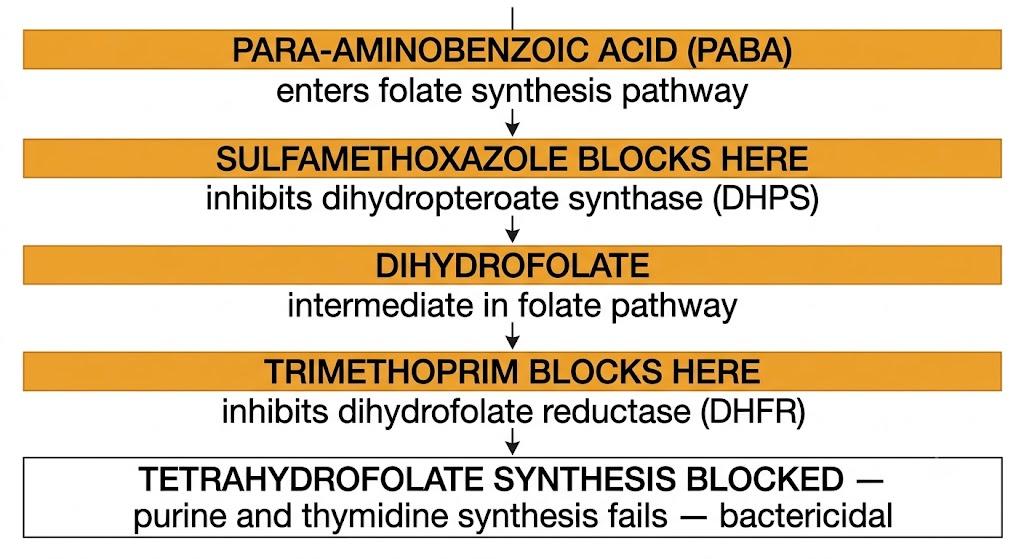
Trimethoprim-sulfamethoxazole produces sequential blockade of the bacterial folate synthesis pathway. Sulfamethoxazole competitively inhibits dihydropteroate synthase, blocking incorporation of para-aminobenzoic acid into the folate pathway, while trimethoprim inhibits dihydrofolate reductase, blocking reduction of dihydrofolate to tetrahydrofolate. The two drugs act on sequential steps, producing synergistic inhibition that prevents synthesis of tetrahydrofolate — the cofactor essential for purine and thymidine synthesis. This combination is bactericidal rather than merely bacteriostatic against susceptible organisms.

The spectrum includes most community-acquired Gram-negative Enterobacteriaceae when susceptible, Stenotrophomonas maltophilia (for which it is a primary treatment), community-acquired methicillin-resistant Staphylococcus aureus, Nocardia species, and Pneumocystis jirovecii — for which trimethoprim-sulfamethoxazole is both the preferred prophylactic agent and the drug of choice for treatment at higher doses. Adverse effects include sulfonamide hypersensitivity rash (which can progress to Stevens-Johnson syndrome), hyperkalemia from trimethoprim's blockade of renal tubular potassium secretion, elevation of serum creatinine without true reduction in glomerular filtration rate, myelosuppression (particularly with high-dose therapy), and photosensitivity.

Flow diagram showing trimethoprim-sulfamethoxazole sequential folate blockade: PABA enters pathway, sulfamethoxazole blocks dihydropteroate synthase, dihydrofolate accumulates, trimethoprim blocks dihydrofolate reductase, resulting in tetrahydrofolate synthesis blocked and bactericidal effect.
Figure 2. Trimethoprim-sulfamethoxazole: sequential blockade of two steps in the bacterial folate synthesis pathway. Generated with Gemini AI.

Section 5

Polymyxins

Membrane disruption for carbapenem-resistant Gram-negative infections, colistin as prodrug, nephrotoxicity, and the last-resort stewardship imperative

Polymyxins — colistin (polymyxin E) and polymyxin B — are cyclic lipopeptide antibiotics that disrupt the outer and inner membranes of Gram-negative bacteria. They are last-resort agents for carbapenem-resistant Gram-negative infections, with a narrow therapeutic window defined by significant nephrotoxicity and neurotoxicity.

Mechanism of Action

Polymyxins bind to lipopolysaccharide in the outer membrane of Gram-negative bacteria and disrupt both the outer and inner membranes, causing rapid leakage of cytoplasmic contents and cell death. Polymyxins are active exclusively against Gram-negative bacteria.

Spectrum and Clinical Role

The spectrum includes Pseudomonas aeruginosa, Acinetobacter baumannii, and most Enterobacteriaceae including carbapenem-resistant strains, making polymyxins among the very few options for carbapenem-resistant Acinetobacter baumannii and carbapenem-resistant Enterobacterales. Colistin is administered intravenously as colistimethate sodium — an inactive prodrug converted to active colistin in vivo. Polymyxin B is administered as the active form directly.

Adverse Effects

Nephrotoxicity is the primary dose-limiting adverse effect of colistin, occurring in a substantial proportion of patients receiving intravenous therapy. It is dose-dependent and often reversible but can be severe. Neurotoxicity — including facial paresthesias, dizziness, and peripheral neuropathy — and rare neuromuscular blockade also occur. Given the narrow therapeutic window and significant toxicity, polymyxins are strictly reserved for infections caused by organisms with no other active therapeutic options. They are not empiric drugs and must not be used for susceptible organisms.

Stewardship: Matching Agent to Indication

Fosfomycin (single dose) and nitrofurantoin (five days) are first-line options for uncomplicated cystitis when trimethoprim-sulfamethoxazole local resistance rates are high or the patient has a sulfonamide allergy. Nitrofurantoin must never be used for pyelonephritis. Polymyxins are strictly reserved for documented carbapenem-resistant Gram-negative infections with no other active agents — they are not appropriate for empiric use or for susceptible organisms.


Suggested References

Suggested References

Author / Organization Title Source
Leitsch D A review on metronidazole: an old warhorse in antimicrobial chemotherapy Parasitology. 2019;146(9):1167–1178
Solomkin JS, Mazuski JE, Bradley JS, et al. Diagnosis and management of complicated intra-abdominal infection in adults and children: guidelines by the Surgical Infection Society and the Infectious Diseases Society of America Clin Infect Dis. 2010;50(2):133–164
Lamp KC, Freeman CD, Klutman NE, Lacy MK Pharmacokinetics and pharmacodynamics of the nitroimidazole antimicrobials Clin Pharmacokinet. 1999;36(5):353–373
O'Reilly RA The stereoselective interaction of warfarin and metronidazole in man N Engl J Med. 1976;295(7):354–357
Kuriyama A, Jackson JL, Doi A, Kamiya T Metronidazole-induced central nervous system toxicity: a systematic review Clin Neuropharmacol. 2011;34(6):241–247
Stevens DL, Bisno AL, Chambers HF, et al. Practice guidelines for the diagnosis and management of skin and soft tissue infections: 2014 update by the Infectious Diseases Society of America Clin Infect Dis. 2014;59(2):e10–e52
Falagas ME, Gorbach SL Clindamycin and metronidazole Med Clin North Am. 1995;79(4):845–867
Kelly CP, LaMont JT Clostridium difficile — more difficult than ever N Engl J Med. 2008;359(18):1932–1940
Leclercq R Mechanisms of resistance to macrolides and lincosamides: nature of the resistance elements and their clinical implications Clin Infect Dis. 2002;34(4):482–492
Falagas ME, Kasiakou SK, Saravolatz LD Colistin: the revival of polymyxins for the management of multidrug-resistant gram-negative bacterial infections Clin Infect Dis. 2005;40(9):1333–1341
Cunha BA Nitrofurantoin — current concepts Urology. 1988;32(1):67–71
Masters PA, O'Bryan TA, Zurlo J, et al. Trimethoprim-sulfamethoxazole revisited Arch Intern Med. 2003;163(4):402–410
Pogue JM, Lee J, Marchaim D, et al. Incidence of and risk factors for colistin-associated nephrotoxicity in a large academic health system Clin Infect Dis. 2011;53(9):879–884
Gupta K, Hooton TM, Naber KG, et al. International clinical practice guidelines for the treatment of acute uncomplicated cystitis and pyelonephritis in women Clin Infect Dis. 2011;52(5):e103–e120
McDonald LC, Gerding DN, Johnson S, et al. Clinical practice guidelines for Clostridium difficile infection in adults and children: 2017 update by the Infectious Diseases Society of America and Society for Healthcare Epidemiology of America Clin Infect Dis. 2018;66(7):e1–e48