Serotonin-norepinephrine reuptake inhibitors block both the serotonin reuptake transporter and the norepinephrine reuptake transporter, producing dual monoaminergic enhancement. The addition of norepinephrine reuptake blockade extends clinical utility beyond mood and anxiety into neuropathic pain and fibromyalgia — conditions where descending noradrenergic pain modulation in the spinal cord is pharmacologically relevant.
Norepinephrine released in descending spinal pathways suppresses nociceptive transmission at the dorsal horn — a pain-modulating mechanism that pure serotonin reuptake inhibitors do not reliably activate at therapeutic doses. By blocking the norepinephrine reuptake transporter, serotonin-norepinephrine reuptake inhibitors augment this descending inhibitory signal, producing analgesic effects that underlie their approved indications in diabetic peripheral neuropathy, fibromyalgia, and chronic musculoskeletal pain. This same noradrenergic activity also accounts for cardiovascular effects — blood pressure elevation and heart rate increase — that require monitoring not needed with selective serotonin reuptake inhibitors.
Venlafaxine is the most widely prescribed serotonin-norepinephrine reuptake inhibitor and has a pharmacodynamically distinctive feature: its norepinephrine reuptake blockade is dose-dependent. At low doses (75 mg per day or below), venlafaxine behaves pharmacologically like a selective serotonin reuptake inhibitor — the serotonin transporter is its primary target and norepinephrine transporter inhibition is minimal. At higher doses (150 mg per day and above), meaningful norepinephrine transporter inhibition emerges, and at 225 mg per day the dual mechanism is fully expressed. This dose-dependence means that a patient who fails to respond at low doses has not yet had an adequate trial of the drug's dual mechanism — escalation is pharmacologically rational before declaring failure.
Venlafaxine is metabolized to desvenlafaxine (O-desmethylvenlafaxine), which is approved as a separate antidepressant. The immediate-release formulation has a short half-life and must be taken twice or three times daily; the extended-release formulation permits once-daily dosing and significantly reduces the risk of discontinuation symptoms from missed doses, though this risk remains higher than with selective serotonin reuptake inhibitors. Venlafaxine extended-release is approved for major depressive disorder, generalized anxiety disorder, social anxiety disorder, and panic disorder.
Duloxetine achieves meaningful inhibition of both the serotonin and norepinephrine transporters across its full therapeutic dose range — no dose-dependent duality as seen with venlafaxine. It has the broadest Food and Drug Administration approval of the class: major depressive disorder, generalized anxiety disorder, diabetic peripheral neuropathic pain, fibromyalgia, and chronic musculoskeletal pain. This pain portfolio makes duloxetine the preferred serotonin-norepinephrine reuptake inhibitor when analgesia is a co-primary treatment goal.
Duloxetine is a moderate inhibitor of cytochrome P450 2D6, which can raise plasma concentrations of tricyclic antidepressants and some antipsychotics — monitor when adding to complex regimens. It carries a hepatotoxicity risk, rare but real, and should be avoided in patients with substantial alcohol use or pre-existing liver disease. Narrow-angle glaucoma is a contraindication due to mydriatic effects from noradrenergic activity.
Desvenlafaxine, the active metabolite of venlafaxine developed as a standalone agent, is approved for major depressive disorder at a fixed dose of 50 mg per day. It has minimal cytochrome P450 inhibition and avoids the metabolic variability of the parent compound. Levomilnacipran has the strongest norepinephrine transporter selectivity of the class — it inhibits the norepinephrine transporter more potently than the serotonin transporter, giving it a more noradrenergic profile than duloxetine or venlafaxine. It is approved for major depressive disorder only and has low cytochrome P450 drug interaction potential, making it a cleaner pharmacokinetic choice when polypharmacy is a concern. A distinctive adverse effect of levomilnacipran is urinary hesitancy, more prominent than with other agents in the class, due to strong noradrenergic stimulation of the internal urethral sphincter.
Duloxetine: major depressive disorder, generalized anxiety disorder, diabetic peripheral neuropathic pain, fibromyalgia, chronic musculoskeletal pain. Venlafaxine extended-release: major depressive disorder, generalized anxiety disorder, social anxiety disorder, panic disorder. Desvenlafaxine: major depressive disorder only. Levomilnacipran: major depressive disorder only. For patients needing both antidepressant and analgesic effects, duloxetine has the strongest evidence.
The adverse effect profile of serotonin-norepinephrine reuptake inhibitors includes all the serotonergic effects shared with selective serotonin reuptake inhibitors — nausea, sexual dysfunction, insomnia — plus a layer of noradrenergic effects that require additional monitoring. Understanding what the norepinephrine component adds clinically is the key to differentiating this class on Step 1.
Norepinephrine reuptake blockade increases sympathetic tone, which raises blood pressure and heart rate in a dose-dependent fashion. This effect is more pronounced at higher doses and with agents that achieve stronger norepinephrine transporter inhibition. Blood pressure should be measured at baseline, at each dose increase, and periodically during maintenance in all patients on serotonin-norepinephrine reuptake inhibitors. For patients with pre-existing hypertension, blood pressure should be optimized before starting and monitored more frequently after initiation. If sustained blood pressure elevation develops, options include dose reduction, addition of an antihypertensive, or switching to a lower-risk antidepressant class.
Serotonin-norepinephrine reuptake inhibitors are generally used with caution in patients with poorly controlled hypertension, recent myocardial infarction, or unstable cardiac disease. Sweating and urinary hesitancy are additional noradrenergic adverse effects, the latter most prominent with levomilnacipran given its strong norepinephrine transporter selectivity.
Serotonin-norepinephrine reuptake inhibitors, particularly venlafaxine immediate-release, carry a high discontinuation syndrome risk due to short half-lives. Abrupt cessation or missed doses can produce flu-like symptoms, insomnia, nausea, electric-shock sensory disturbances, and irritability within 24 hours. Venlafaxine immediate-release is among the most discontinuation-prone antidepressants available. The extended-release formulation reduces but does not eliminate this risk. Gradual tapering over weeks to months is required for most patients. A useful clinical bridge for difficult venlafaxine discontinuations is converting to fluoxetine — whose long-acting active metabolite norfluoxetine provides inherent self-tapering — and then stopping fluoxetine.
Duloxetine carries two contraindications not shared by the class broadly. Hepatotoxicity risk — rare but reported — means duloxetine should be avoided in patients with substantial alcohol use or pre-existing hepatic disease. Narrow-angle glaucoma is a contraindication due to noradrenergic mydriatic effects that can precipitate acute angle-closure. These two contraindications are high-yield for Step 1.
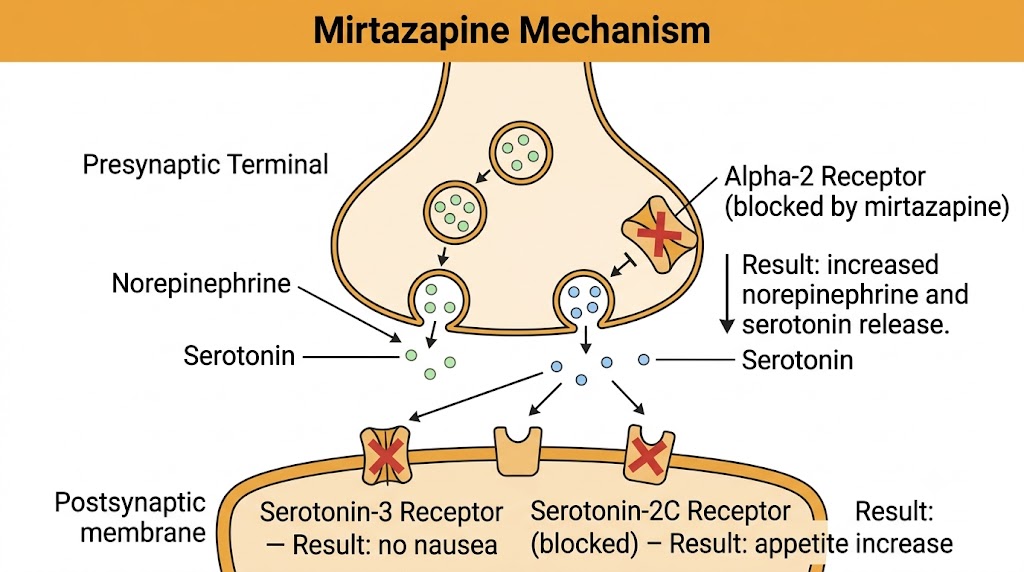
Mirtazapine works by blocking receptors rather than transporters. By antagonizing presynaptic alpha-2 adrenergic receptors, it removes the inhibitory brake on both norepinephrine and serotonin release, increasing output of both monoamines without touching the reuptake transporters. Its additional postsynaptic receptor blockade profile produces a distinctive adverse effect and tolerability pattern that makes it the preferred antidepressant in specific clinical settings.
Presynaptic alpha-2 adrenergic autoreceptors on noradrenergic neurons normally act as a negative feedback brake — when norepinephrine activates them, they suppress further norepinephrine release. Mirtazapine blocks these receptors, removing the brake and allowing greater norepinephrine release with each neuronal firing. The same alpha-2 receptors located on serotonergic terminals also suppress serotonin release when activated by norepinephrine; mirtazapine blocks these as well, disinhibiting serotonin release simultaneously. The result is enhanced output of both norepinephrine and serotonin through a presynaptic mechanism.
At postsynaptic serotonin receptors, mirtazapine blocks the serotonin-2A, serotonin-2C, and serotonin-3 subtypes. Serotonin-3 blockade produces a pronounced antiemetic effect — patients on mirtazapine rarely experience the nausea that limits tolerability with selective serotonin reuptake inhibitors and serotonin-norepinephrine reuptake inhibitors. Serotonin-2C blockade increases appetite and promotes weight gain, which is therapeutically useful in patients with depression-related anorexia and weight loss but is an adverse effect in others. Mirtazapine is also a potent histamine H1 antagonist, which produces marked sedation — most pronounced at lower doses and the basis for its common use at bedtime.
Mirtazapine has a counterintuitive dose-sedation relationship: it is more sedating at lower doses (15 mg) than at higher doses (30 to 45 mg). This occurs because histamine H1 antagonism, which drives sedation, is maximal across the full dose range, while the alpha-2 blockade-mediated increase in norepinephrine output at higher doses produces noradrenergic activation that partially counteracts histaminergic sedation. Clinically, patients troubled by daytime sedation at 15 mg may actually tolerate 30 mg better — the opposite of the usual expectation.
Mirtazapine's receptor profile defines when it is preferred. It is well-suited for patients with depression plus significant insomnia (sedation is an asset given at bedtime), patients with poor appetite and weight loss (serotonin-2C blockade stimulates appetite), and patients who cannot tolerate the nausea of serotonin transporter inhibitors (serotonin-3 blockade prevents nausea). Because it does not increase serotonin tone via the serotonin-2A pathway, mirtazapine does not cause the sexual dysfunction that affects roughly a third of patients on selective serotonin reuptake inhibitors or serotonin-norepinephrine reuptake inhibitors. It also has no clinically significant cytochrome P450 inhibition, making it one of the cleaner choices for drug interaction burden.
Weight gain is mirtazapine's most clinically limiting adverse effect — driven by serotonin-2C and H1 blockade, it is among the most weight-promoting antidepressants available. This should be discussed explicitly before initiation. Mirtazapine is frequently combined with a selective serotonin reuptake inhibitor or serotonin-norepinephrine reuptake inhibitor as an augmentation strategy, exploiting complementary mechanisms: reuptake inhibition plus receptor disinhibition.
Alpha-2 antagonism: increases norepinephrine and serotonin release. Serotonin-3 antagonism: antiemetic — no nausea. Serotonin-2C antagonism: appetite stimulation and weight gain. Histamine H1 antagonism: sedation (more at low dose). No serotonin reuptake transporter activity: no sexual dysfunction. No cytochrome P450 inhibition: clean interaction profile. Best use: depression with insomnia, poor appetite, or intolerance to selective serotonin reuptake inhibitor nausea.
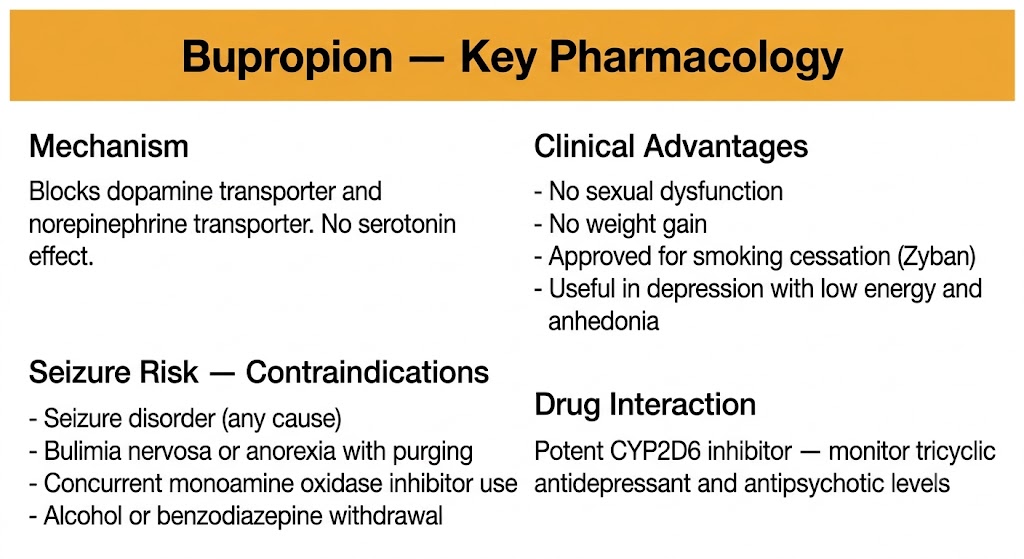
Bupropion is mechanistically unlike any other antidepressant: it blocks the dopamine and norepinephrine reuptake transporters with no effect on the serotonin transporter. This absence of serotonergic activity produces a strikingly different adverse effect profile — no sexual dysfunction, no nausea — while its dopaminergic activity enables its use as a smoking cessation agent. Its defining safety concern is a dose-dependent risk of seizures that creates several absolute contraindications.
Bupropion inhibits the norepinephrine reuptake transporter and the dopamine reuptake transporter, increasing synaptic availability of both monoamines. Norepinephrine enhancement contributes to antidepressant and antianxiety effects. Dopamine enhancement — in the mesolimbic and mesocortical pathways — specifically addresses anhedonia and amotivation, making bupropion a logical choice for patients whose depression is characterized primarily by low energy, loss of pleasure, cognitive slowing, and hypersomnia rather than prominent anxiety (where bupropion's activating properties can worsen symptoms). Active metabolites, particularly hydroxybupropion, contribute substantially to bupropion's pharmacological activity and have a longer half-life than the parent compound.
Bupropion is a potent inhibitor of cytochrome P450 2D6 — an important interaction that mirrors paroxetine and fluoxetine in its clinical consequences. Co-administration with tricyclic antidepressants, certain antipsychotics, or other cytochrome P450 2D6 substrates requires monitoring for elevated drug levels. Bupropion is primarily metabolized by cytochrome P450 2B6.
Bupropion lowers the seizure threshold in a dose-dependent manner. At standard therapeutic doses, the seizure risk is comparable to other antidepressants and is clinically acceptable. Above maximum recommended doses, seizure risk rises sharply. The immediate-release formulation must be dosed multiple times daily with no single dose exceeding 150 mg, because rapid peak concentrations from a large single dose disproportionately increase seizure risk; the extended-release formulation reduces peak concentrations and is the preferred formulation for this reason.
Absolute contraindications based on seizure risk are high-yield for Step 1. A prior seizure disorder of any cause is an absolute contraindication. Eating disorders — specifically bulimia nervosa and anorexia nervosa with purging — are contraindicated because electrolyte abnormalities from purging (hypokalemia, hypomagnesemia) independently lower the seizure threshold and interact synergistically with bupropion. Concurrent use with monoamine oxidase inhibitors is contraindicated due to risk of severe hypertensive crisis and neurotoxicity. Abrupt withdrawal from alcohol, benzodiazepines, or antiepileptic drugs — all of which lower the seizure threshold as withdrawal phenomena — is also a contraindication.
Bupropion was the first non-nicotine pharmacotherapy approved for smoking cessation, marketed as Zyban for this indication. Its efficacy is thought to be mediated through dopaminergic activity in the nucleus accumbens, where it raises basal dopamine tone and attenuates the drop in dopamine that drives nicotine craving during withdrawal. Bupropion also weakly blocks nicotinic acetylcholine receptors, which may reduce the reinforcing effect of cigarettes if a patient smokes while on treatment. The standard protocol initiates bupropion one to two weeks before the target quit date to allow plasma levels to reach steady state. Bupropion approximately doubles quit rates compared to placebo and has an additive effect when combined with nicotine replacement therapy.
The complete absence of serotonergic activity means bupropion does not produce sexual dysfunction — no decreased libido, no delayed orgasm, no anorgasmia. This makes it the preferred antidepressant when sexual function is a priority and a useful augmentation agent added to a selective serotonin reuptake inhibitor or serotonin-norepinephrine reuptake inhibitor specifically to counteract serotonergic sexual adverse effects. Bupropion does not cause weight gain — some patients experience modest weight loss, consistent with its stimulant-like dopaminergic properties. Common adverse effects include insomnia, dry mouth, headache, and activation or agitation, particularly in patients with anxiety disorders.
Absolute contraindications: seizure disorder (any cause); bulimia nervosa or anorexia nervosa with purging; concurrent monoamine oxidase inhibitor use; abrupt withdrawal from alcohol, benzodiazepines, or antiepileptic drugs. Relative contraindications: head trauma, central nervous system tumors. These are distinctively high-yield because they differ from contraindications of all other antidepressant classes.
| Author / Organization | Title | Source |
|---|---|---|
| Millan MJ | Descending control of pain | Prog Neurobiol. 2002;66(6):355–474 |
| Stahl SM, Grady MM, Moret C, Briley M | SNRIs: their pharmacology, clinical efficacy, and tolerability in comparison with other classes of antidepressants | CNS Spectr. 2005;10(9):732–747 |
| Deecher DC, Beyer CE, Johnston G, et al. | Desvenlafaxine succinate: a new serotonin and norepinephrine reuptake inhibitor | J Pharmacol Exp Ther. 2006;318(2):657–665 |
| Auclair AL, Martel JC, Assie MB, et al. | Levomilnacipran (F2695), a norepinephrine-preferring SNRI: profile in vitro and in models of depression and anxiety | Neuropharmacology. 2013;70:338–347 |
| Thase ME, Entsuah AR, Rudolph RL | Remission rates during treatment with venlafaxine or selective serotonin reuptake inhibitors | Br J Psychiatry. 2001;178:234–241 |
| Croom KF, Perry CM, Plosker GL | Mirtazapine: a review of its use in major depression and other psychiatric disorders | CNS Drugs. 2009;23(5):427–452 |
| Fawcett J, Barkin RL | Review of the results from clinical studies on the efficacy, safety and tolerability of mirtazapine for the treatment of patients with major depression | J Affect Disord. 1998;51(3):267–285 |
| Stahl SM, Pradko JF, Haight BR, et al. | A review of the neuropharmacology of bupropion, a dual norepinephrine and dopamine reuptake inhibitor | Prim Care Companion J Clin Psychiatry. 2004;6(4):159–166 |
| Johnston JA, Lineberry CG, Ascher JA, et al. | A 102-center prospective study of seizure in association with bupropion | J Clin Psychiatry. 1991;52(11):450–456 |
| Hurt RD, Sachs DP, Glover ED, et al. | A comparison of sustained-release bupropion and placebo for smoking cessation | N Engl J Med. 1997;337(17):1195–1202 |
| Clayton AH, Warnock JK, Kornstein SG, et al. | A placebo-controlled trial of bupropion SR as an antidote for selective serotonin reuptake inhibitor-induced sexual dysfunction | J Clin Psychiatry. 2004;65(1):62–67 |
| Stahl SM | Stahl's Essential Psychopharmacology: Neuroscientific Basis and Practical Applications, 5th ed. Chapters 9–10 | Cambridge University Press; 2021 |
| Bymaster FP, Dreshfield-Ahmad LJ, Threlkeld PG, et al. | Comparative affinity of duloxetine and venlafaxine for serotonin and norepinephrine transporters in vitro and in vivo | Neuropsychopharmacology. 2001;25(6):871–880 |