CHAPTER 17  ·  ANTIDEPRESSANT DRUGS
Section 1

Mechanism and Class Overview

How selective serotonin reuptake inhibitors work, what makes them selective, and why they are first-line agents across multiple conditions

Selective serotonin reuptake inhibitors are the most widely prescribed antidepressants and the first-line pharmacological treatment for major depressive disorder and most anxiety disorders. All six agents in the class share a single primary mechanism: blockade of the serotonin reuptake transporter on the presynaptic membrane, which reduces clearance of serotonin from the synaptic cleft and increases serotonergic neurotransmission over time.

What Selective Means

Selectivity refers to preference for the serotonin reuptake transporter over the norepinephrine and dopamine transporters — not to pharmacological purity. At standard therapeutic doses, all six agents are far more potent at the serotonin reuptake transporter than at the other monoamine transporters, which is why their primary clinical effects and adverse effects are serotonin-mediated. However, selectivity is relative. Paroxetine, for example, also has significant anticholinergic activity through muscarinic receptor antagonism, a property not shared by the other five agents in the class.

Indications

Selective serotonin reuptake inhibitors are first-line for major depressive disorder, generalized anxiety disorder, panic disorder, social anxiety disorder, post-traumatic stress disorder, and obsessive-compulsive disorder. All agents in the class carry at least one anxiety disorder approval. Fluoxetine and sertraline are approved for premenstrual dysphoric disorder. Fluvoxamine has a primary indication in obsessive-compulsive disorder. The breadth of indication across mood and anxiety disorders makes this the most widely used drug class in psychiatry.

Black-Box Warning: Suicidality

All antidepressants carry a Food and Drug Administration black-box warning for increased risk of suicidal thinking and behavior in children, adolescents, and young adults up to age 24. This risk appears greatest in the first weeks of treatment and is thought to relate to the activating effects of early serotonergic stimulation before mood improvement occurs. The warning does not apply to adults over 24 and does not mean antidepressants cause suicidality as a primary effect — untreated depression itself carries far greater suicide risk. Close monitoring in the first four weeks is the clinical response to this warning.

Mechanism Summary

All selective serotonin reuptake inhibitors block the serotonin reuptake transporter. The immediate result is elevated synaptic serotonin. The therapeutic result — antidepressant and anxiolytic effects — requires two to four weeks of continuous treatment due to the autoreceptor desensitization mechanism described in Module 1. Despite sharing the same primary mechanism, the six agents differ meaningfully in half-life, active metabolites, cytochrome P450 inhibition, and secondary receptor activity.


Section 2

Individual Agent Profiles

The pharmacokinetic and pharmacodynamic features that distinguish the six selective serotonin reuptake inhibitors from one another

All six selective serotonin reuptake inhibitors work by the same primary mechanism, but they differ enough in their pharmacokinetic profiles, drug interaction potential, and secondary receptor activity to make agent selection clinically meaningful. These differences — not the shared mechanism — are what Step 1 tests.
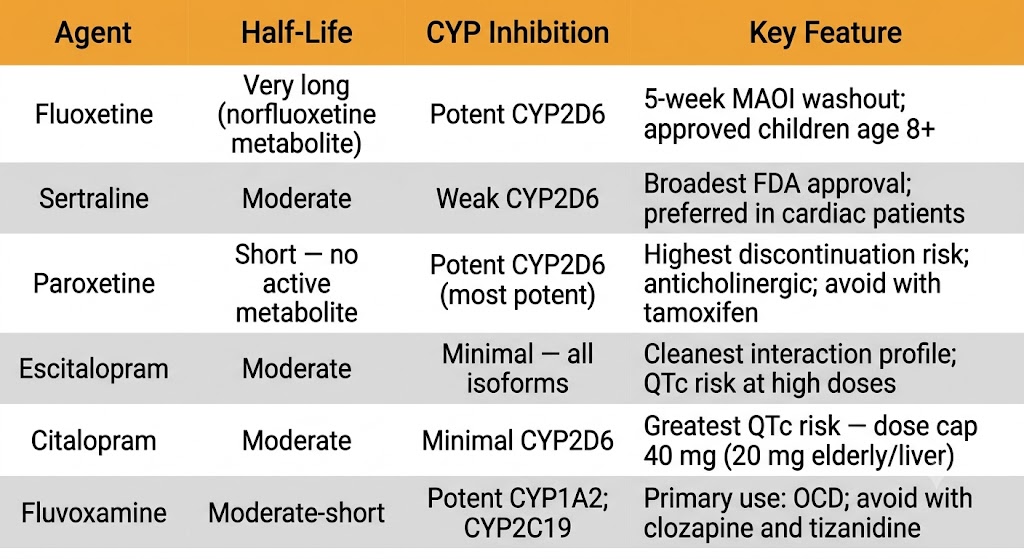
Comparison table of the six selective serotonin reuptake inhibitors showing half-life tier, cytochrome P450 inhibition profile, and key distinguishing clinical feature for each agent.
Comparison of the six selective serotonin reuptake inhibitors by half-life, cytochrome P450 inhibition profile, and key distinguishing clinical feature. Figure generated by Gemini AI.
Fluoxetine

Fluoxetine is unique among selective serotonin reuptake inhibitors for its exceptionally long effective duration. The parent drug has a long half-life, and its active metabolite norfluoxetine has a half-life of one to two weeks. This extended active metabolite produces three clinically critical consequences. First, abrupt discontinuation of fluoxetine causes minimal or no discontinuation syndrome — norfluoxetine self-tapers over weeks. Second, a five-week washout period is required before starting a monoamine oxidase inhibitor after stopping fluoxetine (versus two weeks for all other selective serotonin reuptake inhibitors). Third, cytochrome P450 2D6 inhibition by fluoxetine and norfluoxetine persists for weeks after the last dose.

Fluoxetine is a potent inhibitor of cytochrome P450 2D6 and a moderate inhibitor of cytochrome P450 3A4 and cytochrome P450 2C19. It is approved for major depressive disorder, obsessive-compulsive disorder, panic disorder, bulimia nervosa, premenstrual dysphoric disorder, and bipolar depression (combined with olanzapine). It is the only selective serotonin reuptake inhibitor approved for depression in children age 8 and older.

Sertraline

Sertraline has the broadest Food and Drug Administration approval profile of the class — covering major depressive disorder, obsessive-compulsive disorder, panic disorder, post-traumatic stress disorder, social anxiety disorder, and premenstrual dysphoric disorder. It has a moderate half-life (no long active metabolite), weak cytochrome P450 2D6 inhibition at standard doses, and minimal effects on other cytochrome P450 isoforms. This clean interaction profile, combined with evidence of cardiac safety, makes sertraline the preferred selective serotonin reuptake inhibitor in cardiac patients and a common first choice in primary care. It is also among the most studied agents in pregnancy.

Paroxetine

Paroxetine carries the highest clinical caution burden of any selective serotonin reuptake inhibitor for several compounding reasons. Its half-life is short and it has no active metabolites, making it the selective serotonin reuptake inhibitor most prone to discontinuation syndrome — abrupt cessation frequently produces flu-like symptoms, insomnia, nausea, sensory disturbances (electric-shock sensations), and irritability. It is the most potent cytochrome P450 2D6 inhibitor in the class, effectively converting normal metabolizers to poor metabolizer phenotype, with significant consequences for co-administered drugs including tricyclic antidepressants, antipsychotics, and tamoxifen.

Uniquely among selective serotonin reuptake inhibitors, paroxetine has clinically significant muscarinic receptor antagonism, producing anticholinergic adverse effects — dry mouth, constipation, urinary hesitancy, and cognitive effects — that are not seen with other class members. Paroxetine is also of concern in pregnancy due to signals of cardiovascular malformation in neonates with first-trimester exposure, making it the selective serotonin reuptake inhibitor most avoided during pregnancy.

Escitalopram

Escitalopram is the S-enantiomer of citalopram and is pharmacokinetically the cleanest selective serotonin reuptake inhibitor in terms of drug interactions. It has minimal inhibition of all major cytochrome P450 isoforms, making it the preferred choice when a patient is on multiple medications and drug interactions are a primary concern. It carries a Food and Drug Administration warning for QTc prolongation at higher doses, with a maximum recommended dose of 20 mg per day in elderly patients, those with liver disease, and cytochrome P450 2C19 poor metabolizers. Escitalopram is approved for major depressive disorder and generalized anxiety disorder, and has additional off-label use across anxiety disorders. It is approved for depression in adolescents age 12 and older.

Citalopram

Citalopram is a racemic mixture. It has minimal cytochrome P450 inhibition and a relatively clean receptor profile, but carries the most significant QTc prolongation concern of the class. The Food and Drug Administration caps citalopram at 40 mg per day in most patients and at 20 mg per day in patients over age 60, those with hepatic impairment, and cytochrome P450 2C19 poor metabolizers. It is not recommended above these doses for any indication. When QTc prolongation is a particular concern, escitalopram or sertraline are preferred over citalopram.

Fluvoxamine

Fluvoxamine is used primarily for obsessive-compulsive disorder and social anxiety disorder rather than major depressive disorder, and its use in other settings is limited by its drug interaction burden. It is the most potent cytochrome P450 1A2 inhibitor in the class and also inhibits cytochrome P450 2C19 and cytochrome P450 3A4. The cytochrome P450 1A2 inhibition is particularly consequential: fluvoxamine can raise plasma concentrations of clozapine dramatically, risking clozapine toxicity. It also significantly raises theophylline, olanzapine, and tizanidine levels — the tizanidine combination is contraindicated due to severe hypotension. In patients on clozapine or complex psychiatric regimens, fluvoxamine is generally avoided.

The Four Distinctions That Drive Agent Selection

Discontinuation syndrome risk: paroxetine (highest — short half-life, no active metabolite) versus fluoxetine (lowest — norfluoxetine self-tapers). Cytochrome P450 2D6 inhibition: paroxetine and fluoxetine (potent) versus escitalopram and citalopram (minimal). Monoamine oxidase inhibitor washout: fluoxetine requires five weeks; all others require two weeks. QTc prolongation: citalopram (most significant — dose cap 40 mg) and escitalopram (lesser but real — dose cap 20 mg in high-risk patients).

Section 3

Adverse Effects and Drug Interactions

Class-wide adverse effects shared by all selective serotonin reuptake inhibitors, and the cytochrome P450-mediated interactions that vary by agent

Selective serotonin reuptake inhibitors share a class adverse effect profile rooted in their common mechanism — excess serotonergic stimulation and the incidental activation of serotonin receptors outside the therapeutic target. Drug interactions, by contrast, vary significantly by agent and are driven primarily by differences in cytochrome P450 inhibition rather than the shared mechanism.

Class Adverse Effects

The most common adverse effects of selective serotonin reuptake inhibitors are gastrointestinal — nausea, diarrhea, and dyspepsia — most prominent in the first one to two weeks of treatment and typically attenuating as tolerance develops. Taking the drug with food reduces nausea for most agents. Sexual dysfunction is the most clinically significant and persistent adverse effect of the class: decreased libido, delayed orgasm, and anorgasmia affect a substantial proportion of patients and are a leading cause of nonadherence. Unlike gastrointestinal effects, sexual dysfunction does not reliably improve with time and often persists for the duration of treatment. Insomnia and activation are common early, particularly with fluoxetine.

Weight gain is modest with most selective serotonin reuptake inhibitors during acute treatment but may become clinically significant with long-term use, particularly with paroxetine. Hyponatremia through the syndrome of inappropriate antidiuretic hormone secretion is a class effect, most relevant in elderly patients. Platelet dysfunction — serotonin is required for platelet aggregation — is a class effect that increases bleeding risk, particularly in combination with nonsteroidal anti-inflammatory drugs or anticoagulants.

Discontinuation Syndrome

Abrupt discontinuation of a selective serotonin reuptake inhibitor can produce a characteristic syndrome: flu-like symptoms, insomnia, nausea, sensory disturbances (electric-shock sensations called "brain zaps"), and irritability. This syndrome reflects acute serotonin withdrawal and is not a sign of addiction, but it can be distressing and should be distinguished from relapse of depression. Risk is highest with paroxetine (short half-life, no active metabolite, potent anticholinergic rebound) and lowest with fluoxetine (long-acting norfluoxetine provides intrinsic tapering). Management is gradual dose tapering, or switching to fluoxetine and then tapering.

Cytochrome P450 Drug Interactions

The most clinically important selective serotonin reuptake inhibitor drug interactions are pharmacokinetic — selective serotonin reuptake inhibitors as inhibitors of cytochrome P450 enzymes raise plasma concentrations of co-administered drugs that depend on those enzymes for clearance.

Cytochrome P450 2D6 inhibition by paroxetine and fluoxetine is the highest-yield interaction pattern. Key victim drugs include tricyclic antidepressants (levels double or triple — tricyclic antidepressant toxicity risk), antipsychotics metabolized by cytochrome P450 2D6, opioids including codeine (reduced conversion to active morphine — reduced analgesia), and tamoxifen (reduced conversion to active endoxifen — potentially reduced anticancer efficacy). The tamoxifen interaction is of particular clinical importance: paroxetine and fluoxetine should be avoided in patients receiving tamoxifen for breast cancer, with escitalopram, citalopram, or venlafaxine preferred instead.

Cytochrome P450 1A2 inhibition by fluvoxamine is the most potent in the class and affects clozapine (dramatic level increase — toxicity risk), theophylline (narrow therapeutic index — toxicity risk), olanzapine, and tizanidine (contraindicated combination due to severe hypotension). Monoamine oxidase inhibitor interactions are covered in Section 4 under serotonin syndrome.

Interaction Alert — Tamoxifen

Tamoxifen is a prodrug activated by cytochrome P450 2D6 to its active metabolite endoxifen. Paroxetine and fluoxetine, as potent cytochrome P450 2D6 inhibitors, reduce endoxifen levels substantially and may reduce the breast cancer survival benefit of tamoxifen. These two selective serotonin reuptake inhibitors should be avoided in patients receiving tamoxifen. Preferred alternatives: venlafaxine, citalopram, or escitalopram at standard doses.


Section 4

Serotonin Syndrome

The clinical triad, precipitating drug combinations, and management — and how to distinguish it from neuroleptic malignant syndrome

Serotonin syndrome is a potentially life-threatening drug reaction caused by excess serotonergic activity, almost always from a combination of two or more serotonergic drugs. It is not idiosyncratic — it is a predictable pharmacological consequence of too much serotonin receptor stimulation, making it largely preventable through careful prescribing.

The Clinical Triad

Serotonin syndrome produces a characteristic triad of three feature categories. Neuromuscular findings are the most distinguishing: clonus (rhythmic involuntary muscle contractions, especially at the ankles and eyes), hyperreflexia, myoclonus, and tremor. Autonomic instability produces hyperthermia, diaphoresis, tachycardia, hypertension, and diarrhea. Altered mental status ranges from mild agitation and anxiety to severe confusion and delirium.

The presence of all three elements of the triad is not required for diagnosis. The Hunter Serotonin Toxicity Criteria are the most clinically useful diagnostic tool: exposure to a serotonergic agent plus clonus (spontaneous, inducible, or ocular) with or without agitation and diaphoresis is the key diagnostic finding. Clonus — particularly ocular clonus (rhythmic oscillation of the eyes) — is the feature that most reliably distinguishes serotonin syndrome from neuroleptic malignant syndrome.

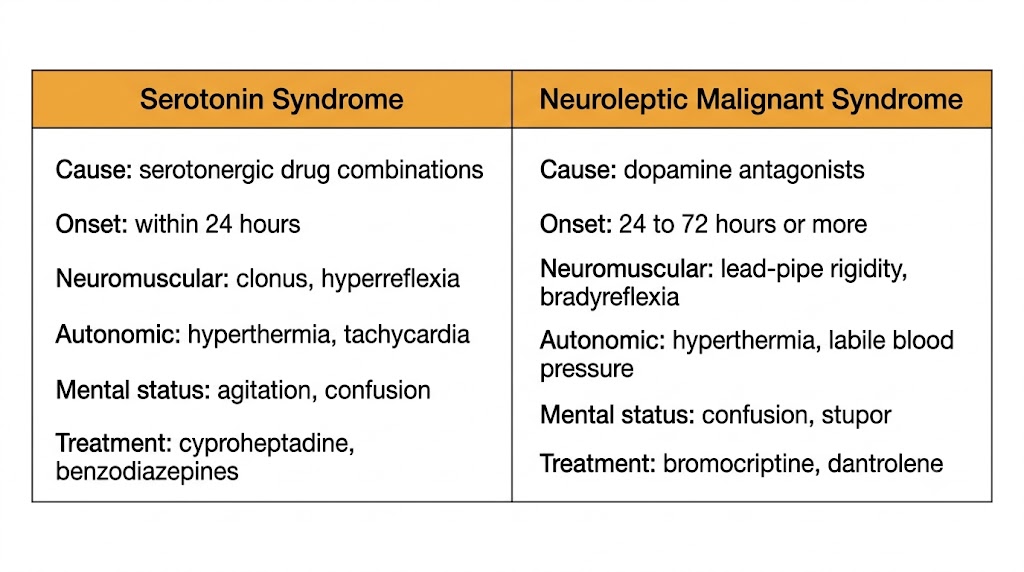
Two-panel comparison table distinguishing serotonin syndrome from neuroleptic malignant syndrome by cause, onset, neuromuscular findings, autonomic features, mental status, and treatment.
Serotonin syndrome versus neuroleptic malignant syndrome: key distinguishing features. Clonus and hyperreflexia identify serotonin syndrome; lead-pipe rigidity identifies neuroleptic malignant syndrome. Figure generated by Gemini AI.
Precipitating Drug Combinations

The highest-risk combination is a selective serotonin reuptake inhibitor combined with an irreversible monoamine oxidase inhibitor — this combination is absolutely contraindicated and can be fatal. The required washout before starting a monoamine oxidase inhibitor after stopping a selective serotonin reuptake inhibitor is two weeks for most agents and five weeks for fluoxetine. After stopping a monoamine oxidase inhibitor, at least two weeks must pass before starting any serotonergic agent.

Other important serotonergic combinations include selective serotonin reuptake inhibitors with linezolid (an antibiotic that inhibits monoamine oxidase A — requires switching the antidepressant before use), intravenous methylene blue (monoamine oxidase inhibitor activity — can trigger serotonin syndrome perioperatively in patients on selective serotonin reuptake inhibitors), tramadol (serotonin reuptake transporter inhibition plus opioid activity), meperidine, dextromethorphan, and St. John's Wort. Triptans in combination with selective serotonin reuptake inhibitors carry a debated but real risk and warrant monitoring.

Management

The first step in management is stopping all serotonergic agents. Mild cases resolve within 24 hours with supportive care and benzodiazepines for agitation. Moderate cases require hospital admission, active cooling if temperature is elevated, and cyproheptadine — an antihistamine with serotonin-2A antagonist activity that reduces serotonergic tone. Severe cases require intensive care, neuromuscular paralysis and sedation to halt the muscle hyperactivity driving hyperthermia, and management of rhabdomyolysis.

Serotonin Syndrome versus Neuroleptic Malignant Syndrome

Both produce hyperthermia and altered mental status, but the neuromuscular findings, time course, and precipitants differ sharply. Serotonin syndrome: onset within 24 hours, clonus and hyperreflexia, caused by serotonergic drugs, treated with cyproheptadine and benzodiazepines. Neuroleptic malignant syndrome: onset over 24 to 72 hours or more, lead-pipe rigidity and bradyreflexia, caused by dopamine antagonists or abrupt dopaminergic withdrawal, treated with bromocriptine and dantrolene. Confusing the two leads to inappropriate treatment — cyproheptadine is useless in neuroleptic malignant syndrome; dantrolene is not indicated for serotonin syndrome.


Suggested References
Author / Organization Title Source
Stahl SM Mechanism of action of serotonin selective reuptake inhibitors: serotonin receptors and pathways mediate therapeutic effects and side effects J Affect Disord. 1998;51(3):215–235
Blier P, de Montigny C Current advances and trends in the treatment of depression Trends Pharmacol Sci. 1994;15(7):220–226
Casarotto PC, Girych M, Fred SM, et al. Antidepressant drugs act by directly binding to TRKB neurotrophin receptors Cell. 2021;184(5):1299–1313
American Psychiatric Association Practice Guideline for the Treatment of Patients with Major Depressive Disorder, 3rd ed. American Psychiatric Publishing; 2010
Hiemke C, Hartter S Pharmacokinetics of selective serotonin reuptake inhibitors Pharmacol Ther. 2000;85(1):11–28
Hemeryck A, Belpaire FM Selective serotonin reuptake inhibitors and cytochrome P-450 mediated drug-drug interactions: an update Curr Drug Metab. 2002;3(1):13–37
U.S. Food and Drug Administration FDA Drug Safety Communication: Revised recommendations for Celexa (citalopram hydrobromide) related to a potential risk of abnormal heart rhythms with high doses FDA.gov; 2012
Woosley RL, Heise CW, Romero KA QTDrugs List AZCERT, Inc.; crediblemeds.org. Accessed 2025
Boyer EW, Shannon M The serotonin syndrome N Engl J Med. 2005;352(11):1112–1120
Pedavally S, Fugate JE, Rabinstein AA Serotonin syndrome in the intensive care unit: clinical presentations and precipitating medications Neurocrit Care. 2014;21(1):108–113
Kelly CM, Juurlink DN, Gomes T, et al. Selective serotonin reuptake inhibitors and breast cancer mortality in women receiving tamoxifen: a population based cohort study BMJ. 2010;340:c693
Stahl SM Stahl's Essential Psychopharmacology: Neuroscientific Basis and Practical Applications, 5th ed. Chapter 8 Cambridge University Press; 2021
Sogaard B, Mengel H, Rao N, Larsen F The pharmacokinetics of escitalopram after oral and intravenous administration of single and multiple doses to healthy subjects J Clin Pharmacol. 2005;45(12):1400–1406