CHAPTER 17  ·  ANTIDEPRESSANT DRUGS
Section 1

Mechanism — N-methyl-D-aspartate Receptor Blockade and Rapid Antidepressant Action

How blocking the glutamate N-methyl-D-aspartate receptor produces antidepressant effects within hours — a fundamentally different mechanism from every prior antidepressant class

Ketamine and esketamine represent the most significant mechanistic departure in antidepressant pharmacology in decades. Every antidepressant approved before ketamine acts on monoamine systems and requires weeks of continuous exposure for therapeutic benefit. Ketamine blocks the N-methyl-D-aspartate glutamate receptor and produces antidepressant effects within hours of a single administration — a difference that is not merely quantitative but reflects an entirely different pharmacological mechanism.

The N-methyl-D-aspartate Receptor

Glutamate is the primary excitatory neurotransmitter in the brain. The N-methyl-D-aspartate receptor is a glutamate-gated ion channel that plays a central role in synaptic plasticity, learning, and the regulation of neuronal circuits relevant to mood. It requires both glutamate binding and membrane depolarization to open fully, and when activated it conducts calcium ions into the neuron — the calcium influx that drives downstream signaling for synaptic strengthening and neuroplasticity.

Ketamine is an open-channel blocker of the N-methyl-D-aspartate receptor — it enters and binds within the channel pore when the channel is open, physically blocking ion flow. This mechanism is dose-dependent and use-dependent: channel opening is required for ketamine to gain access to its binding site. At the doses used for antidepressant treatment (substantially below anesthetic doses), ketamine selectively blocks N-methyl-D-aspartate receptors in circuits relevant to mood without producing full anesthesia.

Why Antidepressant Effects Develop Within Hours

The speed of ketamine's antidepressant action is explained by the downstream consequences of N-methyl-D-aspartate blockade rather than by the blockade itself. When ketamine blocks N-methyl-D-aspartate receptors on inhibitory interneurons in the prefrontal cortex, it releases pyramidal neurons from inhibitory control, producing a rapid burst of glutamate release. This glutamate burst activates another receptor type — the alpha-amino-3-hydroxy-5-methyl-4-isoxazolepropionic acid (AMPA) receptor — which triggers the release of brain-derived neurotrophic factor and activation of the tropomyosin receptor kinase B receptor pathway. This cascade drives rapid synaptogenesis — the formation of new synaptic connections in prefrontal circuits — within hours. The new synapses reverse the synaptic loss caused by chronic stress and depression and represent the structural correlate of the antidepressant effect.

The antidepressant effect outlasts the drug itself by days: ketamine is eliminated within a few hours, but the synaptic changes it triggers persist for three to seven days following a single dose. This is the pharmacological basis for the multi-day antidepressant response seen clinically even after a single infusion.
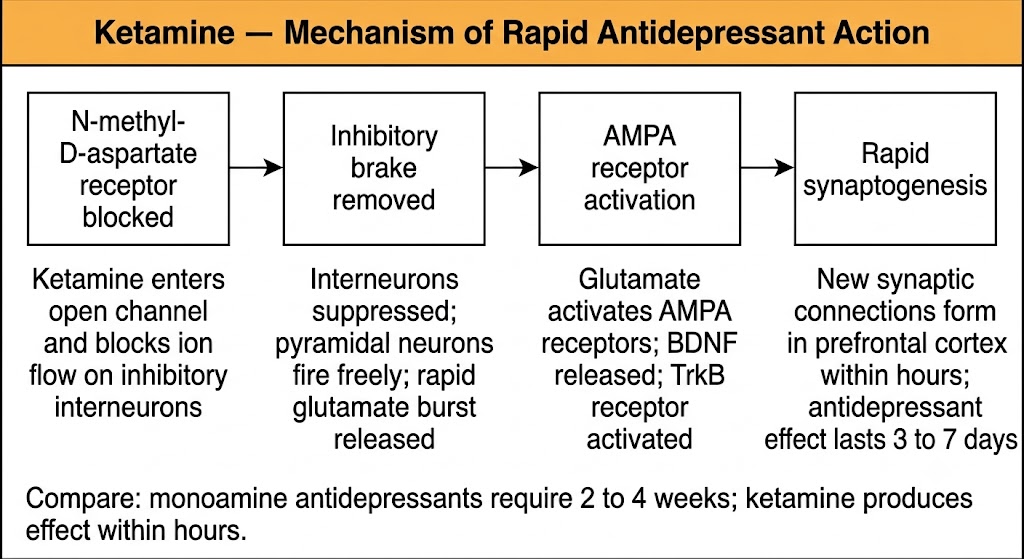
Four-box flow diagram showing the ketamine mechanism of rapid antidepressant action: N-methyl-D-aspartate receptor blockade on inhibitory interneurons leads to glutamate burst, which activates AMPA receptors and releases BDNF, driving rapid synaptogenesis in prefrontal cortex within hours.
Ketamine mechanism of rapid antidepressant action: four sequential steps from N-methyl-D-aspartate receptor blockade to synaptogenesis within hours. Figure generated by Gemini AI.
Ketamine versus Esketamine — Stereochemistry

Ketamine exists as two mirror-image forms (enantiomers). Racemic ketamine — the form used for intravenous infusion — contains equal proportions of both enantiomers. Esketamine is the S-enantiomer alone and has approximately three to four times greater affinity for the N-methyl-D-aspartate receptor than the R-enantiomer, making it the more pharmacologically potent form. Esketamine also produces more pronounced dissociative effects per unit dose for the same reason. The intranasal formulation of esketamine (Spravato) is the only Food and Drug Administration-approved product for antidepressant use; racemic ketamine given intravenously is used off-label.

The Fundamental Distinction

All antidepressants before ketamine: monoamine mechanism, two-to-four-week onset. Ketamine and esketamine: N-methyl-D-aspartate glutamate receptor blockade, antidepressant effect within hours of a single dose. The mechanism is entirely different. The speed is entirely different. This distinction is the central high-yield fact for Step 1.

Section 2

Esketamine and Intravenous Ketamine — Clinical Use

Food and Drug Administration-approved esketamine and off-label intravenous ketamine — indications, administration requirements, and what distinguishes the two formulations

Ketamine-based antidepressant treatment is available in two clinical forms: intranasal esketamine (Spravato), which is Food and Drug Administration-approved with defined regulatory requirements, and intravenous racemic ketamine, which is used off-label based on a substantial evidence base but without Food and Drug Administration approval for psychiatric indications.

Esketamine (Spravato) — Food and Drug Administration-Approved

Esketamine received Food and Drug Administration approval in March 2019 for treatment-resistant depression — defined as major depressive disorder that has not responded to at least two adequate antidepressant trials. A second approval followed in August 2020 for major depressive disorder with acute suicidal ideation or behavior, recognizing its ability to produce rapid anti-suicidal effects where conventional antidepressants would take weeks to act. These approvals represent the first non-monoaminergic antidepressant mechanism ever approved by the Food and Drug Administration.

Esketamine is administered intranasally as a nasal spray. Because it produces dissociation and transiently elevates blood pressure, the Food and Drug Administration requires all administration to occur in a certified healthcare setting under a Risk Evaluation and Mitigation Strategy program. Patients are monitored for at least two hours after each dose before being cleared to leave. They cannot drive on the day of administration. Self-administration at home is not permitted. Esketamine must be used in conjunction with an oral antidepressant — it is not approved as monotherapy. Dosing is twice weekly for the induction phase (approximately four weeks), then weekly, then biweekly for maintenance.

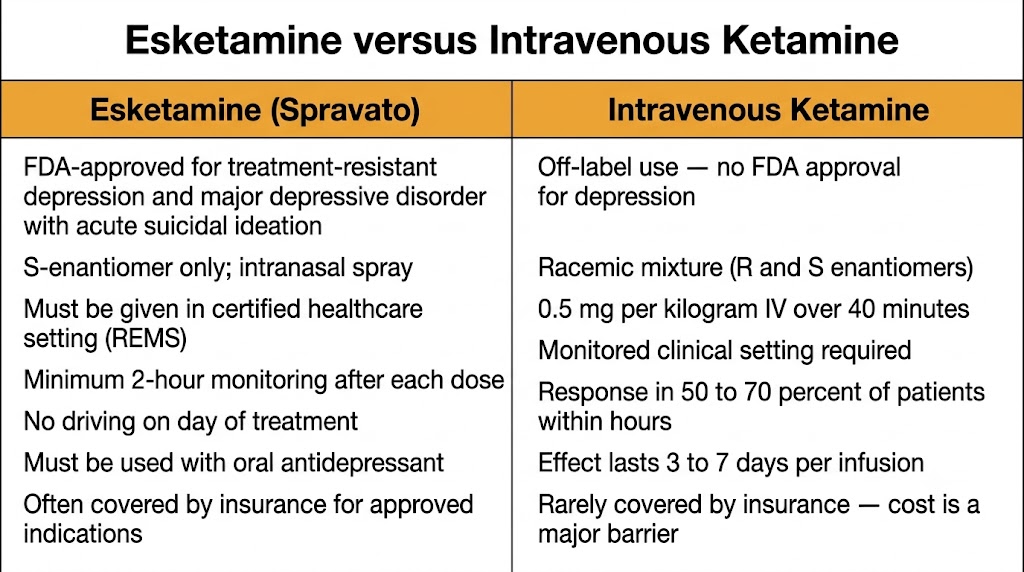
Two-panel comparison table distinguishing esketamine (Spravato) from intravenous ketamine by regulatory status, formulation, administration setting, monitoring requirements, oral antidepressant requirement, and insurance coverage.
Esketamine (Spravato) versus intravenous ketamine: regulatory status, administration requirements, and clinical differences. Figure generated by Gemini AI.
Intravenous Ketamine — Off-Label Use in Treatment-Resistant Depression

Racemic ketamine given intravenously is used off-label for treatment-resistant depression and acute suicidal ideation despite having no Food and Drug Administration approval for psychiatric indications — its licensed uses are anesthetic induction and maintenance. The evidence base from multiple randomized controlled trials is substantial: a single intravenous infusion at 0.5 mg per kilogram over 40 minutes produces antidepressant response in approximately 50 to 70 percent of patients with treatment-resistant depression within hours, with peak effect at 24 hours and duration of three to seven days. This response rate and speed has no equivalent among conventional antidepressants.

A single infusion is typically used as a proof-of-concept or acute bridge; a standard course of six infusions over two weeks is widely used to extend benefit. Because intravenous ketamine is off-label, it is rarely covered by insurance for this indication in the United States, making cost a significant barrier. Administration requires a monitored clinical setting capable of managing dissociation and hemodynamic changes. Intravenous ketamine and intranasal esketamine are considered complementary options; no adequately powered head-to-head comparison has been conducted.

Esketamine Risk Evaluation and Mitigation Strategy — Key Requirements

All esketamine administration must occur in a certified healthcare setting. Patients are monitored for at least two hours after each dose. No driving on the day of administration. No self-administration or take-home dispensing. Must be used with an oral antidepressant. These requirements apply nationwide and are not at the clinician's discretion — they are regulatory requirements of the Food and Drug Administration approval.


Section 3

Safety Profile and Monitoring

Dissociation, cardiovascular effects, abuse potential, and contraindications — the safety considerations that define how ketamine and esketamine are used in practice

Ketamine and esketamine have a distinctive adverse effect profile that reflects their N-methyl-D-aspartate antagonist and dissociative properties. Understanding these effects — and distinguishing expected pharmacological effects from adverse events requiring intervention — is essential for safe clinical use.

Dissociation — The Primary Acute Effect

Dissociation is the most consistent acute effect of both intravenous ketamine and intranasal esketamine at antidepressant doses. It is characterized by perceptual distortions, feelings of unreality, depersonalization, altered sense of time, and sometimes visual misperceptions — effects that do not reach the intensity of frank psychosis at therapeutic doses. These effects begin within minutes of intravenous infusion or within 10 to 20 minutes of intranasal administration, peak near the end of the infusion or 30 to 40 minutes after nasal dosing, and resolve within 60 to 90 minutes in most patients.

Dissociation is expected and dose-dependent — it is a pharmacological effect, not a sign of adverse reaction, at typical antidepressant doses. Patients should be warned before the first treatment that perceptual changes will occur and will resolve. Ketamine and esketamine should be used with extreme caution or avoided in patients with a personal or family history of schizophrenia or other primary psychotic disorders, where dissociative states may precipitate or worsen psychosis.

Cardiovascular Effects

Ketamine produces transient increases in heart rate and blood pressure through sympathomimetic activity — it inhibits catecholamine reuptake, raising sympathetic tone. At antidepressant doses, blood pressure increases of 10 to 20 mmHg systolic are typical, peaking during infusion or shortly after nasal dosing and returning to baseline within one to two hours. Patients with baseline hypertension, significant cardiac disease, or a history of hypertensive emergency require pre-treatment blood pressure optimization and close monitoring during the session. Vital signs are measured before administration, during the monitoring period at regular intervals, and before discharge.

Abuse Potential and Regulatory Schedule

Ketamine is a Schedule III controlled substance under the United States Controlled Substances Act, reflecting established potential for misuse at higher doses and frequencies than those used in antidepressant treatment. At recreational doses, ketamine produces intense dissociation and euphoria. Chronic high-dose recreational use is associated with ketamine-induced uropathy — a serious and potentially permanent bladder condition — and with cognitive impairment. Esketamine carries the same Schedule III classification. The Risk Evaluation and Mitigation Strategy program for esketamine directly addresses the abuse risk by requiring supervised in-clinic administration and prohibiting take-home dispensing.

Other Adverse Effects and Contraindications

Nausea and vomiting occur in approximately 20 to 30 percent of patients. Pre-treatment with antiemetics is standard practice at most ketamine treatment centers and reduces the frequency and severity of nausea. Headache and sedation are common after esketamine — sedation is the pharmacological basis for the two-hour post-dose monitoring requirement and the no-driving restriction.

Absolute contraindications to esketamine and intravenous ketamine in the antidepressant setting include: history of aneurysmal vascular disease or arteriovenous malformation; intracerebral hemorrhage; hypersensitivity to ketamine. Uncontrolled hypertension is a relative contraindication requiring pre-treatment blood pressure management. Active psychotic disorders including schizophrenia are clinical contraindications.

Contraindications — High-Yield Summary

Absolute: aneurysmal vascular disease or arteriovenous malformation; intracerebral hemorrhage; ketamine hypersensitivity. Clinical: active psychosis or schizophrenia (may precipitate or worsen). Relative: uncontrolled hypertension. No driving on day of treatment. No self-administration. Two-hour post-dose monitoring mandatory for esketamine under Risk Evaluation and Mitigation Strategy.


Suggested References
Author / Organization Title Source
Traynelis SF, Wollmuth LP, McBain CJ, et al. Glutamate receptor ion channels: structure, regulation, and function Pharmacol Rev. 2010;62(3):405–496
Bhatt DL, Bhatt S, Bhatt DK Ketamine and its receptor binding: a pharmacological review J Pharmacol Pharmacother. 2021;12(1):1–7
Zanos P, Moaddel R, Morris PJ, et al. Ketamine and ketamine metabolite pharmacology: insights into therapeutic mechanisms Pharmacol Rev. 2018;70(3):621–660
Hasler G, van der Veen JW, Tumonis T, et al. Reduced prefrontal glutamate/glutamine and gamma-aminobutyric acid levels in major depression determined using proton magnetic resonance spectroscopy Arch Gen Psychiatry. 2007;64(2):193–200
Duman RS, Aghajanian GK, Sanacora G, Bhatt DL Synaptic plasticity and depression: new insights from stress and rapid-acting antidepressants Nat Med. 2016;22(3):238–249
Casarotto PC, Girych M, Fred SM, et al. Antidepressant drugs act by directly binding to TRKB neurotrophin receptors Cell. 2021;184(5):1299–1313
Li N, Lee B, Liu RJ, et al. mTOR-dependent synapse formation underlies the rapid antidepressant effects of NMDA antagonists Science. 2010;329(5994):959–964
Zanos P, Moaddel R, Morris PJ, et al. NMDAR inhibition-independent antidepressant actions of (R,S)-ketamine metabolites Nature. 2016;533(7604):481–486
Zarate CA Jr, Singh JB, Carlson PJ, et al. A randomized trial of an N-methyl-D-aspartate antagonist in treatment-resistant major depression Arch Gen Psychiatry. 2006;63(8):856–864
aan het Rot M, Collins KA, Murrough JW, et al. Safety and efficacy of repeated-dose intravenous ketamine for treatment-resistant depression Biol Psychiatry. 2010;67(2):139–145
Zhu ZD, Xu Y, Gao Y, et al. Lateral habenula in the pathophysiology of depression Front Cell Neurosci. 2021;15:666988
Daly EJ, Singh JB, Fedgus M, et al. Efficacy and safety of intranasal esketamine adjunctive to oral antidepressant therapy in treatment-resistant depression JAMA Psychiatry. 2018;75(2):139–148
U.S. Food and Drug Administration Spravato (esketamine) prescribing information. Revised 2023 FDA; 2023
Popova V, Daly EJ, Trivedi M, et al. Efficacy and safety of flexibly dosed esketamine nasal spray combined with a newly initiated oral antidepressant in treatment-resistant depression Am J Psychiatry. 2019;176(6):428–438
Murrough JW, Iosifescu DV, Chang LC, et al. Antidepressant efficacy of ketamine in treatment-resistant major depression: a two-site randomized controlled trial Am J Psychiatry. 2013;170(10):1134–1142
Drug Enforcement Administration Ketamine. Diversion Control Division DEA; 2020