Serotonin syndrome is a potentially life-threatening drug toxidrome caused by excess serotonergic activity at central and peripheral receptors. It is predictable, almost always iatrogenic, and entirely preventable through attention to drug combinations. Recognition requires distinguishing it from neuroleptic malignant syndrome, with which it shares surface features but differs in mechanism, time course, neuromuscular findings, and treatment.
Serotonin syndrome results from excessive stimulation of serotonin-1A and serotonin-2A receptors in the central and peripheral nervous systems. The most dangerous precipitating combinations are those that block serotonin reuptake and simultaneously inhibit its enzymatic degradation — two normally redundant protective mechanisms. The highest-risk combination in clinical practice is any selective serotonin reuptake inhibitor or serotonin-norepinephrine reuptake inhibitor combined with a monoamine oxidase inhibitor, which is absolutely contraindicated. Other important combinations include selective serotonin reuptake inhibitors with tramadol (which also inhibits the serotonin reuptake transporter), dextromethorphan, triptans, linezolid (an antibiotic with monoamine oxidase A inhibitory activity), and intravenous methylene blue (also a monoamine oxidase inhibitor). St. John's Wort contributes mild serotonin reuptake transporter inhibition and adds to serotonergic burden when combined with prescription antidepressants.
The clinical presentation consists of three feature categories. Altered mental status ranges from agitation and anxiety to confusion and delirium. Autonomic instability produces hyperthermia, diaphoresis, tachycardia, hypertension, and diarrhea. Neuromuscular findings — the most diagnostically specific — include clonus (rhythmic involuntary muscle contractions, especially at the ankle and eyes), hyperreflexia, myoclonus, and tremor. All three elements need not be present simultaneously.
The Hunter Serotonin Toxicity Criteria are the standard diagnostic tool: a serotonergic agent must be present, plus one of the following — spontaneous clonus; inducible clonus with agitation or diaphoresis; ocular clonus with agitation or diaphoresis; tremor with hyperreflexia; or hypertonic rigidity with temperature above 38 degrees Celsius plus ocular or inducible clonus. Clonus — particularly ocular clonus — is the feature that most reliably distinguishes serotonin syndrome from neuroleptic malignant syndrome.
Both conditions produce hyperthermia, altered mental status, and rigidity, but they differ in ways that are high-yield for Step 1. Serotonin syndrome: rapid onset (hours after precipitant), caused by serotonergic drug combinations, neuromuscular findings are clonus and hyperreflexia, bowel sounds are hyperactive. Neuroleptic malignant syndrome: slow onset (24 to 72 hours or longer) after dopamine antagonist initiation or withdrawal, neuromuscular findings are lead-pipe rigidity and bradyreflexia. Treatment also differs: serotonin syndrome is treated with cyproheptadine and benzodiazepines; neuroleptic malignant syndrome is treated with bromocriptine and dantrolene.
The first step is stopping all serotonergic agents. Mild cases resolve with supportive care and benzodiazepines for agitation within 24 to 48 hours. Moderate cases require hospital admission, active cooling if temperature is elevated, and cyproheptadine — a histamine H1 antagonist with serotonin-2A blocking activity — to directly reduce serotonergic receptor stimulation. Severe cases with temperatures above 41 degrees Celsius require intensive care, neuromuscular paralysis and sedation to halt thermogenesis from muscle hyperactivity, and management of rhabdomyolysis. Dantrolene, effective in malignant hyperthermia and sometimes used in neuroleptic malignant syndrome, is not indicated for serotonin syndrome — the hyperthermia mechanism is different.
Selective serotonin reuptake inhibitor or serotonin-norepinephrine reuptake inhibitor plus any monoamine oxidase inhibitor — absolutely contraindicated. Selective serotonin reuptake inhibitor plus linezolid or methylene blue — monoamine oxidase inhibitor activity; must switch the antidepressant before use. Selective serotonin reuptake inhibitor plus tramadol — underrecognized risk in postoperative pain management. Fluoxetine requires a five-week washout before starting a monoamine oxidase inhibitor; all other selective serotonin reuptake inhibitors require two weeks.
Antidepressant adverse effects are not random. They follow directly from each drug's receptor binding profile. A drug that blocks histamine H1 receptors will cause sedation and weight gain; a drug that blocks alpha-1 adrenergic receptors will cause orthostatic hypotension; a drug that strongly inhibits the serotonin reuptake transporter will cause nausea and sexual dysfunction. Understanding this pharmacological logic makes adverse effect prediction systematic.
Sexual dysfunction — decreased libido, delayed orgasm, and anorgasmia — is the most common reason for antidepressant discontinuation in patients who have otherwise achieved adequate therapeutic response. Prospective assessment with validated instruments shows rates of 40 to 65 percent with selective serotonin reuptake inhibitors and serotonin-norepinephrine reuptake inhibitors, substantially higher than rates reported in passive clinical trial adverse event collection. The mechanism involves sustained serotonin-2A and serotonin-2C receptor activation in spinal reflex arcs governing sexual response.
Management options include: switching to an agent with a lower burden — bupropion, mirtazapine, and vortioxetine have the most favorable sexual dysfunction profiles; adding bupropion to augment dopaminergic tone in circuits mediating sexual response; or, for erectile dysfunction, adding a phosphodiesterase type 5 inhibitor. Drug holidays — reducing or stopping the dose on weekends — have limited utility because the receptor adaptations causing sexual dysfunction persist across days, and the risk of breakthrough depression outweighs modest benefit.
Weight gain varies substantially across classes. Mirtazapine causes the most significant weight gain through potent histamine H1 blockade (reduces hypothalamic satiety signaling) plus serotonin-2C antagonism (stimulates appetite). Paroxetine produces more weight gain than other selective serotonin reuptake inhibitors due to its antihistaminic activity. Tricyclic antidepressants cause weight gain through histamine H1 and muscarinic blockade. Bupropion is weight-neutral or modestly weight-reducing — the only antidepressant approved as part of a weight management combination. Most other selective serotonin reuptake inhibitors and serotonin-norepinephrine reuptake inhibitors are weight-neutral over the first several months, though long-term use may produce modest gains.
The clinically significant cardiovascular effects of modern antidepressants are QTc prolongation and blood pressure changes. Citalopram produces dose-dependent QTc prolongation — the Food and Drug Administration dose cap is 40 mg per day in most patients and 20 mg per day in those over 60, with hepatic impairment, or taking cytochrome P450 2C19 inhibitors. Escitalopram carries the same 20 mg per day maximum in high-risk populations. No other selective serotonin reuptake inhibitor or serotonin-norepinephrine reuptake inhibitor produces clinically meaningful QTc prolongation at standard doses. Tricyclic antidepressants carry a major cardiovascular burden — orthostatic hypotension (alpha-1 blockade), QTc prolongation, and sodium channel blockade that is lethal in overdose. Serotonin-norepinephrine reuptake inhibitors, particularly venlafaxine at higher doses, elevate blood pressure through norepinephrine transporter inhibition and require blood pressure monitoring.
Nausea is the most common early adverse effect of selective serotonin reuptake inhibitors and serotonin-norepinephrine reuptake inhibitors, occurring in 20 to 30 percent of patients. It typically resolves within one to two weeks as serotonin-3 receptors in the gut and brain stem desensitize. Starting at the lowest available dose, taking the drug with food, or using extended-release formulations reduces early nausea without compromising eventual efficacy.
Gastrointestinal bleeding risk is elevated with selective serotonin reuptake inhibitors because serotonin is required for platelet aggregation — blocking the serotonin reuptake transporter on platelets depletes their serotonin stores and impairs platelet plug formation. This effect is additive with nonsteroidal anti-inflammatory drugs, and the combination substantially increases upper gastrointestinal bleeding risk. Co-prescribing a proton pump inhibitor reduces but does not eliminate this risk. Patients on anticoagulants plus a selective serotonin reuptake inhibitor require monitoring.
Histamine H1 blockade: sedation, weight gain (mirtazapine, doxepin, paroxetine, tricyclic antidepressants). Alpha-1 blockade: orthostatic hypotension, falls (tricyclic antidepressants, trazodone). Muscarinic blockade: anticholinergic syndrome — dry mouth, urinary retention, constipation, confusion (tertiary tricyclic antidepressants, paroxetine). Serotonin reuptake transporter inhibition: nausea, sexual dysfunction, impaired platelet aggregation (all selective serotonin reuptake inhibitors, serotonin-norepinephrine reuptake inhibitors). QTc prolongation: citalopram and escitalopram (dose-dependent), all tricyclic antidepressants.
Antidepressants generate pharmacokinetic drug interactions primarily as inhibitors of cytochrome P450 enzymes, raising plasma concentrations of co-administered drugs that depend on those enzymes for clearance. Several antidepressants are among the most potent cytochrome P450 inhibitors in common clinical use — understanding which agent inhibits which isoform is directly testable on Step 1 and directly relevant to patient safety.
Fluoxetine and paroxetine are the most potent cytochrome P450 2D6 inhibitors among the selective serotonin reuptake inhibitors, capable of converting a patient who is a normal metabolizer into a functional poor metabolizer during treatment. The most clinically consequential interaction is with tamoxifen: cytochrome P450 2D6 converts tamoxifen to its active metabolite endoxifen, which is responsible for the majority of the drug's anti-estrogenic efficacy in hormone receptor-positive breast cancer. Coadministration of fluoxetine or paroxetine substantially reduces endoxifen levels and is associated with reduced tamoxifen efficacy and increased breast cancer recurrence. Oncology guidelines recommend against fluoxetine and paroxetine in patients on tamoxifen; sertraline, citalopram, escitalopram, or venlafaxine are preferred alternatives.
Other cytochrome P450 2D6 substrates affected include tricyclic antidepressants (plasma levels can double or triple — toxicity risk), codeine (reduced conversion to active morphine — analgesic failure), metoprolol (excessive beta-blockade), and risperidone and haloperidol (elevated antipsychotic concentrations). Note that fluoxetine's active metabolite norfluoxetine means cytochrome P450 2D6 inhibition persists for weeks after the last dose, even after the drug itself has been stopped.
Fluvoxamine has the broadest cytochrome P450 inhibition profile of any selective serotonin reuptake inhibitor, with potent inhibition of cytochrome P450 1A2 and cytochrome P450 2C19 and moderate inhibition of cytochrome P450 3A4. Its cytochrome P450 1A2 inhibition is particularly dangerous with clozapine — fluvoxamine can increase clozapine concentrations three-fold or more, raising the risk of clozapine-associated seizures and cardiotoxicity. Theophylline, with its narrow therapeutic index, is another cytochrome P450 1A2 substrate requiring active management. Olanzapine concentrations are also substantially increased. In practice, patients on clozapine who need a selective serotonin reuptake inhibitor for obsessive-compulsive disorder should use an alternative agent with a cleaner cytochrome P450 profile.
St. John's Wort induces cytochrome P450 3A4 and reduces plasma concentrations of selective serotonin reuptake inhibitors and other antidepressants while contributing its own mild serotonin reuptake transporter inhibitory activity — the combination creates dual risk of both therapeutic failure of the prescription antidepressant and serotonin syndrome.
Warfarin interactions with antidepressants occur through two compounding mechanisms: selective serotonin reuptake inhibitors impair platelet serotonin-mediated aggregation, potentiating the anticoagulant effect pharmacodynamically; and fluvoxamine, fluoxetine, and paroxetine inhibit cytochrome P450 2C9, which metabolizes the more potent warfarin enantiomer, raising international normalized ratio pharmacokinetically. Any patient on warfarin starting or changing an antidepressant requires an international normalized ratio check within one to two weeks. Citalopram and escitalopram have the least cytochrome P450 2C9 inhibitory activity and are preferred when a selective serotonin reuptake inhibitor is needed in a patient on warfarin.
Fluoxetine or paroxetine plus tamoxifen: use an alternative selective serotonin reuptake inhibitor. Fluvoxamine plus clozapine: avoid — dramatic clozapine level increase. Any selective serotonin reuptake inhibitor plus warfarin: international normalized ratio check within 2 weeks. Selective serotonin reuptake inhibitor or serotonin-norepinephrine reuptake inhibitor plus any monoamine oxidase inhibitor: absolutely contraindicated. St. John's Wort plus prescription antidepressant: avoid — dual risk of reduced efficacy and serotonin syndrome.
Antidepressant discontinuation syndrome is a predictable pharmacological consequence of abrupt or rapid cessation after four weeks or more of continuous treatment. It is not addiction or physiological dependence — there is no craving, dose escalation, or compulsive drug-seeking — but it produces genuine and sometimes severe physical and psychological symptoms that can prevent discontinuation and must be distinguished from depression relapse, because they require entirely different management responses.
During chronic antidepressant treatment, presynaptic autoreceptors and postsynaptic serotonin receptors undergo compensatory adaptations in response to sustained serotonergic stimulation. When the serotonin reuptake transporter is abruptly unblocked — because the drug is stopped — synaptic serotonin falls rapidly. The receptor adaptations that developed over weeks cannot compensate acutely, producing a transient functional serotonin deficiency state that generates the discontinuation syndrome. The speed of onset is governed by the half-life of the drug and its active metabolites.
The symptoms of antidepressant discontinuation syndrome are organized by the FINISH mnemonic: Flu-like symptoms (myalgia, fatigue, sweating, chills); Insomnia (vivid dreams, nightmares, disrupted sleep); Nausea (and vomiting, especially with paroxetine and venlafaxine); Imbalance (dizziness, gait unsteadiness); Sensory disturbances ("brain zaps" — brief electric-shock sensations spreading from the head, highly characteristic); and Hyperarousal (anxiety, agitation, irritability).
The sensory disturbances — particularly the "brain zap" phenomenon — are the most distinctive feature and are the single most useful finding for distinguishing discontinuation syndrome from relapse, because brain zaps do not occur as a manifestation of depression itself. The temporal pattern also distinguishes the two: discontinuation syndrome begins within days of cessation and is self-limited within one to four weeks; relapse intensifies progressively over days to weeks and does not self-resolve.
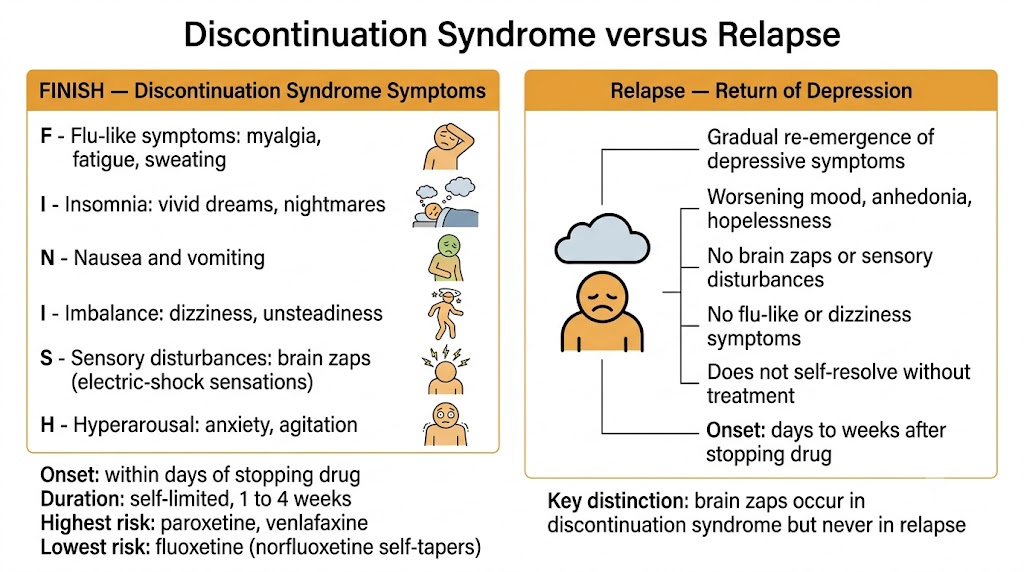
Risk is directly determined by half-life. Paroxetine carries the highest risk among selective serotonin reuptake inhibitors — shortest half-life in the class, no active metabolite, plus anticholinergic rebound adds to the withdrawal picture. Venlafaxine immediate-release is also very high risk given its very short half-life; clinicians frequently misattribute the rapidly appearing sensory symptoms to a neurological condition. Sertraline, citalopram, and escitalopram carry intermediate risk. Fluoxetine has the lowest risk of any selective serotonin reuptake inhibitor or serotonin-norepinephrine reuptake inhibitor because norfluoxetine provides inherent self-tapering over weeks after the last dose.
Gradual dose tapering rather than abrupt cessation is the primary prevention strategy. Tapers should extend over at least two to four weeks for most agents and potentially months for patients on high doses for prolonged periods or those who have previously experienced severe discontinuation syndromes. There is no universal tapering schedule — the rate should be guided by symptom emergence. For patients who cannot taper paroxetine or venlafaxine successfully, switching to fluoxetine first — exploiting norfluoxetine's long half-life as a pharmacokinetic bridge — then tapering fluoxetine, is a validated strategy. If symptoms develop during tapering, reinstatement at the prior dose followed by a slower taper is preferable to prolonged symptom exposure.
Discontinuation syndrome: onset within days of stopping; includes brain zaps, dizziness, flu-like symptoms; self-limited within one to four weeks; responds to dose reinstatement within 24 hours. Relapse: gradual re-emergence of depressive symptoms over weeks; no sensory disturbances; does not self-resolve; requires treatment decision — restart, switch, or augment. The presence of brain zaps strongly favors discontinuation syndrome over relapse.
Antidepressant prescribing in pregnancy and in older adults requires integrating pharmacokinetic changes, altered risk-benefit ratios, and population-specific safety data. Major depressive disorder affects approximately 10 to 15 percent of pregnant women and is among the most common psychiatric diagnoses in patients over 65 — these are not edge cases.
The clinical decision is never between drug exposure and safety — it is between drug exposure and the risks of untreated depression. Untreated major depressive disorder in pregnancy carries its own fetal and maternal risks: poor prenatal care adherence, inadequate gestational weight gain, increased preterm birth rates, and elevated rates of postpartum depression with impaired mother-infant bonding. These risks must be explicitly weighed against medication risks in every clinical conversation with a pregnant patient.
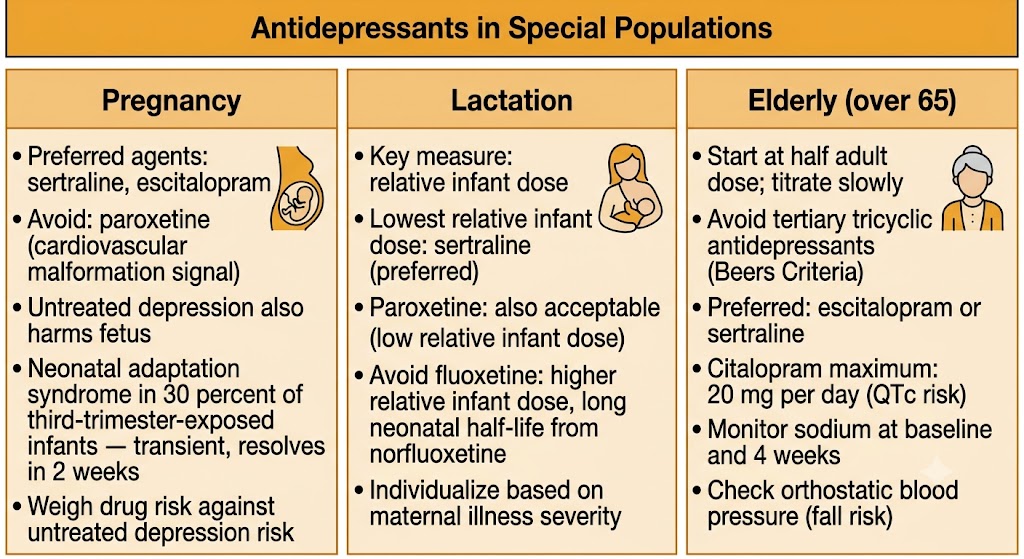
Selective serotonin reuptake inhibitors are the most studied antidepressants in pregnancy and remain first-line when pharmacological treatment is indicated. Overall congenital malformation rates do not appear to differ significantly from background rates in adequately controlled studies. Paroxetine carries the most cautious labeling based on earlier signals of a possible association with ventricular septal defects, though subsequent larger studies have not consistently replicated this finding. Sertraline and escitalopram are the preferred selective serotonin reuptake inhibitors in pregnancy based on the most favorable available safety data.
Neonatal adaptation syndrome occurs in approximately 30 percent of neonates exposed to selective serotonin reuptake inhibitors in the third trimester, consisting of transient jitteriness, hypoglycemia, respiratory distress, and feeding difficulties. It typically resolves within two weeks without specific intervention and should be communicated to the obstetric team for neonatal monitoring planning.
Most antidepressants are excreted in breast milk, but the relevant measure is relative infant dose — the infant's weight-adjusted dose as a percentage of the maternal weight-adjusted dose. For preferred agents this is low. Sertraline has the lowest relative infant dose among selective serotonin reuptake inhibitors and is the preferred first choice during breastfeeding. Paroxetine also has a low relative infant dose. Fluoxetine has a higher relative infant dose with a long neonatal half-life due to norfluoxetine and is generally avoided during breastfeeding when an alternative is feasible. All decisions require case-by-case assessment of maternal illness severity, infant age and health, and availability of alternatives.
Four pharmacokinetic and pharmacodynamic changes of aging require modified antidepressant prescribing: reduced hepatic cytochrome P450 activity, reduced renal clearance, reduced albumin binding (increasing free drug fraction), and increased central nervous system sensitivity to adverse drug effects at equivalent plasma concentrations. The practical consequence is that equivalent doses produce higher effective exposures and greater adverse effects in older adults. The general principle is to start at half the usual adult dose and titrate slowly.
Anticholinergic burden is particularly dangerous in the elderly — cognitive impairment, urinary retention, constipation, and fall risk — making tertiary amine tricyclic antidepressants strongly discouraged. They appear on the Beers Criteria list of potentially inappropriate medications for older adults. Orthostatic hypotension from alpha-1 blockade (tricyclic antidepressants, trazodone) is a leading cause of falls and hip fractures; if trazodone is used for insomnia in this population, starting at 25 mg and titrating cautiously is essential. QTc prolongation risk from citalopram is specifically amplified in older adults — the 20 mg per day maximum applies to all patients over 60. Hyponatremia through the syndrome of inappropriate antidiuretic hormone secretion occurs at several-fold higher rates in elderly patients on selective serotonin reuptake inhibitors and serotonin-norepinephrine reuptake inhibitors than in younger patients; baseline and four-week sodium monitoring is recommended. Escitalopram and sertraline are the preferred first choices in the elderly based on tolerability, pharmacokinetic data, and evidence from trials in late-life depression.
Pregnancy: weigh drug risk against risk of untreated depression; prefer sertraline or escitalopram; counsel on neonatal adaptation syndrome; avoid paroxetine when possible. Lactation: sertraline lowest relative infant dose — preferred; avoid fluoxetine when alternatives exist. Elderly: start at half adult dose, titrate slowly; avoid tertiary tricyclic antidepressants (Beers Criteria); prefer escitalopram or sertraline; monitor sodium at baseline and four weeks; check orthostatic blood pressure; citalopram maximum is 20 mg per day in patients over 60.
| Author / Organization | Title | Source |
|---|---|---|
| Boyer EW, Shannon M | The serotonin syndrome | N Engl J Med. 2005;352(11):1112–1120 |
| Dunkley EJ, Isbister GK, Sibbritt D, et al. | The Hunter Serotonin Toxicity Criteria: simple and accurate diagnostic decision rules for serotonin toxicity | QJM. 2003;96(9):635–642 |
| Graudins A, Stearman A, Chan B | Treatment of the serotonin syndrome with cyproheptadine | J Emerg Med. 1998;16(4):615–619 |
| Montejo AL, Llorca G, Izquierdo JA, Rico-Villademoros F | Incidence of sexual dysfunction associated with antidepressant agents: a prospective multicenter study of 1022 outpatients | J Clin Psychiatry. 2001;62(suppl 3):10–21 |
| Fava M | Weight gain and antidepressants | J Clin Psychiatry. 2000;61(suppl 11):37–41 |
| U.S. Food and Drug Administration | Celexa (citalopram hydrobromide) drug safety communication: abnormal heart rhythms associated with use | FDA; 2011 |
| Anglin R, Yuan Y, Moayyedi P, et al. | Risk of upper gastrointestinal bleeding with selective serotonin reuptake inhibitors with or without concurrent nonsteroidal anti-inflammatory use | Am J Gastroenterol. 2014;109(6):811–819 |
| Borges S, Desta Z, Li L, et al. | Quantitative effect of CYP2D6 genotype and inhibitors on tamoxifen metabolism: implication for optimizing analgesic and antidepressant therapy | Clin Pharmacol Ther. 2006;80(1):61–74 |
| Spina E, Trifiro G, Caraci F | Clinically significant drug interactions with newer antidepressants | CNS Drugs. 2012;26(1):39–67 |
| Fava GA, Gatti A, Belaise C, et al. | Withdrawal symptoms after selective serotonin reuptake inhibitor discontinuation: a systematic review | Psychother Psychosom. 2015;84(2):72–81 |
| Davies J, Read J | A systematic review into the incidence, severity and duration of antidepressant withdrawal effects: are guidelines evidence-based? | Addict Behav. 2019;97:111–121 |
| Yonkers KA, Wisner KL, Stewart DE, et al. | The management of depression during pregnancy: a report from the American Psychiatric Association and the American College of Obstetricians and Gynecologists | Gen Hosp Psychiatry. 2009;31(5):403–413 |
| Hale TW | Medications and Mothers' Milk: A Manual of Lactational Pharmacology, 19th ed. Antidepressants chapter | Springer Publishing; 2021 |
| Roose SP, Schatzberg AF | The efficacy of antidepressants in the treatment of late-life depression | J Clin Psychopharmacol. 2005;25(suppl 1):S1–S7 |