Introduction to Medical Pharmacology
Phenoxybenzamine, phentolamine, selective alpha-1 blockers, uroselective agents, and pheochromocytoma management
Chapter 5 · Module 4 of 6Section 1
Irreversible versus competitive blockade, cardiovascular effects, and clinical applications in catecholamine excess states
The non-selective alpha blockers target both alpha-1 and alpha-2 receptors. Their clinical roles are narrow but irreplaceable — phenoxybenzamine for preoperative pheochromocytoma preparation, phentolamine for acute hypertensive emergencies caused by catecholamine excess. The defining pharmacological distinction between them is the nature of their receptor binding: one irreversible, one competitive.
Phenoxybenzamine forms a permanent covalent bond with alpha-adrenergic receptors, producing irreversible, non-competitive blockade. Because no amount of agonist can displace a covalently bound antagonist, the blockade cannot be overcome by catecholamine surges — which is precisely why it is used for pheochromocytoma. The duration of action depends entirely on new receptor synthesis, taking 24 to 48 hours or longer. Given orally, it has a slow onset and prolonged effect, making it suitable for gradual titration over one to two weeks of preoperative preparation.
Because alpha-2 autoreceptors on presynaptic terminals are also blocked, the normal feedback inhibition of norepinephrine release is removed. Norepinephrine is released without restraint, producing pronounced reflex tachycardia — more severe than with selective alpha-1 blockers. This tachycardia is both a side effect and a clinical marker that adequate peripheral blockade has been achieved during preoperative titration. Other adverse effects include orthostatic hypotension, nasal congestion from mucosal vasodilation, and miosis.
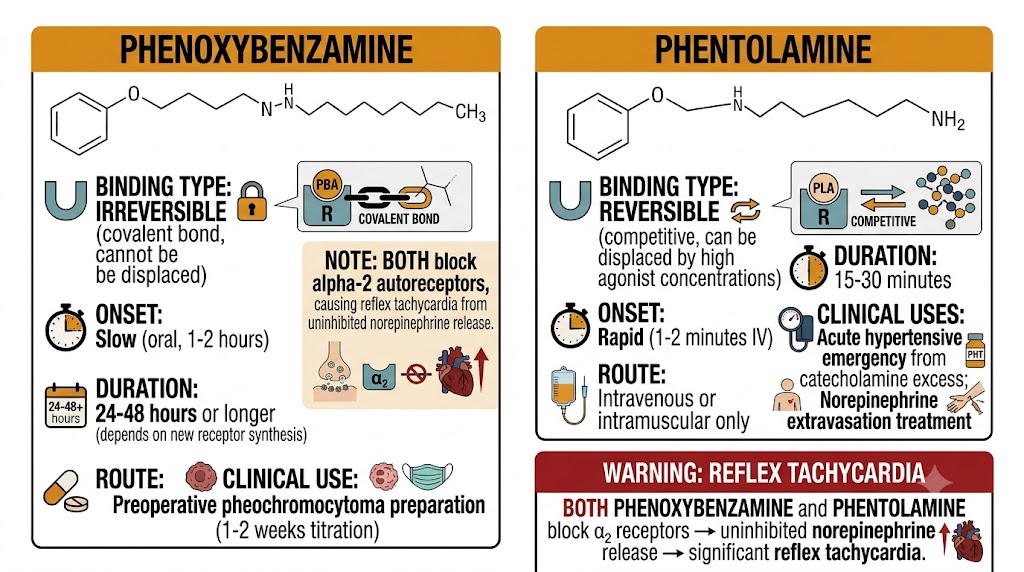
Phentolamine competitively blocks alpha-1 and alpha-2 receptors at the same binding site as catecholamines. Because the blockade is competitive, it can be overcome by sufficiently high agonist concentrations, and its effects terminate as the drug is eliminated. After intravenous administration the onset is within one to two minutes and the duration is 15 to 30 minutes per dose, making it highly titratable for acute hemodynamic emergencies. It cannot be given orally due to extensive first-pass hepatic metabolism.
Phentolamine is the drug of choice for hypertensive emergencies caused by catecholamine excess — pheochromocytoma crisis, tyramine-induced hypertension in patients on monoamine oxidase inhibitors, or cocaine-induced severe hypertension. It directly antagonizes the alpha-1 vasopressor effect driving the blood pressure elevation. It is also used to treat norepinephrine extravasation: infiltrated subcutaneously around the affected area, it blocks local alpha-1 receptors and reverses the vasoconstriction causing ischemic necrosis.
Phenoxybenzamine vs. Phentolamine — Key Distinction
Phenoxybenzamine: Irreversible covalent blockade. Oral. Slow onset. Duration 24 to 48 hours. Used for preoperative pheochromocytoma preparation over one to two weeks — the irreversibility is the clinical advantage, providing consistent blockade that cannot be overcome by surgical catecholamine surges.
Phentolamine: Reversible competitive blockade. Intravenous or intramuscular only. Onset 1 to 2 minutes. Duration 15 to 30 minutes. Used for acute hypertensive emergencies from catecholamine excess and for norepinephrine extravasation.
Both: Block alpha-2 autoreceptors, removing the feedback brake on norepinephrine release and producing reflex tachycardia that is more pronounced than with selective alpha-1 blockers.
Section 2
Preserved alpha-2 feedback, first-dose phenomenon, antihypertensive and benign prostatic hyperplasia uses, and the ALLHAT trial repositioning
The selective alpha-1 blockers were developed to provide the antihypertensive benefit of alpha blockade without the pronounced reflex tachycardia of non-selective agents. By preserving alpha-2 autoreceptor feedback on presynaptic terminals, these drugs allow normal feedback inhibition of norepinephrine release to continue, markedly attenuating the reflex tachycardia. This refinement made selective alpha-1 blockade viable for long-term use in hypertension and benign prostatic hyperplasia.
Prazosin, terazosin, and doxazosin competitively and reversibly block alpha-1 receptors on vascular smooth muscle, reducing arteriolar resistance and venous return and lowering blood pressure. Blockade of alpha-1A and alpha-1D receptors in the prostate capsule, bladder neck, and urethra reduces smooth muscle tone, improving urinary flow in men with benign prostatic hyperplasia. Because presynaptic alpha-2 autoreceptors are not blocked, norepinephrine release remains subject to feedback inhibition, and reflex tachycardia is substantially less pronounced than with non-selective agents.
These drugs are approved for both hypertension and benign prostatic hyperplasia. The combination of both indications in a single drug is a clinical advantage for men with both conditions. Doxazosin, with its once-daily dosing and extended-release formulation, is the most convenient of the three. Prazosin also has an established evidence base for reducing nightmares and improving sleep in post-traumatic stress disorder — an important off-label application mediated by central alpha-1 receptor blockade in brain regions involved in fear and arousal.
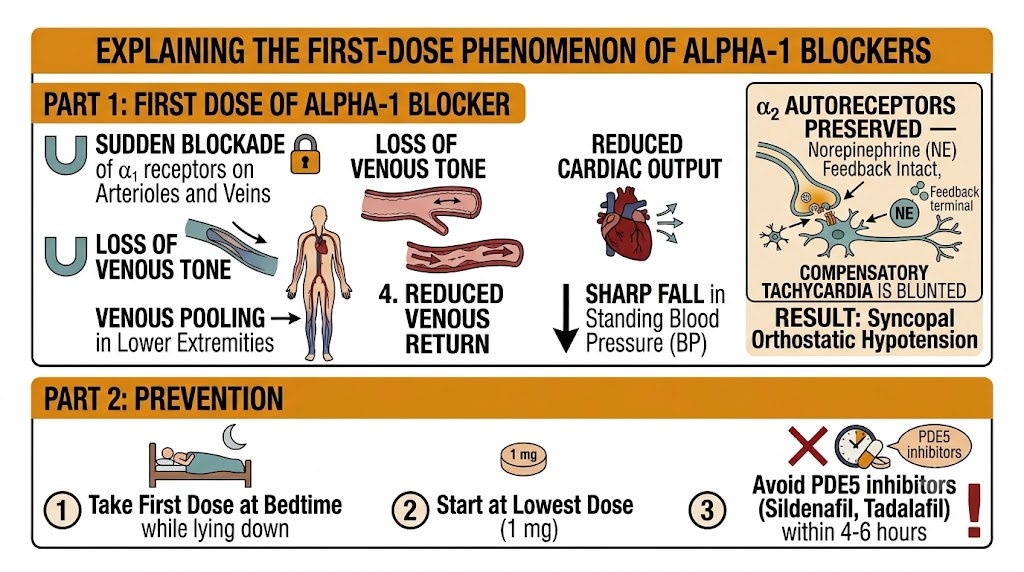
The first-dose phenomenon is a clinically important adverse effect: a sudden, potentially syncopal episode of orthostatic hypotension occurring within 30 to 90 minutes of the first dose. Sudden alpha-1 blockade removes arteriolar and venous tone simultaneously. Because alpha-2 autoreceptors remain intact, the feedback brake on norepinephrine release is still active, blunting the compensatory catecholamine surge that would normally limit the hypotension. The result is a larger and more sustained blood pressure drop than the patient's compensatory mechanisms can offset.
Prevention is straightforward: the first dose should always be taken at bedtime while supine. The starting dose should be the lowest available (1 milligram for all three agents). Phosphodiesterase type 5 inhibitors (sildenafil, tadalafil, vardenafil) must not be taken within four to six hours, as their independent vasodilatory mechanism produces additive hypotension that substantially increases the syncopal risk.
The Antihypertensive and Lipid-Lowering Treatment to Prevent Heart Attack trial (2002) compared doxazosin against chlorthalidone (a thiazide-type diuretic) as initial antihypertensive therapy in high-risk patients. The doxazosin arm was terminated early due to a significantly higher rate of heart failure hospitalizations compared with chlorthalidone. This finding repositioned selective alpha-1 blockers from first-line antihypertensives to adjunctive agents used when first-line options are insufficient or contraindicated. They remain valuable for men with hypertension and coexisting benign prostatic hyperplasia, and in patients requiring multiple antihypertensive agents.
Section 3
Alpha-1A receptor subtype selectivity, preferential urological benefit with less hypotension, retrograde ejaculation, and intraoperative floppy iris syndrome
Tamsulosin and silodosin represent a further refinement of selectivity within the alpha-1 blocker class. By preferentially targeting alpha-1A receptors — which predominate in the prostate, urethra, and bladder neck — over alpha-1B receptors that mediate vascular smooth muscle contraction, these agents achieve meaningful relief of urinary obstruction from benign prostatic hyperplasia with substantially less systemic hypotension than the non-subtype-selective alpha-1 blockers. This vascular-sparing profile makes them the dominant pharmacological treatment for lower urinary tract symptoms from benign prostatic hyperplasia in current practice.
Because vascular alpha-1B receptors are relatively preserved, tamsulosin and silodosin produce much less orthostatic hypotension than prazosin, terazosin, or doxazosin. The first-dose phenomenon is substantially attenuated — patients do not need to take the first dose at bedtime. This favorable tolerability profile, combined with their urological efficacy, makes them first-line pharmacotherapy for benign prostatic hyperplasia-related lower urinary tract symptoms.
The most common drug-specific adverse effect is retrograde ejaculation — semen entering the bladder rather than the urethra during ejaculation, because alpha-1A blockade prevents bladder neck closure during seminal emission. Silodosin, with its higher alpha-1A selectivity, produces retrograde ejaculation in approximately 28 percent of patients compared with 4 to 11 percent for tamsulosin. This is not harmful but is important to counsel patients about before prescribing, as it is a common reason for discontinuation.
Intraoperative Floppy Iris Syndrome — Clinical Alert
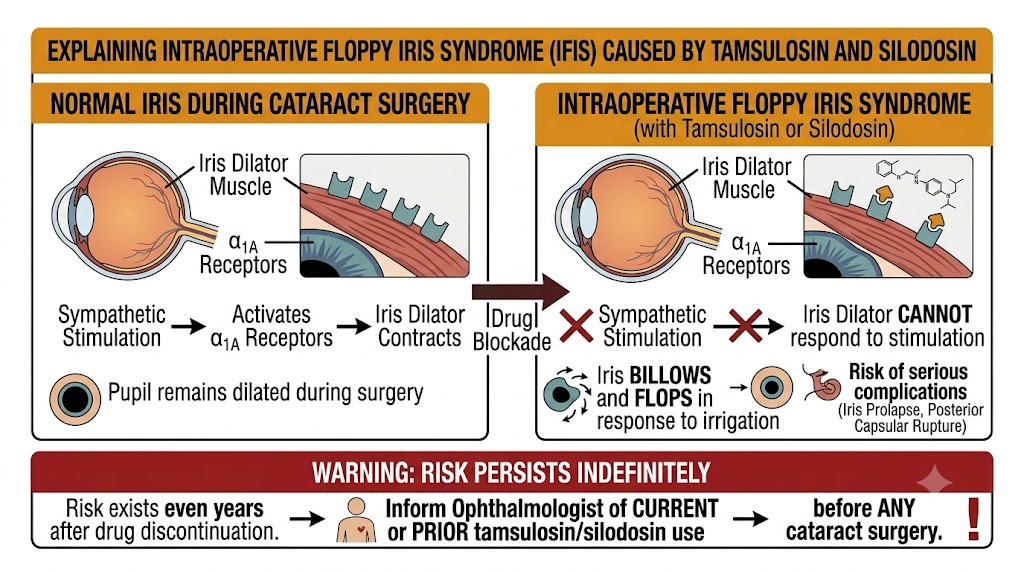
Tamsulosin and silodosin block alpha-1A receptors in the iris dilator muscle. During cataract surgery, the iris normally maintains dilation through sympathetic alpha-1A activation. With alpha-1A blockade, the dilator cannot respond — the iris billows and flops in response to irrigation currents, progressively constricts, and may prolapse through surgical incisions. Standard mydriatic eye drops (topical phenylephrine, atropine) are ineffective because the receptor coupling is blocked, not the muscarinic constrictor pathway.
The critical clinical point: the risk persists indefinitely after drug discontinuation. Alpha-1A receptor expression in the iris does not recover to full responsiveness even if tamsulosin was stopped months or years before surgery. Every patient with current or prior tamsulosin or silodosin use must disclose this to their ophthalmologist before any cataract surgery so that modified surgical techniques can be planned.
Section 4
Biochemical diagnosis, phenoxybenzamine-based preoperative alpha blockade, and the alpha-before-beta sequencing rule
Pheochromocytoma is a catecholamine-secreting tumor of adrenal medulla chromaffin cells. Without adequate preoperative alpha blockade, surgical manipulation triggers massive catecholamine release, producing life-threatening hypertensive crises, arrhythmias, and hemodynamic instability. The pharmacological preparation of these patients represents the most critical clinical application of alpha-adrenergic antagonists — and one of the most important drug-sequencing rules in medicine.
The preferred biochemical test for pheochromocytoma is plasma free metanephrines or 24-hour urinary fractionated metanephrines. Metanephrines are produced by continuous catabolism of catecholamines within the tumor cells — this constitutive production is independent of episodic secretory bursts, which is why metanephrine measurement is more sensitive than direct catecholamine measurement. Elevated metanephrines should prompt anatomic imaging with computed tomography or magnetic resonance imaging to localize the tumor before surgical planning.
Phenoxybenzamine is begun one to two weeks before surgery and titrated gradually to establish complete, irreversible alpha blockade. The irreversible mechanism provides a critical advantage: the blockade cannot be overcome by the massive catecholamine surges that occur when the surgeon manipulates the tumor. Gradual titration also allows progressive reversal of the chronic vasoconstriction that depletes plasma volume in these patients — volume repletion is essential for hemodynamic stability after tumor removal, when the catecholamine stimulus is suddenly eliminated.
During titration, patients are encouraged to consume a high-sodium diet and liberal fluids to actively replete volume. Goals of adequate preoperative blockade include blood pressure below 130/80 millimeters of mercury, no orthostatic drop greater than 10 millimeters of mercury on standing, heart rate 60 to 80 beats per minute while supine, and the presence of reflex tachycardia and nasal congestion confirming peripheral alpha blockade has been achieved.
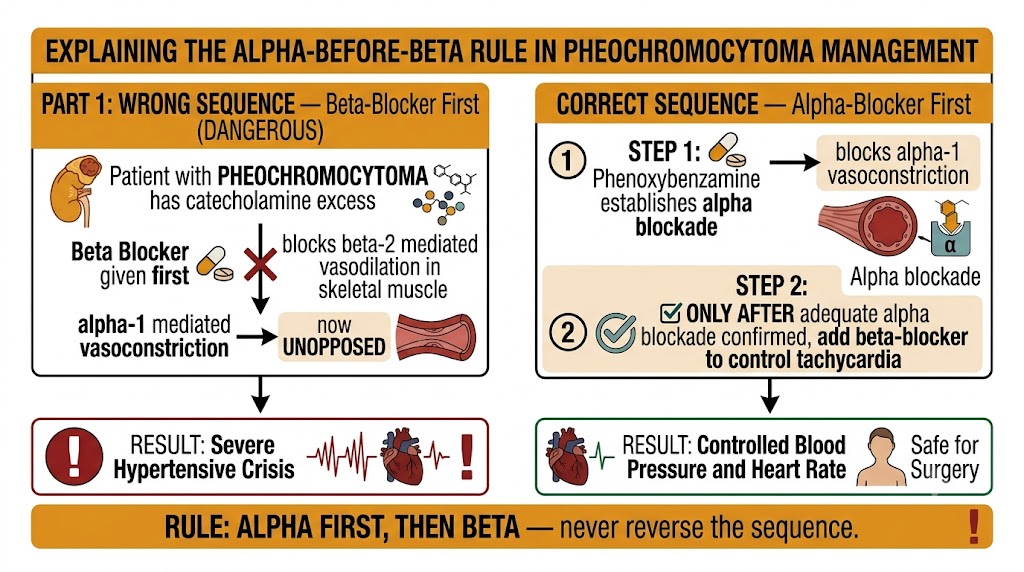
Reflex tachycardia and arrhythmias from pheochromocytoma may require beta-blockade, but the sequencing is pharmacologically critical. In a patient with active catecholamine excess, beta-2-mediated vasodilation in skeletal muscle vasculature provides a partial counterbalance to alpha-1-mediated vasoconstriction. If a beta-blocker is given before adequate alpha blockade is established, this beta-2-mediated vasodilation is eliminated while alpha-1-mediated vasoconstriction remains completely unopposed. The result is a severe, potentially catastrophic hypertensive crisis.
The rule is absolute: alpha blockade must be established first, confirmed by blood pressure normalization and clinical signs of adequate blockade, before any beta-blocker is added. Once alpha blockade is confirmed, a beta-blocker — typically propranolol or atenolol — may be added to control persistent tachycardia or arrhythmias.
Pheochromocytoma — Alpha Before Beta: The Non-Negotiable Rule
Step 1: Establish alpha blockade with phenoxybenzamine (begin 10 mg twice daily, titrate over 1 to 2 weeks).
Step 2: Confirm adequate alpha blockade (blood pressure below 130/80 mmHg, reflex tachycardia and nasal congestion present, no orthostatic drop greater than 10 mmHg).
Step 3: Only then add a beta-blocker (propranolol, atenolol) to control tachycardia or arrhythmias.
Step 4: High-sodium diet and liberal fluids throughout to correct chronic volume depletion.
Why the sequence matters: Beta-blocker before alpha blockade eliminates beta-2-mediated vasodilation while alpha-1 vasoconstriction remains unopposed — triggering hypertensive crisis. Alpha first protects against this by blocking the vasoconstriction before the vasodilation is removed.
Section 5
Alpha-2 antagonism pharmacology, epinephrine reversal with complete alpha blockade, and PDE5 inhibitor interaction
Yohimbine is the pharmacological opposite of clonidine — an alpha-2 antagonist that removes the presynaptic feedback brake on norepinephrine release, raising sympathetic tone. The drug interactions of alpha blockers follow directly from their receptor pharmacology: anything that also lowers vascular resistance produces additive hypotension, and anything that raises catecholamine concentrations may have blunted or paradoxical effects in the setting of established alpha blockade.
Yohimbine blocks alpha-2 autoreceptors on presynaptic adrenergic terminals, removing the feedback inhibition of norepinephrine release. The result is uninhibited norepinephrine exocytosis, raising heart rate, blood pressure, and sympathetic tone. Central alpha-2 blockade in the brainstem increases noradrenergic transmission, producing anxiety, restlessness, and sympathomimetic arousal. These effects are dose-dependent and more pronounced in patients with underlying autonomic dysfunction, hypertension, or anxiety disorders.
Yohimbine has no accepted first-line clinical indication in current practice. It is not recommended for erectile dysfunction (phosphodiesterase type 5 inhibitors are far superior) or for weight loss (evidence is insufficient). Its contraindications are extensive: hypertension, cardiac disease, anxiety disorders, and any condition requiring monoamine-based treatment, where it can precipitate hypertensive crisis. It is used as a pharmacological research probe for studying central noradrenergic systems but this is a specialist application.
Phosphodiesterase type 5 inhibitors (sildenafil, tadalafil, vardenafil) lower blood pressure by increasing cyclic guanosine monophosphate in vascular smooth muscle, causing vasodilation through a mechanism entirely independent of adrenergic receptors. Combined with alpha-1 blockers, which lower blood pressure by blocking alpha-1-mediated vasoconstriction, the result is additive vasodilation that can cause symptomatic, severe hypotension — particularly around the first dose of the alpha-1 blocker or after dose escalation. A minimum separation of four to six hours between these drug classes is required. Tamsulosin has the most favorable interaction profile among the alpha-1 blockers in this combination, though caution remains warranted.
In a patient with complete alpha blockade (as from phenoxybenzamine), the vasopressor response to alpha-1 agonists is eliminated. When epinephrine is given to such a patient, the alpha-1-mediated vasopressor component is blocked while the beta-2-mediated vasodilatory component in skeletal muscle vasculature remains intact. The net result is a paradoxical fall in blood pressure — called epinephrine reversal. This is a classic pharmacological demonstration of the consequence of complete alpha blockade, and has direct clinical implications in the operating room: patients prepared with phenoxybenzamine for pheochromocytoma surgery may require vasopressin or very large doses of norepinephrine to maintain blood pressure after tumor removal, as standard doses of vasopressors may be partially ineffective against the established blockade.
Alpha-Antagonist Drug Interactions — Summary
Phosphodiesterase type 5 inhibitors + alpha-1 blockers: Additive vasodilation; severe hypotension risk especially at first dose. Require 4 to 6 hour separation. Tamsulosin has most favorable profile.
Other antihypertensives + alpha-1 blockers: Additive blood pressure lowering. Diuretics increase orthostatic hypotension risk in volume-depleted patients.
Epinephrine reversal: Complete alpha blockade (phenoxybenzamine) eliminates the alpha-1 pressor response. Beta-2-mediated vasodilation remains, causing paradoxical blood pressure fall. Use norepinephrine or vasopressin for intraoperative hypotension in phenoxybenzamine-prepared patients.
Yohimbine + monoamine oxidase inhibitors: Hypertensive crisis risk from amplified norepinephrine accumulation. Avoid combination.
| Author / Organization | Title | Source |
|---|---|---|
| Westfall TC, Westfall DP | Adrenergic agonists and antagonists. In: Brunton LL, et al., eds. Goodman & Gilman’s: The Pharmacological Basis of Therapeutics, 13th ed. | McGraw-Hill; 2018:191–224 |
| Pacak K | Preoperative management of the pheochromocytoma patient | J Clin Endocrinol Metab. 2007;92(11):4069–4079 |
| Lenders JW, Duh QY, Eisenhofer G, et al. | Pheochromocytoma and paraganglioma: an Endocrine Society clinical practice guideline | J Clin Endocrinol Metab. 2014;99(6):1915–1942 |
| Chapple CR | Pharmacotherapy for benign prostatic hyperplasia — the potential for alpha1-adrenoceptor subtype-specific blockade | Br J Urol. 1998;81(Suppl 1):34–47 |
| Kirby RS | The clinical pharmacology of novel alpha1-adrenoceptor-selective antagonists | Br J Clin Pharmacol. 1998;45(2):101–108 |
| The ALLHAT Officers and Coordinators for the ALLHAT Collaborative Research Group | Major outcomes in high-risk hypertensive patients randomized to angiotensin-converting enzyme inhibitor or calcium channel blocker vs diuretic | JAMA. 2002;288(23):2981–2997 |
| Roehrborn CG | Efficacy of alpha-adrenoceptor blockers in the treatment of benign prostatic hyperplasia | Br J Urol. 1998;81(Suppl 1):14–23 |
| Chang DF, Campbell JR | Intraoperative floppy iris syndrome associated with tamsulosin | J Cataract Refract Surg. 2005;31(4):664–673 |
| Eisenhofer G, Lenders JW, Siegert G, et al. | Plasma normetanephrine and metanephrine for detecting pheochromocytoma in von Hippel-Lindau disease and multiple endocrine neoplasia type 2 | N Engl J Med. 1999;340(24):1872–1879 |
| Bravo EL, Tagle R | Pheochromocytoma: state-of-the-art and future prospects | Endocr Rev. 2003;24(4):539–553 |
| Goldberg MR, Robertson D | Yohimbine: a pharmacological probe for study of the alpha2-adrenoreceptor | Pharmacol Rev. 1983;35(3):143–180 |
| Ernst E, Pittler MH | Yohimbine for erectile dysfunction: a systematic review and meta-analysis of randomized clinical trials | J Urol. 1998;159(2):433–436 |
| McVary KT, Roehrborn CG, Avins AL, et al. | Update on AUA guideline on the management of benign prostatic hyperplasia | J Urol. 2011;185(5):1793–1803 |
| Raskind MA, Peskind ER, Chow B, et al. | Trial of prazosin for post-traumatic stress disorder in military veterans | N Engl J Med. 2018;378(6):507–517 |