CHAPTER 5 · ADRENERGIC PHARMACOLOGY

Section 1

Amphetamines and Methylphenidate

Indirect catecholamine release via reverse transport and vesicular displacement, reuptake inhibition, clinical uses in attention deficit hyperactivity disorder and narcolepsy, and adverse effects

The indirect-acting sympathomimetics do not bind adrenergic receptors directly — they increase the availability of endogenous catecholamines at the synapse. Amphetamines and methylphenidate are the clinically dominant agents of this class, used for attention deficit hyperactivity disorder and narcolepsy, but they operate through distinct mechanisms that have real consequences for their efficacy, adverse effect profiles, and abuse potential.

Amphetamine — Triple Mechanism of Action

Amphetamine increases synaptic monoamine concentrations through three complementary mechanisms. The primary mechanism is carrier-mediated reverse transport: amphetamine enters the presynaptic terminal via the dopamine transporter and norepinephrine transporter, then causes these transporters to run in reverse — pumping dopamine and norepinephrine out of the cytosol into the synapse rather than clearing them. This reverse transport is the defining feature of amphetamine's action and distinguishes it from reuptake inhibitors.

Second, amphetamine disrupts vesicular storage by displacing dopamine and norepinephrine from synaptic vesicles into the cytosol — mediated through alkalinization of the vesicular lumen, which disrupts the proton gradient that drives vesicular monoamine transporter-2 activity. Third, amphetamine inhibits monoamine oxidase intraneuronally, preventing degradation of the cytosolic monoamines that become available for reverse transport. The net result is a large, non-exocytotic release of dopamine, norepinephrine, and serotonin into the synapse — independent of action potentials and far larger than any physiological neurotransmitter release event.
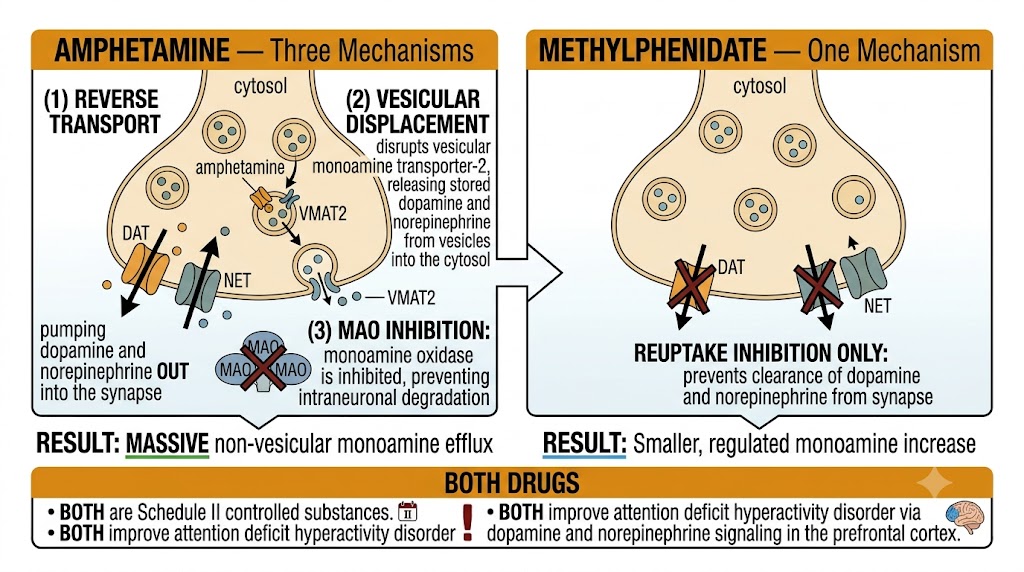
Side-by-side comparison of amphetamine (three mechanisms: reverse transport via dopamine transporter and norepinephrine transporter, vesicular monoamine transporter-2 displacement releasing vesicular stores into cytosol, and monoamine oxidase inhibition — producing massive non-vesicular monoamine efflux) versus methylphenidate (reuptake inhibition only via dopamine transporter and norepinephrine transporter — producing a smaller regulated monoamine increase). Both are Schedule II and improve attention deficit hyperactivity disorder via prefrontal cortex dopamine and norepinephrine signaling.
Amphetamine versus methylphenidate: three mechanisms versus one — reverse transport, vesicular displacement, and MAO inhibition versus reuptake inhibition only. Source: Gemini AI, generated for educational use.
Methylphenidate — Reuptake Inhibition Only

Methylphenidate blocks the dopamine transporter and norepinephrine transporter, preventing reuptake of dopamine and norepinephrine from the synapse back into the terminal. This is the only mechanism it uses — there is no reverse transport, no vesicular depletion, and no monoamine oxidase inhibition. The result is a smaller, more physiologically regulated increase in synaptic dopamine and norepinephrine compared with amphetamine. This mechanistic difference translates into a lower cardiovascular and psychological adverse effect burden at therapeutic doses and reduced abuse potential.

Lisdexamfetamine — Prodrug with Reduced Abuse Potential

Lisdexamfetamine is amphetamine covalently attached to the amino acid lysine. It is pharmacologically inert until cleaved by enzymes in red blood cells, which release active dextroamphetamine. This prodrug design produces a smoother pharmacokinetic profile — slower rise and longer duration — and substantially reduces abuse potential because snorting or injecting the prodrug does not produce the rapid high associated with abuse of immediate-release amphetamine formulations.

Clinical Uses and Adverse Effects

Both amphetamines and methylphenidate are approved for attention deficit hyperactivity disorder in children and adults, and for narcolepsy. The apparently paradoxical calming effect in attention deficit hyperactivity disorder reflects normalization of hypoactive dopamine and norepinephrine signaling in the prefrontal cortex — this is therapeutic enhancement of a deficient system, not sedation. Both drugs are Schedule II controlled substances due to high abuse potential.

Cardiovascular adverse effects are dose-dependent: increased heart rate, raised blood pressure, and rare arrhythmias. Central nervous system adverse effects include insomnia, anorexia, anxiety, and — at high doses — psychosis and stereotyped behavior. Growth monitoring is required in pediatric patients on long-term therapy.
Section 2

Cocaine and Ephedrine

Monoamine reuptake inhibition, sodium channel blockade, cardiovascular toxicity management, mixed-acting ephedrine, and tachyphylaxis

Cocaine is pharmacologically unique: it is simultaneously a monoamine reuptake inhibitor, a sodium channel blocker, and the only local anesthetic that retains vasoconstrictive properties — the latter making it useful in selected ear, nose, and throat surgical procedures. Its cardiovascular toxicity is among the most dangerous of any commonly used substance. Ephedrine is a mixed-acting sympathomimetic with both direct receptor agonism and indirect catecholamine release, used clinically in anesthesia.

Cocaine — Mechanism and Cardiovascular Toxicity

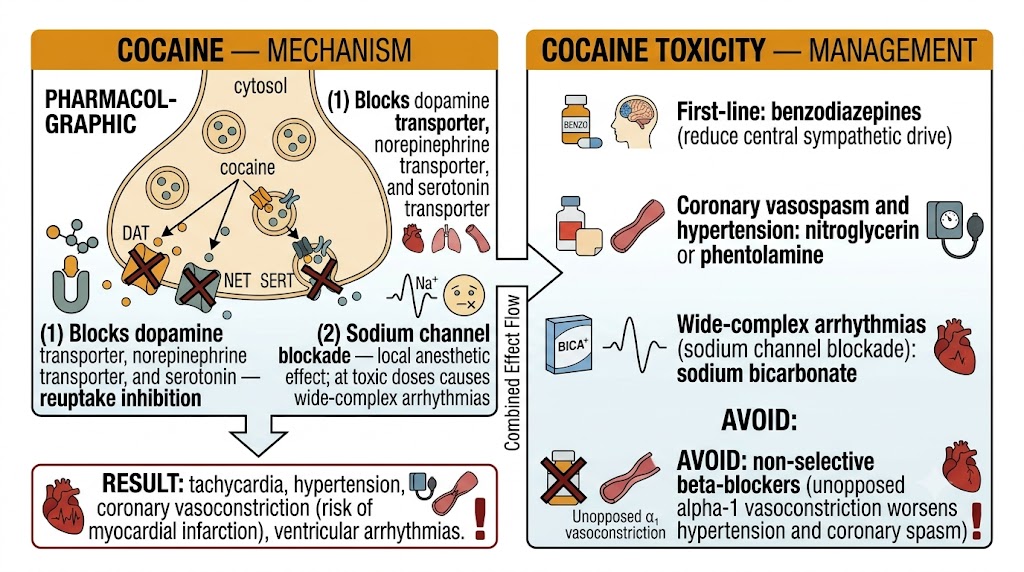
Cocaine blocks the reuptake transporters for dopamine, norepinephrine, and serotonin simultaneously. Dopamine transporter blockade in the mesolimbic pathway produces euphoria — the basis of cocaine's abuse potential. Norepinephrine transporter blockade prevents clearance of norepinephrine from adrenergic synapses, amplifying sympathetic stimulation of the heart and vasculature. The cardiovascular consequences include tachycardia and hypertension from increased sympathetic tone, coronary vasoconstriction from alpha-1 stimulation that can precipitate myocardial infarction even in young patients with structurally normal coronary arteries, and ventricular arrhythmias from increased automaticity.

Cocaine also blocks fast sodium channels in cardiac and nerve membranes — the same mechanism that produces its local anesthetic effect. At toxic doses this sodium channel blockade produces wide-complex arrhythmias resembling those caused by class I antiarrhythmic agents. The combination of coronary vasospasm, increased myocardial oxygen demand, and sodium channel blockade makes cocaine the most cardiovascularly dangerous sympathomimetic in clinical toxicology.

Two-panel diagram showing cocaine mechanisms (blocks dopamine transporter, norepinephrine transporter, and serotonin transporter; sodium channel blockade producing local anesthetic effect and wide-complex arrhythmias at toxic doses; result: tachycardia, hypertension, coronary vasoconstriction, ventricular arrhythmias) and cocaine toxicity management (benzodiazepines first-line, nitroglycerin or phentolamine for vasospasm, sodium bicarbonate for arrhythmias, avoid non-selective beta-blockers).
Cocaine mechanisms and toxicity management: transporter blockade, sodium channel blockade, cardiovascular consequences, and management principles. Source: Gemini AI, generated for educational use.

Cocaine Cardiovascular Toxicity — Management Principles

First-line: Benzodiazepines for agitation, hypertension, and tachycardia — reduce central sympathetic activation without direct cardiovascular effects.

Coronary vasospasm and hypertension: Nitroglycerin or phentolamine — reverse alpha-1-mediated vasoconstriction.

Wide-complex arrhythmias (sodium channel blockade): Sodium bicarbonate — same mechanism as in tricyclic antidepressant overdose.

Avoid non-selective beta-blockers acutely: Beta-2 blockade removes the vasodilatory counterbalance, leaving alpha-1 vasoconstriction unopposed and potentially worsening hypertension and coronary spasm.

Ephedrine — Mixed Direct and Indirect Action

Ephedrine exerts sympathomimetic effects through two mechanisms: direct agonism at alpha-1, beta-1, and beta-2 receptors, and indirect release of endogenous norepinephrine from presynaptic terminals via carrier-mediated reverse transport, similar to amphetamine. In clinical practice, ephedrine is used to treat hypotension induced by spinal or epidural anesthesia — where its combined increase in heart rate (beta-1) and blood pressure (alpha-1 and beta-1) is useful. It also has mild bronchodilatory (beta-2) activity.

Tachyphylaxis occurs rapidly with repeated ephedrine doses. Each dose triggers norepinephrine release from vesicular stores, and if doses are given faster than stores can be replenished by new synthesis, the releasable pool progressively depletes and subsequent doses produce a smaller response. This is the defining characteristic of indirect sympathomimetics: their action depends on the availability of vesicular norepinephrine stores. Pseudoephedrine, ephedrine's stereoisomer, is used as an oral nasal decongestant but is regulated in the United States because it serves as a precursor in illicit methamphetamine synthesis.


Section 3

Reserpine and Guanethidine — Neuron-Depleting Blockers

Vesicular monoamine depletion, postganglionic adrenergic neuron blockade, and mechanistically important drug interactions

Reserpine and guanethidine are largely obsolete as therapeutic agents but remain mechanistically important for understanding monoamine physiology and drug interactions. Both deplete presynaptic norepinephrine stores by different mechanisms, producing a state that reverses the expected responses to direct and indirect sympathomimetics.

Reserpine — Irreversible Vesicular Monoamine Transporter-2 Blockade

Reserpine irreversibly inhibits vesicular monoamine transporter-2, the protein responsible for packaging dopamine, norepinephrine, and serotonin from the cytosol into storage vesicles. With vesicular monoamine transporter-2 blocked, these monoamines can no longer be protected from intraneuronal monoamine oxidase — they are exposed to degradation in the cytosol and progressively depleted. Because reserpine acts covalently and new vesicular monoamine transporter-2 synthesis takes days, its effects persist long after the drug is discontinued.

Depletion occurs in both peripheral sympathetic neurons and central nervous system neurons, producing its two major adverse effects: sustained reduction in sympathetic tone lowering blood pressure (the therapeutic effect), and central monoamine depletion causing profound depression, sedation, and extrapyramidal effects from dopamine depletion in the basal ganglia. Reserpine-induced depression was historically one of the most common causes of drug-induced depression and effectively ended its clinical use in modern antihypertensive therapy.

Guanethidine — Norepinephrine Transporter-Dependent Peripheral Depletion

Guanethidine must be actively taken up into peripheral adrenergic nerve terminals via the norepinephrine transporter to exert its effect. Once inside, it accumulates in vesicles and depletes norepinephrine stores, blocking sympathetic neurotransmission. Unlike reserpine, guanethidine does not cross the blood-brain barrier and produces no central nervous system monoamine depletion — so no depression or sedation. Its primary dose-limiting adverse effect was severe orthostatic hypotension from abolished reflex sympathetic vasoconstriction on standing.

Guanethidine's norepinephrine transporter-dependent uptake requirement creates a critical drug interaction: any drug that blocks the norepinephrine transporter prevents guanethidine from entering the neuron and completely abolishes its antihypertensive effect. Tricyclic antidepressants, cocaine, and ephedrine all block the norepinephrine transporter — co-administration with guanethidine causes loss of blood pressure control. This interaction is a high-yield pharmacological principle even though guanethidine itself is no longer used.

Reserpine vs. Guanethidine — Key Comparison

Reserpine: Irreversible vesicular monoamine transporter-2 blockade. Depletes dopamine, norepinephrine, AND serotonin. Acts in both central nervous system and periphery. Crosses blood-brain barrier → depression, sedation, extrapyramidal effects. Effect persists days to weeks after stopping. Potentiates direct agonists (postsynaptic supersensitivity); abolishes indirect agonist response (no releasable stores).

Guanethidine: Requires norepinephrine transporter uptake to enter neuron. Depletes peripheral norepinephrine only. Does NOT cross blood-brain barrier → no central nervous system effects. Severe orthostatic hypotension. Completely blocked by tricyclic antidepressants, cocaine, ephedrine (all norepinephrine transporter inhibitors) → loss of antihypertensive effect.


Section 4

Tyramine and the Monoamine Oxidase Inhibitor Hypertensive Crisis

Normal dietary tyramine metabolism, monoamine oxidase inhibitor destruction of the first-pass barrier, massive norepinephrine release, clinical presentation, management, and drug interactions

The tyramine-monoamine oxidase inhibitor interaction is one of the most pharmacodynamically elegant — and clinically dangerous — drug-food interactions in medicine. It integrates intestinal first-pass metabolism, vesicular norepinephrine release, and the pharmacology of monoamine oxidase inhibition into a single, predictable crisis mechanism.

Normal Tyramine Metabolism — The First-Pass Barrier

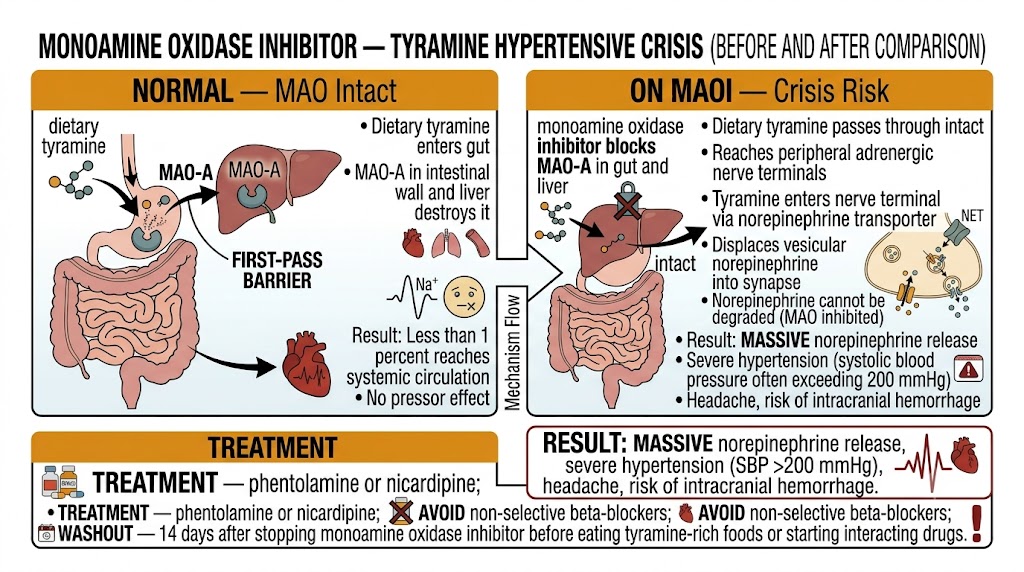
Tyramine is a biogenic amine formed by bacterial decarboxylation of tyrosine in fermented and aged foods — aged cheeses, cured meats, fermented soy products, tap beer, and certain wines. Under normal physiological conditions, virtually all orally ingested tyramine is destroyed by monoamine oxidase type A in the intestinal wall and liver before reaching the systemic circulation. This constitutes a robust first-pass barrier: less than one percent of ingested tyramine normally survives to reach peripheral adrenergic nerve terminals.

Two-panel before-and-after diagram of the monoamine oxidase inhibitor tyramine hypertensive crisis: normal state shows MAO-A in gut and liver destroying dietary tyramine (first-pass barrier, less than 1 percent reaches systemic circulation); MAOI state shows first-pass barrier abolished, systemic tyramine entering nerve terminals via norepinephrine transporter, displacing vesicular norepinephrine that cannot be degraded, producing massive norepinephrine release and severe hypertension exceeding 200 mmHg. Treatment box: phentolamine or nicardipine; avoid non-selective beta-blockers; 14-day washout.
MAOI-tyramine hypertensive crisis: normal first-pass destruction versus crisis mechanism when MAO-A is inhibited. Source: Gemini AI, generated for educational use.
Monoamine Oxidase Inhibitor Destruction of the First-Pass Barrier

Monoamine oxidase inhibitors (phenelzine, tranylcypromine, isocarboxazid) inhibit monoamine oxidase type A in the intestinal wall and liver, destroying the first-pass barrier to dietary tyramine. When a patient on a monoamine oxidase inhibitor ingests tyramine-containing food, tyramine is absorbed intact and reaches peripheral adrenergic nerve terminals in large quantities. There, tyramine enters sympathetic neurons via the norepinephrine transporter and acts as a potent indirect sympathomimetic — displacing vesicular norepinephrine stores into the synapse in large amounts.

In a patient on a monoamine oxidase inhibitor, the released norepinephrine cannot be metabolized intraneuronally (monoamine oxidase is inhibited), and the massive ongoing tyramine-driven efflux overwhelms transporter-mediated reuptake. The result is a hypertensive crisis: sudden, severe hypertension often exceeding 200 millimeters of mercury systolic, with throbbing occipital headache, diaphoresis, palpitations, and in severe cases intracranial hemorrhage and death.

Management and the 14-Day Washout Rule

Acute management of a monoamine oxidase inhibitor-tyramine hypertensive crisis requires rapid blood pressure reduction without aggravating the adrenergic excess. Phentolamine (intravenous) is the classic treatment, directly blocking alpha-1-mediated vasoconstriction during the norepinephrine surge. Nicardipine (intravenous calcium channel blocker) is frequently preferred in current practice as a titratable alternative. Non-selective beta-blockers are contraindicated for the same reason as in cocaine toxicity — removing beta-2-mediated vasodilation leaves alpha-1 vasoconstriction unopposed.

Because monoamine oxidase inhibitor-mediated enzyme inhibition is irreversible, the 14-day washout rule applies before any interacting drug or food can be safely introduced after stopping a monoamine oxidase inhibitor. This is the time needed for new monoamine oxidase enzyme synthesis. All patients on monoamine oxidase inhibitors must follow a strict tyramine-restricted diet for the duration of therapy.

Monoamine Oxidase Inhibitor Interactions Beyond Tyramine

Serotonin syndrome: Monoamine oxidase inhibitors + selective serotonin reuptake inhibitors, serotonin-norepinephrine reuptake inhibitors, meperidine, dextromethorphan, tramadol, or St. John's Wort → potentially fatal serotonin excess (hyperthermia, rigidity, clonus, autonomic instability). This combination must never be used.

Sympathomimetic crisis: Monoamine oxidase inhibitors + indirect sympathomimetics (amphetamines, ephedrine, pseudoephedrine) → hypertensive crisis by the same mechanism as tyramine.

Opioids: Meperidine is absolutely contraindicated with monoamine oxidase inhibitors (severe serotonin syndrome risk). Tramadol also contraindicated. Morphine is relatively safer.

14-day washout: After stopping a monoamine oxidase inhibitor, wait 14 days before starting any interacting drug or resuming normal diet.


Section 5

Integrated Adrenergic Framework and Chapter Summary

Direct versus indirect sympathomimetic distinction, tachyphylaxis mechanism, receptor-based clinical decision rules, and high-yield integration points across all six modules

The adrenergic pharmacology covered across six modules reduces to a small number of fundamental principles that predict responses to drugs, toxins, and disease states not covered individually. Mastery of the receptor-mechanism framework allows clinical prediction in novel situations — which is what Step 1 pharmacology is designed to test.

Direct versus Indirect Sympathomimetics — Clinical Consequences

The distinction between drugs that act directly on adrenergic receptors and drugs that work by releasing endogenous norepinephrine from presynaptic terminals has three important clinical consequences. First, in patients with depleted catecholamine stores — from chronic reserpine use, autonomic neuropathy, or prolonged critical illness — indirect sympathomimetics (amphetamine, ephedrine, tyramine) produce markedly attenuated or absent pressor responses because there is no vesicular norepinephrine available for release. Direct agonists (phenylephrine, norepinephrine, epinephrine) remain fully effective because they do not depend on presynaptic stores.

Second, patients pretreated with reserpine or who have depleted stores develop postsynaptic receptor upregulation (supersensitivity) in response to the loss of normal sympathetic input. Direct agonists in these patients produce exaggerated, supernormal responses. Third, tachyphylaxis affects only indirect sympathomimetics. With repeated doses, each release event depletes the releasable norepinephrine pool faster than new synthesis can replenish it, progressively reducing the response. Direct agonists maintain consistent responses because they do not depend on presynaptic stores.

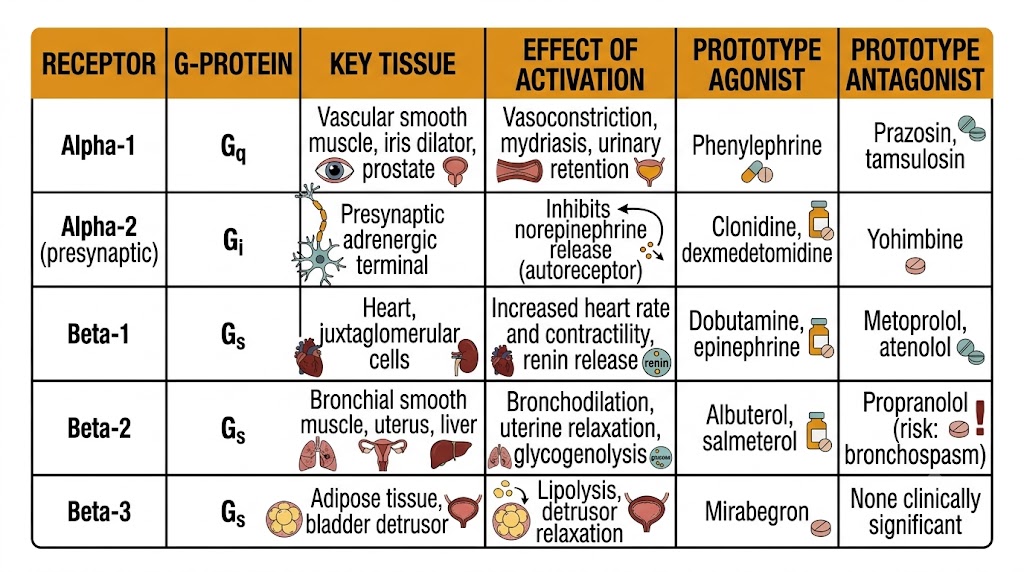
Reference table of all five adrenergic receptor subtypes showing G-protein coupling, key tissue locations, effects of activation, prototype agonist drugs, and prototype antagonist drugs: alpha-1 (Gq, vasoconstriction, phenylephrine, prazosin/tamsulosin), alpha-2 presynaptic (Gi, inhibits norepinephrine release, clonidine/dexmedetomidine, yohimbine), beta-1 (Gs, increased heart rate/contractility/renin, dobutamine/epinephrine, metoprolol/atenolol), beta-2 (Gs, bronchodilation/uterine relaxation/glycogenolysis, albuterol/salmeterol, propranolol with bronchospasm risk), beta-3 (Gs, lipolysis/detrusor relaxation, mirabegron).
Adrenergic receptor subtype reference table: G-protein coupling, key tissues, activation effects, and prototype agonists and antagonists for all five subtypes. Source: Gemini AI, generated for educational use.
Vasopressor Selection — Clinical Decision Rules

Several practical rules distill the receptor pharmacology into actionable clinical guidance. For septic shock, norepinephrine is first-line — its predominant alpha-1 vasoconstriction reliably raises mean arterial pressure with less arrhythmia than dopamine. For anaphylaxis, epinephrine is the only appropriate first-line agent because it simultaneously addresses all three pathophysiological components: alpha-1 reverses vasodilation and angioedema, beta-1 supports cardiac output, and beta-2 reverses bronchospasm and inhibits further mast cell mediator release. For hypotension when tachycardia must be avoided — in hypertrophic obstructive cardiomyopathy or severe aortic stenosis — phenylephrine is preferred because its pure alpha-1 profile raises afterload and allows reflex bradycardia without beta-1 cardiac stimulation. For benign prostatic hyperplasia coexisting with hypertension, a selective alpha-1 blocker addresses both conditions simultaneously.

Chapter 5 High-Yield Integration Points
Clinical Scenario Receptor Mechanism Drug of Choice
Anaphylaxis Alpha-1 (vasoconstriction) + beta-1 (cardiac output) + beta-2 (bronchodilation, mast cell inhibition) Epinephrine intramuscular — addresses all three components simultaneously
Septic shock Alpha-1 vasoconstriction; modest beta-1 support Norepinephrine — first-line per surviving sepsis guidelines (Sepsis Occurrence in Acutely Ill Patients II trial)
Cardiogenic shock (low output, preserved blood pressure) Beta-1 positive inotropy; mild beta-2 afterload reduction Dobutamine — selective inotrope; combine with norepinephrine if hypotensive
Pheochromocytoma preoperative preparation Alpha-1/alpha-2 irreversible blockade Phenoxybenzamine — alpha before beta rule; titrate over 1 to 2 weeks
Hypertensive emergency from catecholamine excess Alpha-1/alpha-2 competitive blockade Phentolamine — short-acting, titratable; also for norepinephrine extravasation
Heart failure with reduced ejection fraction Beta-1 blockade → receptor resensitization, reverse remodeling Carvedilol, bisoprolol, or metoprolol succinate extended-release — only these three have proven mortality benefit
Acute asthma / bronchospasm Beta-2 agonism → bronchodilation Albuterol (rescue); salmeterol or formoterol (maintenance, only with inhaled corticosteroid)
Monoamine oxidase inhibitor hypertensive crisis Alpha-1 blockade to reverse norepinephrine surge Phentolamine or nicardipine; avoid non-selective beta-blockers
Thyroid storm Beta-1/2 blockade + inhibition of T4→T3 peripheral conversion Propranolol — only beta-blocker that inhibits type 1 deiodinase
Benign prostatic hyperplasia (with hypertension) Alpha-1A/1B blockade → prostate and vascular smooth muscle relaxation Selective alpha-1 blocker (prazosin, doxazosin) — addresses both conditions

Suggested References
Author / Organization Title Source
Westfall TC, Westfall DP Adrenergic agonists and antagonists. In: Brunton LL, et al., eds. Goodman & Gilman’s: The Pharmacological Basis of Therapeutics, 13th ed. McGraw-Hill; 2018:191–224
Stahl SM Stahl’s Essential Psychopharmacology: Neuroscientific Basis and Practical Applications, 4th ed. Cambridge University Press; 2013:471–525
Cortese S, Adamo N, Del Giovane C, et al. Comparative efficacy and tolerability of medications for attention-deficit hyperactivity disorder in children, adolescents, and adults: a systematic review and network meta-analysis Lancet Psychiatry. 2018;5(9):727–738
Hoffman BB Catecholamines, sympathomimetic drugs, and adrenergic receptor antagonists. In: Hardman JG, Limbird LE, eds. Goodman & Gilman’s: The Pharmacological Basis of Therapeutics, 10th ed. McGraw-Hill; 2001:215–268
Lange RA, Hillis LD Cardiovascular complications of cocaine use N Engl J Med. 2001;345(5):351–358
Kanfer I, Dowse R, Vuma V Pharmacokinetics of oral decongestants Pharmacotherapy. 1993;13(6 Pt 2):116S–128S
Shore PA, Silver SL, Brodie BB Interaction of reserpine, serotonin, and lysergic acid diethylamide in brain Science. 1955;122(3163):284–285
Maxwell RA, Eckhardt SB Drug Discovery: A Casebook and Analysis [Guanethidine: mechanism of adrenergic neuron blockade and clinical pharmacology] Humana Press; 1990:143–154
Gardner DM, Shulman KI, Walker SE, Tailor SA The making of a user friendly MAOI diet J Clin Psychiatry. 1996;57(3):99–104
Gillman PK Monoamine oxidase inhibitors, opioid analgesics and serotonin toxicity Br J Anaesth. 2005;95(4):434–441
Bylund DB Subtypes of alpha 1- and alpha 2-adrenergic receptors FASEB J. 1992;6(3):832–839
Hollenberg SM Vasoactive drugs in circulatory shock Am J Respir Crit Care Med. 2011;183(7):847–855