CHAPTER 37  ·  ANTIFUNGAL AGENTS
Section 1

Mechanism of Action — Ergosterol Binding and Pore Formation

Why fungi are selectively vulnerable to polyene antifungals

The polyene antifungals exploit a fundamental difference between fungal and mammalian cell membranes. Fungal cells depend on ergosterol as their primary membrane sterol, filling the same structural role that cholesterol fills in mammalian membranes. Polyenes bind ergosterol directly and insert into the membrane, forming channels that kill by disrupting the electrochemical gradient the cell depends on for survival.

Ergosterol as the Target

Ergosterol is a 28-carbon sterol synthesized by fungi through a pathway that diverges from mammalian cholesterol synthesis at the level of lanosterol. It regulates membrane fluidity, supports membrane-bound enzyme function, and is essential for cell integrity. Because mammalian cells use cholesterol instead of ergosterol, ergosterol is a fungal-specific target.

Amphotericin B is a macrolide polyene produced by the bacterium Streptomyces nodosus. Its molecular structure is amphipathic: one face of the large ring is hydrophobic and polyene-rich, the other hydrophilic. When amphotericin B encounters a membrane containing ergosterol, the hydrophobic face inserts into the lipid bilayer and the drug molecules self-assemble around ergosterol into barrel-shaped transmembrane pore structures.

Pore Formation and Cell Death

These pores allow non-selective ion flux across the membrane. Potassium leaks outward down its concentration gradient, the membrane potential collapses, and active transport systems fail. Against susceptible yeasts such as Candida species and Cryptococcus neoformans, amphotericin B is fungicidal. Against molds including Aspergillus species, it is fungistatic. This distinction matters clinically because candidemia and cryptococcal meningitis require rapid fungicidal killing, and amphotericin B provides it reliably in organisms that remain susceptible.

Selectivity and Its Limits

Amphotericin B binds ergosterol with approximately ten-fold higher affinity than it binds cholesterol. That selectivity is real but incomplete. At therapeutic concentrations, amphotericin B interacts with cholesterol in mammalian membranes as well, particularly in the cholesterol-rich apical membranes of renal tubular epithelial cells. This cholesterol interaction is the basis of the nephrotoxicity that defines and limits clinical use of conventional amphotericin B. The higher the free plasma drug concentration, the greater the interaction with renal cholesterol, and this observation drove the development of lipid formulations designed to reduce free drug exposure to the kidney while preserving antifungal delivery to sites of infection.
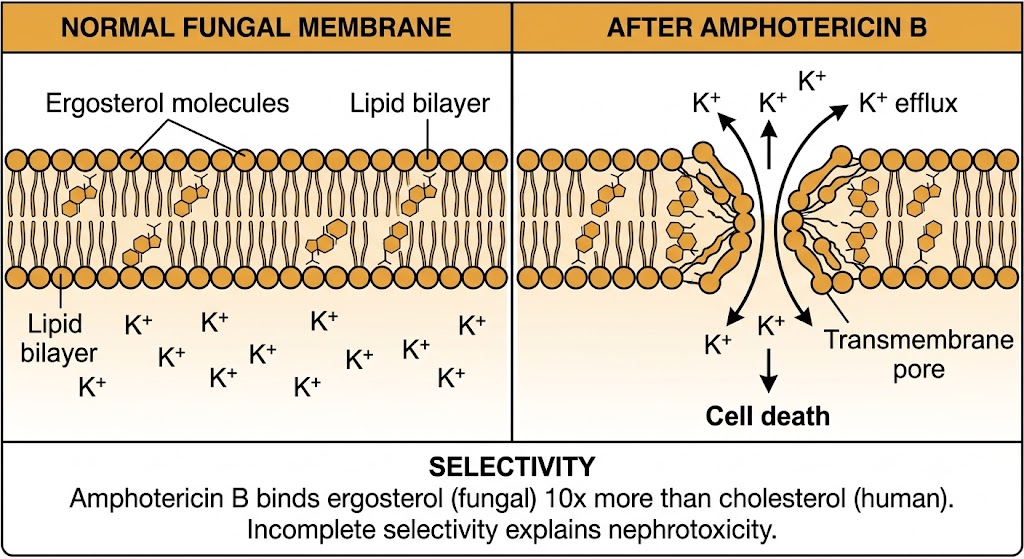
Two-panel diagram showing normal fungal membrane with ergosterol molecules on the left, and on the right amphotericin B assembled into a transmembrane pore causing potassium efflux and cell death. A shared panel below notes that amphotericin B binds ergosterol ten times more than cholesterol, explaining nephrotoxicity.
Amphotericin B mechanism: ergosterol binding and transmembrane pore formation causing potassium efflux and cell death. Gemini-generated figure.
Mechanism Summary

Amphotericin B binds ergosterol in the fungal cell membrane and self-assembles into transmembrane pores, causing potassium efflux, membrane depolarization, and cell death. It is fungicidal against susceptible Candida species and Cryptococcus neoformans, and fungistatic against Aspergillus. Selectivity for ergosterol over mammalian cholesterol is real but incomplete, which accounts for both the drug's efficacy and its inherent toxicity.

Section 2

Amphotericin B Deoxycholate — Pharmacokinetics and Spectrum

Absorption, distribution, antifungal spectrum, and current clinical role of the conventional formulation

Amphotericin B deoxycholate was the original formulation, using sodium deoxycholate as a micellar solubilizing vehicle. Understanding its pharmacokinetics establishes the baseline from which lipid formulations differ, and clarifies why those formulations were developed.

Pharmacokinetics

Amphotericin B deoxycholate is not absorbed from the gastrointestinal tract and must be given intravenously for systemic infections. It is highly protein-bound in plasma, primarily to lipoproteins, and distributes extensively into tissues including liver, spleen, lung, and kidney. Central nervous system penetration from the systemic circulation is poor, with cerebrospinal fluid concentrations typically below four percent of plasma concentrations. Despite this, amphotericin B deoxycholate was effective for decades in cryptococcal meningitis, likely because high concentrations accumulate in the choroid plexus and meninges themselves.

The drug is not significantly metabolized by cytochrome P450 enzymes, which means it has no pharmacokinetic drug-drug interactions of the type that make azole prescribing so complex. About forty percent of a dose appears unchanged in urine over several days to weeks. The terminal elimination half-life is approximately fifteen days, reflecting slow release from deep tissue compartments. Dose adjustment is not required for renal impairment because glomerular filtration is not the primary elimination route, though the drug itself causes nephrotoxicity in a dose-dependent fashion.

Antifungal Spectrum

The spectrum of amphotericin B is broad. It covers most Candida species, Cryptococcus neoformans and Cryptococcus gattii, Aspergillus species (fungistatic), the agents of mucormycosis including Rhizopus and Mucor, and the dimorphic fungi responsible for endemic mycoses including Histoplasma capsulatum, Blastomyces dermatitidis, and Coccidioides immitis.

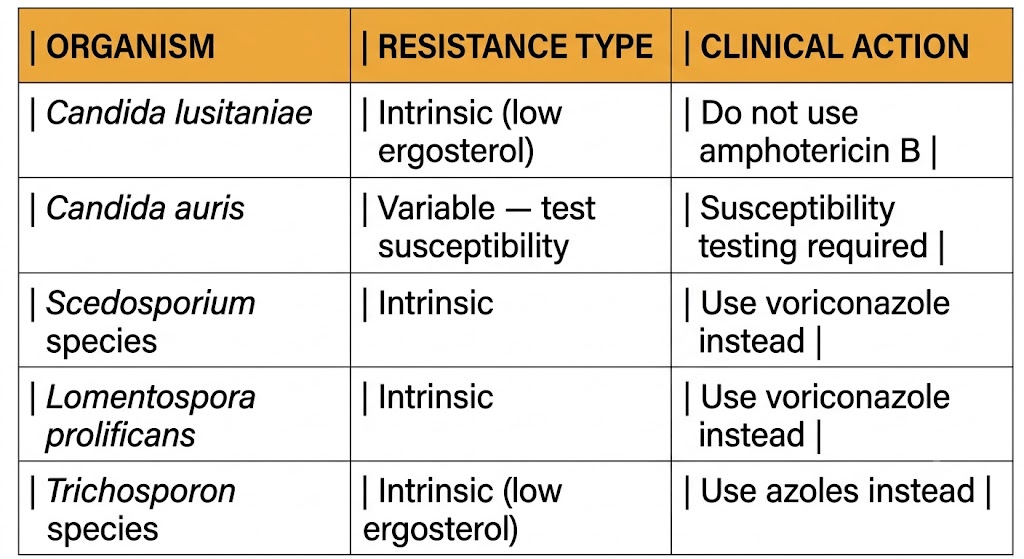
Important gaps exist. Candida lusitaniae has intrinsic resistance due to constitutive mutations that reduce ergosterol content. Scedosporium species and Lomentospora prolificans are intrinsically resistant. Trichosporon species have low membrane ergosterol and are not reliably covered. Candida auris shows variable susceptibility and susceptibility testing is mandatory before relying on amphotericin B. Species-level identification is therefore essential before empirical amphotericin B therapy is considered definitive.


Section 3

Lipid-Based Formulations

How packaging amphotericin B in lipid vehicles reduces nephrotoxicity without sacrificing antifungal activity

Three lipid-based formulations are available: liposomal amphotericin B, amphotericin B lipid complex, and amphotericin B colloidal dispersion. All three reduce nephrotoxicity compared to amphotericin B deoxycholate by limiting the concentration of free drug available to interact with renal tubular cholesterol. None has been shown to be more effective than the conventional formulation in controlled trials; the advantage is tolerability.

Liposomal Amphotericin B

Liposomal amphotericin B consists of small unilamellar liposomes in which the drug is intercalated into the phospholipid bilayer of the liposome membrane. The liposomal shell shields amphotericin B from contact with mammalian cholesterol during circulation. It is the best-tolerated lipid formulation, with the largest body of clinical trial evidence and the best defined role in current guidelines. It is the preferred formulation when cost is not a limiting factor. Standard dosing is three to five milligrams per kilogram per day intravenously.

Amphotericin B Lipid Complex

Amphotericin B lipid complex consists of ribbon-like lipid bilayer structures rather than closed liposomes. Because of its large particle size, it is rapidly taken up by the mononuclear phagocyte system, producing high drug concentrations in liver, spleen, and lung. Standard dosing is five milligrams per kilogram per day. Nephrotoxicity is reduced compared to amphotericin B deoxycholate but is greater than with liposomal amphotericin B. It is an acceptable and generally less costly alternative when liposomal amphotericin B is not available or budget is a consideration.

Amphotericin B Colloidal Dispersion

Amphotericin B colloidal dispersion consists of disk-shaped cholesteryl sulfate complexes. It is associated with the highest rate of acute infusion reactions among the three lipid formulations and is rarely chosen when the other two are available. It remains approved for aspergillosis refractory to conventional amphotericin B deoxycholate.

When to Use a Lipid Formulation from the Start

Use a lipid formulation as initial therapy rather than amphotericin B deoxycholate when any of the following apply: baseline creatinine above 2.5 mg/dL, concurrent nephrotoxin use that cannot be stopped (calcineurin inhibitors, aminoglycosides), solid organ or stem cell transplant status, anticipated treatment duration beyond two weeks, or prior amphotericin B nephrotoxicity. Starting with the conventional formulation and switching after nephrotoxicity develops is a suboptimal strategy because tubular damage is cumulative and partially irreversible.


Section 4

Toxicity — Infusion Reactions and Nephrotoxicity

Mechanisms, prevention strategies, and electrolyte management

The two dominant toxicities of amphotericin B are acute infusion-related reactions and cumulative nephrotoxicity. They are mechanistically distinct and require different management approaches.

Infusion Reactions

Acute infusion reactions occur in up to seventy percent of patients receiving amphotericin B deoxycholate and typically begin fifteen to sixty minutes into the infusion. The syndrome includes fever, rigors, headache, nausea, and myalgia. The mechanism involves drug-induced release of prostaglandins, interleukin-1, and tumor necrosis factor-alpha from monocytes and macrophages through toll-like receptor-dependent pathways, plus complement activation. This is not an immunoglobulin E-mediated allergic reaction and does not predict anaphylaxis or contraindicate continued use.

Premedication with acetaminophen and diphenhydramine given thirty to sixty minutes before each infusion attenuates the febrile and histaminergic components. Meperidine given intravenously is specifically effective for breaking established rigors. Reactions typically diminish in severity with subsequent infusions as tolerance develops.

Nephrotoxicity

Nephrotoxicity involves two distinct mechanisms. First, amphotericin B causes afferent arteriolar vasoconstriction, reducing renal blood flow and glomerular filtration rate. This component is rapidly reversible. Second, it directly damages distal tubular epithelium by forming pores in cholesterol-containing apical membranes, causing type 1 distal renal tubular acidosis, potassium wasting, and magnesium wasting. This tubular damage is dose-dependent and cumulative.

Sodium loading with 500 milliliters of normal saline given before each amphotericin B infusion reduces nephrotoxicity risk by attenuating tubuloglomerular feedback-mediated vasoconstriction, expanding intravascular volume, and delivering sodium to the distal tubule to compete with potassium loss. Multiple prospective studies support this practice. It is contraindicated when the volume load is not tolerable, such as in severe heart failure or pulmonary edema.

Electrolyte Management

Hypokalemia and hypomagnesemia are nearly universal with prolonged amphotericin B therapy and require aggressive replacement. Potassium wasting from distal tubular dysfunction can be severe and refractory to oral supplementation. Hypomagnesemia must be corrected first because magnesium is required for normal function of the renal potassium channel responsible for distal tubular potassium reabsorption. Correcting magnesium deficiency is a prerequisite for effective potassium repletion.

Nephrotoxicity Monitoring

Measure serum creatinine, potassium, and magnesium at baseline and at minimum every two to three days during stable therapy. A doubling of serum creatinine from baseline is the standard threshold for switching from amphotericin B deoxycholate to a lipid formulation or discontinuing therapy. Correct hypomagnesemia before attempting to normalize potassium.


Section 5

Nystatin and Polyene Resistance

Nystatin's clinical niche and the mechanisms behind intrinsic and acquired polyene resistance

Nystatin shares the same ergosterol-binding mechanism as amphotericin B but differs so dramatically in aqueous solubility that it cannot be formulated for intravenous use at non-toxic concentrations. This pharmacokinetic reality confines nystatin entirely to topical and non-absorbed oral applications.

Nystatin

Nystatin is a polyene antifungal produced by Streptomyces noursei. It binds ergosterol and forms membrane pores with the same mechanism as amphotericin B. Its antifungal spectrum against Candida species is comparable to amphotericin B. However, nystatin is essentially insoluble in aqueous solution at physiological pH, and early attempts at intravenous formulation produced unacceptable systemic toxicity.

Oral nystatin suspension is used for oropharyngeal candidiasis by swishing and swallowing. It is also used as a swish-and-swallow preparation for esophageal candidiasis, though fluconazole is significantly more effective for documented esophageal disease. Topical nystatin preparations treat cutaneous and mucocutaneous candidiasis. Vaginal nystatin suppositories are an option during pregnancy, when systemic azoles are generally avoided. Because nystatin is not absorbed from the gastrointestinal tract, it produces no systemic toxicity when taken orally; nausea, vomiting, and diarrhea are the only adverse effects at standard doses.

Polyene Resistance

True resistance to amphotericin B is rare, which is one of the defining clinical advantages of the polyene class. The primary resistance mechanism is depletion or structural alteration of ergosterol in the fungal cell membrane. This most commonly results from mutations in ergosterol biosynthesis genes, particularly the gene encoding C-5 sterol desaturase and the gene encoding lanosterol 14-alpha-demethylase. These mutations allow the organism to survive despite the presence of amphotericin B by removing or altering the drug's binding target in the membrane.

Candida lusitaniae is intrinsically resistant through constitutive mutations that reduce membrane ergosterol content. This is clinically actionable: Candida lusitaniae can be misidentified by automated systems as other Candida species, and a patient with Candida lusitaniae fungemia treated empirically with amphotericin B will not respond. Scedosporium species and Trichosporon species have intrinsic polyene resistance. Candida auris shows variable susceptibility with some clades carrying isolates above susceptibility breakpoints. Acquired resistance during therapy is uncommon but has been documented in immunocompromised hosts on prolonged exposure.

Reference table listing five fungal organisms with intrinsic or variable amphotericin B resistance: Candida lusitaniae (intrinsic, low ergosterol — do not use amphotericin B), Candida auris (variable — test susceptibility), Scedosporium species (intrinsic — use voriconazole), Lomentospora prolificans (intrinsic — use voriconazole), and Trichosporon species (intrinsic, low ergosterol — use azoles).
Organisms with intrinsic or high-level polyene resistance and recommended alternatives. Gemini-generated figure.
Organisms With Intrinsic Polyene Resistance

Candida lusitaniae: intrinsic resistance; do not rely on amphotericin B for any isolate. Candida auris: variable; susceptibility testing mandatory. Scedosporium and Lomentospora prolificans: intrinsically resistant; voriconazole preferred. Trichosporon species: intrinsically resistant; azoles preferred. Never assume amphotericin B susceptibility without species-level identification.


Suggested References
Author / Organization Title Source
Brajtburg J, Powderly WG, Kobayashi GS, Medoff G Amphotericin B: current understanding of mechanisms of action Antimicrob Agents Chemother. 1990;34(2):183-188
Bolard J How do the polyene macrolide antibiotics affect the cellular membrane properties? Biochim Biophys Acta. 1986;864(3-4):257-304
Adler-Moore J, Proffitt RT AmBisome: liposomal formulation, structure, mechanism of action and pre-clinical experience J Antimicrob Chemother. 2002;49(Suppl 1):21-30
Gallis HA, Drew RH, Pickard WW Amphotericin B: 30 years of clinical experience Rev Infect Dis. 1990;12(2):308-329
Patterson TF, Thompson GR, Denning DW, et al. Practice guidelines for the diagnosis and management of aspergillosis: 2016 update by the Infectious Diseases Society of America Clin Infect Dis. 2016;63(4):e1-e60
World Health Organization Guidelines for Diagnosing, Preventing and Managing Cryptococcal Disease Among Adults, Adolescents and Children Living with HIV Geneva: WHO; 2022
Walsh TJ, Finberg RW, Arndt C, et al. Liposomal amphotericin B for empirical therapy in patients with persistent fever and neutropenia N Engl J Med. 1999;340(10):764-771
Heidemann HT, Gerkens JF, Spickard WA, Jackson EK, Branch RA Amphotericin B nephrotoxicity in humans decreased by salt repletion Am J Med. 1983;75(3):476-481
Pappas PG, Kauffman CA, Andes DR, et al. Clinical practice guideline for the management of candidiasis: 2016 update by the Infectious Diseases Society of America Clin Infect Dis. 2016;62(4):e1-e50
Sanglard D, Odds FC Resistance of Candida species to antifungal agents: molecular mechanisms and clinical consequences Lancet Infect Dis. 2002;2(2):73-85