CHAPTER 37  ·  ANTIFUNGAL AGENTS
Section 1

Mechanism of Action — Cytochrome P450 51 Inhibition

How azoles block ergosterol synthesis and why the effect is fungistatic rather than fungicidal

The azole antifungals act by inhibiting a fungal cytochrome P450 (CYP) enzyme called lanosterol 14-alpha-demethylase. In fungi this enzyme is encoded by the gene designated ERG11 and classified as cytochrome P450 51 (CYP51). Its inhibition depletes ergosterol from the fungal membrane while causing accumulation of toxic methylated sterol intermediates. The result is impaired membrane function and arrested fungal growth.

The Ergosterol Biosynthesis Pathway

Ergosterol biosynthesis begins with acetyl-CoA and proceeds through the mevalonate pathway to lanosterol. From lanosterol, the fungal pathway diverges from mammalian cholesterol synthesis. The fungal CYP51 enzyme catalyzes the oxidative removal of the 14-alpha-methyl group from lanosterol, a required step on the route to ergosterol. Azole inhibition at this step causes two simultaneous consequences: depletion of ergosterol, which is essential for normal membrane fluidity and function, and accumulation of 14-alpha-methylfecosterol and other toxic sterol intermediates that further disrupt membrane integrity.

How Azoles Inhibit CYP51

All clinically used azoles share a triazole or imidazole nitrogen atom that coordinates directly with the heme iron of the CYP51 active site, blocking the enzyme's oxidative catalytic cycle. The azole side chains make additional contacts with residues lining the active site channel, determining selectivity and potency. Triazoles — fluconazole, itraconazole, voriconazole, posaconazole, isavuconazole — are preferred over imidazoles for systemic use because they have greater selectivity for fungal CYP51 over mammalian cytochrome P450 enzymes.

The same triazole nitrogen that inhibits fungal CYP51 also interacts with human hepatic cytochrome P450 enzymes, which is the mechanistic basis for the drug interactions that define the azole class. The degree of human cytochrome P450 inhibition differs substantially among individual azoles and drives their different interaction profiles.

Fungistatic Activity

Azoles are fungistatic rather than fungicidal against most target organisms. Ergosterol depletion impairs fungal growth and replication without producing the rapid membrane disruption that characterizes polyene-mediated killing. This has several clinical consequences. First, azole therapy relies on an intact host immune system to eliminate surviving fungal cells, meaning outcomes in profoundly immunosuppressed patients are worse than in those with functional immunity. Second, fungistatic drugs carry a higher risk of selecting resistant mutants during prolonged courses because surviving cells continue to replicate. Third, azoles are not appropriate as primary monotherapy where rapid fungicidal killing is required, such as cryptococcal meningitis induction, where polyenes or echinocandins are preferred.
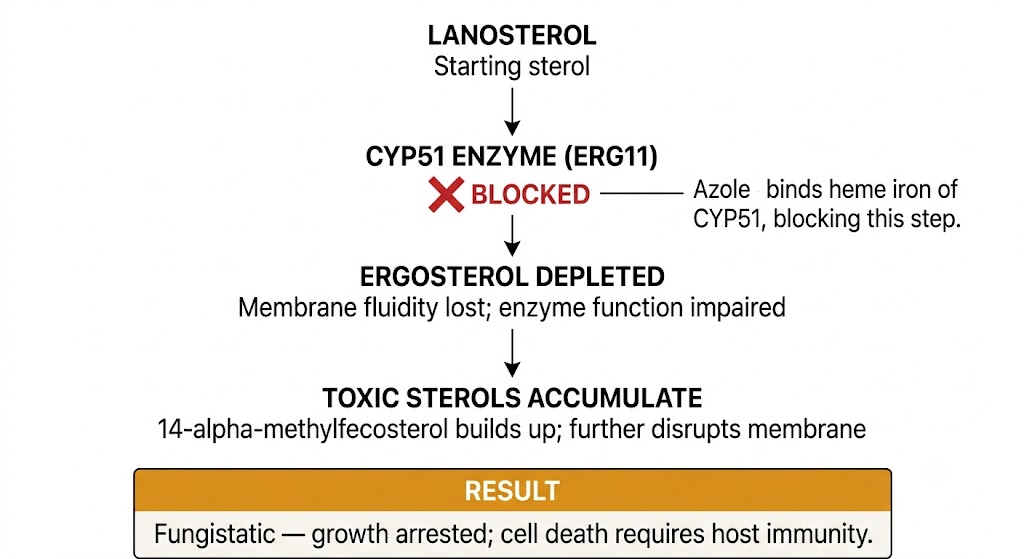
Vertical flow diagram showing the ergosterol biosynthesis pathway: lanosterol at top, followed by the CYP51 enzyme marked as blocked by azole binding to its heme iron, leading to ergosterol depletion and toxic sterol accumulation, with a result box at the bottom stating the effect is fungistatic.
Azole mechanism: inhibition of CYP51 (ERG11) blocks ergosterol synthesis, causing ergosterol depletion and toxic sterol accumulation. Gemini-generated figure.
Mechanism Summary

Azoles inhibit fungal CYP51 (lanosterol 14-alpha-demethylase, encoded by ERG11) by coordinating the enzyme's heme iron. This blocks ergosterol synthesis and causes accumulation of toxic 14-alpha-methyl sterol intermediates. The result is fungistatic activity against most yeasts and molds. Cross-inhibition of human cytochrome P450 enzymes — cytochrome P450 3A4 (CYP3A4), cytochrome P450 2C9 (CYP2C9), cytochrome P450 2C19 (CYP2C19) — is the mechanistic basis for drug interactions that vary in magnitude among individual azole agents.

Section 2

Fluconazole — Pharmacokinetics and Spectrum

Oral bioavailability, central nervous system penetration, renal elimination, and the breadth and limits of fluconazole coverage

Fluconazole is the most widely used antifungal agent globally and the prototypical triazole. Its pharmacokinetic profile is uniquely favorable: near-complete oral bioavailability, excellent penetration into all body compartments including the central nervous system (CNS), predictable linear pharmacokinetics, and renal elimination allowing straightforward dose adjustment.

Absorption and Bioavailability

Fluconazole is available in both oral and intravenous (IV) formulations with oral bioavailability of approximately 90%. Absorption is not significantly affected by gastric acid, food, or gastric motility, making it highly reliable in patients with altered gastrointestinal function including those receiving proton pump inhibitors or those who have undergone gastrointestinal surgery. This distinguishes fluconazole sharply from itraconazole capsules, whose absorption is highly pH-dependent and variable. Given the near-complete oral bioavailability, transition from IV to oral fluconazole at equivalent doses is appropriate as soon as oral intake is possible.

Distribution and CNS Penetration

Fluconazole distributes extensively into tissues and body fluids. CNS penetration is exceptional among antifungals: cerebrospinal fluid (CSF) concentrations reach approximately 60 to 80 percent of plasma concentrations. Protein binding is low at approximately 12 percent, contributing to the high free drug fraction available for distribution. Saliva, sputum, urine, and vaginal secretions all achieve drug concentrations near plasma levels, which explains the efficacy of fluconazole for superficial mucosal infections with relatively short courses.

Metabolism and Elimination

Unlike most other azoles, fluconazole is predominantly eliminated unchanged by the kidneys, with approximately 80 percent of a dose excreted as intact drug in the urine. Dose adjustment is required when creatinine clearance falls below 50 mL/min: reduce the dose by 50 percent. Supplemental doses are needed after hemodialysis sessions because dialysis removes approximately half the drug. The elimination half-life of approximately 30 hours allows once-daily dosing. Because fluconazole is minimally metabolized by CYP3A4, its pharmacokinetics are not significantly affected by CYP3A4 inducers or inhibitors, in contrast to itraconazole and voriconazole.

Antifungal Spectrum

Fluconazole covers most Candida species, Cryptococcus neoformans and Cryptococcus gattii, and the dimorphic fungi causing endemic mycoses including Histoplasma capsulatum and Coccidioides immitis. It has no meaningful activity against Aspergillus species, the Mucorales, or most molds.

Among Candida species, susceptibility is not uniform. Candida albicans, Candida tropicalis, and Candida parapsilosis are generally susceptible. Candida glabrata frequently shows reduced susceptibility or frank resistance due to upregulation of efflux pumps. Candida krusei has intrinsic resistance to fluconazole and must never be treated with it regardless of susceptibility testing results. Species identification is therefore mandatory before relying on fluconazole for candidiasis treatment.

Clinical Indications

Fluconazole is the drug of choice for oropharyngeal and esophageal candidiasis, uncomplicated vulvovaginal candidiasis (single oral dose of 150 mg), and consolidation and maintenance therapy for cryptococcal meningitis following amphotericin B induction. It is also used for step-down therapy in stable patients with candidemia caused by susceptible species after initial echinocandin therapy, and for antifungal prophylaxis in hematopoietic stem cell transplant recipients and high-risk liver transplant recipients where the predominant risk is from fluconazole-susceptible Candida species.


Section 3

Itraconazole — Formulations, Absorption, and Monitoring

Capsule versus oral solution pharmacology, pH-dependent absorption, and the role of therapeutic drug monitoring

Itraconazole presents one of the most complex pharmacokinetic profiles of any oral antifungal. Its two oral formulations behave so differently that they should be considered pharmacologically distinct for practical purposes.

Formulations and Absorption

Itraconazole capsules require an acidic gastric environment and the presence of food for adequate dissolution and absorption. Under optimal conditions the capsule bioavailability reaches approximately 55 percent, but in patients receiving proton pump inhibitors, histamine-2 receptor antagonists, antacids, or those with achlorhydria, absorption falls dramatically, sometimes to near zero. The oral solution uses hydroxypropyl-beta-cyclodextrin as a solubilizing vehicle, which improves absorption substantially. The oral solution should be taken on an empty stomach, achieves bioavailability of approximately 60 percent, and is far less sensitive to gastric pH. The oral solution is the preferred formulation for most systemic indications.

Distribution

Itraconazole has an extremely large volume of distribution reflecting extensive binding to plasma proteins — approximately 99.8 percent — and massive accumulation in highly lipophilic tissues including skin, nails, lungs, liver, and adipose tissue. Tissue concentrations in these compartments exceed plasma concentrations by factors of 10 to 100, so plasma concentrations underestimate tissue exposure. Itraconazole does not penetrate well into the CNS or cerebrospinal fluid due to its high lipophilicity and protein binding, making it unsuitable for treating CNS fungal infections.

Metabolism and CYP3A4 Interactions Affecting Itraconazole Levels

Itraconazole is extensively metabolized by hepatic CYP3A4 to numerous metabolites, of which hydroxy-itraconazole is the principal active metabolite. Because itraconazole is both a substrate and a potent inhibitor of CYP3A4, its plasma concentration is highly sensitive to co-administered CYP3A4 inducers and inhibitors. Strong CYP3A4 inducers — rifampin, rifabutin, phenytoin, carbamazepine, phenobarbital, efavirenz, nevirapine — dramatically reduce itraconazole plasma concentrations, sometimes to subtherapeutic levels. The combination with rifampin is essentially contraindicated. The substantial interpatient variability in itraconazole pharmacokinetics is the primary rationale for therapeutic drug monitoring (TDM).

Therapeutic Drug Monitoring

TDM is recommended for itraconazole because of high interpatient pharmacokinetic variability and the narrow exposure window between subtherapeutic concentrations, which cause treatment failure, and toxic concentrations, which cause adverse effects. Plasma itraconazole trough concentrations measured at steady state — typically after 14 days of therapy — should exceed 0.5 mcg/mL for prophylaxis and 1.0 mcg/mL for treatment of invasive fungal infections. Concentrations above 10 mcg/mL are associated with increased toxicity. Itraconazole has a negative inotropic effect that can worsen or precipitate heart failure and is contraindicated in patients with ventricular dysfunction.

Itraconazole Absorption Rules

Capsules: take with a full meal; avoid proton pump inhibitors, histamine-2 receptor antagonists, and antacids — absorption falls dramatically without acid. Not suitable for patients with achlorhydria. Oral solution: take fasting; far less pH-dependent; preferred for systemic infections. Both formulations: check trough at 14 days — target above 1.0 mcg/mL for treatment. Avoid in heart failure. Rifampin co-administration is essentially contraindicated.


Section 4

Azole Resistance Mechanisms

ERG11 mutations, efflux pump upregulation, and the clinical epidemiology of azole-resistant Candida

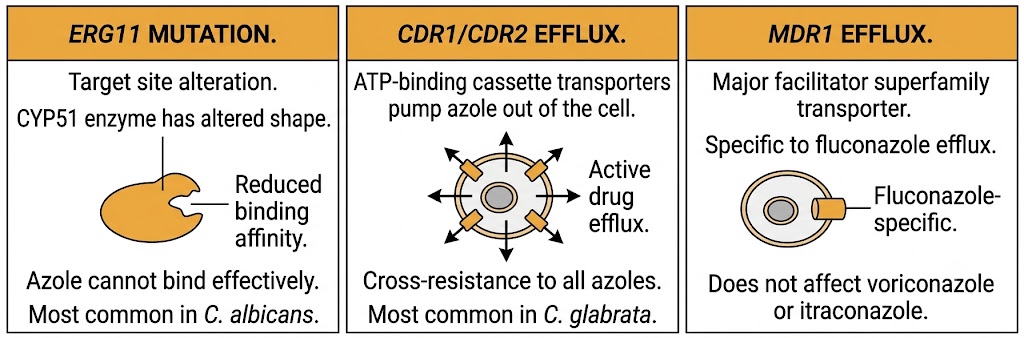
Azole resistance has become one of the most clinically consequential problems in medical mycology. Three primary mechanisms account for the majority of resistance in clinical isolates: target site alteration through mutations in the ERG11 gene, active drug efflux through upregulation of transporter proteins, and target bypass through ERG3 gene mutations.

ERG11 Mutations

Point mutations in ERG11, the gene encoding the CYP51 target enzyme, reduce azole binding affinity by altering key amino acid residues that contact the azole nitrogen or adjacent side chain. Over 140 distinct point mutations have been described in azole-resistant Candida albicans isolates. ERG11 mutations generally confer resistance to fluconazole more readily than to the extended-spectrum azoles, because the additional contacts made by voriconazole and posaconazole side chains partially compensate for the loss of binding.

Efflux Pump Upregulation

Two families of drug efflux transporters reduce intracellular azole concentrations below the threshold needed for CYP51 inhibition. The adenosine triphosphate-binding cassette (ABC) transporters CDR1 and CDR2 actively export azoles from the fungal cell. Gain-of-function mutations in the transcription factor gene TAC1 constitutively upregulate CDR1 and CDR2, causing cross-resistance to fluconazole, itraconazole, and other azoles. The major facilitator superfamily transporter MDR1 (multidrug resistance 1) provides a second efflux mechanism specific to fluconazole; its overexpression confers fluconazole-specific resistance without necessarily affecting voriconazole or itraconazole susceptibility.

Clinical Epidemiology

Candida albicans remains predominantly fluconazole-susceptible in most regions. Candida glabrata has the highest rates of fluconazole resistance among common Candida species — 10 to 30 percent in many centers — driven primarily by efflux pump upregulation. Candida krusei is intrinsically resistant to fluconazole due to low-affinity CYP51 combined with efflux pumps, and must never be treated with fluconazole regardless of susceptibility testing results. Candida auris shows variable pan-azole resistance; echinocandins are the drug of choice pending susceptibility data.

Three-panel diagram illustrating azole resistance mechanisms in Candida: left panel shows ERG11 mutation causing reduced azole binding affinity, most common in C. albicans; center panel shows CDR1/CDR2 ATP-binding cassette efflux pumps actively expelling azole from the cell, causing cross-resistance to all azoles, most common in C. glabrata; right panel shows MDR1 major facilitator superfamily transporter specific to fluconazole efflux that does not affect voriconazole or itraconazole.
Three mechanisms of azole resistance in Candida species: target site mutation (ERG11), broad efflux (CDR1/CDR2), and fluconazole-specific efflux (MDR1). Gemini-generated figure.
Species-Level Prescribing Rules

Candida albicans: generally fluconazole-susceptible; test if prolonged prior azole exposure. Candida glabrata: assume potential resistance; echinocandin preferred for invasive infections; fluconazole only if confirmed susceptible and patient is stable. Candida krusei: intrinsic fluconazole resistance — never use fluconazole. Candida auris: variable pan-azole resistance; echinocandin is drug of choice; susceptibility testing mandatory.


Section 5

Drug Interactions

Cytochrome P450 inhibition profiles, QT prolongation, and the highest-priority clinical interaction pairs

The drug interaction profile of azole antifungals is among the most complex in clinical pharmacology. Fluconazole and itraconazole inhibit overlapping but distinct sets of human cytochrome P450 enzymes, producing meaningfully different interaction liabilities that must be looked up for each specific agent rather than generalized across the class.

CYP Inhibition Profiles

Fluconazole is a potent inhibitor of CYP2C9 and a moderate inhibitor of CYP3A4 and CYP2C19. It does not significantly inhibit cytochrome P450 1A2 (CYP1A2) or cytochrome P450 2D6 (CYP2D6). Itraconazole is a potent inhibitor of CYP3A4 and P-glycoprotein, an efflux transporter affecting intestinal and hepatic drug disposition, but does not significantly inhibit CYP2C9 or CYP2C19. The difference — fluconazole primarily CYP2C9, itraconazole primarily CYP3A4 — means the two agents have largely different interaction partners despite sharing a class mechanism.

Calcineurin Inhibitor Interactions

Tacrolimus is a CYP3A4 and P-glycoprotein substrate with an extremely narrow therapeutic index. Itraconazole co-administration can increase tacrolimus blood concentrations by five to ten-fold or more through combined CYP3A4 and P-glycoprotein inhibition, causing calcineurin inhibitor toxicity including nephrotoxicity and neurotoxicity. Fluconazole causes a smaller but still clinically significant increase of two to four-fold through CYP3A4 inhibition. When initiating either azole in a transplant patient receiving tacrolimus or cyclosporine, doses must be proactively reduced before the azole reaches steady state, and trough concentrations must be monitored daily until a new steady state is established.

Warfarin Interaction

Fluconazole potentiates warfarin anticoagulation through CYP2C9 inhibition. CYP2C9 metabolizes S-warfarin, the more pharmacologically active enantiomer; fluconazole inhibition of CYP2C9 reduces S-warfarin clearance and elevates the international normalized ratio (INR) substantially, with increases of two to three-fold reported within days of initiating fluconazole. Patients receiving warfarin who are started on any azole require INR monitoring within three to five days of initiation, with dose reductions guided by INR response.

QT Prolongation

Both fluconazole and itraconazole can prolong the corrected QT interval. Fluconazole directly blocks the hERG cardiac potassium channel, causing dose-dependent QT prolongation; clinically significant prolongation and torsades de pointes have been reported, particularly at doses of 400 mg or above in patients with additional risk factors such as hypokalemia, hypomagnesemia, or concurrent QT-prolonging drugs. Itraconazole causes QT prolongation both through direct channel effects and indirectly by increasing plasma concentrations of co-administered QT-prolonging drugs via CYP3A4 inhibition. A baseline electrocardiogram and electrolyte assessment are indicated before initiating azole therapy in high-risk patients.

High-Priority Interaction Pairs

Azole plus tacrolimus or cyclosporine: reduce calcineurin inhibitor dose 50 to 75 percent at azole initiation; monitor trough daily. Fluconazole plus warfarin: INR check within three to five days; expect two to three-fold increase; reduce warfarin dose proactively. Itraconazole plus simvastatin or lovastatin: contraindicated — potent CYP3A4 inhibition drives myopathy and rhabdomyolysis risk; use pravastatin or rosuvastatin instead. Azole plus QT-prolonging drugs: avoid combination or monitor electrocardiogram closely. Itraconazole plus rifampin: essentially contraindicated — rifampin reduces itraconazole levels to near zero.


Section 6

Clinical Applications

When to use fluconazole, when to use itraconazole, and when to escalate beyond both

Fluconazole and itraconazole cover a broad range of fungal infections but each has well-defined boundaries. Recognizing when to escalate to a broader-spectrum azole or a different antifungal class is as important as knowing the indications for use.

Fluconazole Indications

Fluconazole is first-line for oropharyngeal and esophageal candidiasis, uncomplicated vulvovaginal candidiasis, and cryptococcal meningitis consolidation and maintenance following amphotericin B induction. It is the step-down agent of choice for candidemia caused by susceptible Candida albicans, Candida tropicalis, or Candida parapsilosis after at least five to seven days of echinocandin induction, provided the patient is clinically stable, blood cultures are negative, and susceptibility is confirmed. It is also the standard prophylactic agent in allogeneic hematopoietic stem cell transplant recipients during the engraftment period and for coccidioidomycosis — both pulmonary and, at higher doses, meningeal disease requiring long-term suppression.

Itraconazole Indications

Itraconazole has a broader spectrum than fluconazole, adding reliable activity against Aspergillus species, Blastomyces dermatitidis, Histoplasma capsulatum, and Sporothrix schenckii. It is the drug of choice for mild to moderate histoplasmosis, blastomycosis limited to non-CNS disease, and lymphocutaneous sporotrichosis. For dermatophyte onychomycosis, itraconazole pulse therapy is an alternative to terbinafine. The oral solution is preferred over capsules for all systemic indications, and TDM is recommended for invasive fungal infections to confirm adequate drug exposure.

When to Escalate

Neither fluconazole nor itraconazole is adequate for invasive aspergillosis — voriconazole or isavuconazole are first-line. Mucormycosis requires liposomal amphotericin B. Fluconazole-resistant Candida species require echinocandins. CNS infections should not be treated with itraconazole given its poor CNS penetration. Echinocandins should be preferred over any azole for empirical treatment of candidemia in hospitalized patients, particularly those who are severely ill or have prior azole exposure, with de-escalation to fluconazole once susceptibility is confirmed and the patient is stable.

Monitoring During Azole Therapy

Liver function tests including alanine aminotransferase (ALT), aspartate aminotransferase (AST), and alkaline phosphatase should be measured at baseline and periodically during prolonged azole therapy. Hepatotoxicity occurs with all azoles but is most common with itraconazole and voriconazole; fluconazole hepatotoxicity is rare at standard doses. TDM is routinely recommended for itraconazole with a target trough above 1.0 mcg/mL for treatment. Drug interaction review using a validated interaction database should be performed at every azole initiation, and for calcineurin inhibitor-based immunosuppression, tacrolimus or cyclosporine trough concentrations must be monitored intensively during the first week of any azole start or dose change.

Prescribing Framework — Fluconazole vs. Itraconazole

Use fluconazole for: oral and esophageal candidiasis, vulvovaginal candidiasis, cryptococcal meningitis consolidation and maintenance, candidemia step-down (susceptible species), hematopoietic stem cell transplant and liver transplant prophylaxis, coccidioidomycosis. Use itraconazole for: histoplasmosis (mild to moderate), blastomycosis (non-CNS), sporotrichosis, onychomycosis, Aspergillus (non-severe, step-down). Do not use either for: invasive aspergillosis (use voriconazole or isavuconazole), mucormycosis (use liposomal amphotericin B), Candida krusei (intrinsic fluconazole resistance), Candida auris (echinocandin preferred), CNS infections (avoid itraconazole).

Suggested References
Author / Organization Title Source
Odds FC, Brown AJ, Gow NA Antifungal agents: mechanisms of action Trends Microbiol. 2003;11(6):272-279
Sanglard D, Odds FC Resistance of Candida species to antifungal agents: molecular mechanisms and clinical consequences Lancet Infect Dis. 2002;2(2):73-85
Pappas PG, Kauffman CA, Andes DR, et al. Clinical practice guideline for the management of candidiasis: 2016 update by the Infectious Diseases Society of America Clin Infect Dis. 2016;62(4):e1-e50
Brammer KW, Farrow PR, Faulkner JK Pharmacokinetics and tissue penetration of fluconazole in humans Rev Infect Dis. 1990;12(Suppl 3):S318-S326
Rex JH, Sobel JD Prophylactic antifungal therapy in the intensive care unit Clin Infect Dis. 2001;32(8):1191-1200
Kullberg BJ, Arendrup MC Invasive candidiasis N Engl J Med. 2015;373(15):1445-1456
Barone JA, Koh JG, Bierman RH, et al. Food interaction and steady-state pharmacokinetics of itraconazole capsules in healthy male volunteers Antimicrob Agents Chemother. 1993;37(4):778-784
Glasmacher A, Hahn C, Leutner C, et al. Breakthrough invasive fungal infections in neutropenic patients after prophylaxis with itraconazole Mycoses. 1999;42(7-8):443-451
Snelders E, van der Lee HAL, Kuijpers J, et al. Emergence of azole resistance in Aspergillus fumigatus and spread of a single resistance mechanism PLoS Med. 2008;5(11):e219
Carolus H, Pierson S, Lagrou K, Van Dijck P Amphotericin B and other polyenes — discovery, clinical use, mode of action and drug resistance J Fungi. 2020;6(4):321
Bruggemann RJ, Alffenaar JW, Blijlevens NM, et al. Clinical relevance of the pharmacokinetic interactions of azole antifungal drugs with other coadministered agents Clin Infect Dis. 2009;48(10):1441-1458