CHAPTER 7 · ANTIHYPERTENSIVE DRUGS

Section 1

Calcium Channel Blockers

Mechanism, subclass distinctions, adverse effects, and contraindications

Calcium channel blockers are among the most versatile antihypertensive agents available, with efficacy across demographic groups and established roles in angina and certain arrhythmias. The single most important concept in this class is the distinction between dihydropyridine and non-dihydropyridine subclasses, which have fundamentally different tissue selectivity and clinical profiles.

Shared Mechanism — L-Type Calcium Channel Blockade

All calcium channel blockers inhibit voltage-gated L-type calcium channels, the principal pathway for calcium entry that triggers smooth muscle contraction and regulates cardiac automaticity, conduction, and contractility. Blocking these channels relaxes vascular smooth muscle, reducing total peripheral resistance and lowering blood pressure. The critical variable that separates the two subclasses is tissue selectivity — whether the drug acts predominantly on vascular smooth muscle or on both vascular and cardiac tissue.
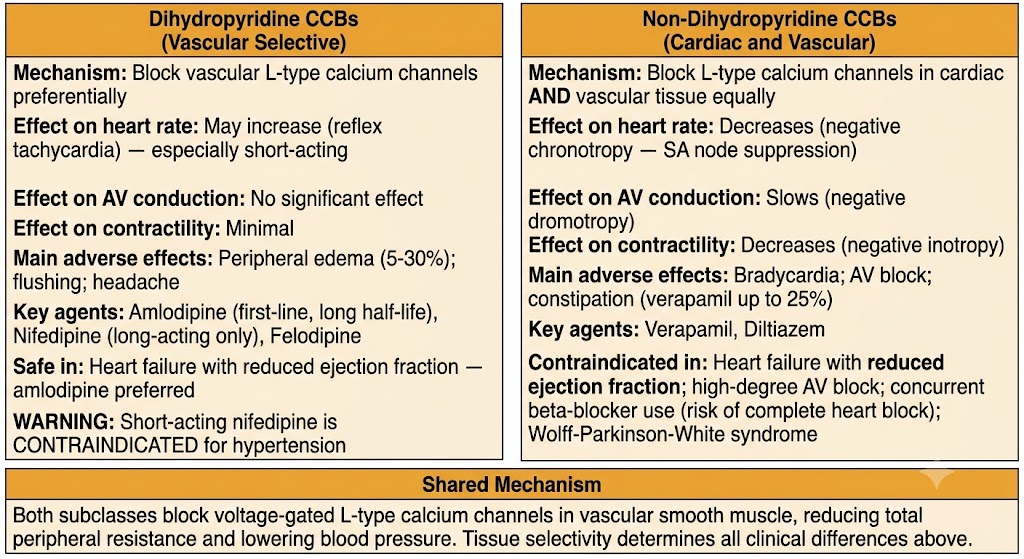
Two-panel comparison of dihydropyridine and non-dihydropyridine calcium channel blockers showing mechanism, heart rate effect, AV conduction, contractility, adverse effects, key agents, and contraindications, with a shared mechanism box below.
Dihydropyridine versus non-dihydropyridine calcium channel blockers: tissue selectivity determines all clinical differences. Source: AI-generated figure (Gemini). Educational use.
Dihydropyridine Calcium Channel Blockers — Vascular Selective

Dihydropyridines bind preferentially to vascular L-type calcium channels and have high vascular-to-cardiac selectivity. They produce potent peripheral and coronary vasodilation with minimal direct cardiac effects at therapeutic doses. The prototype is amlodipine — the most widely used agent, with a very long half-life supporting once-daily dosing, extensive outcome trial evidence (ALLHAT, ACCOMPLISH), and first-line status for hypertension in most patients including elderly and Black patients.

Because dihydropyridines dilate arterioles without a corresponding venous effect, they can trigger reflex sympathetic activation and reflex tachycardia. This is most pronounced with short-acting formulations and substantially reduced with long-acting agents. The same arteriolar-selective vasodilation explains the most common adverse effect of this subclass: peripheral edema from increased capillary hydrostatic pressure in dependent tissues. This edema is not sodium-mediated volume overload — diuretics are largely ineffective against it. Renin-angiotensin-aldosterone system inhibitors are more effective because they cause efferent arteriolar and venous dilation that reduces capillary hydrostatic pressure, which also partly explains why the calcium channel blocker plus renin-angiotensin-aldosterone system inhibitor combination is particularly effective.

Short-Acting Nifedipine — Contraindicated for Hypertension

Immediate-release nifedipine is contraindicated for hypertension management. Abrupt vasodilation produces reflex tachycardia and has been associated with adverse cardiovascular outcomes. Only long-acting formulations (gastrointestinal therapeutic system, extended-release) are appropriate. This distinction does not apply to other dihydropyridines, which are available only as long-acting formulations.

Non-Dihydropyridine Calcium Channel Blockers — Cardiac and Vascular

Non-dihydropyridines — verapamil and diltiazem — have approximately equal effects on vascular smooth muscle and cardiac tissue. Their cardiac actions distinguish them clinically: negative chronotropy (slows heart rate via sinoatrial node suppression), negative dromotropy (slows atrioventricular node conduction), and negative inotropy (reduces myocardial contractility). These properties make them useful for rate control in atrial fibrillation and for angina, but also create important safety constraints.

Verapamil is the more potent cardiac agent of the two. Its most distinctive adverse effect is constipation, occurring in up to 25 percent of patients — a consequence of calcium channel inhibition in intestinal smooth muscle. Both verapamil and diltiazem are metabolized by cytochrome P450 3A4 and inhibit it, raising levels of statins, cyclosporine, digoxin, and other cytochrome P450 3A4 substrates. Diltiazem is preferred over verapamil when rate control in atrial fibrillation coexists with hypertension, as it has a somewhat more favorable adverse effect profile.

Dihydropyridines

Adverse Effects

  • Peripheral edema (5–30%, dose-dependent) — arteriolar dilation increases capillary hydrostatic pressure; not sodium-mediated
  • Reflex tachycardia and flushing — more common with short-acting agents
  • Headache and dizziness from vasodilation
  • No cardiac depression — safe in heart failure with reduced ejection fraction

Non-Dihydropyridines

Adverse Effects & Contraindications

  • Bradycardia (sinoatrial node suppression) and atrioventricular block
  • Reduced myocardial contractility — dangerous in heart failure with reduced ejection fraction
  • Constipation (verapamil — up to 25%)
  • Contraindicated with beta-blockers (risk of complete heart block and asystole)
  • Contraindicated in heart failure with reduced ejection fraction, pre-existing bradycardia or high-degree atrioventricular block, Wolff-Parkinson-White syndrome with atrial fibrillation
Section 2

Diuretics

Thiazides, loop diuretics, and potassium-sparing agents — mechanisms, clinical roles, and metabolic effects

Diuretics were the first drug class proven to reduce cardiovascular mortality in hypertension, and they remain essential both as monotherapy and as partners in combination regimens. The three subclasses — thiazide and thiazide-like, loop, and potassium-sparing — act at different nephron segments and carry distinct metabolic profiles that shape their clinical use.

Thiazide and Thiazide-Like Diuretics — First-Line Agents

Thiazide and thiazide-like diuretics inhibit the sodium-chloride cotransporter in the distal convoluted tubule, producing natriuresis and mild potassium wasting. Their acute blood pressure-lowering effect is from volume depletion, but with chronic use, total peripheral resistance falls through mechanisms that are not fully understood — possibly involving reduced vascular smooth muscle sodium content. Blood pressure reduction is maintained despite normalization of volume over weeks.

A notable pharmacological feature is paradoxical calcium reabsorption enhancement in the distal convoluted tubule — the opposite of loop diuretics. This makes thiazides useful in calcium nephrolithiasis and potentially protective against osteoporotic fractures.

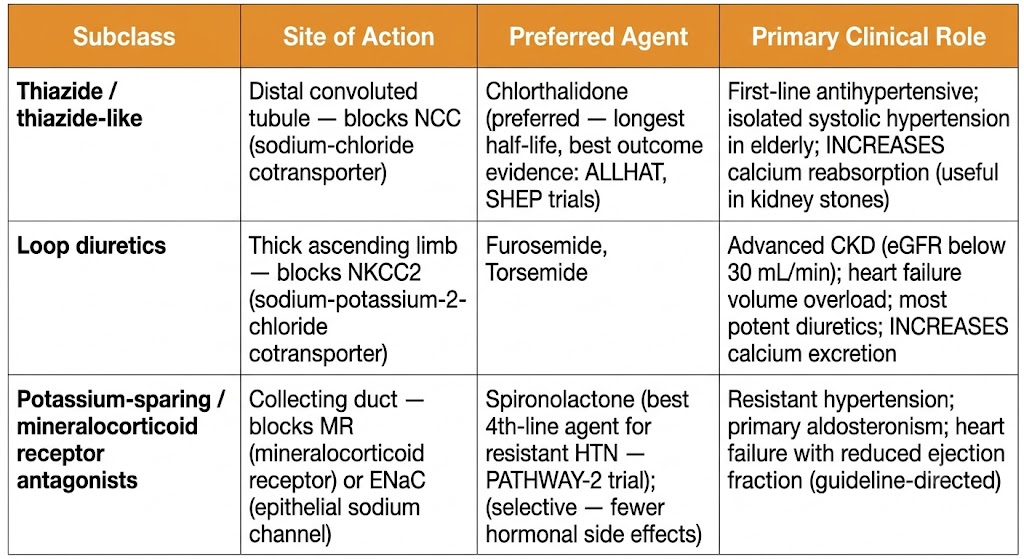
Among the available agents, chlorthalidone is preferred over hydrochlorothiazide. Chlorthalidone has a much longer half-life (40 to 60 hours versus 10 to 12 hours for hydrochlorothiazide), provides superior 24-hour blood pressure control, and has the strongest outcome trial evidence base — including the ALLHAT and Systolic Hypertension in the Elderly Program (SHEP) trials. Current guidelines favor chlorthalidone as the thiazide of choice for hypertension. Indapamide has additional vascular effects beyond sodium-chloride cotransporter inhibition and the most favorable metabolic profile of the three.

Reference table comparing three diuretic subclasses — thiazide, loop, and potassium-sparing — with columns for site of action, preferred agent, and primary clinical role.
Diuretic subclasses: site of action, preferred agents, and primary clinical roles in hypertension management. Source: AI-generated figure (Gemini). Educational use.
Metabolic Adverse Effects of Thiazides

The metabolic consequences of thiazide diuretics are clinically important and require monitoring. Hypokalemia occurs in 10 to 30 percent of patients on standard doses. The mechanism is increased sodium delivery to the collecting duct, which stimulates aldosterone-mediated potassium secretion. Hypomagnesemia co-occurs with hypokalemia — magnesium depletion impairs renal potassium conservation, so correcting magnesium is often necessary to effectively correct potassium.

Hyperuricemia results from reduced uric acid excretion competing with thiazide for tubular secretion and from volume contraction increasing urate reabsorption. Asymptomatic hyperuricemia alone is not a contraindication, but when thiazide therapy coexists with gout, losartan is the preferred renin-angiotensin-aldosterone system inhibitor partner given its uricosuric effect.

Glucose intolerance and new-onset diabetes are dose-dependent, most prominent at hydrochlorothiazide doses above 25 mg per day. The mechanism involves hypokalemia impairing insulin secretion and angiotensin II upregulation reducing insulin sensitivity. Chlorthalidone at 12.5 to 25 mg has a more modest glucose effect. Hyponatremia occurs most often in elderly women through free water retention driven by volume depletion-stimulated antidiuretic hormone release — chlorthalidone carries higher risk than hydrochlorothiazide due to its longer half-life.

Loop Diuretics — For Advanced Renal Impairment and Volume Overload

Loop diuretics inhibit the sodium-potassium-2-chloride cotransporter in the thick ascending limb of the loop of Henle, the nephron segment responsible for reabsorbing approximately 25 percent of filtered sodium. They are the most potent diuretics available. Unlike thiazides, loop diuretics increase urinary calcium excretion.

Loop diuretics are not first-line antihypertensive agents in patients with preserved renal function. Their antihypertensive role is primarily in stage 4 to 5 chronic kidney disease (estimated glomerular filtration rate below approximately 30 mL/min), where thiazide efficacy is markedly reduced, and in volume overload from heart failure. Furosemide has variable oral bioavailability and requires twice-daily dosing. Torsemide has more predictable oral pharmacokinetics and is suitable for once-daily dosing.

Potassium-Sparing Diuretics and Mineralocorticoid Receptor Antagonists

These agents act in the collecting duct to reduce potassium excretion while maintaining modest natriuresis. Spironolactone and eplerenone are competitive mineralocorticoid receptor antagonists that block aldosterone-mediated sodium reabsorption. Their most important antihypertensive role beyond primary aldosteronism is in resistant hypertension — the PATHWAY-2 trial established spironolactone as the most effective fourth-line agent for resistant hypertension, superior to bisoprolol and doxazosin.

Spironolactone is non-selective, also binding progesterone and androgen receptors, causing gynecomastia, breast tenderness, and menstrual irregularities. Eplerenone is selective for the mineralocorticoid receptor and avoids these sex hormone adverse effects, making it preferred in men who develop spironolactone-related sexual or hormonal side effects. Both require potassium monitoring, especially in chronic kidney disease or when combined with renin-angiotensin-aldosterone system inhibitors. Amiloride and triamterene directly block epithelial sodium channels in the collecting duct, independent of aldosterone.


Section 3

Combination Strategies & Special Populations

Evidence-based drug pairings, combinations to avoid, and diuretic selection across clinical contexts

Most patients with hypertension require two or more drugs to reach target blood pressure. The choice of combination is not arbitrary — physiologically synergistic pairings produce greater blood pressure reduction with fewer adverse effects than additive combinations, and some pairings are contraindicated.

Preferred Combinations

The calcium channel blocker plus renin-angiotensin-aldosterone system inhibitor combination is the most evidence-supported dual regimen for high-risk patients. The ACCOMPLISH trial (2008) demonstrated that benazepril plus amlodipine was significantly superior to benazepril plus hydrochlorothiazide in reducing cardiovascular events — a 20 percent relative risk reduction — despite similar blood pressure lowering in both groups. The mechanistic basis is physiological synergy: the calcium channel blocker dilates arterioles, the renin-angiotensin-aldosterone system inhibitor blunts the reactive renin-angiotensin-aldosterone system activation this triggers, and both agents together reduce the peripheral edema that either drug alone can cause.

The renin-angiotensin-aldosterone system inhibitor plus thiazide combination is also well-established: the diuretic activates the renin-angiotensin-aldosterone system through volume depletion, which amplifies renin-angiotensin-aldosterone system inhibitor efficacy, while the renin-angiotensin-aldosterone system inhibitor blunts the diuretic-induced hypokalemia and metabolic activation. This combination is particularly appropriate when fluid retention is a clinical concern. Triple therapy — calcium channel blocker, renin-angiotensin-aldosterone system inhibitor, and thiazide diuretic — simultaneously targets all major blood pressure-regulating pathways and is the standard of care for hypertension uncontrolled on dual therapy.

Combinations to Avoid

Non-dihydropyridine calcium channel blocker plus beta-blocker: both suppress sinoatrial and atrioventricular nodal conduction — risk of severe bradycardia, complete heart block, and asystole. This combination is contraindicated.

Dual renin-angiotensin-aldosterone system blockade (angiotensin converting enzyme inhibitor plus angiotensin receptor blocker): ONTARGET and VA NEPHRON-D demonstrated no benefit and significantly more acute kidney injury and hyperkalemia. Do not combine.

Thiazide plus loop diuretic: causes excessive natriuresis and volume depletion; appropriate only in severe diuretic-resistant states under specialist supervision.

Diuretic Selection in Special Populations

Chronic Kidney Disease

eGFR Above 30 vs Below 30

  • Estimated glomerular filtration rate 30–60 mL/min: thiazides retain partial efficacy; chlorthalidone and indapamide preferred over hydrochlorothiazide
  • Estimated glomerular filtration rate below 30 mL/min: loop diuretics required as primary diuretic; thiazide efficacy markedly reduced
  • Potassium-sparing agents require caution — hyperkalemia risk amplified by reduced renal potassium excretion

Heart Failure

Volume Overload & Guideline-Directed Therapy

  • Loop diuretics for symptomatic volume overload
  • Spironolactone or eplerenone are guideline-directed medical therapy in heart failure with reduced ejection fraction (EMPHASIS-HF trial: eplerenone reduced mortality and hospitalizations by 37%)
  • Thiazides generally avoided in moderate-to-severe heart failure
  • Non-dihydropyridine calcium channel blockers contraindicated in heart failure with reduced ejection fraction

Elderly Patients

Isolated Systolic Hypertension

  • Thiazide and thiazide-like diuretics highly effective and preferred for isolated systolic hypertension (SHEP and HYVET trials)
  • Long-acting dihydropyridine calcium channel blockers also highly effective
  • Higher risk of hyponatremia, orthostatic hypotension, and electrolyte disturbance — start at lowest effective dose
  • Falls risk from orthostatic hypotension requires consideration in overall management

Diabetes Mellitus

Low-Dose Thiazides Acceptable

  • Thiazides at low doses are acceptable: hydrochlorothiazide 12.5–25 mg and chlorthalidone 12.5 mg have modest glucose effects
  • Preferred primary combination: renin-angiotensin-aldosterone system inhibitor plus calcium channel blocker; thiazide added for additional blood pressure control
  • Indapamide has the most favorable metabolic profile among thiazide-like agents in diabetes
  • Higher thiazide doses increase glucose intolerance risk

Suggested References
Author / OrganizationTitleSource
Whelton PK, Carey RM, Aronow WS, et al.2017 ACC/AHA guideline for the prevention, detection, evaluation, and management of high blood pressure in adultsJ Am Coll Cardiol. 2018;71(19):e127–e248
Mancia G, Kreutz R, Brunstrom M, et al.2023 ESH guidelines for the management of arterial hypertensionJ Hypertens. 2023;41(12):1874–2071
Opie LH, Schall ROld antihypertensives and new diabetesJ Hypertens. 2004;22(8):1453–1458
ALLHAT Officers and CoordinatorsMajor outcomes in high-risk hypertensive patients randomized to angiotensin-converting enzyme inhibitor or calcium channel blocker vs diuretic (ALLHAT)JAMA. 2002;288(23):2981–2997
Jamerson K, Weber MA, Bakris GL, et al.Benazepril plus amlodipine or hydrochlorothiazide for hypertension in high-risk patients (ACCOMPLISH)N Engl J Med. 2008;359(23):2417–2428
Nissen SE, Tuzcu EM, Libby P, et al.Effect of antihypertensive agents on cardiovascular events in patients with coronary disease and normal blood pressure (CAMELOT)JAMA. 2004;292(18):2217–2225
Staessen JA, Fagard R, Thijs L, et al.Randomised double-blind comparison of placebo and active treatment for older patients with isolated systolic hypertension (Syst-Eur)Lancet. 1997;350(9080):757–764
Ernst ME, Moser MUse of diuretics in patients with hypertensionN Engl J Med. 2009;361(22):2153–2164
SHEP Cooperative Research GroupPrevention of stroke by antihypertensive drug treatment in older persons with isolated systolic hypertension (SHEP)JAMA. 1991;265(24):3255–3264
PROGRESS Collaborative GroupRandomised trial of a perindopril-based blood-pressure-lowering regimen among 6105 individuals with previous stroke or transient ischaemic attack (PROGRESS)Lancet. 2001;358(9287):1033–1041
Beckett NS, Peters R, Fletcher AE, et al.Treatment of hypertension in patients 80 years of age or older (HYVET)N Engl J Med. 2008;358(18):1887–1898
Williams B, MacDonald TM, Morant S, et al.Spironolactone versus placebo, bisoprolol, and doxazosin to determine the optimal treatment for drug-resistant hypertension (PATHWAY-2)Lancet. 2015;386(10008):2059–2068
Zannad F, McMurray JJ, Krum H, et al.Eplerenone in patients with systolic heart failure and mild symptoms (EMPHASIS-HF)N Engl J Med. 2011;364(1):11–21
Bakris GL, Agarwal R, Anker SD, et al.Effect of finerenone on chronic kidney disease outcomes in type 2 diabetes (FIDELIO-DKD)N Engl J Med. 2020;383(23):2219–2229
Carey RM, Calhoun DA, Bakris GL, et al.Resistant hypertension: detection, evaluation, and management — a scientific statement from the American Heart AssociationHypertension. 2018;72(5):e53–e90