Introduction to Medical Pharmacology
Module 5 — Beta-Blockers, Alpha-Blockers, Centrally Acting Agents & Direct Vasodilators
AHTN · Module 5 of 11Section 1
Mechanism, cardioselectivity, compelling indications, adverse effects, and contraindications
Beta-blockers are not first-line monotherapy for uncomplicated hypertension, but they are essential — and sometimes life-saving — when a compelling indication drives drug selection. The most important concept in this class is the distinction between cardioselective and non-selective agents, which determines the adverse effect profile in patients with asthma, diabetes, and peripheral arterial disease.
Beta-blockers competitively antagonize catecholamines at beta-adrenoceptors. The acute antihypertensive effect is reduction in heart rate and myocardial contractility, lowering cardiac output. With chronic use, additional mechanisms contribute: suppression of renin release from juxtaglomerular cells (reducing angiotensin II and aldosterone), and with lipophilic agents, reduced central sympathetic outflow through central nervous system beta-receptor blockade.
The receptor distribution determines the clinical consequences of blockade. Beta-1 receptors are located in the heart and kidney. Beta-2 receptors are in bronchial smooth muscle, vascular smooth muscle, pancreatic beta cells, and skeletal muscle. Cardioselective agents — metoprolol, bisoprolol, atenolol, nebivolol — preferentially block beta-1 receptors at therapeutic doses. Selectivity is relative, not absolute, and diminishes at higher doses. Non-selective agents — propranolol, nadolol, carvedilol — block both beta-1 and beta-2, producing bronchoconstriction, peripheral vasoconstriction, and greater metabolic effects.
Beta-blockers are generally not recommended as first-line monotherapy for uncomplicated hypertension. The ASCOT-BPLA trial demonstrated inferior stroke prevention with atenolol-based therapy compared to amlodipine plus perindopril despite equivalent blood pressure reduction. They are also less effective in older patients and Black patients, who more often have low-renin hypertension where renin-suppressing mechanisms provide less antihypertensive benefit.
Beta-blockers are the preferred or necessary choice when a specific comorbidity is present: heart failure with reduced ejection fraction (carvedilol, metoprolol succinate, bisoprolol — each with proven mortality benefit as guideline-directed medical therapy); post-myocardial infarction; stable angina or acute coronary syndrome; rate control in atrial fibrillation; acute aortic dissection (target heart rate below 60 beats per minute); and hypertension concurrent with migraine prophylaxis or essential tremor.
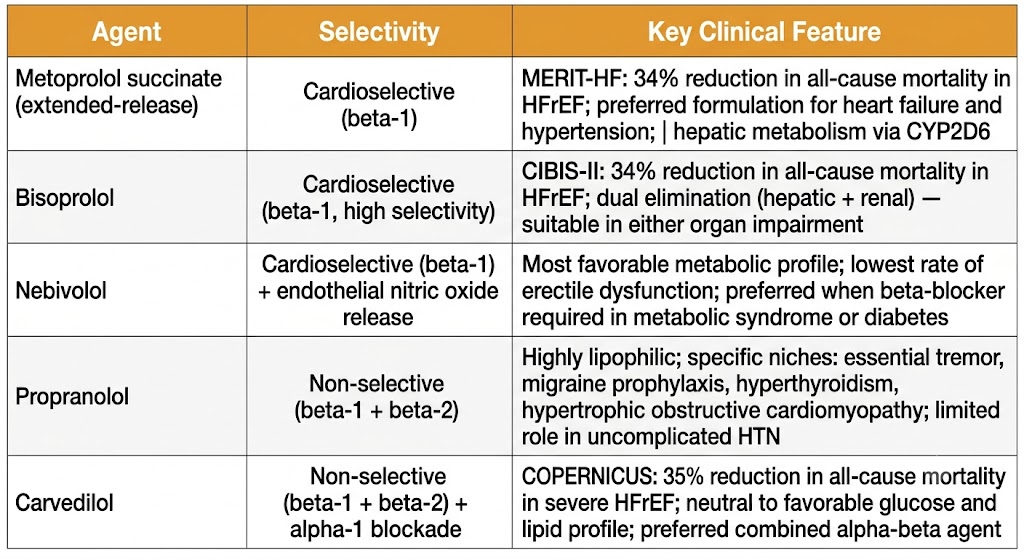
Metoprolol succinate (extended-release) is the preferred formulation for heart failure with reduced ejection fraction and hypertension — the MERIT-HF trial demonstrated 34 percent reduction in all-cause mortality. Bisoprolol has high cardioselectivity and dual elimination (hepatic and renal), making it suitable when either organ is impaired. Atenolol is renally eliminated and was found inferior to losartan in the LIFE trial for cardiovascular event reduction and left ventricular hypertrophy regression — its use in uncomplicated hypertension without other indications is generally not preferred. Nebivolol combines beta-1 blockade with endothelial nitric oxide release, producing vasodilation and the most favorable metabolic profile of the class — preferred when a beta-blocker is needed in metabolic syndrome or diabetes. Propranolol is non-selective and highly lipophilic, with specific niches in essential tremor, migraine prophylaxis, hyperthyroidism, and hypertrophic obstructive cardiomyopathy.
Beta-2 blockade in pancreatic beta cells impairs insulin secretion and in skeletal muscle impairs glycogenolysis. Most hypoglycemia warning symptoms (tremor, tachycardia, palpitations) are adrenergically mediated and may be masked — diaphoresis is the exception, being cholinergically mediated and preserved. Cardioselective agents cause less metabolic impairment than non-selective agents; nebivolol has the most favorable glucose and lipid profile.
Non-selective agents raise triglycerides and lower high-density lipoprotein through reduced lipoprotein lipase activity. Carvedilol and nebivolol have neutral to favorable lipid profiles. Bronchoconstriction from beta-2 blockade is most pronounced with non-selective agents — cardioselective agents are relatively safer in mild to moderate reactive airway disease but should not be considered safe in severe asthma. Erectile dysfunction, fatigue, exercise intolerance, and — with lipophilic agents — sleep disturbance and vivid dreams are additional class effects. Abrupt withdrawal may precipitate rebound hypertension, tachycardia, or angina in patients with coronary artery disease — taper over one to two weeks when discontinuing.
Section 2
Mechanism, the ALLHAT lesson, labetalol and carvedilol in heart failure and emergencies
Alpha-1 adrenoceptor blockers produce vasodilation by blocking norepinephrine at postsynaptic alpha-1 receptors in vascular smooth muscle. Their antihypertensive role is primarily as add-on agents in resistant hypertension — the ALLHAT trial established they should not be used as monotherapy. Combined alpha/beta-blockers add vasodilation to beta-blockade, making them valuable in heart failure and hypertensive emergencies.
Selective alpha-1 blockers — doxazosin, prazosin, terazosin — competitively block postsynaptic alpha-1 receptors in arteriolar and venous smooth muscle, reducing total peripheral resistance and preload. First-dose hypotension is the most clinically significant adverse effect, resulting from rapid venodilation in a vascular system accustomed to elevated sympathetic tone. The risk is greatest 30 to 90 minutes after the first dose, particularly in volume-depleted patients. Starting at the lowest available dose and administering at bedtime reduces this risk.
The ALLHAT trial terminated its doxazosin arm early after finding 25 percent more cardiovascular events and approximately double the rate of heart failure compared to chlorthalidone as monotherapy. This definitively removed alpha-1 blockers from first- and second-line antihypertensive roles. Their current use is as add-on agents in resistant hypertension, and in men with concurrent benign prostatic hyperplasia — alpha-1 blockade at the bladder neck and prostatic smooth muscle improves urinary flow while simultaneously lowering blood pressure.
Phenoxybenzamine is a non-selective, irreversible alpha blocker used for preoperative preparation before pheochromocytoma surgery — started 10 to 14 days before the operation to protect against intraoperative catecholamine surges. Phentolamine is a non-selective alpha blocker given intravenously for pheochromocytoma hypertensive crises and cocaine-associated hypertension.
Carvedilol provides non-selective beta blockade combined with alpha-1 blockade. The net hemodynamic effect is reduction in cardiac output from beta-blockade alongside reduced total peripheral resistance from alpha-1 vasodilation — producing blood pressure reduction with less reflex tachycardia than pure vasodilators and less increase in peripheral resistance than pure beta-blockers. The COPERNICUS trial demonstrated 35 percent reduction in all-cause mortality in severe heart failure with reduced ejection fraction. Carvedilol has a neutral to favorable glucose and lipid profile, making it the preferred combined agent when metabolic syndrome or diabetes coexists.
Labetalol provides non-selective beta blockade combined with alpha-1 blockade, with a higher alpha-to-beta potency ratio intravenously than orally. It lowers blood pressure while maintaining cerebral and uteroplacental perfusion, making it the preferred intravenous agent for hypertensive emergencies in pregnancy and in neurological emergencies. Oral labetalol is one of three first-line antihypertensive agents in pregnancy alongside long-acting nifedipine and methyldopa, with an established safety record across all trimesters. No dose adjustment is required for renal impairment.
Three Situations Where Standard Instincts Cause Harm
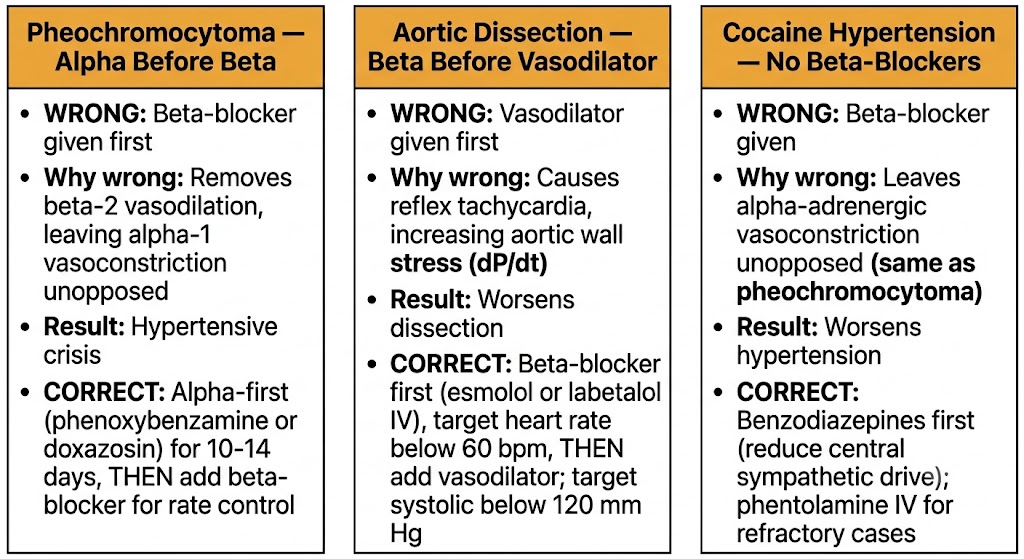
Pheochromocytoma: beta-blocker given before alpha-blocker removes vasodilatory beta-2 tone, leaving alpha-mediated vasoconstriction unopposed — potentially precipitating hypertensive crisis. Always establish alpha-blockade first.
Aortic dissection: vasodilator given without prior beta-blockade causes reflex tachycardia that increases aortic wall stress (dP/dt). The beta-blocker must come first — target heart rate below 60 beats per minute before adding a vasodilator.
Cocaine-associated hypertension: beta-blockers leave alpha-adrenergic vasoconstriction unopposed — same mechanism as pheochromocytoma. Use benzodiazepines first; phentolamine for refractory cases.
Section 3
Clonidine and methyldopa — mechanisms, clinical roles, and critical safety warnings
Centrally acting agents reduce blood pressure by decreasing central sympathetic outflow. They occupy specific clinical niches — clonidine for resistant hypertension and opioid withdrawal; methyldopa as the most extensively studied antihypertensive agent in pregnancy. Both carry important safety considerations that distinguish them from other drug classes.
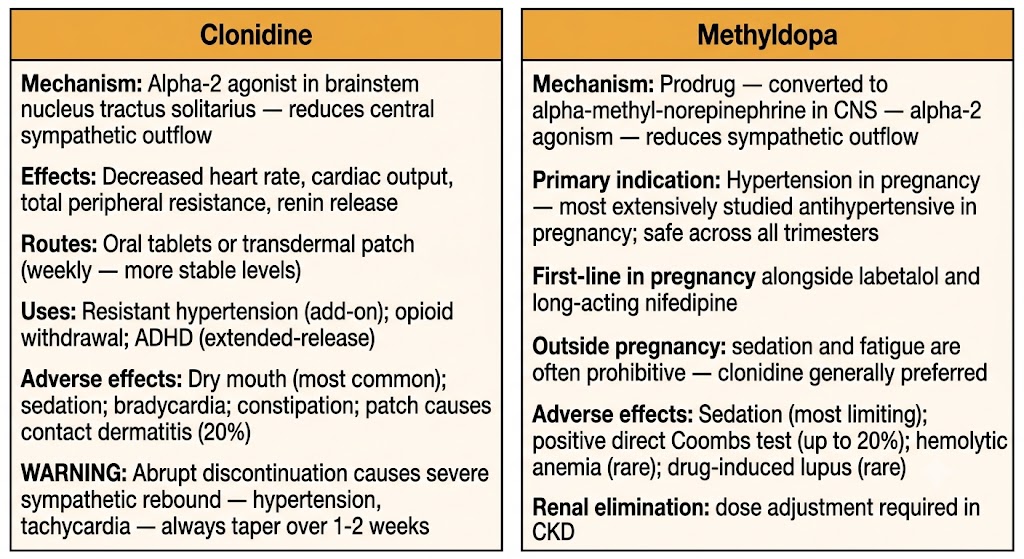
Clonidine stimulates presynaptic alpha-2 adrenoceptors in the brainstem nucleus tractus solitarius, reducing central sympathetic outflow. The net effects are reduced norepinephrine release from sympathetic terminals, decreased heart rate and cardiac output, reduced total peripheral resistance, and suppressed renin release. The transdermal patch provides more stable plasma levels than twice-daily oral dosing and is useful in patients with adherence difficulties.
Clinical applications include resistant hypertension as an add-on agent, opioid withdrawal (where it reduces adrenergically mediated symptoms including tachycardia, diaphoresis, and agitation), attention deficit hyperactivity disorder in extended-release formulation, and menopausal hot flashes off-label. The most common adverse effects are dry mouth, sedation, bradycardia, and constipation. Contact dermatitis occurs in up to 20 percent of patients using the transdermal patch.
Clonidine Withdrawal — Potentially Life-Threatening
Abrupt discontinuation of clonidine may precipitate severe sympathetic rebound: hypertension, tachycardia, diaphoresis, and anxiety. The mechanism is upregulation of alpha-2 receptors during chronic therapy — when the drug is withdrawn suddenly, uninhibited catecholamine release follows from sensitized, now unoccupied receptors. Clonidine should always be tapered over one to two weeks. It should be used with caution in patients with poor medication adherence. If withdrawal occurs: restart clonidine immediately by oral or transdermal route.
Methyldopa is a prodrug converted in the central nervous system to alpha-methyl-norepinephrine, a potent alpha-2 agonist that reduces central sympathetic outflow by the same mechanism as clonidine. Its primary clinical indication is hypertension in pregnancy. Methyldopa has the most extensively studied safety record of any antihypertensive in pregnancy, with decades of data across all trimesters. It crosses the placenta but has not been associated with fetal harm at therapeutic doses. It is a first-line option alongside labetalol and long-acting nifedipine.
Outside of pregnancy, the adverse effect profile substantially limits its use. Sedation and fatigue are often prohibitive. A positive direct Coombs test occurs in up to 20 percent of patients on long-term therapy; clinically significant hemolytic anemia is uncommon. Drug-induced lupus and hepatotoxicity are rare. Where a centrally acting agent is needed in non-pregnant patients, clonidine is generally preferred.
Section 4
Hydralazine, minoxidil, sodium nitroprusside, and parenteral agent selection by target organ
Direct vasodilators act directly on arteriolar smooth muscle, producing potent blood pressure reduction with predictable reflex responses that require companion drugs. Parenteral agents for hypertensive emergencies are selected based on which organ system is injured — there is no single universal first-line agent.
Hydralazine directly relaxes arteriolar smooth muscle through poorly characterized mechanisms involving potassium channel activation and antioxidant effects. The resulting vasodilation triggers reflex sympathetic activation — tachycardia, increased cardiac output — and secondary renin-angiotensin-aldosterone system activation causing sodium and water retention. These reflex responses generally require co-administration of a beta-blocker and a diuretic when hydralazine is used chronically. Hepatic acetylation via the NAT2 enzyme substantially influences pharmacokinetics: slow acetylators have higher plasma levels and greater risk of drug-induced lupus; fast acetylators may require higher doses.
Clinical indications include acute severe hypertension in pregnancy (intravenous, as an alternative to labetalol and nifedipine), heart failure with reduced ejection fraction in patients who cannot tolerate renin-angiotensin-aldosterone system inhibitors (the A-HeFT trial demonstrated benefit with hydralazine plus isosorbide dinitrate in Black patients with heart failure with reduced ejection fraction on standard therapy), and as an oral add-on in resistant hypertension. Drug-induced lupus occurs in approximately 5 to 10 percent of patients on long-term therapy, more common in slow acetylators and at doses above 200 mg per day — presents with arthralgias, rash, serositis, and positive antinuclear antibody with anti-histone antibodies; resolves on discontinuation.
Minoxidil is a prodrug converted to minoxidil sulfate, which activates adenosine triphosphate-sensitive potassium channels in vascular smooth muscle. Channel opening causes membrane hyperpolarization, preventing voltage-gated calcium channel activation and producing profound arteriolar vasodilation — one of the most potent oral antihypertensive agents available. Reflex responses are marked: severe tachycardia and sodium and water retention with weight gains of 2 to 10 kilograms are expected.
Minoxidil — Mandatory Combination Rule
Minoxidil requires concurrent administration of both a beta-blocker (to counter reflex tachycardia) and a loop diuretic (to manage fluid retention — thiazides are insufficient). Prescribing minoxidil without these companion agents risks severe tachycardia, fluid overload, and in patients with ischemic disease, angina from increased cardiac workload. Minoxidil is reserved for severe, treatment-resistant hypertension unresponsive to multiple agents. Hypertrichosis — diffuse hair growth on the face, arms, and back — occurs in most patients and led to the development of topical minoxidil for hair loss.
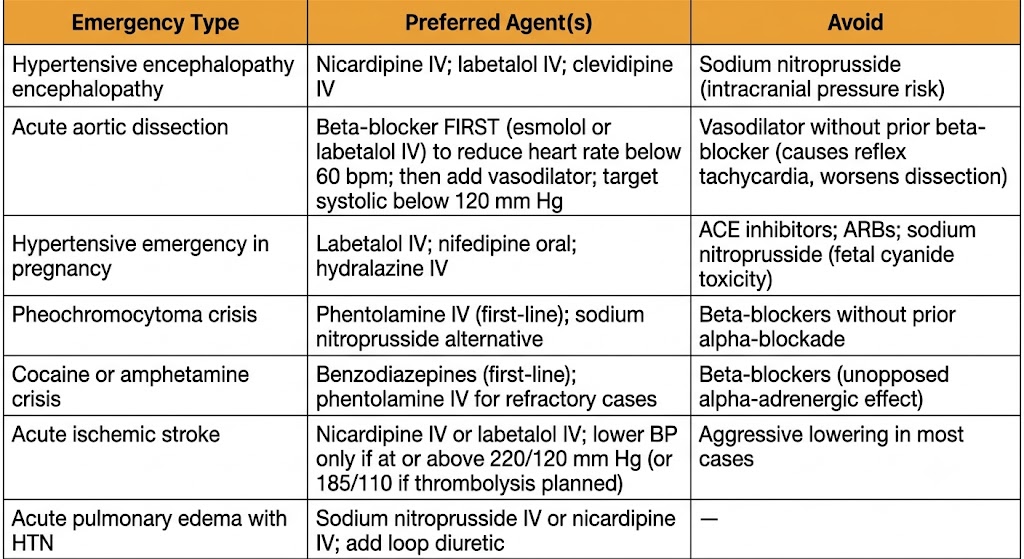
A hypertensive emergency is defined as severely elevated blood pressure — typically above 180/120 millimeters of mercury — with evidence of acute target organ damage. The appropriate parenteral agent depends on which organ system is involved. Nicardipine intravenous and labetalol intravenous are the most broadly applicable agents across emergency types. Sodium nitroprusside releases nitric oxide spontaneously, producing rapid, titratable, balanced arteriolar and venodilation — but carries risk of cyanide toxicity with prolonged infusion above 48 hours or high doses, and has been largely replaced by nicardipine or labetalol for most emergencies.
| Emergency Type | Preferred Agent(s) | Agents to Avoid |
|---|---|---|
| Hypertensive encephalopathy | Nicardipine intravenous; labetalol intravenous; clevidipine intravenous | Sodium nitroprusside (intracranial pressure risk) |
| Acute ischemic stroke | Nicardipine intravenous; labetalol intravenous — lower only if blood pressure at or above 220/120 (or above 185/110 if thrombolysis planned) | Aggressive lowering in most cases |
| Acute aortic dissection | Beta-blocker first (esmolol or labetalol intravenous) to reduce heart rate and dP/dt; add vasodilator only after heart rate controlled. Target heart rate below 60; systolic below 120 | Vasodilator without prior beta-blockade (causes reflex tachycardia, increasing aortic wall stress) |
| Hypertensive emergency in pregnancy | Labetalol intravenous; nifedipine oral; hydralazine intravenous | Angiotensin converting enzyme inhibitors, angiotensin receptor blockers, sodium nitroprusside (fetal cyanide toxicity) |
| Pheochromocytoma crisis | Phentolamine intravenous (first-line); sodium nitroprusside as alternative | Beta-blockers without prior alpha-blockade (unopposed alpha vasoconstriction) |
| Cocaine/amphetamine crisis | Benzodiazepines (first-line); phentolamine intravenous for refractory hypertension | Beta-blockers (unopposed alpha-adrenergic effect) |
| Acute pulmonary edema with hypertension | Sodium nitroprusside intravenous or nicardipine intravenous; concurrent loop diuretics | — |
| Author / Organization | Title | Source |
|---|---|---|
| Whelton PK, Carey RM, Aronow WS, et al. | 2017 ACC/AHA guideline for the prevention, detection, evaluation, and management of high blood pressure in adults | J Am Coll Cardiol. 2018;71(19):e127–e248 |
| Mancia G, Kreutz R, Brunstrom M, et al. | 2023 ESH guidelines for the management of arterial hypertension | J Hypertens. 2023;41(12):1874–2071 |
| Frishman WH | Beta-adrenergic blockers: a 50-year historical perspective | Am J Ther. 2008;15(6):565–576 |
| MERIT-HF Study Group | Effect of metoprolol CR/XL in chronic heart failure: MERIT-HF | Lancet. 1999;353(9169):2001–2007 |
| Dahlof B, Devereux RB, Kjeldsen SE, et al. | Cardiovascular morbidity and mortality in the Losartan Intervention For Endpoint reduction in hypertension study (LIFE) | Lancet. 2002;359(9311):995–1003 |
| CIBIS-II Investigators and Committees | The Cardiac Insufficiency Bisoprolol Study II (CIBIS-II): a randomised trial | Lancet. 1999;353(9146):9–13 |
| Packer M, Coats AJ, Fowler MB, et al. | Effect of carvedilol on survival in severe chronic heart failure (COPERNICUS) | N Engl J Med. 2001;344(22):1651–1658 |
| Dahlof B, Sever PS, Poulter NR, et al. | Prevention of cardiovascular events with an antihypertensive regimen of amlodipine adding perindopril vs atenolol adding bendroflumethiazide (ASCOT-BPLA) | Lancet. 2005;366(9489):895–906 |
| Packer M, Bristow MR, Cohn JN, et al. | The effect of carvedilol on morbidity and mortality in patients with chronic heart failure | N Engl J Med. 1996;334(21):1349–1355 |
| ALLHAT Collaborative Research Group | Major cardiovascular events in hypertensive patients randomized to doxazosin vs chlorthalidone (ALLHAT) | JAMA. 2000;283(15):1967–1975 |
| Taylor AL, Ziesche S, Yancy C, et al. | Combination of isosorbide dinitrate and hydralazine in Blacks with heart failure (A-HeFT) | N Engl J Med. 2004;351(20):2049–2057 |
| Varon J, Marik PE | The diagnosis and management of hypertensive crises | Chest. 2000;118(1):214–227 |
| Williams B, MacDonald TM, Morant S, et al. | Spironolactone versus placebo, bisoprolol, and doxazosin to determine the optimal treatment for drug-resistant hypertension (PATHWAY-2) | Lancet. 2015;386(10008):2059–2068 |
| Calhoun DA, Jones D, Textor S, et al. | Resistant hypertension: diagnosis, evaluation, and treatment | Hypertension. 2008;51(6):1403–1419 |
| Carey RM, Calhoun DA, Bakris GL, et al. | Resistant hypertension: detection, evaluation, and management | Hypertension. 2018;72(5):e53–e90 |
| ALLHAT Officers and Coordinators | Major outcomes in high-risk hypertensive patients randomized to ACE inhibitor or calcium channel blocker vs diuretic (ALLHAT) | JAMA. 2002;288(23):2981–2997 |