Introduction to Medical Pharmacology
Module 7 — Hypertension in Chronic Kidney Disease
AHTN · Module 7 of 11Section 1
The bidirectional cycle and the intraglomerular pressure axis that drives progressive nephron loss
Hypertension and chronic kidney disease exist in a bidirectional, self-amplifying relationship. Hypertension causes chronic kidney disease through hypertensive nephrosclerosis, and chronic kidney disease perpetuates hypertension through sodium retention, renin-angiotensin-aldosterone system activation, and sympathetic stimulation. Approximately 80 to 85 percent of patients with chronic kidney disease have hypertension, and hypertension is the second leading cause of end-stage renal disease in the United States after diabetes. Drug selection in this population has measurable effects on the trajectory of renal function over years to decades — making it one of the most consequential pharmacological decisions in clinical medicine.
As nephron mass is lost, the surviving nephrons must compensate by increasing their individual filtration burden. This adaptation preserves sodium balance initially but resets the pressure-natriuresis curve to a higher operating point — the kidney now defends a higher blood pressure. Volume-dependent hypertension predominates in advanced chronic kidney disease as reduced nephron mass decreases total natriuretic capacity. Renin-angiotensin-aldosterone system activation occurs when ischemic nephrons release renin inappropriately even in volume-expanded states, sustaining angiotensin II-driven vasoconstriction, aldosterone release, and further sodium retention. Renal nerve activation increases efferent sympathetic outflow, raising cardiac output and peripheral resistance while further stimulating renin release. The result is a self-amplifying cycle in which kidney damage worsens hypertension, which damages kidneys further.
Intraglomerular hypertension — elevated pressure within the glomerular capillaries — is the critical mediator of progressive nephron loss. Even when systemic blood pressure is controlled, intraglomerular pressure may remain elevated because surviving nephrons hyperfiltrate to compensate for reduced nephron mass, and angiotensin II preferentially constricts the efferent arteriole, increasing intraglomerular hydrostatic pressure.
Elevated intraglomerular pressure drives proteinuria, which is itself nephrotoxic: filtered proteins activate tubular cells promoting inflammation and fibrosis; albumin carries fatty acids toxic to proximal tubular cells; and complement activation within tubular fluid drives interstitial injury. This creates a pressure-proteinuria-fibrosis cycle in which intraglomerular hypertension causes proteinuria, which causes tubular injury and fibrosis, which causes further nephron loss and worsens hypertension. Pharmacological intervention that specifically reduces intraglomerular pressure — renin-angiotensin-aldosterone system inhibition — interrupts this cycle more effectively than equivalent blood pressure reduction by non-renin-angiotensin-aldosterone system agents.
Section 2
Mechanism of renoprotection beyond blood pressure lowering, landmark trial evidence, and monitoring requirements
Angiotensin converting enzyme inhibitors and angiotensin receptor blockers are the cornerstone of antihypertensive therapy in chronic kidney disease with proteinuria. Their benefit extends substantially beyond blood pressure lowering — they reduce intraglomerular pressure, decrease proteinuria, and inhibit fibrotic pathways through mechanisms that operate independently of their systemic antihypertensive effect.
Angiotensin II preferentially constricts the efferent arteriole relative to the afferent arteriole, maintaining intraglomerular hydrostatic pressure. Renin-angiotensin-aldosterone system inhibition dilates the efferent arteriole, reducing intraglomerular pressure — which directly decreases proteinuria and slows glomerulosclerosis. This is the primary renoprotective mechanism and explains why a rise in serum creatinine after starting these drugs (reflecting reduced glomerular filtration from lower intraglomerular pressure) is expected and associated with long-term protection, not harm.
Beyond reducing intraglomerular pressure, renin-angiotensin-aldosterone system inhibitors reduce the permeability of the glomerular filtration barrier. Angiotensin II also stimulates transforming growth factor beta, a key driver of glomerular and interstitial fibrosis — renin-angiotensin-aldosterone system inhibition reduces this fibrotic signaling. A fall in proteinuria of more than 30 percent from baseline following renin-angiotensin-aldosterone system inhibitor initiation predicts long-term renoprotection and should be confirmed at three months.
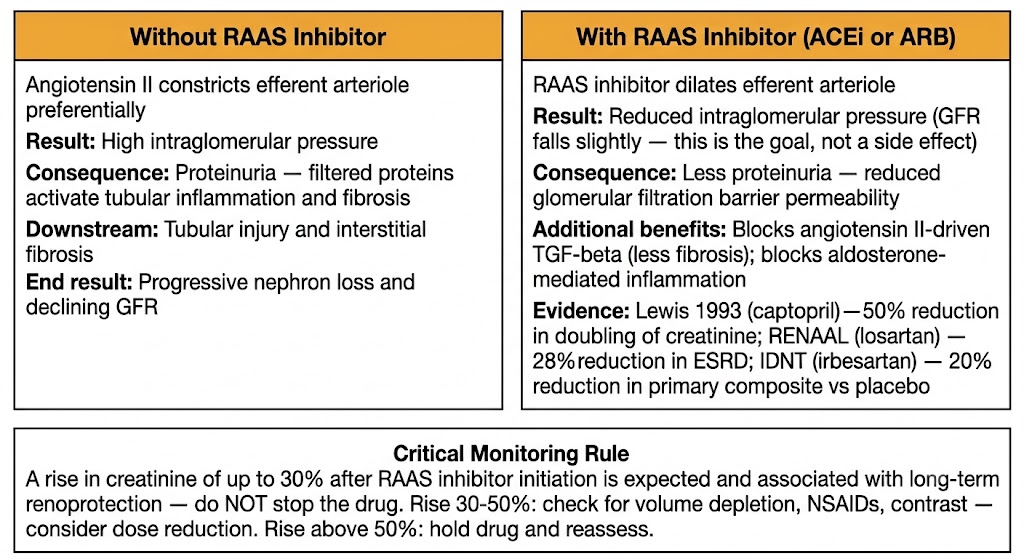
In type 1 diabetic nephropathy, Lewis et al. (1993) showed that captopril reduced the risk of doubling of serum creatinine by 50 percent and the combined endpoint of death, dialysis, or transplantation by 50 percent, independent of blood pressure effects — establishing angiotensin converting enzyme inhibitors as the standard of care for this indication.
In type 2 diabetic nephropathy, the RENAAL trial (2001) showed losartan reduced end-stage renal disease by 28 percent, and the Irbesartan Diabetic Nephropathy Trial (2001) showed irbesartan reduced the primary renal composite endpoint by 20 percent versus placebo and 23 percent versus amlodipine — confirming renoprotection independent of blood pressure reduction. In non-diabetic chronic kidney disease, the REIN trial showed ramipril significantly reduced the rate of glomerular filtration rate decline and the risk of reaching end-stage renal disease, with effects greatest in those with the highest baseline proteinuria.
Kidney Disease: Improving Global Outcomes 2021 guidelines now recommend angiotensin converting enzyme inhibitors or angiotensin receptor blockers as first-line antihypertensive therapy for all patients with chronic kidney disease and albuminuria above 30 mg/g. Routine combination of angiotensin converting enzyme inhibitor plus angiotensin receptor blocker (dual renin-angiotensin-aldosterone system blockade) is not recommended — the VA NEPHRON-D trial showed excess acute kidney injury and hyperkalemia with no renal benefit.
The Acceptable Creatinine Rise — A Critical Monitoring Concept
A rise in serum creatinine of up to 30 percent following renin-angiotensin-aldosterone system inhibitor initiation is expected, acceptable, and associated with long-term renoprotection. This rise reflects the intended reduction in intraglomerular pressure — the reduced glomerular filtration rate is the pharmacological goal, not an adverse effect. Check creatinine, estimated glomerular filtration rate, and potassium 2 to 4 weeks after initiation. A rise of 30 to 50 percent: reassess for volume depletion, nonsteroidal anti-inflammatory drugs, or contrast exposure; consider dose reduction. A rise above 50 percent: hold the drug, reassess, restart at lower dose when stable. Potassium above 5.5 mEq/L: dose reduction or discontinuation. Patients should receive sick-day guidance to hold renin-angiotensin-aldosterone system inhibitors and diuretics during acute illness with significant volume depletion.
Section 3
Stage-specific prescribing from early chronic kidney disease through end-stage renal disease
Drug selection in chronic kidney disease is not static — it shifts as estimated glomerular filtration rate falls. The key transitions are the progressive loss of thiazide efficacy below estimated glomerular filtration rate 45 to 30 mL/min, the preference shift to loop diuretics below estimated glomerular filtration rate 30, and the increasingly careful potassium management required as renal clearance declines.
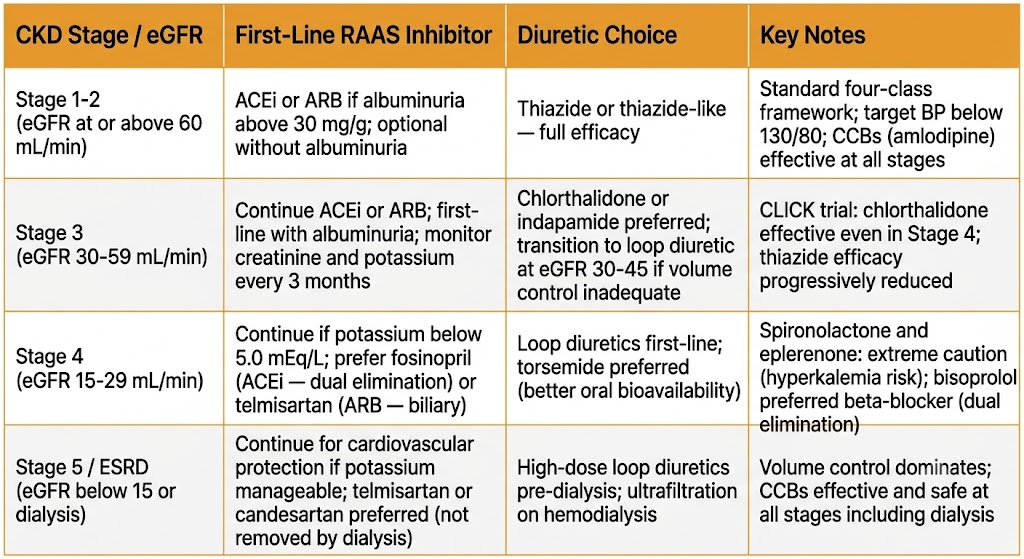
Renal function is preserved or mildly reduced. When albuminuria is above 30 mg per g, the first-line agent is an angiotensin converting enzyme inhibitor or angiotensin receptor blocker for renoprotection, with a calcium channel blocker (amlodipine) or thiazide-like diuretic added for additional blood pressure control. Without albuminuria, the standard four-class framework applies. Target blood pressure is below 130/80 millimeters of mercury.
This is the most clinically important stage for pharmacological decision-making. Renin-angiotensin-aldosterone system inhibitors remain first-line with albuminuria and should be continued if already initiated. Calcium channel blockers, particularly amlodipine, are highly effective with no dose adjustment and no adverse renal effects across all stages. Thiazide and thiazide-like diuretics retain partial but progressively reduced efficacy — chlorthalidone and indapamide retain better efficacy at lower estimated glomerular filtration rates than hydrochlorothiazide. The CLICK trial (2021) demonstrated that chlorthalidone reduced 24-hour ambulatory systolic blood pressure by 11 millimeters of mercury versus placebo even in Stage 4 chronic kidney disease on background renin-angiotensin-aldosterone system inhibitor therapy. At estimated glomerular filtration rate 30 to 45 mL/min (Stage 3b), thiazide efficacy is substantially reduced — adding or transitioning to a loop diuretic should be considered when volume control is inadequate.
Loop diuretics become the first-line diuretic class — thiazides are largely ineffective below estimated glomerular filtration rate 30. Torsemide is preferred over furosemide for more predictable oral bioavailability and once-daily dosing. Renin-angiotensin-aldosterone system inhibitors can be continued with close monitoring if potassium is below 5.0 mEq/L and creatinine is stable — the cardiovascular and renoprotective benefit-risk calculation favors continuation even at this stage. Fosinopril (dual renal and hepatic elimination) is the preferred angiotensin converting enzyme inhibitor, and telmisartan (biliary elimination) is the preferred angiotensin receptor blocker. Calcium channel blockers require no dose adjustment. Spironolactone and eplerenone should be used with extreme caution due to high hyperkalemia risk with concurrent renin-angiotensin-aldosterone system inhibition. Bisoprolol is the preferred beta-blocker in advanced chronic kidney disease due to dual elimination.
Volume control is the dominant mechanism of blood pressure management. Before dialysis, high-dose loop diuretics maintain any residual urine output and sodium excretion. On hemodialysis, blood pressure is primarily controlled by ultrafiltration and interdialytic sodium removal — interdialytic weight gain is a key driver of hypertension. Renin-angiotensin-aldosterone system inhibitors may provide cardiovascular benefit in dialysis patients; telmisartan and candesartan are not significantly dialyzed and are preferred over dialyzable agents such as lisinopril and enalapril. Calcium channel blockers are effective and safe across all stages including dialysis.
Section 4
Evidence-based targets, sodium-glucose cotransporter 2 inhibitors, finerenone, and the emerging triple renoprotective strategy
Blood pressure targets in chronic kidney disease have been refined by large trials, and a new class — sodium-glucose cotransporter 2 inhibitors — has demonstrated renal outcome benefit that is additive to renin-angiotensin-aldosterone system inhibition, fundamentally changing the standard of care for chronic kidney disease with albuminuria.
Kidney Disease: Improving Global Outcomes 2021 guidelines recommend a target systolic blood pressure below 120 millimeters of mercury for most adult patients with chronic kidney disease when tolerated using standardized measurement — consistent with SPRINT intensive targets, noting that SPRINT's automated unattended measurement yields readings approximately 5 to 10 millimeters of mercury lower than standard attended measurement. The American College of Cardiology/American Heart Association 2017 guidelines recommend below 130/80 millimeters of mercury for all patients with chronic kidney disease. Patients with significant proteinuria above 300 mg per g appear to derive greater benefit from lower targets, as blood pressure reduction provides an additional antiproteinuric effect. Reducing proteinuria is a co-primary treatment goal alongside systolic blood pressure control. In elderly patients with advanced chronic kidney disease, avoid diastolic blood pressure below 65 to 70 millimeters of mercury due to the risk of reduced coronary perfusion.
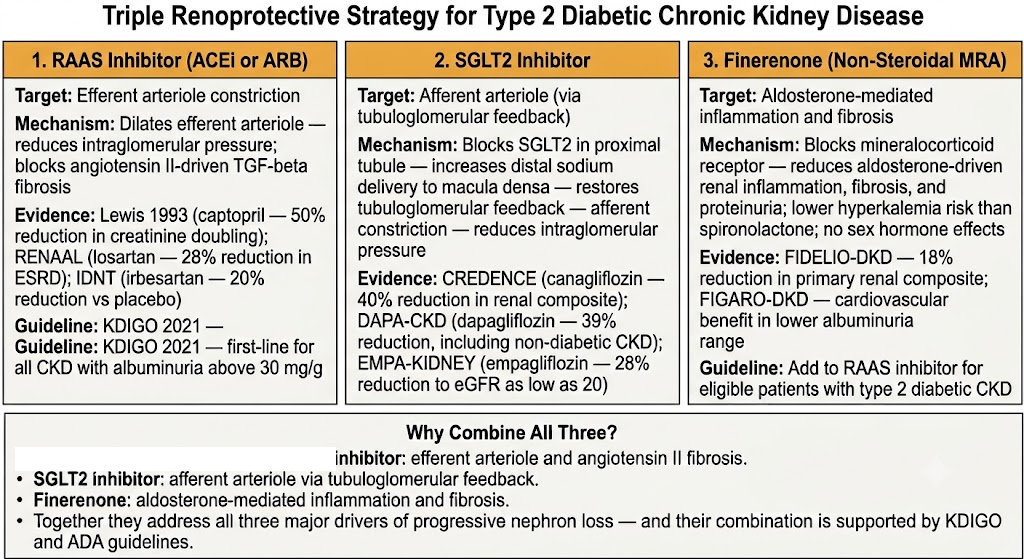
Sodium-glucose cotransporter 2 inhibitors inhibit sodium-glucose cotransporter 2 in the proximal tubule, reducing glucose and sodium co-reabsorption and promoting osmotic diuresis and natriuresis. Their antihypertensive effect is modest — systolic blood pressure reduction of approximately 3 to 5 millimeters of mercury — but their renal protection extends far beyond blood pressure lowering. Increased distal sodium delivery to the macula densa restores tubuloglomerular feedback, causing afferent arteriolar constriction and reducing intraglomerular pressure, the same mechanism targeted by renin-angiotensin-aldosterone system inhibitors but through a complementary pathway.
The CREDENCE trial (2019) showed canagliflozin produced a 40 percent relative risk reduction in the primary renal composite endpoint in type 2 diabetes with chronic kidney disease on background renin-angiotensin-aldosterone system inhibitor therapy. The DAPA-CKD trial (2020) showed dapagliflozin reduced the primary composite endpoint by 39 percent in chronic kidney disease with or without diabetes — the first trial demonstrating renal benefit independent of diabetes status. The EMPA-KIDNEY trial (2022) showed empagliflozin reduced composite kidney disease progression or cardiovascular death by 28 percent at estimated glomerular filtration rates as low as 20 mL/min. Kidney Disease: Improving Global Outcomes guidelines now recommend sodium-glucose cotransporter 2 inhibitors for all patients with type 2 diabetes and chronic kidney disease at estimated glomerular filtration rate 20 or above, and increasingly in non-diabetic chronic kidney disease with significant albuminuria.
Finerenone is a non-steroidal mineralocorticoid receptor antagonist with distinct pharmacology from spironolactone and eplerenone. It has lower hyperkalemia risk than steroidal agents at antifibrotic doses and no sex hormone adverse effects. The FIDELIO-DKD trial (2020) demonstrated an 18 percent reduction in the primary composite kidney outcome and a 14 percent reduction in the cardiovascular composite endpoint in type 2 diabetes with chronic kidney disease on maximum tolerated renin-angiotensin-aldosterone system inhibition. Finerenone is approved as add-on therapy to renin-angiotensin-aldosterone system inhibition for type 2 diabetic chronic kidney disease with significant albuminuria.
The combination of renin-angiotensin-aldosterone system inhibitor plus sodium-glucose cotransporter 2 inhibitor plus finerenone represents the emerging triple renoprotective strategy in type 2 diabetic chronic kidney disease. Each targets a distinct pathway — renin-angiotensin-aldosterone system inhibitors reduce efferent arteriolar tone and angiotensin II-driven fibrosis; sodium-glucose cotransporter 2 inhibitors restore tubuloglomerular feedback reducing afferent arteriolar pressure; finerenone blocks aldosterone-mediated inflammation and fibrosis at the mineralocorticoid receptor. Together they address the three major drivers of progressive nephron loss in this population.
| Author / Organization | Title | Source |
|---|---|---|
| Kidney Disease: Improving Global Outcomes (KDIGO) Blood Pressure Work Group | KDIGO 2021 clinical practice guideline for the management of blood pressure in chronic kidney disease | Kidney Int. 2021;99(3S):S1–S87 |
| Whelton PK, Carey RM, Aronow WS, et al. | 2017 ACC/AHA guideline for the prevention, detection, evaluation, and management of high blood pressure in adults | J Am Coll Cardiol. 2018;71(19):e127–e248 |
| Brenner BM, Cooper ME, de Zeeuw D, et al. | Effects of losartan on renal and cardiovascular outcomes in patients with type 2 diabetes and nephropathy (RENAAL) | N Engl J Med. 2001;345(12):861–869 |
| Lewis EJ, Hunsicker LG, Bain RP, Rohde RD | The effect of angiotensin-converting-enzyme inhibition on diabetic nephropathy | N Engl J Med. 1993;329(20):1456–1462 |
| Lewis EJ, Hunsicker LG, Clarke WR, et al. | Renoprotective effect of the angiotensin-receptor antagonist irbesartan in patients with nephropathy due to type 2 diabetes (IDNT) | N Engl J Med. 2001;345(12):851–860 |
| Gruppo Italiano di Studi Epidemiologici in Nefrologia (GISEN) | Randomised placebo-controlled trial of effect of ramipril on decline in glomerular filtration rate and risk of terminal renal failure in proteinuric, non-diabetic nephropathy (REIN trial) | Lancet. 1997;349(9069):1857–1863 |
| Agarwal R, Sinha AD, Cramer AE, et al. | Chlorthalidone for hypertension in advanced chronic kidney disease (CLICK trial) | N Engl J Med. 2021;385(27):2507–2519 |
| Heerspink HJL, Stefansson BV, Correa-Rotter R, et al. | Dapagliflozin in patients with chronic kidney disease (DAPA-CKD) | N Engl J Med. 2020;383(15):1436–1446 |
| Williams B, Mancia G, Spiering W, et al. | 2018 ESC/ESH guidelines for the management of arterial hypertension | Eur Heart J. 2018;39(33):3021–3104 |
| Perkovic V, Jardine MJ, Neal B, et al. | Canagliflozin and renal outcomes in type 2 diabetes and nephropathy (CREDENCE) | N Engl J Med. 2019;380(24):2295–2306 |
| Bakris GL, Agarwal R, Anker SD, et al. | Effect of finerenone on chronic kidney disease outcomes in type 2 diabetes (FIDELIO-DKD) | N Engl J Med. 2020;383(23):2219–2229 |
| Fried LF, Emanuele N, Zhang JH, et al. | Combined angiotensin inhibition for the treatment of diabetic nephropathy (VA NEPHRON-D) | N Engl J Med. 2013;369(20):1892–1903 |
| Mancia G, Kreutz R, Brunstrom M, et al. | 2023 ESH guidelines for the management of arterial hypertension | J Hypertens. 2023;41(12):1874–2071 |
| Wheeler DC, Stefansson BV, Jongs N, et al. | Effects of dapagliflozin on major adverse kidney events in patients with diabetic and non-diabetic chronic kidney disease (DAPA-CKD prespecified analysis) | Lancet Diabetes Endocrinol. 2021;9(1):22–31 |