Introduction to Medical Pharmacology
Module 6 — Treatment Strategy, Combination Therapy & Resistant Hypertension
AHTN · Module 6 of 11Section 1
When to start, monotherapy versus combination, lifestyle, and the pharmacological rationale for pairing drug classes
The preceding modules established how individual drug classes work. This module synthesizes that knowledge into clinical practice: how to initiate therapy, when to combine agents, which pairings produce the best outcomes, and how to approach the patient whose blood pressure remains uncontrolled on multiple drugs.
The fundamental rationale for treatment is the dose-response relationship between blood pressure reduction and cardiovascular benefit. For each 10 millimeters of mercury reduction in systolic blood pressure, stroke risk falls by approximately 35 percent, coronary artery disease risk by approximately 20 percent, and all-cause mortality by approximately 13 percent. This relationship provides the rationale for combination therapy: larger blood pressure reductions produce proportionally greater benefit, exceeding what any single drug can achieve at tolerable doses.
For Stage 1 hypertension (130 to 139/80 to 89 millimeters of mercury) with low cardiovascular risk, lifestyle modification is tried first with pharmacotherapy added if target is not met in three to six months. With high cardiovascular risk, diabetes, or chronic kidney disease, pharmacotherapy begins alongside lifestyle modification. For Stage 2 hypertension (at or above 140/90), pharmacotherapy is initiated immediately — and when blood pressure is 20/10 millimeters of mercury or more above target, combination therapy is started from the outset rather than titrating a single drug first.
Most patients with Stage 2 hypertension require two or more drugs to reach target blood pressure. Initiating monotherapy and waiting to add a second drug delays goal attainment by months. More importantly, dose-response curves for adverse effects are steeper than for efficacy — combining two drugs at half-standard doses achieves blood pressure reduction equivalent to full-dose monotherapy with fewer adverse effects. Single-pill combinations also improve adherence by 20 to 30 percent compared with separate pills, addressing the single most common cause of treatment failure in clinical practice.
Lifestyle interventions lower blood pressure independently and amplify the efficacy of antihypertensive drugs. The Dietary Approaches to Stop Hypertension eating pattern reduces systolic blood pressure by approximately 11 millimeters of mercury. Sodium restriction below 2.3 grams per day reduces systolic blood pressure by 5 to 6 millimeters of mercury, with greater effect in salt-sensitive individuals. Weight loss reduces systolic blood pressure by approximately 1 millimeters of mercury per kilogram lost. Aerobic exercise at 90 to 150 minutes per week of moderate intensity reduces systolic blood pressure by 5 to 8 millimeters of mercury. Alcohol moderation reduces systolic blood pressure by approximately 4 millimeters of mercury. Lifestyle modifications should be prescribed alongside pharmacotherapy at all stages — not as an alternative to pharmacotherapy in high-risk patients.
Effective combination pairs drugs with complementary, non-redundant mechanisms. Renin-angiotensin-aldosterone system inhibitors reduce angiotensin II-driven vasoconstriction and aldosterone-mediated sodium retention. Diuretics reduce volume and activate the renin-angiotensin-aldosterone system — which is then counteracted by the renin-angiotensin-aldosterone system inhibitor, producing mutual enhancement of both agents. Calcium channel blockers dilate arterioles independently of neurohormonal pathways and are effective even in low-renin states where renin-angiotensin-aldosterone system inhibitors are less potent alone. Beta-blockers reduce cardiac output and renin release, adding benefit in high-sympathetic-tone states. These mechanisms are synergistic rather than merely additive.
Section 2
Preferred combinations from landmark trials and drug selection by age, race, and comorbidity
Clinical trial evidence does more than confirm that blood pressure lowering helps — it tells us which specific combinations produce the best outcomes in which patients. The two most informative trials for combination strategy are ACCOMPLISH and ALLHAT, and their findings directly shape current guideline recommendations.
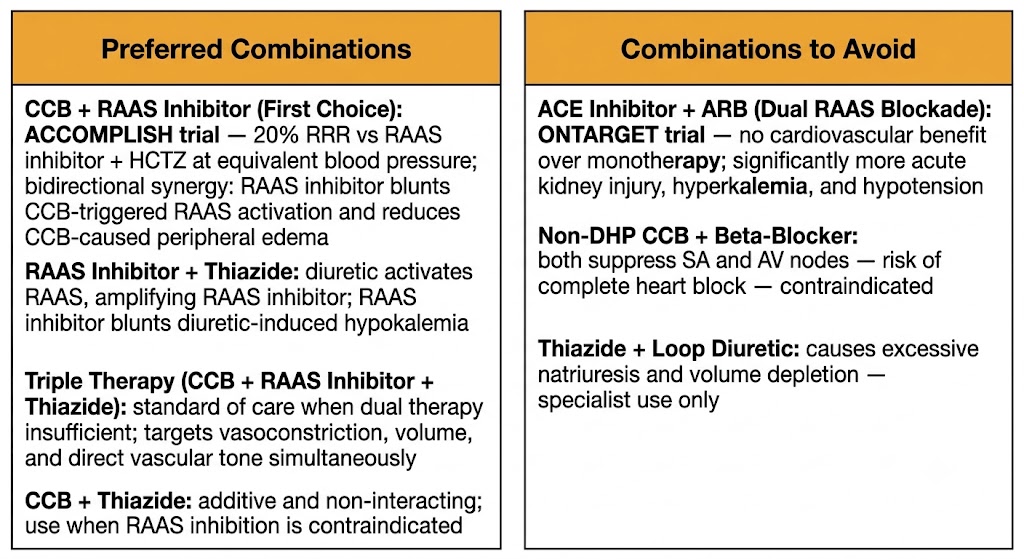
The calcium channel blocker plus renin-angiotensin-aldosterone system inhibitor combination is the preferred dual regimen for most high-risk patients. The ACCOMPLISH trial (2008) demonstrated that benazepril plus amlodipine was superior to benazepril plus hydrochlorothiazide with a 20 percent relative risk reduction in composite cardiovascular events despite equivalent blood pressure in both groups. The physiological synergy works in both directions: the renin-angiotensin-aldosterone system inhibitor blunts the reflex renin-angiotensin-aldosterone system activation triggered by calcium channel blocker-induced vasodilation, and also reduces calcium channel blocker-associated peripheral edema through venodilation.
The renin-angiotensin-aldosterone system inhibitor plus thiazide combination is well-established and preferred when fluid retention is a concern. Triple therapy — calcium channel blocker, renin-angiotensin-aldosterone system inhibitor, and thiazide or thiazide-like diuretic — addresses all three major blood pressure pathways simultaneously and is the standard of care when dual therapy is insufficient.
The ALLHAT trial (2002, 33,357 patients) showed that chlorthalidone, amlodipine, and lisinopril produced equivalent reductions in the primary cardiovascular endpoint, with chlorthalidone superior for heart failure and stroke prevention — reinforcing chlorthalidone as the preferred thiazide and establishing calcium channel blockers and thiazide-like diuretics as robust first-line options.
When a compelling indication is present, the drug class providing that indication-specific benefit takes priority over the general preference framework. Heart failure with reduced ejection fraction mandates three of four guideline-directed medical therapy pillars that are also antihypertensive: a renin-angiotensin-aldosterone system inhibitor (or sacubitril-valsartan), one of the three proven beta-blockers (carvedilol, metoprolol succinate, bisoprolol), and a mineralocorticoid receptor antagonist. Dihydropyridine calcium channel blockers such as amlodipine are safe for additional blood pressure control; non-dihydropyridine calcium channel blockers are contraindicated. Post-myocardial infarction management requires a beta-blocker and a renin-angiotensin-aldosterone system inhibitor, particularly with left ventricular dysfunction. Diabetes and chronic kidney disease both call for a renin-angiotensin-aldosterone system inhibitor as the anchor drug, with additional detail in Modules 7 and 8.
Younger patients below 40 to 50 years often have high-renin, high-sympathetic-tone hypertension, making renin-angiotensin-aldosterone system inhibitors and beta-blockers particularly effective. Secondary causes should be excluded when hypertension presents before age 30 without obesity or family history. Angiotensin converting enzyme inhibitors and angiotensin receptor blockers must be avoided in women who may become pregnant.
Older patients benefit most from calcium channel blockers and thiazide-like diuretics for isolated systolic hypertension. Start low and titrate slowly, monitoring for orthostatic hypotension, falls, and electrolyte disturbances. Beta-blockers are less effective for isolated systolic hypertension and should be reserved for compelling indications.
Black patients more commonly have low-renin, volume-dependent hypertension — calcium channel blockers and thiazide-type diuretics are the most effective initial agents. Renin-angiotensin-aldosterone system inhibitors are less effective as monotherapy but achieve equivalent efficacy when combined with a diuretic or calcium channel blocker, and remain appropriate when compelling indications (chronic kidney disease, heart failure with reduced ejection fraction, diabetes) are present. Black patients have three to four times higher rates of angiotensin converting enzyme inhibitor-associated angioedema — angiotensin receptor blockers are preferred when a renin-angiotensin-aldosterone system inhibitor is needed.
Section 3
Definition, pseudo-resistance, systematic evaluation, and the PATHWAY-2 evidence base for fourth-line therapy
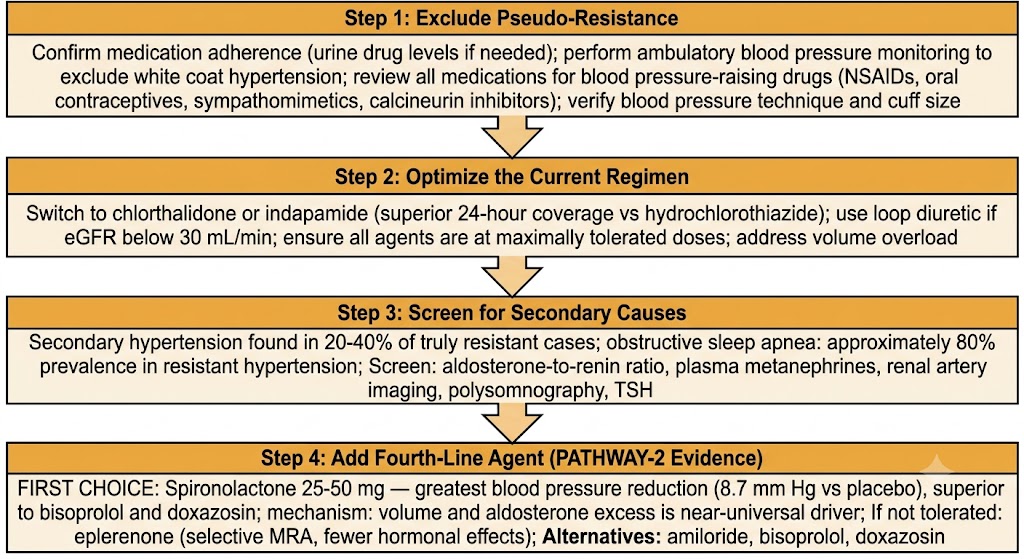
Resistant hypertension is defined as blood pressure that remains above goal despite three antihypertensive agents of different classes — one of which must be a diuretic — at maximally tolerated doses. Before adding a fourth drug, pseudo-resistance must be excluded, as it is far more common than true resistance.
The most common cause of apparent resistance is medication non-adherence — rates of non-adherence at one year range from 40 to 60 percent. Other causes include white coat hypertension (elevated office blood pressure but normal ambulatory measurements), suboptimal drug doses below the level needed for adequate response, inadequate diuretic therapy using the wrong agent or wrong dose for renal function, drug interactions from nonsteroidal anti-inflammatory drugs, sympathomimetics, oral contraceptives, or calcineurin inhibitors, and inaccurate blood pressure measurement due to technique errors or improper cuff sizing.
Before labeling a patient as truly resistant: confirm adherence (urine drug levels if needed), perform ambulatory blood pressure monitoring to exclude the white coat effect, review all medications for blood pressure-raising drugs, verify blood pressure technique, and ensure the diuretic component is appropriate — chlorthalidone or indapamide rather than hydrochlorothiazide for superior 24-hour coverage, and a loop diuretic if estimated glomerular filtration rate is below 30 mL/min.
Secondary hypertension is found in 20 to 40 percent of truly resistant cases and should be screened before adding a fourth agent. Obstructive sleep apnea is particularly prevalent — present in approximately 80 percent of patients with resistant hypertension. Essential screening includes the aldosterone-to-renin ratio for primary aldosteronism, plasma metanephrines for pheochromocytoma, renal artery imaging for renovascular hypertension, and polysomnography for obstructive sleep apnea.
The PATHWAY-2 trial (2015) is the definitive evidence base for fourth-line agent selection in resistant hypertension. In a crossover design with 314 patients on established three-drug therapy, spironolactone 25 to 50 mg produced the greatest home systolic blood pressure reduction — 8.7 millimeters of mercury greater than placebo — significantly superior to bisoprolol (4.5 millimeters of mercury greater than placebo) and doxazosin (4.0 millimeters of mercury greater than placebo). The benefit was greatest in patients with the lowest plasma renin, consistent with volume and aldosterone excess as the near-universal mechanism in resistant hypertension.
Spironolactone 25 to 50 mg daily is therefore the evidence-based preferred fourth-line agent for resistant hypertension regardless of whether the aldosterone-to-renin ratio is elevated. If spironolactone is not tolerated due to gynecomastia or hyperkalemia, eplerenone is the alternative selective mineralocorticoid receptor antagonist. If mineralocorticoid receptor antagonist therapy is contraindicated due to severe hyperkalemia or advanced chronic kidney disease, amiloride, bisoprolol, or doxazosin are alternatives. If blood pressure remains uncontrolled on four agents, oral minoxidil with mandatory beta-blocker and loop diuretic, or clonidine with attention to adherence, may be considered.
PATHWAY-2 — Key Finding for Clinical Practice
Spironolactone is the most effective fourth-line agent for resistant hypertension (PATHWAY-2, 2015). The magnitude of benefit correlated with low plasma renin, confirming that volume and aldosterone excess — not sympathetic overactivity or vasoconstriction — is the dominant mechanism in most patients with true resistant hypertension. This finding explains why adding a fourth drug that targets aldosterone (rather than a beta-blocker or alpha-blocker) produces the greatest additional blood pressure reduction.
Section 4
The critical distinction, safe rate of blood pressure reduction, and organ-specific management
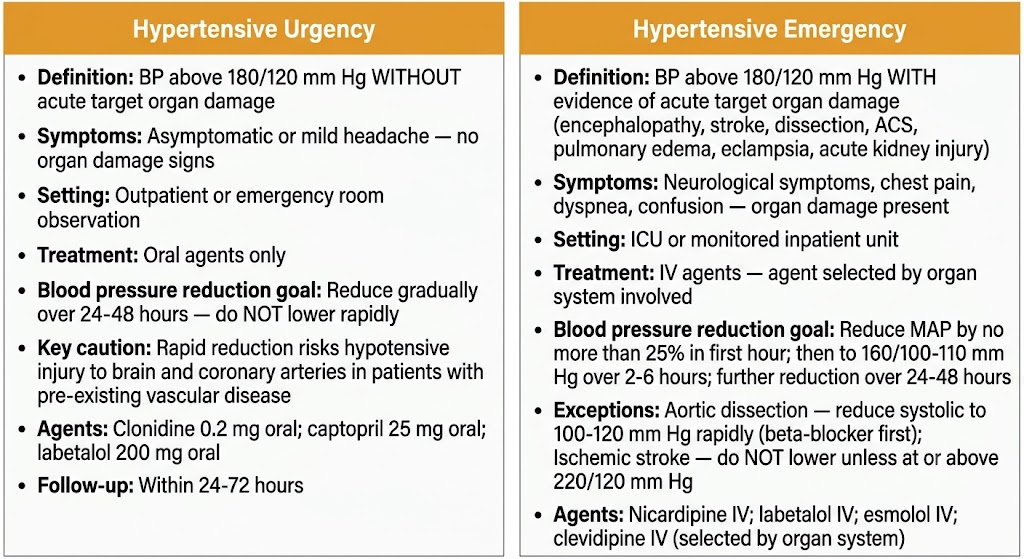
The distinction between hypertensive urgency and emergency is not the blood pressure number — it is the presence or absence of acute target organ damage. Getting this distinction right determines whether the patient requires hospitalization and intravenous therapy, or can be safely managed with oral agents and outpatient follow-up.
Hypertensive urgency is defined as blood pressure above 180/120 millimeters of mercury without evidence of acute target organ damage. The patient is asymptomatic or has mild nonspecific symptoms. Management involves oral antihypertensive therapy with the goal of blood pressure reduction over 24 to 48 hours — this is not a medical emergency requiring hospitalization. The most important principle is not to lower blood pressure too rapidly, as this risks hypotensive injury to vulnerable organs, particularly in patients with pre-existing cerebrovascular disease. Practical approach: ensure the patient is calm and rested, recheck blood pressure after 30 minutes, use oral agents such as clonidine 0.2 mg or captopril, and arrange close follow-up within 24 to 72 hours.
Hypertensive emergency is defined as blood pressure above 180/120 millimeters of mercury with evidence of acute target organ damage — encephalopathy, stroke, aortic dissection, acute coronary syndrome, acute pulmonary edema, eclampsia, or acute kidney injury. It requires immediate intravenous therapy in a monitored setting. The target is to reduce mean arterial pressure by no more than 25 percent within the first hour, then to 160/100 to 110 millimeters of mercury over the next two to six hours, with further reduction toward target over 24 to 48 hours. Exceptions: aortic dissection (reduce systolic to 100 to 120 as rapidly as safely possible) and acute ischemic stroke (do not lower unless blood pressure is at or above 220/120).
Most Time-Critical
Acute Aortic Dissection
Stroke — Counterintuitive Rule
Acute Ischemic Stroke
Pregnancy Emergency
Severe Preeclampsia / Eclampsia
Cardiac Emergency
Acute Pulmonary Edema with Hypertension
| Author / Organization | Title | Source |
|---|---|---|
| Whelton PK, Carey RM, Aronow WS, et al. | 2017 ACC/AHA guideline for the prevention, detection, evaluation, and management of high blood pressure in adults | J Am Coll Cardiol. 2018;71(19):e127–e248 |
| Mancia G, Kreutz R, Brunstrom M, et al. | 2023 ESH guidelines for the management of arterial hypertension | J Hypertens. 2023;41(12):1874–2071 |
| Ettehad D, Emdin CA, Kiran A, et al. | Blood pressure lowering for prevention of cardiovascular disease and death: a systematic review and meta-analysis | Lancet. 2016;387(10022):957–967 |
| Appel LJ, Moore TJ, Obarzanek E, et al. | A clinical trial of the effects of dietary patterns on blood pressure (DASH) | N Engl J Med. 1997;336(16):1117–1124 |
| Jamerson K, Weber MA, Bakris GL, et al. | Benazepril plus amlodipine or hydrochlorothiazide for hypertension in high-risk patients (ACCOMPLISH) | N Engl J Med. 2008;359(23):2417–2428 |
| ALLHAT Officers and Coordinators | Major outcomes in high-risk hypertensive patients randomized to angiotensin-converting enzyme inhibitor or calcium channel blocker vs diuretic (ALLHAT) | JAMA. 2002;288(23):2981–2997 |
| SPRINT Research Group; Wright JT Jr, Williamson JD, Whelton PK, et al. | A randomized trial of intensive versus standard blood-pressure control (SPRINT) | N Engl J Med. 2015;373(22):2103–2116 |
| Yusuf S, Teo KK, Pogue J, et al. | Telmisartan, ramipril, or both in patients at high risk for vascular events (ONTARGET) | N Engl J Med. 2008;358(15):1547–1559 |
| Calhoun DA, Jones D, Textor S, et al. | Resistant hypertension: diagnosis, evaluation, and treatment | Hypertension. 2008;51(6):1403–1419 |
| Carey RM, Calhoun DA, Bakris GL, et al. | Resistant hypertension: detection, evaluation, and management | Hypertension. 2018;72(5):e53–e90 |
| Williams B, MacDonald TM, Morant S, et al. | Spironolactone versus placebo, bisoprolol, and doxazosin to determine the optimal treatment for drug-resistant hypertension (PATHWAY-2) | Lancet. 2015;386(10008):2059–2068 |
| Bhatt DL, Kandzari DE, O'Neill WW, et al. | A controlled trial of renal denervation for resistant hypertension (SYMPLICITY HTN-3) | N Engl J Med. 2014;370(15):1393–1401 |
| Castellano JM, Pocock SJ, Bhatt DL, et al. | Polypill strategy in secondary cardiovascular prevention (SECURE) | N Engl J Med. 2022;387(11):967–977 |
| Bakris GL, Agarwal R, Anker SD, et al. | Effect of finerenone on chronic kidney disease outcomes in type 2 diabetes (FIDELIO-DKD) | N Engl J Med. 2020;383(23):2219–2229 |
| McMurray JJ, Packer M, Desai AS, et al. | Angiotensin-neprilysin inhibition versus enalapril in heart failure (PARADIGM-HF) | N Engl J Med. 2014;371(11):993–1004 |