CHAPTER 41  ·  ANTI-INFLAMMATORY DRUGS
Section 1

Arachidonic Acid Cascade and Cyclooxygenase Biology

Phospholipase A2, the cyclooxygenase and lipoxygenase pathways, and the physiological roles of prostaglandins and thromboxane A2

Abbreviations used in this module: nonsteroidal anti-inflammatory drug (NSAID), cyclooxygenase (COX), prostaglandin (PG), prostaglandin E2 (PGE2), prostacyclin (PGI2), thromboxane A2 (TXA2), lipoxygenase (LOX), phospholipase A2 (PLA2), aspirin-exacerbated respiratory disease (AERD), cytochrome P450 2C9 (CYP2C9), proton pump inhibitor (PPI), estimated glomerular filtration rate (eGFR), angiotensin-converting enzyme (ACE), angiotensin receptor blocker (ARB), selective serotonin reuptake inhibitor (SSRI).

NSAIDs produce their anti-inflammatory, analgesic, and antipyretic effects by blocking the COX enzyme, which sits at the center of the arachidonic acid cascade. This cascade is the lipid signaling pathway that generates prostaglandins, prostacyclin, and thromboxane A2 — molecules that regulate inflammation, pain, fever, platelet function, and tissue protection throughout the body.

The Arachidonic Acid Cascade

Arachidonic acid is a fatty acid stored within cell membrane phospholipids. It is released by PLA2 when cells are activated by injury, infection, or inflammatory stimuli. This release is the rate-limiting step in eicosanoid synthesis. Once free, arachidonic acid enters one of two enzymatic pathways.

The COX pathway, the pharmacological target of NSAIDs, converts arachidonic acid through two sequential reactions to prostaglandin H2, an unstable intermediate. Tissue-specific enzymes then convert prostaglandin H2 into the final eicosanoid products: PGE2 (the principal mediator of pain, fever, and inflammation, and a key protective factor in the gastric mucosa and kidney), PGI2 (produced by vascular endothelium, inhibits platelet aggregation and promotes vasodilation), and TXA2 (produced by platelets, promotes aggregation and vasoconstriction). The balance between endothelial PGI2 and platelet TXA2 is a critical determinant of vascular homeostasis — disrupting this balance drives the cardiovascular risk of selective COX-2 inhibitors.

The LOX pathway converts arachidonic acid to leukotrienes. NSAIDs do not inhibit this pathway. Leukotrienes mediate bronchoconstriction and allergic inflammation. When COX is blocked, more arachidonic acid is available for the LOX pathway — this leukotriene shunting is the mechanism underlying AERD, in which COX inhibition by any NSAID triggers severe bronchoconstriction in susceptible patients.

Glucocorticoids act upstream of both pathways by inducing annexin A1, which inhibits PLA2, thereby blocking arachidonic acid release. This is why glucocorticoids have broader anti-inflammatory potency than NSAIDs: they suppress both the COX and LOX branches simultaneously.
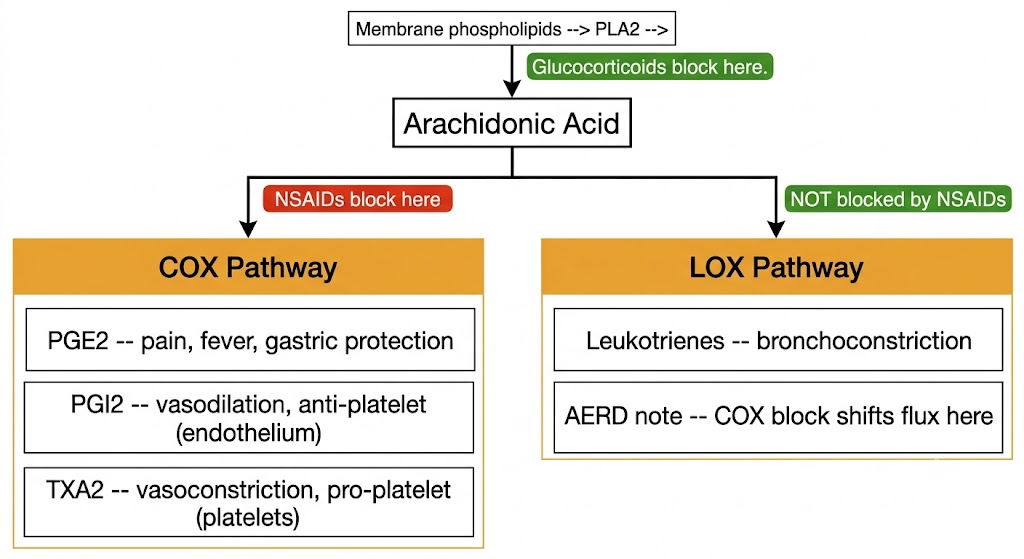
Flow diagram showing the arachidonic acid cascade: membrane phospholipids release arachidonic acid via PLA2 (blocked by glucocorticoids); the COX pathway (blocked by NSAIDs) produces PGE2, PGI2, and TXA2; the LOX pathway (not blocked by NSAIDs) produces leukotrienes including the bronchoconstricting cysteinyl leukotrienes relevant to AERD.
Arachidonic acid cascade showing the COX and LOX branches, NSAID and glucocorticoid block points. Figure generated with Gemini AI for educational use.
COX-1 versus COX-2

Two COX isoforms exist with distinct expression patterns and functions. COX-1 is constitutively expressed in most tissues. In the gastric mucosa it drives synthesis of the cytoprotective prostaglandins that maintain the mucosal barrier. In platelets it generates TXA2, the primary signal for platelet aggregation. In the kidney it helps maintain perfusion under physiological stress. These are the homeostatic prostaglandins that NSAIDs disrupt, producing the class-wide toxicity profile.

COX-2 is largely inducible — its expression rises rapidly in response to inflammatory stimuli such as cytokines and bacterial products. It is the dominant source of PGE2 in inflamed tissues and of the pyrogenic prostaglandins in the hypothalamus. The rationale for selective COX-2 inhibitors was to suppress inflammatory prostaglandins while sparing the COX-1-dependent cytoprotective prostaglandins of the stomach and platelets.

This rationale was partly correct: selective COX-2 inhibitors cause significantly less gastric mucosal damage than nonselective NSAIDs. However, vascular endothelium constitutively expresses COX-2 as its source of PGI2. Selective COX-2 inhibition therefore suppresses endothelial PGI2 while leaving platelet TXA2 fully intact, creating a prothrombotic imbalance. This mechanism explains the class-wide cardiovascular risk of selective COX-2 inhibitors.

Cascade Branch Point — Why Glucocorticoids Outperform NSAIDs

NSAIDs block COX only, leaving the LOX pathway active. Glucocorticoids inhibit PLA2 via annexin A1, blocking both COX-derived prostaglandins and LOX-derived leukotrienes. This upstream block is why glucocorticoids are more potent anti-inflammatory agents than NSAIDs, and why they are effective in AERD where NSAIDs trigger bronchoconstriction through leukotriene shunting.

Section 2

NSAID Pharmacokinetics and Individual Agents

Shared pharmacokinetic features, COX selectivity spectrum, and clinically important agent differences

Despite structural diversity, all NSAIDs share core pharmacokinetic features: they are weak organic acids, highly protein-bound to albumin, and predominantly metabolized by CYP2C9 in the liver. These shared properties explain common drug interactions and predict behavior in populations with reduced albumin or hepatic disease.

Shared Pharmacokinetic Properties

All oral NSAIDs are well absorbed from the gastrointestinal tract. Enteric-coated formulations delay absorption but do not reduce gastric toxicity, because NSAID-induced gastropathy is a systemic effect of prostaglandin suppression, not a local effect of direct mucosal contact. NSAIDs are among the most highly protein-bound drugs in clinical use — nearly all circulating drug is bound to albumin, leaving a very small free fraction that is pharmacologically active. In patients with hypoalbuminemia, this free fraction increases unpredictably.

CYP2C9 metabolizes most clinically used NSAIDs. Inhibitors of CYP2C9 — including fluconazole and amiodarone — reduce NSAID clearance and raise plasma concentrations, increasing toxicity risk. CYP2C9 inducers such as rifampin accelerate clearance and may reduce efficacy. Half-life varies widely across the class and is the primary determinant of dosing interval: short-acting agents (ibuprofen, diclofenac, ketorolac) require more frequent dosing; long-acting agents (naproxen, piroxicam, meloxicam) allow once- or twice-daily dosing but have slower offset when adverse effects occur.

COX Selectivity Spectrum and Key Agents

NSAIDs span a continuous spectrum of COX selectivity. Nonselective NSAIDs — including ibuprofen, naproxen, indomethacin, and ketorolac — inhibit both COX-1 and COX-2 at similar concentrations. COX-2 preferential agents — diclofenac and meloxicam — inhibit COX-2 at lower concentrations than COX-1 but are not fully selective. Celecoxib is the only selective COX-2 inhibitor currently marketed in the United States, following the withdrawal of rofecoxib (2004) and valdecoxib (2005) due to cardiovascular harm.

Ibuprofen is the most widely used over-the-counter NSAID. It inhibits COX reversibly and has a short half-life, giving it a rapid offset. One clinically important interaction: ibuprofen can competitively block aspirin's access to platelet COX-1, preventing the irreversible acetylation that underlies aspirin's antiplatelet effect. Patients on aspirin for cardiovascular protection should take aspirin at least 30 minutes before ibuprofen, or substitute naproxen for ibuprofen.

Naproxen has the most favorable cardiovascular risk profile among nonselective NSAIDs, attributed to its long half-life producing sustained COX-1 inhibition that provides a partial antiplatelet effect. It is the preferred NSAID in patients with cardiovascular risk factors when an NSAID cannot be avoided.

Indomethacin is one of the most potent nonselective COX inhibitors. It is first-line for acute crystal arthropathy (gout, pseudogout) and is used intravenously in neonates to close a hemodynamically significant patent ductus arteriosus by blocking the prostaglandin-dependent ductal patency mechanism. Its high rate of central nervous system side effects (headache, dizziness, cognitive changes) limits long-term use.

Ketorolac is the only NSAID available for parenteral (intramuscular and intravenous) administration, giving it a role in acute postoperative and trauma pain when oral dosing is not possible. Its analgesic potency is comparable to moderate opioid doses. Potent nonselective COX inhibition makes its renal and gastrointestinal toxicity significant; current labeling limits use to a maximum of five days.

Celecoxib causes significantly less gastric mucosal injury than nonselective agents. Its gastrointestinal benefit is attenuated when patients also take low-dose aspirin, because aspirin suppresses COX-1 in the gastric mucosa and negates the gastroprotective advantage of COX-2 selectivity. Celecoxib is a moderate inhibitor of CYP2D6 (cytochrome P450 2D6), which is relevant when co-prescribed with CYP2D6 substrates such as metoprolol and codeine.

Diclofenac is COX-2 preferential in vivo and carries a distinct hepatotoxicity signal: transaminase elevations occur in a meaningful proportion of patients on prolonged therapy, and clinically significant liver injury, while uncommon, is more frequent than with other NSAIDs. Liver function monitoring is appropriate during extended use.

Ibuprofen — Aspirin Interaction

Ibuprofen reversibly occupies the COX-1 active site and can block aspirin's access for irreversible acetylation. In patients taking aspirin for secondary cardiovascular prevention: take aspirin first and wait at least 30 minutes before ibuprofen, or switch to naproxen. Naproxen does not interfere with aspirin's antiplatelet effect to the same degree.


Section 3

Aspirin — Irreversible Inhibition and Dose-Dependent Pharmacology

Covalent COX acetylation, platelet-selective antiplatelet effect at low doses, and the analgesic-to-anti-inflammatory dose spectrum

Aspirin is unique among NSAIDs in one defining property: it inhibits COX irreversibly by transferring an acetyl group to a serine residue in the COX active site, forming a permanent covalent bond. Every other NSAID inhibits COX reversibly, with effect duration determined by plasma half-life. Aspirin's effect on a given COX molecule lasts for the lifetime of that protein.

Irreversible Acetylation and the Antiplatelet Effect

The clinical significance of irreversible COX inhibition is greatest in platelets. Platelets are anucleate — they cannot synthesize new protein, including new COX-1. When aspirin acetylates platelet COX-1, TXA2 synthesis in that platelet is abolished permanently, for the platelet's entire lifespan of approximately 8 to 10 days. New platelets entering circulation from bone marrow carry new, uninhibited COX-1. Because roughly 10% of the platelet pool is replaced each day, continuous daily aspirin dosing is required to maintain suppression of the renewing platelet pool.

Vascular endothelial cells, by contrast, have nuclei and can regenerate COX-2. Between daily aspirin doses, endothelial cells restore PGI2 synthesis. This asymmetry — permanent platelet inhibition paired with recovering endothelial function — is the pharmacological basis of low-dose aspirin's selective antiplatelet effect.

Dose-Dependent Pharmacology

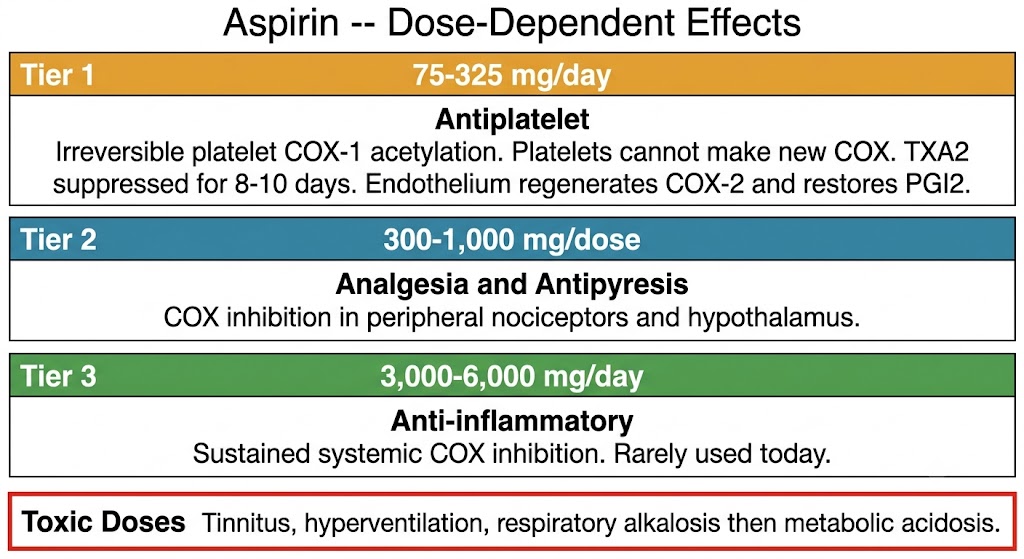
Aspirin's pharmacological effects change qualitatively with dose, not just quantitatively. At low doses (75 to 325 mg per day), aspirin provides selective and durable antiplatelet effect through the mechanism described above. Aspirin itself has a plasma half-life of only 15 to 20 minutes before hydrolysis to salicylate, but platelet acetylation occurs in the portal circulation during first-pass absorption — brief systemic exposure is sufficient to produce lasting antiplatelet action.

At intermediate doses (300 to 1,000 mg per dose), aspirin produces analgesia and antipyresis through COX inhibition in peripheral nociceptors and the hypothalamus. At high doses used for anti-inflammatory indications (3,000 to 6,000 mg per day), aspirin achieves sustained systemic COX inhibition sufficient to reduce inflammation, though these doses are rarely used today because gastrointestinal toxicity is substantial and better-tolerated alternatives exist.

Salicylate, the active hydrolysis product, undergoes dose-dependent elimination. At low antiplatelet doses, conjugation pathways handle the load efficiently. At high anti-inflammatory doses, these pathways saturate and elimination shifts toward slower renal excretion of unchanged salicylate — a clinically important pharmacokinetic change that explains why small dose increases at high doses produce disproportionate plasma concentration increases and toxicity risk. Alkalinizing the urine (as in management of salicylate toxicity) increases ionization of salicylate in the tubular lumen, trapping it there and dramatically accelerating its renal excretion.

Three-tier aspirin dose-response diagram: Tier 1 (75-325 mg/day) shows antiplatelet effect via irreversible platelet COX-1 acetylation; Tier 2 (300-1000 mg/dose) shows analgesia and antipyresis; Tier 3 (3000-6000 mg/day) shows anti-inflammatory effect; toxic dose warning shows tinnitus, hyperventilation, and metabolic acidosis.
Aspirin dose-dependent pharmacology: antiplatelet, analgesic-antipyretic, anti-inflammatory, and toxic dose ranges with mechanisms. Figure generated with Gemini AI for educational use.
Aspirin Dose-Response Summary

75–325 mg/day: irreversible platelet COX-1 acetylation → permanent TXA2 suppression for platelet lifespan (8–10 days); endothelium recovers PGI2 between doses. 300–1,000 mg per dose: analgesia and antipyresis. 3,000–6,000 mg/day: anti-inflammatory. Toxic doses: tinnitus, hyperventilation, respiratory alkalosis followed by metabolic acidosis. Enteric coating does not reduce gastrointestinal risk (systemic mechanism) and delays onset in acute coronary syndrome — use plain aspirin for the loading dose.


Section 4

Adverse Effects, Drug Interactions, and Clinical Use

Class-wide toxicity mechanisms, high-yield drug interactions, prescribing by risk profile, and special population considerations

The adverse effects of NSAIDs follow directly from their mechanism. Blocking prostaglandin synthesis in the stomach, kidney, and cardiovascular system removes physiologically essential prostaglandin-dependent protection in those organs. These are not idiosyncratic reactions — they are predictable pharmacological consequences of COX inhibition in tissues that depend on prostaglandins for normal function.

Gastrointestinal Toxicity

PGE2 and PGI2 produced by gastric mucosal COX-1 stimulate mucus and bicarbonate secretion, maintain mucosal blood flow, and inhibit parietal cell acid secretion. NSAID-mediated COX-1 suppression simultaneously impairs all four components of mucosal defense. The gastric mucosa becomes vulnerable to injury from acid, bile salts, and Helicobacter pylori. This mechanism is systemic: enteric-coated and parenteral NSAIDs cause equivalent mucosal injury to plain oral formulations because prostaglandin suppression in the mucosa is driven by the drug in the bloodstream, not by local contact.

Patients at high gastrointestinal risk (prior ulcer or gastrointestinal bleed, age above 65, concurrent anticoagulant or corticosteroid use, high-dose NSAID) should receive either a selective COX-2 inhibitor (celecoxib) or a nonselective NSAID with PPI co-therapy. PPIs reduce the relative risk of NSAID-associated ulcers by approximately 75% and are preferred over misoprostol because of better tolerability. Testing for and eradicating Helicobacter pylori before starting long-term NSAID therapy further reduces risk.

Cardiovascular and Renal Toxicity

Cardiovascular risk from NSAIDs is proportional to COX-2 selectivity and dose. Selective COX-2 inhibitors suppress endothelial PGI2 while leaving platelet TXA2 intact, creating a prothrombotic state. High-dose diclofenac and ibuprofen carry cardiovascular risk comparable to selective COX-2 inhibitors. Naproxen has the most favorable cardiovascular profile among commonly used NSAIDs and is preferred when an oral NSAID is required in a patient with cardiovascular risk factors.

Renal toxicity is class-wide, independent of COX selectivity, because both COX-1 and COX-2 contribute to renal prostaglandin synthesis. In euvolemic healthy patients, NSAIDs cause minimal reduction in glomerular filtration. In physiologically stressed states — heart failure, cirrhosis, volume depletion, chronic kidney disease — the kidney depends on prostaglandin-mediated vasodilation to maintain perfusion. NSAID-mediated suppression of these prostaglandins in stressed patients can precipitate acute kidney injury rapidly. NSAIDs also cause sodium and water retention, can induce hyperkalemia, and blunt the effect of antihypertensive drugs.

NSAIDs should be avoided in patients with an eGFR below 30 mL per minute per 1.73 m², decompensated heart failure, hepatic cirrhosis with ascites, and in the third trimester of pregnancy (risk of premature closure of the ductus arteriosus).

High-Yield Drug Interactions

The combination of an NSAID, a renin-angiotensin-aldosterone system inhibitor (ACE inhibitor or ARB), and a diuretic — the "triple whammy" — carries a markedly elevated risk of acute kidney injury through additive reduction of glomerular filtration and renal perfusion. This combination should be avoided; when unavoidable, renal function and electrolytes must be monitored closely within one to two weeks of initiation.

NSAIDs raise lithium plasma concentrations by reducing renal prostaglandin synthesis and thereby reducing renal lithium clearance. Because lithium has a narrow therapeutic index, even modest increases in concentration can cause toxicity. Lithium levels should be checked within five to seven days of starting or stopping an NSAID in a patient taking lithium.

At oncology doses of methotrexate (above 15 mg per week), NSAIDs impair renal methotrexate excretion and should not be used within 24 hours of a methotrexate infusion. NSAIDs combined with SSRIs increase the risk of upper gastrointestinal bleeding beyond either drug alone because SSRIs deplete platelet serotonin, impairing platelet activation, while NSAIDs suppress TXA2; the combination should trigger PPI co-prescription. NSAIDs combined with warfarin or direct oral anticoagulants multiply gastrointestinal bleeding risk through both mucosal injury and platelet dysfunction.

Special Populations and AERD

AERD affects approximately 10 to 20% of adults with asthma, rising to 30% in those with nasal polyps. Any COX-1 inhibiting NSAID can trigger severe bronchoconstriction in these patients through leukotriene shunting. Celecoxib does not inhibit mucosal COX-1 at therapeutic doses and does not trigger this reaction; it is the preferred NSAID in patients with confirmed or suspected AERD. Acetaminophen at standard doses is also generally safe in AERD.

In elderly patients, NSAIDs carry disproportionate risk: reduced renal reserve, diminished gastric mucosal regenerative capacity, higher prevalence of polypharmacy, and increased sensitivity to central nervous system effects of indomethacin. The American Geriatrics Society recommends avoiding oral nonselective NSAIDs in patients 65 and older when alternatives are available. Topical diclofenac gel provides effective local analgesia for hand and knee osteoarthritis with minimal systemic exposure, avoiding most systemic risks.

High-Priority Drug Interactions at a Glance

Ibuprofen + aspirin: competitive block of platelet COX-1 acetylation — take aspirin first. NSAIDs + warfarin or direct oral anticoagulants: additive gastrointestinal bleed risk — avoid or use PPI. NSAIDs + ACE inhibitor or ARB + diuretic (triple whammy): acute kidney injury risk — avoid. NSAIDs + lithium: reduced renal clearance of lithium — monitor levels. NSAIDs + high-dose methotrexate: impaired methotrexate excretion — do not use within 24 hours. NSAIDs + SSRIs: additive gastrointestinal bleeding — use PPI. CYP2C9 inhibitors (fluconazole, amiodarone): raise NSAID concentrations.


Suggested References
Author / Organization Title Source
Ricciotti E, FitzGerald GA Prostaglandins and inflammation Arterioscler Thromb Vasc Biol. 2011;31(5):986-1000
Vane JR, Bakhle YS, Botting RM Cyclooxygenases 1 and 2 Annu Rev Pharmacol Toxicol. 1998;38:97-120
Peters-Golden M, Henderson WR Jr Leukotrienes N Engl J Med. 2007;357(18):1841-1854
Patrono C, Patrignani P, Garcia Rodriguez LA Cyclooxygenase-selective inhibition of prostanoid formation: transducing biochemical selectivity into clinical read-outs J Clin Invest. 2001;108(1):7-13
Bhala N, Emberson J, Merhi A, et al; CNT Collaboration Vascular and upper gastrointestinal effects of non-steroidal anti-inflammatory drugs: meta-analyses of individual participant data from randomised trials Lancet. 2013;382(9894):769-779
Brune K, Patrignani P New insights into the use of currently available non-steroidal anti-inflammatory drugs J Pain Res. 2015;8:105-118
Kirchheiner J, Brockmoller J Clinical consequences of cytochrome P450 2C9 polymorphisms Clin Pharmacol Ther. 2005;77(1):1-16
Patrono C Aspirin as an antiplatelet drug N Engl J Med. 1994;330(18):1287-1294
Needs CJ, Brooks PM Clinical pharmacokinetics of the salicylates Clin Pharmacokinet. 1985;10(2):164-177
Catella-Lawson F, Reilly MP, Kapoor SC, et al Cyclooxygenase inhibitors and the antiplatelet effects of aspirin N Engl J Med. 2001;345(25):1809-1817
Lanas A, Scheiman J Low-dose aspirin and upper gastrointestinal damage: epidemiology, prevention and treatment Curr Med Res Opin. 2007;23(1):163-173
Hochberg MC, Altman RD, April KT, et al American College of Rheumatology 2012 recommendations for the use of nonpharmacologic and pharmacologic therapies in osteoarthritis of the hand, hip, and knee Arthritis Care Res (Hoboken). 2012;64(4):465-474