Introduction to Medical Pharmacology
Module 4 — Ezetimibe and Proprotein Convertase Subtilisin/Kexin Type 9 Inhibitors
ALIP · Module 4 of 6Section 1
Blocking intestinal cholesterol absorption to complement statin therapy
Even on maximally tolerated statin therapy, many high-risk patients do not reach their low-density lipoprotein cholesterol target. Ezetimibe is the logical first add-on agent: it works through a mechanism entirely distinct from statins, is well-tolerated, inexpensive, and has proven cardiovascular benefit. Understanding its mechanism explains both its efficacy and its complementarity with every other drug class in this chapter.
Mechanism of Action
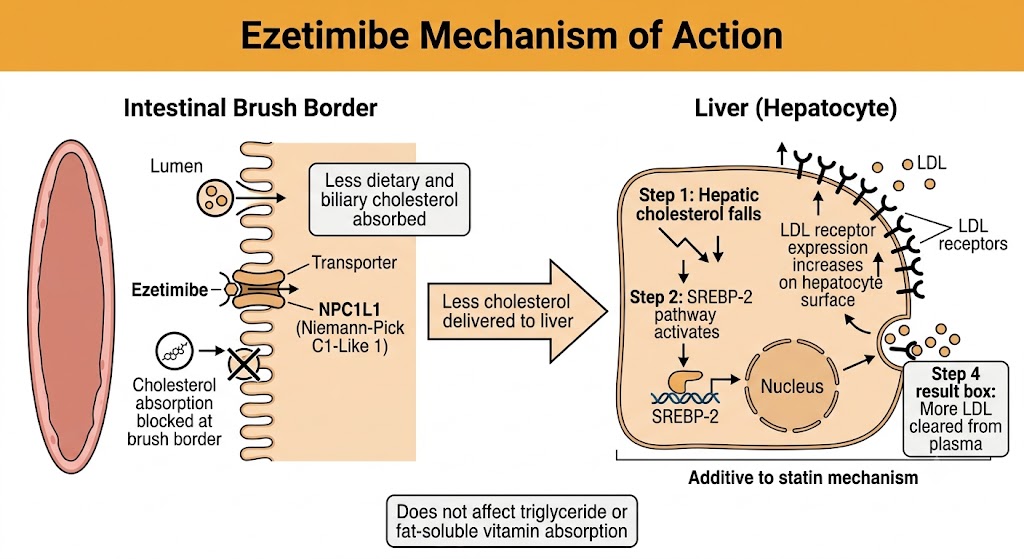
Ezetimibe selectively inhibits the Niemann-Pick C1-Like 1 protein, a sterol transporter located on the brush border of small intestinal enterocytes. This transporter is responsible for absorbing both dietary cholesterol from food and biliary cholesterol recycled from the liver into the gut. By blocking Niemann-Pick C1-Like 1, ezetimibe reduces the amount of cholesterol delivered from the intestine to the liver through the exogenous pathway.
The fall in hepatic cholesterol content activates the same sterol regulatory element-binding protein 2 pathway that statins activate: the liver upregulates low-density lipoprotein receptor expression to import more cholesterol from the plasma. This is why ezetimibe and statins are additive rather than redundant — statins reduce hepatic cholesterol synthesis while ezetimibe reduces intestinal cholesterol delivery, and both trigger low-density lipoprotein receptor upregulation through the same compensatory pathway. Together they reduce low-density lipoprotein cholesterol by approximately 60 to 65 percent from the untreated baseline, more than either drug achieves alone.
Unlike bile acid sequestrants, ezetimibe does not interfere with the absorption of triglycerides, fat-soluble vitamins, or other nutrients. It is highly selective for cholesterol absorption.
Pharmacokinetics and Dosing
Ezetimibe is given as a fixed dose of 10 milligrams orally once daily, without dose titration. It is minimally metabolized by cytochrome P450 enzymes, which gives it an extremely low drug-drug interaction potential. No dose adjustment is required for renal impairment. Ezetimibe is available as a generic and is inexpensive, which makes it the most cost-effective add-on agent when the low-density lipoprotein cholesterol target is not reached on statin alone.
Efficacy and Cardiovascular Evidence
Ezetimibe monotherapy reduces low-density lipoprotein cholesterol by approximately 18 to 20 percent. When added to statin therapy, it provides an additional 18 to 25 percent reduction on top of whatever the statin has already achieved.
The pivotal cardiovascular outcomes trial demonstrated that adding ezetimibe to statin therapy after acute coronary syndrome reduced major cardiovascular events compared to statin therapy alone. This was the first trial to show that non-statin low-density lipoprotein cholesterol lowering reduces cardiovascular events, confirming that the benefit comes from the low-density lipoprotein cholesterol reduction itself, not from any statin-specific mechanism. It also demonstrated that achieving very low low-density lipoprotein cholesterol levels is safe, with no evidence of harm at levels around 50 milligrams per deciliter.
Safety Profile
Ezetimibe has an excellent safety record. Gastrointestinal discomfort, headache, and myalgia are reported at rates not significantly different from placebo. There is no hepatotoxicity, no diabetogenic effect, no cytochrome P450 drug interactions, and no evidence of cancer or cognitive impairment with long-term use. The favorable safety profile and low cost make ezetimibe the standard first choice when adding a non-statin agent to statin therapy.
Why Ezetimibe and Statins Are Additive
Statins reduce hepatic cholesterol synthesis. Ezetimibe reduces intestinal cholesterol delivery to the liver. Both trigger the same compensatory low-density lipoprotein receptor upregulation. The two mechanisms attack cholesterol supply from different directions, making their combination more effective than doubling either drug’s dose.
Section 2
Evolocumab and alirocumab: blocking proprotein convertase subtilisin/kexin type 9 to protect low-density lipoprotein receptors
Proprotein convertase subtilisin/kexin type 9 inhibitors are the most potent low-density lipoprotein cholesterol-lowering agents currently available. By preventing the degradation of low-density lipoprotein receptors, they amplify hepatic clearance of low-density lipoprotein cholesterol to a degree that no other drug class can match.
Proprotein Convertase Subtilisin/Kexin Type 9 Biology
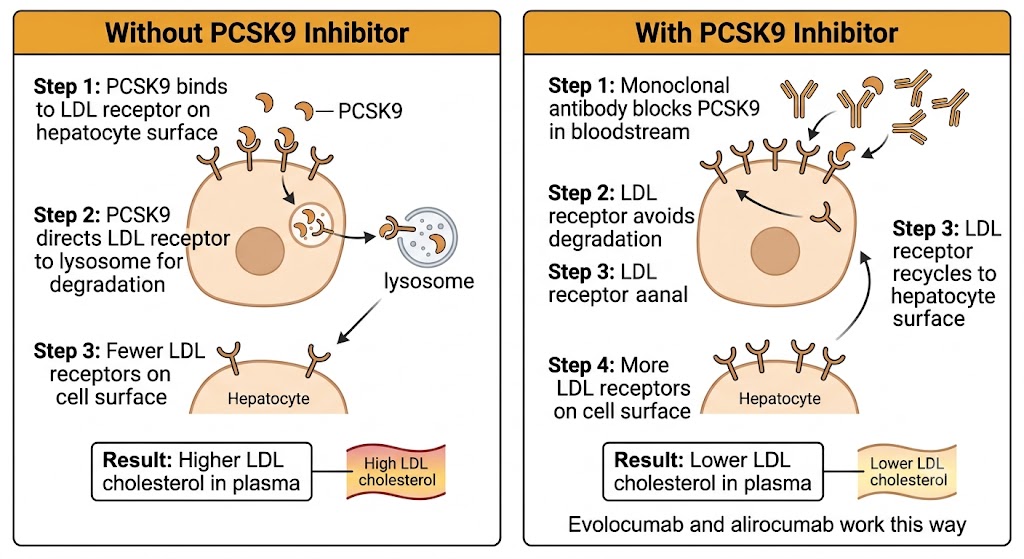
Proprotein convertase subtilisin/kexin type 9 is a serine protease secreted by liver cells. After the low-density lipoprotein receptor on the hepatocyte surface binds and internalizes a low-density lipoprotein particle, the receptor would normally be recycled back to the cell surface to bind another particle. Proprotein convertase subtilisin/kexin type 9 interferes with this recycling: it binds the low-density lipoprotein receptor on the cell surface and directs the receptor to lysosomal degradation instead of recycling. The result is fewer functional low-density lipoprotein receptors on the hepatocyte surface and higher plasma low-density lipoprotein cholesterol.
The pharmacological importance of proprotein convertase subtilisin/kexin type 9 was established by genetic discoveries. People with naturally occurring loss-of-function mutations in proprotein convertase subtilisin/kexin type 9 have very low lifetime low-density lipoprotein cholesterol levels and dramatically reduced rates of coronary heart disease, with no apparent adverse health consequences. This provided compelling genetic validation that blocking proprotein convertase subtilisin/kexin type 9 would be both effective and safe.
Statin therapy also increases proprotein convertase subtilisin/kexin type 9 levels as part of the sterol regulatory element-binding protein 2 counterregulatory response. This explains why proprotein convertase subtilisin/kexin type 9 inhibitors are particularly synergistic with statins: statins upregulate more low-density lipoprotein receptors, and proprotein convertase subtilisin/kexin type 9 inhibitors protect those receptors from degradation.
Evolocumab and Alirocumab
Evolocumab and alirocumab are fully human monoclonal antibodies that bind proprotein convertase subtilisin/kexin type 9 in the bloodstream, preventing it from interacting with the low-density lipoprotein receptor. Both agents reduce low-density lipoprotein cholesterol by approximately 50 to 60 percent when added to maximally tolerated statin therapy. They also reduce lipoprotein(a) by approximately 20 to 25 percent.
Both are administered by subcutaneous injection. Evolocumab is given as 140 milligrams every two weeks or 420 milligrams once monthly. Alirocumab is started at 75 milligrams every two weeks, with the option to increase to 150 milligrams every two weeks if the low-density lipoprotein cholesterol response is insufficient; a 300 milligram monthly option is also available.
Because they are large protein molecules metabolized through normal protein degradation pathways, neither agent has cytochrome P450 drug interactions. No dose adjustment is required for renal or hepatic impairment. Both are approved for patients with established atherosclerotic cardiovascular disease requiring additional low-density lipoprotein cholesterol lowering and for patients with heterozygous or homozygous familial hypercholesterolemia.
Cardiovascular Outcomes Evidence
Both evolocumab and alirocumab have demonstrated reductions in major cardiovascular events in large randomized outcomes trials enrolling patients with established atherosclerotic cardiovascular disease on background statin therapy. Both trials achieved unprecedented reductions in low-density lipoprotein cholesterol — to median levels around 30 to 40 milligrams per deciliter — and showed that very low low-density lipoprotein cholesterol is safe: no increase in cancer, hemorrhagic stroke, muscle symptoms, or cognitive impairment was found at these levels. The alirocumab trial, enrolling patients shortly after acute coronary syndrome, also showed a reduction in all-cause mortality, the first proprotein convertase subtilisin/kexin type 9 inhibitor trial to do so.
Who Gets a Proprotein Convertase Subtilisin/Kexin Type 9 Inhibitor?
Guideline indications: established atherosclerotic cardiovascular disease with low-density lipoprotein cholesterol not at goal on maximally tolerated statin plus ezetimibe; heterozygous familial hypercholesterolemia; homozygous familial hypercholesterolemia. In practice, all agents require prior authorization from payers and most require documented failure of statin plus ezetimibe before approval is granted.
Section 3
A twice-yearly injection that silences proprotein convertase subtilisin/kexin type 9 production at the messenger ribonucleic acid level
Inclisiran takes a fundamentally different approach to proprotein convertase subtilisin/kexin type 9 inhibition. Rather than blocking the proprotein convertase subtilisin/kexin type 9 protein after it has been secreted, inclisiran prevents the liver from making it in the first place by silencing the proprotein convertase subtilisin/kexin type 9 messenger ribonucleic acid. The result is durable, stable low-density lipoprotein cholesterol lowering that persists for months after each dose.
Mechanism and Dosing
Inclisiran is a small interfering ribonucleic acid molecule that is delivered selectively to liver cells after subcutaneous injection. Once inside the hepatocyte, it is incorporated into a cellular complex that degrades proprotein convertase subtilisin/kexin type 9 messenger ribonucleic acid before it can be translated into protein. With less proprotein convertase subtilisin/kexin type 9 protein produced, more low-density lipoprotein receptors remain on the hepatocyte surface and more low-density lipoprotein is cleared from the plasma.
The key practical feature of inclisiran is its dosing schedule. Because the intracellular silencing complex remains active for months, a single injection suppresses proprotein convertase subtilisin/kexin type 9 production long after the drug itself has been cleared from the bloodstream. Inclisiran is administered as a subcutaneous injection at day one, at three months, and then every six months thereafter — two injections per year after the loading phase. This twice-yearly, healthcare provider-administered schedule is the defining clinical differentiator from the monoclonal antibodies.
Efficacy and Safety
Inclisiran reduces low-density lipoprotein cholesterol by approximately 50 to 55 percent from baseline when added to maximally tolerated statin therapy — comparable to the monoclonal antibodies. Low-density lipoprotein cholesterol levels are stable between doses, without the trough-to-peak fluctuation seen with biweekly injections. Adverse effects are minimal: injection site reactions occur in a small proportion of patients and are generally mild. There are no cytochrome P450 drug interactions, no hepatotoxicity, no muscle toxicity, and no diabetogenic effect. It is approved for patients with established atherosclerotic cardiovascular disease or heterozygous familial hypercholesterolemia as an adjunct to maximally tolerated statin therapy.
At the time of writing, inclisiran is approved on the basis of its low-density lipoprotein cholesterol lowering effect rather than demonstrated cardiovascular event reduction. Large outcomes trial data are anticipated, but the definitively proven event reduction that exists for evolocumab and alirocumab is not yet established for inclisiran.
Inclisiran versus Monoclonal Antibodies — The Key Distinction
All three agents reduce low-density lipoprotein cholesterol by approximately 50 to 60 percent and have comparable safety profiles. The choice between them is driven primarily by dosing convenience and the strength of cardiovascular outcomes evidence. Inclisiran offers twice-yearly dosing; evolocumab and alirocumab offer biweekly or monthly self-injection with definitive outcomes trial evidence. When urgent low-density lipoprotein cholesterol reduction is needed (such as early after acute coronary syndrome), the monoclonal antibodies are preferred for their faster onset and established outcomes data.
Section 4
The sequential add-on framework and how to choose between agents
The three non-statin drug classes covered in this module — ezetimibe, monoclonal antibody proprotein convertase subtilisin/kexin type 9 inhibitors, and inclisiran — are used in a defined sequence that reflects both their mechanistic complementarity and their cost and access profiles.
The Sequential Add-On Framework
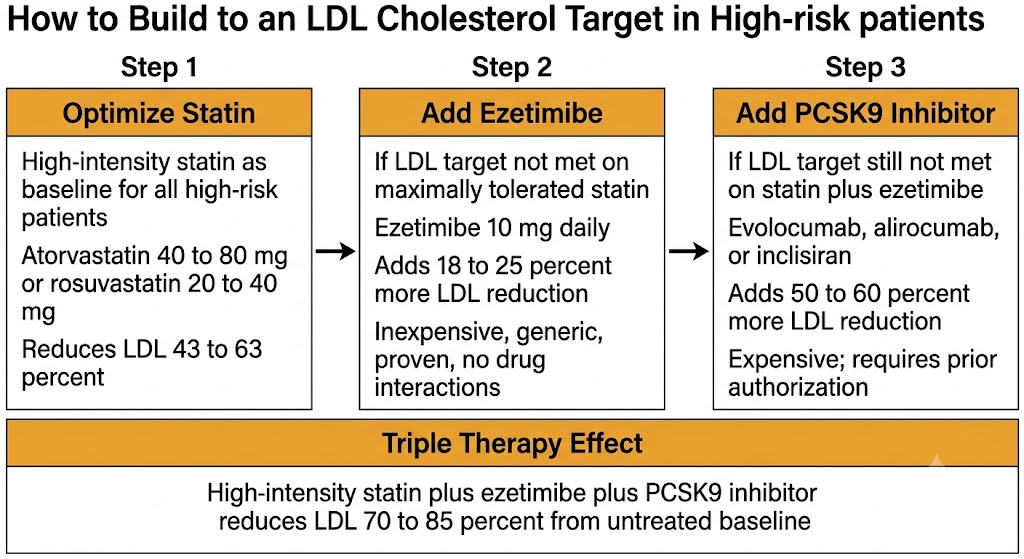
Current guidelines recommend a stepwise approach to achieving low-density lipoprotein cholesterol targets in high-risk patients. The sequence reflects both clinical logic and cost-effectiveness.
Step 1: Optimize statin intensity. High-intensity statin therapy is the foundation for all patients with established atherosclerotic cardiovascular disease and for those with very high-risk primary prevention. The statin dose should be maximized to the highest tolerated level before adding any agent.
Step 2: Add ezetimibe. If the low-density lipoprotein cholesterol target is not reached on maximally tolerated statin, ezetimibe 10 milligrams daily is added. It is inexpensive, generic, well-tolerated, has proven cardiovascular benefit, and is the logical first non-statin addition.
Step 3: Add a proprotein convertase subtilisin/kexin type 9 inhibitor. If the low-density lipoprotein cholesterol target remains unmet on statin plus ezetimibe, a proprotein convertase subtilisin/kexin type 9 inhibitor is added. These agents are effective but expensive and require prior authorization in most health systems.
Triple Therapy
The combination of high-intensity statin plus ezetimibe plus a proprotein convertase subtilisin/kexin type 9 inhibitor is pharmacologically rational and additive at every step. The statin reduces synthesis and upregulates low-density lipoprotein receptors; ezetimibe reduces intestinal delivery and further upregulates receptors; the proprotein convertase subtilisin/kexin type 9 inhibitor protects those upregulated receptors from degradation. Together this triple combination can reduce low-density lipoprotein cholesterol by 70 to 85 percent from the untreated baseline, achieving levels of 20 to 30 milligrams per deciliter in most patients. This combination is most commonly used in patients with homozygous familial hypercholesterolemia, recurrent atherosclerotic cardiovascular disease events despite dual therapy, or very high baseline low-density lipoprotein cholesterol after acute coronary syndrome.
When to Start a Proprotein Convertase Subtilisin/Kexin Type 9 Inhibitor Early
In certain high-risk scenarios, waiting to fail statin plus ezetimibe before starting a proprotein convertase subtilisin/kexin type 9 inhibitor is not appropriate. Early initiation is warranted in patients with very high baseline low-density lipoprotein cholesterol (above 190 milligrams per deciliter, especially homozygous familial hypercholesterolemia) where dual therapy will be insufficient; in patients with multiple prior atherosclerotic cardiovascular disease events; and in post-acute coronary syndrome patients with persistently very elevated low-density lipoprotein cholesterol despite maximally tolerated statin.
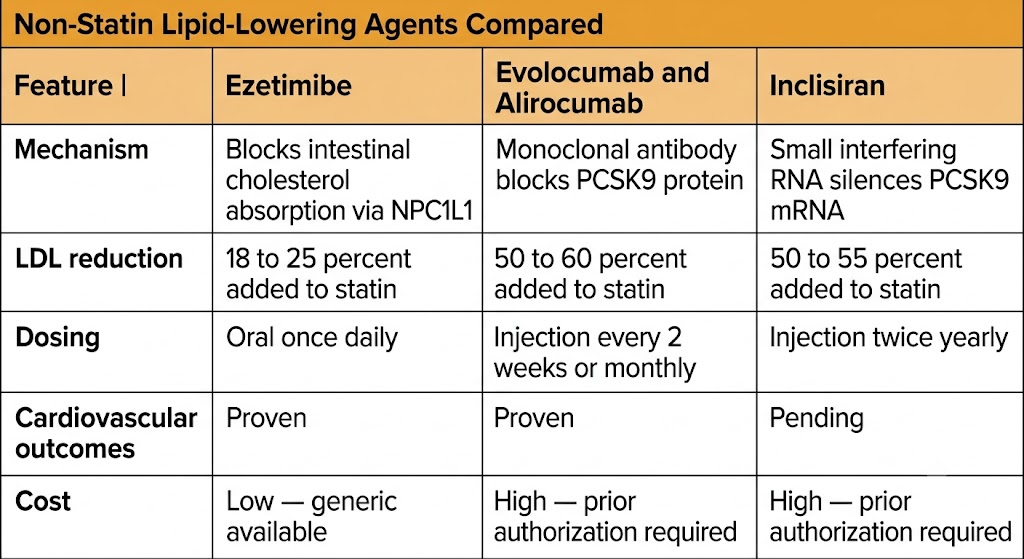
| Feature | Ezetimibe | Evolocumab / Alirocumab | Inclisiran |
|---|---|---|---|
| Mechanism | Niemann-Pick C1-Like 1 inhibition — blocks intestinal cholesterol absorption | Monoclonal antibody — blocks proprotein convertase subtilisin/kexin type 9 protein | Small interfering ribonucleic acid — silences proprotein convertase subtilisin/kexin type 9 messenger ribonucleic acid |
| Low-density lipoprotein cholesterol reduction | 18–20% monotherapy; 18–25% added to statin | 50–60% added to statin | 50–55% added to statin |
| Route and frequency | Oral, once daily | Subcutaneous injection, every 2 weeks or monthly | Subcutaneous injection, twice yearly (after initial loading) |
| Cardiovascular outcomes evidence | Proven (post-acute coronary syndrome trial) | Proven (major outcomes trials) | Pending (outcomes trial awaited) |
| Drug interactions | Minimal — no cytochrome P450 involvement | None — protein catabolism pathway | None — intrahepatic ribonucleic acid mechanism |
| Cost | Low (generic available) | High (prior authorization required) | High (prior authorization required) |
Practical Selection Guide
First non-statin addition: always ezetimibe — inexpensive, generic, proven, oral, no interactions.
Need maximal low-density lipoprotein cholesterol reduction urgently (post-acute coronary syndrome, very high baseline): evolocumab or alirocumab — fastest onset, definitive cardiovascular outcomes evidence.
Adherence is the primary concern, or twice-yearly dosing is preferred: inclisiran — twice-yearly healthcare provider administration, comparable efficacy.
All three proprotein convertase subtilisin/kexin type 9 inhibitors require prior authorization. Most payers require documented use of statin plus ezetimibe before approving a proprotein convertase subtilisin/kexin type 9 inhibitor.
| Author / Organization | Title | Source |
|---|---|---|
| Ballantyne CM, Houri J, Notarbartolo A, et al; Ezetimibe Study Group. | Effect of ezetimibe coadministered with atorvastatin in 628 patients with primary hypercholesterolemia: a prospective, randomized, double-blind trial. | Circulation. 2003;107(19):2409–2415 |
| Cannon CP, Blazing MA, Giugliano RP, et al; IMPROVE-IT Investigators. | Ezetimibe added to statin therapy after acute coronary syndromes. | N Engl J Med. 2015;372(25):2387–2397 |
| Seidah NG, Awan Z, Chrétien M, Mbikay M. | PCSK9: a key modulator of cardiovascular health. | Circ Res. 2014;114(6):1022–1036 |
| Sabatine MS, Giugliano RP, Keech AC, et al; FOURIER Steering Committee and Investigators. | Evolocumab and clinical outcomes in patients with cardiovascular disease. | N Engl J Med. 2017;376(18):1713–1722 |
| Schwartz GG, Steg PG, Szarek M, et al; ODYSSEY OUTCOMES Committees and Investigators. | Alirocumab and cardiovascular outcomes after acute coronary syndrome. | N Engl J Med. 2018;379(22):2097–2107 |
| Ray KK, Wright RS, Kallend D, et al; ORION-10 and ORION-11 Investigators. | Two phase 3 trials of inclisiran in patients with elevated LDL cholesterol. | N Engl J Med. 2020;382(16):1507–1519 |
| Grundy SM, Stone NJ, Bailey AL, et al. | 2018 AHA/ACC Guideline on the Management of Blood Cholesterol. | J Am Coll Cardiol. 2019;73(24):e285–e350 |
| Mach F, Baigent C, Catapano AL, et al. | 2019 ESC/EAS Guidelines for the management of dyslipidaemias. | Eur Heart J. 2020;41(1):111–188 |
| Giugliano RP, Pedersen TR, Park JG, et al; FOURIER Investigators. | Clinical efficacy and safety of achieving very low LDL-cholesterol concentrations with the PCSK9 inhibitor evolocumab. | Lancet. 2017;390(10106):1962–1971 |
| Baigent C, Blackwell L, Emberson J, et al; Cholesterol Treatment Trialists Collaboration. | Efficacy and safety of more intensive lowering of LDL cholesterol: a meta-analysis of data from 170,000 participants in 26 randomised trials. | Lancet. 2010;376(9753):1670–1681 |