Introduction to Medical Pharmacology
Central Nervous System and Cardiovascular Effects of Inhalational Anesthetics
Chapter 14 · Module 3 of 5Section 1
The central nervous system and cardiovascular system are simultaneously the targets and the dose-limiting toxicity sites of inhalational anesthetics
Inhalational anesthetics produce their desired effects — unconsciousness and immobility — through actions on the central nervous system. But the same central nervous system effects extend beyond consciousness suppression to alter cerebral blood flow, cerebral metabolic rate, intracranial pressure, and seizure threshold. Simultaneously, the cardiovascular system is profoundly affected: blood pressure, heart rate, myocardial contractility, and vascular resistance are all modified in ways that are both agent-specific and dose-dependent. Understanding these effects is the foundation for safe agent selection, dose management, and anticipation of adverse events — especially in patients with neurological or cardiac disease.
Section 2
How inhalational agents suppress neuronal activity and the key tension between metabolic protection and intracranial pressure elevation
All inhalational anesthetics suppress central nervous system neuronal activity, producing unconsciousness through potentiation of gamma-aminobutyric acid type A receptor-mediated inhibition and, for nitrous oxide, N-methyl-D-aspartate receptor antagonism. This suppression produces characteristic dose-dependent electroencephalographic changes: progressive slowing, increasing amplitude, burst suppression, and ultimately an isoelectric tracing at supratherapeutic concentrations. Isoflurane most readily produces burst suppression at 1.5 to 2 minimum alveolar concentration — a property exploited to provide maximal metabolic protection during brief periods of deliberate vascular occlusion in neurosurgery.
Two central nervous system effects exist in clinical tension with each other. All volatile agents reduce the cerebral metabolic rate for oxygen — a desirable property that reduces the brain's vulnerability to ischemia. At the same time, all volatile agents cause cerebral vasodilation and increase cerebral blood flow, which raises intracranial blood volume and can elevate intracranial pressure in patients with reduced intracranial compliance. Managing this tension — maximizing metabolic protection while controlling intracranial pressure — is the defining challenge of neuroanesthesia.
Section 3
Enflurane is the only volatile anesthetic with clinically significant epileptogenic potential
The relationship between inhalational anesthetics and seizure activity is agent-specific. Enflurane is the clear outlier: at concentrations above approximately 2 minimum alveolar concentration, particularly in the presence of hypocapnia (which lowers seizure threshold), enflurane produces electroencephalographic spike-and-wave complexes and can induce generalized tonic-clonic seizures even in patients without pre-existing epilepsy. This epileptogenic property is concentration-dependent and was a primary reason for enflurane's displacement by isoflurane and sevoflurane.
Isoflurane, sevoflurane, and desflurane do not have meaningful epileptogenic potential at clinical doses and are safe in patients with seizure disorders. Isoflurane at high doses produces burst suppression — an antiepileptiform pattern. Isolated reports of electroencephalographic spike activity with sevoflurane during high-concentration induction exist, particularly in children, but overt clinical seizures attributable to sevoflurane are exceedingly rare. Halothane has no epileptogenic potential. Nitrous oxide may provide mild anticonvulsant effect through its N-methyl-D-aspartate receptor antagonism.
Seizure Risk Summary
Contraindicated in seizure disorders: enflurane — the only epileptogenic volatile anesthetic.
Safe in seizure disorders: isoflurane, sevoflurane, desflurane, halothane, nitrous oxide.
Aggravating factor: hypocapnia lowers seizure threshold and potentiates enflurane's epileptogenic effect.
Section 4
Volatile agents dilate cerebral vessels; this effect can be attenuated by controlled hyperventilation
All volatile halogenated anesthetics cause dose-dependent cerebral vasodilation, increasing cerebral blood flow at concentrations above approximately 0.5 minimum alveolar concentration. This effect is a direct action on cerebrovascular smooth muscle, independent of changes in cerebral metabolic rate. The magnitude differs among agents: halothane produces the greatest cerebral blood flow increase at equivalent doses, while isoflurane and sevoflurane produce more modest increases. Desflurane is intermediate and similar to isoflurane.
Critically, this vasodilation can be substantially counteracted by controlled hyperventilation. Reducing the arterial carbon dioxide partial pressure through deliberate hyperventilation causes cerebral vasoconstriction via carbon dioxide-mediated changes in perivascular pH, largely offsetting the anesthetic-induced vasodilation. This is the pharmacological rationale for mild hyperventilation in neurosurgical patients — it blunts the anesthetic-induced rise in cerebral blood flow and intracranial pressure. The carbon dioxide vasomotor reactivity of cerebral vessels is preserved during inhalational anesthesia, making this a reliable and rapid intervention.
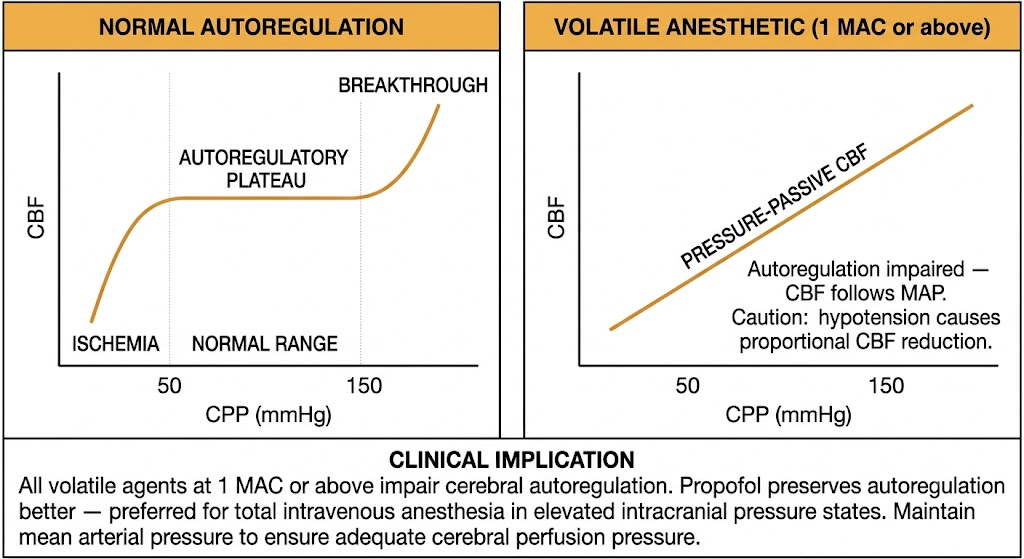
Cerebral autoregulation is the ability of the cerebral vasculature to maintain relatively constant blood flow across a range of cerebral perfusion pressures (approximately 50 to 150 mmHg in healthy adults) by adjusting cerebrovascular resistance. Below the lower limit, vasodilation is maximal and blood flow falls passively with further pressure decreases, risking ischemia. Above the upper limit, forced vasodilation occurs with risk of hypertensive encephalopathy.
Volatile anesthetic agents impair cerebral autoregulation in a dose-dependent fashion. At concentrations of 1 minimum alveolar concentration or above, all volatile agents substantially reduce autoregulatory capacity, making cerebral blood flow more directly dependent on mean arterial pressure. Under deep volatile anesthesia, hypotension causes proportional reductions in cerebral blood flow, while hypertension causes proportional increases and potentially elevated intracranial pressure. This has direct implications for hemodynamic management in neurosurgical patients, where maintaining mean arterial pressure within a range that supports adequate cerebral perfusion pressure is a primary goal. Propofol, at clinical doses, preserves cerebral autoregulation better than volatile agents — one rationale for preferring total intravenous anesthesia in patients with compromised intracranial compliance.
Section 5
The Monro-Kellie doctrine explains why volatile agent-induced cerebral vasodilation raises intracranial pressure in vulnerable patients
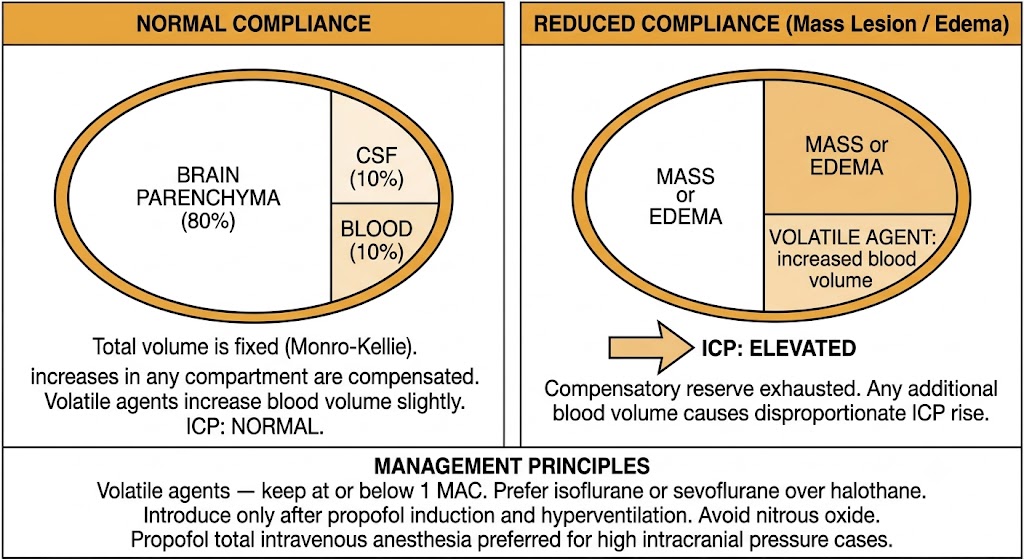
The cranial vault is a rigid compartment of fixed total volume. Its contents — brain parenchyma, cerebrospinal fluid, and intracranial blood — must sum to a constant. Any increase in one component must be compensated by a decrease in another, or intracranial pressure rises. In a patient with normal intracranial compliance (normal brain, no mass lesion), the modest increase in intracranial blood volume caused by volatile agent-induced vasodilation produces only a transient, easily compensated rise in intracranial pressure. In a patient with reduced intracranial compliance — mass lesion, traumatic brain injury, cerebral edema, or hydrocephalus — the same increase in blood volume produces a disproportionate and potentially dangerous intracranial pressure elevation.
When volatile agents are used in patients with elevated intracranial pressure or reduced intracranial compliance, several principles apply. Concentrations should be kept at or below 1 minimum alveolar concentration. Agents with the least cerebral vasodilatory effect — isoflurane or sevoflurane — are preferred over halothane. Volatile agents should be introduced only after induction with propofol (which reduces cerebral blood flow and cerebral metabolic rate without vasodilation) and after establishing hyperventilation. Nitrous oxide should generally be avoided in neurosurgical patients because it increases cerebral blood flow, increases cerebral metabolic rate, and can expand any intracranial gas collection.
Total intravenous anesthesia with propofol is often preferred for high-intracranial-pressure cases because propofol reduces both cerebral blood flow and cerebral metabolic rate without the vasodilatory liability of volatile agents, and it better preserves cerebral autoregulation.
Several drug classes are used to reduce intracranial pressure by targeting different compartments of the Monro-Kellie equation. These are high-yield for understanding the pharmacological management of neurosurgical patients.
Intracranial Pressure Reduction
Mannitol
Intracranial Pressure Reduction
Hyperventilation and Dexamethasone
Section 6
All volatile agents reduce blood pressure, but through different mechanisms with different clinical implications
All inhalational anesthetics reduce mean arterial pressure in a dose-dependent fashion, but the mechanism differs importantly among agents and determines which patients tolerate each agent better.
Halothane reduces blood pressure primarily through direct myocardial depression — it reduces cardiac output by depressing contractility and suppressing sinoatrial node automaticity, causing bradycardia. Systemic vascular resistance is relatively maintained. Patients with impaired myocardial function tolerate this mechanism poorly.
Isoflurane, sevoflurane, and desflurane (at stable concentrations) reduce blood pressure primarily through peripheral vasodilation, lowering systemic vascular resistance. Cardiac output is relatively preserved because reduced afterload maintains stroke volume, and baroreceptor reflexes increase heart rate to compensate for vasodilation. This mechanism is better tolerated in patients with impaired myocardial function compared to halothane, because cardiac output is maintained despite falling blood pressure.
Halothane causes bradycardia through direct depression of sinoatrial node automaticity and sensitization to vagal tone — this is distinct from all modern agents. Isoflurane, sevoflurane, and nitrous oxide maintain or mildly increase heart rate through baroreceptor-mediated sympathetic reflexes in response to vasodilation. Desflurane at stable concentrations has a similar profile to isoflurane, but when the inspired concentration is rapidly increased, a marked transient sympathetic discharge produces tachycardia and hypertension — a property unique to desflurane and clinically important in patients with coronary artery disease.
Hypoxic pulmonary vasoconstriction is the physiological mechanism by which pulmonary blood flow is diverted away from poorly ventilated lung segments, maintaining ventilation-perfusion matching and oxygenation. All volatile halogenated agents inhibit hypoxic pulmonary vasoconstriction in a dose-dependent manner, worsening intrapulmonary shunting and contributing to intraoperative hypoxemia — this is particularly relevant during one-lung ventilation for thoracic surgery. Propofol does not inhibit hypoxic pulmonary vasoconstriction, making total intravenous anesthesia with propofol the preferred technique when oxygenation is marginal during one-lung ventilation.
Cardiovascular Profile
Halothane
Cardiovascular Profile
Isoflurane / Sevoflurane
Cardiovascular Profile
Desflurane
| Author / Organization | Title | Source |
|---|---|---|
| Miller RD, ed. | Miller's Anesthesia, 8th ed. Chapters 27, 57 | Philadelphia: Elsevier; 2015 |
| Stoelting RK, Hillier SC | Pharmacology and Physiology in Anesthetic Practice, 4th ed. | Philadelphia: Lippincott Williams & Wilkins; 2006 |
| Franks NP | Molecular targets underlying general anaesthesia | Br J Pharmacol. 2006;147(Suppl 1):S72–S81 |
| Voss LJ, et al. | The howling cortex: seizures and general anesthetic drugs | Anesth Analg. 2008;107(5):1689–1703 |
| Cottrell JE, Patel P, eds. | Cottrell and Patel's Neuroanesthesia, 6th ed. Chapters 3, 4, 9 | Philadelphia: Elsevier; 2017 |
| Naguib M, et al. | Conceptual and technical insights into the basis of neuromuscular monitoring | Anaesthesia. 2017;72(Suppl 1):16–37 |
| Weiskopf RB, et al. | Rapid increase in desflurane concentration is associated with greater transient cardiovascular stimulation than rapid increases in isoflurane concentration in humans | Anesthesiology. 1994;80(5):1035–1045 |
| Johnston RR, Eger EI 2nd, Wilson C | A comparative interaction of epinephrine with enflurane, isoflurane, and halothane in man | Anesth Analg. 1976;55(5):709–712 |
| Flood P, Rathmell JP, Shafer SL, eds. | Stoelting's Pharmacology and Physiology in Anesthetic Practice, 5th ed. | Philadelphia: Wolters Kluwer; 2015 |