Introduction to Medical Pharmacology
Pulmonary, Hepatic, Renal, Skeletal Muscle, and Obstetrical Effects
Chapter 14 · Module 4 of 5Section 1
Organ-specific adverse effects that inform agent selection and clinical vigilance
Inhalational anesthetics affect every major organ system, not only the central nervous system and cardiovascular system covered in Module 3. This module addresses the pulmonary, hepatic, renal, skeletal muscle, and obstetrical effects — organ systems where volatile agent pharmacology intersects with some of the most clinically consequential adverse effects in anesthesia practice. Malignant hyperthermia is the highest-yield topic in this module and receives the most detailed coverage.
Section 2
Respiratory depression, bronchodilation, and inhibition of hypoxic pulmonary vasoconstriction
All inhalational anesthetics produce dose-dependent respiratory depression by suppressing central respiratory drive in the medullary respiratory centers and blunting chemoreceptor responsiveness. The resulting breathing pattern is rapid and shallow — tidal volume falls while respiratory rate may increase, producing net hypoventilation and hypercapnia under spontaneous breathing conditions. This pattern is in contrast to opioid-induced respiratory depression, which primarily slows rate while preserving tidal volume.
The ventilatory response to rising carbon dioxide is progressively blunted in a dose-dependent manner. At 1 minimum alveolar concentration, this response is reduced by approximately half; at 2 minimum alveolar concentration, it is nearly abolished. Controlled mechanical ventilation is therefore standard practice during general anesthesia for most surgical procedures. The hypoxic ventilatory response — the increase in ventilation triggered by falling arterial oxygen tension, mediated by carotid body chemoreceptors — is even more sensitive to volatile agents and is substantially impaired at subanesthetic concentrations. This explains the rationale for supplemental oxygen and pulse oximetry monitoring throughout the recovery period.
All volatile halogenated anesthetics produce bronchodilation through direct relaxation of bronchial smooth muscle, independent of the autonomic nervous system. Sevoflurane and halothane are the most potent bronchodilators and are preferred in patients with asthma or reactive airways disease. Desflurane at high concentrations is an airway irritant that can paradoxically trigger reflex bronchoconstriction in reactive airways, making it unsuitable in this population.
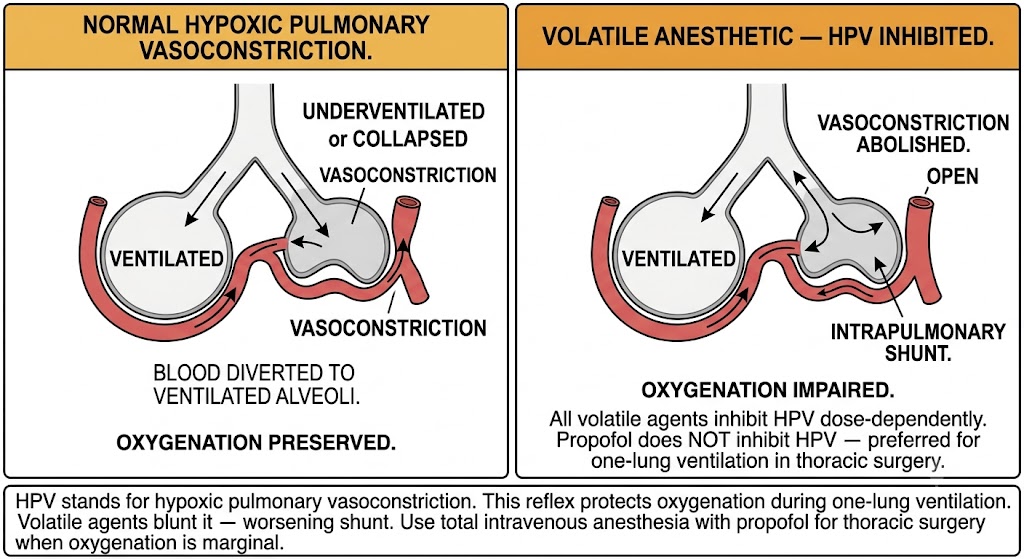
Hypoxic pulmonary vasoconstriction is the physiological reflex that diverts blood flow away from poorly ventilated lung regions, preserving arterial oxygenation. All volatile halogenated agents inhibit this reflex in a dose-dependent manner, worsening intrapulmonary shunting and contributing to hypoxemia — particularly during one-lung ventilation for thoracic surgery. Propofol does not inhibit hypoxic pulmonary vasoconstriction and is preferred for total intravenous anesthesia during thoracic procedures requiring one-lung ventilation.
Section 3
A rank order of hepatotoxic risk based on the degree of trifluoroacetylation of liver proteins
Halothane hepatitis was covered in detail in Module 2. This section focuses on the comparative hepatotoxicity framework across volatile agents.
All halogenated volatile agents that undergo oxidative hepatic metabolism via the cytochrome P450 2E1 enzyme produce trifluoroacetyl chloride, a reactive intermediate that covalently modifies liver proteins. These trifluoroacetylated proteins act as neoantigens capable of triggering immune-mediated hepatitis. The risk of hepatitis is directly proportional to the degree of trifluoroacetylation, which in turn reflects the fraction of the agent that undergoes this metabolic pathway:
| Agent | Hepatic Metabolism | Clinical Hepatotoxicity Risk |
|---|---|---|
| Halothane | ~20% (highest) | Highest risk — immune hepatitis in approximately 1 in 35,000 exposures; potentially fatal on re-exposure |
| Enflurane | ~2–5% | Very low risk — rare cross-reactive hepatitis; largely of historical interest |
| Isoflurane | ~0.2% | Very low risk — rare case reports, usually with prior halothane sensitization |
| Sevoflurane | ~3–5% (different pathway) | Minimal risk — generates hexafluoroisopropanol, not trifluoroacetylated proteins; hepatitis exceedingly rare |
| Desflurane | <0.02% (lowest) | Negligible risk — preferred volatile agent in patients with prior halothane hepatitis history |
Clinical Rule: Prior Halothane Hepatitis
Re-exposure to halothane after a sensitizing exposure dramatically increases the risk of fatal immune-mediated hepatitis and is absolutely contraindicated. In a patient with documented prior halothane hepatitis, use desflurane (lowest trifluoroacetylation) or sevoflurane (different metabolic pathway) as the volatile agent, or use total intravenous anesthesia to avoid volatile agents entirely.
Section 4
A pharmacogenetic crisis triggered by volatile anesthetic agents and succinylcholine, treated with dantrolene
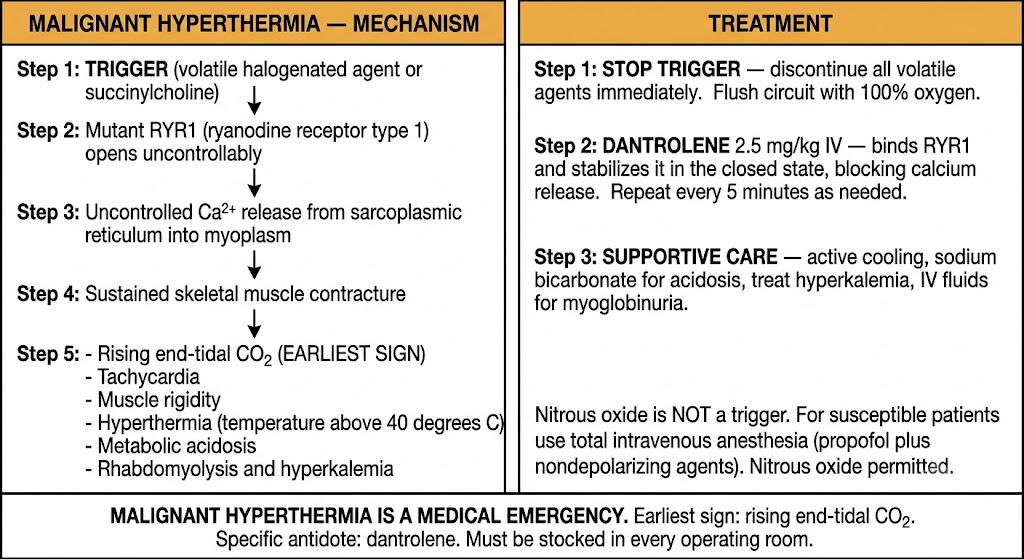
Malignant hyperthermia is a potentially lethal pharmacogenetic disorder of skeletal muscle calcium homeostasis. It is caused primarily by mutations in the ryanodine receptor type 1 gene, which encodes the sarcoplasmic reticulum calcium release channel in skeletal muscle. These gain-of-function mutations produce a channel that is pathologically sensitive to triggering agents, causing uncontrolled calcium release when exposed to them. Inheritance is autosomal dominant with variable penetrance — first-degree relatives of an affected individual have a 50% probability of carrying the mutation.
All volatile halogenated anesthetic agents — halothane, isoflurane, sevoflurane, desflurane, and enflurane — are triggering agents. Succinylcholine, the depolarizing neuromuscular blocking agent, is also a trigger and is often the first drug given in an anesthetic sequence. Nitrous oxide is not a triggering agent for malignant hyperthermia — this distinction is critical for planning anesthesia in susceptible patients.
Exposure to a triggering agent in a susceptible individual causes the mutant ryanodine receptor to open uncontrollably, flooding the myoplasm with calcium from the sarcoplasmic reticulum. The resulting massive, sustained skeletal muscle contracture drives a hypermetabolic crisis: adenosine triphosphate is consumed faster than it can be produced, generating heat, carbon dioxide, and lactic acid at extraordinary rates. Rhabdomyolysis releases myoglobin, potassium, and creatine kinase into the circulation.
The earliest and most sensitive sign of malignant hyperthermia is a rapid, unexplained rise in end-tidal carbon dioxide that cannot be explained by changes in ventilation. This precedes temperature elevation by minutes to hours. Other early signs are tachycardia and masseter muscle rigidity (jaw rigidity after succinylcholine is a warning sign). As the crisis evolves: generalized muscle rigidity, hyperthermia (temperature may rise 1 to 2 degrees Celsius per minute, reaching above 40 to 41 degrees Celsius), metabolic and respiratory acidosis, rhabdomyolysis, hyperkalemia, and cardiovascular collapse follow.
Malignant Hyperthermia: Earliest Sign
Rapidly rising end-tidal carbon dioxide that cannot be explained by changes in ventilation is the earliest and most sensitive sign of malignant hyperthermia. Hyperthermia is a late sign. Act on rising carbon dioxide — do not wait for fever.
Treatment of malignant hyperthermia is a medical emergency requiring immediate action on several fronts simultaneously.
Step 1 — Immediate
Stop the Trigger
Step 2 — Specific Antidote
Dantrolene
Step 3 — Supportive Care
Treat Consequences
Prevention
Susceptible Patients
Section 5
Uterine relaxation and placental transfer are the two key pharmacological properties governing volatile agent use in obstetrics
All volatile halogenated anesthetics produce dose-dependent relaxation of uterine smooth muscle. This is the most clinically important direct obstetrical effect of volatile agents. At maintenance concentrations used during cesarean section under general anesthesia (approximately 0.5 to 0.75 minimum alveolar concentration), uterine atony and increased postpartum hemorrhage risk are real but manageable concerns, particularly when combined with prompt oxytocin administration after delivery. At concentrations above 1.5 minimum alveolar concentration, uterine atony can become severe and life-threatening.
This uterine relaxant property is not always undesirable. In specific obstetric emergencies requiring deliberate relaxation of the uterus — retained placenta requiring manual removal, uterine inversion requiring manual reduction — inhalational anesthesia with a volatile agent is the most rapidly titratable pharmacological approach. Nitroglycerin given intravenously provides a rapid alternative uterine relaxant without systemic anesthetic effects.
All volatile agents cross the placenta readily by passive diffusion — they are small, lipid-soluble, non-ionized molecules. Fetal blood concentrations approach maternal concentrations within minutes of maternal induction, making fetal drug exposure a function of time from induction to delivery. This is the pharmacokinetic basis for minimizing the induction-to-delivery interval during cesarean section under general anesthesia. At the concentrations and intervals used in clinical practice, neonatal respiratory depression from transplacental volatile anesthetic accumulation is generally mild and responsive to standard neonatal resuscitation.
General Anesthesia for Cesarean Section: Key Principles
Aspiration risk: the pregnant patient has delayed gastric emptying and reduced lower esophageal sphincter tone — aspiration prophylaxis (sodium citrate, H2 blocker or proton pump inhibitor, metoclopramide) is mandatory before induction.
Volatile agent concentration: keep at or below 0.5 to 0.75 minimum alveolar concentration to limit uterine relaxation and postpartum hemorrhage risk.
After delivery: reduce volatile agent concentration, add opioid (withheld before delivery to avoid neonatal respiratory depression), administer oxytocin to promote uterine contraction.
Nitrous oxide in obstetrics: 50% nitrous oxide provides moderate analgesia for labor through N-methyl-D-aspartate receptor antagonism; minimal uterine relaxation at this concentration; crosses the placenta but brief exposure is clinically acceptable.
Section 6
Fluoride-related nephrotoxicity risk is agent-specific and depends on both systemic fluoride levels and the site of metabolism
All volatile anesthetics transiently reduce renal blood flow and glomerular filtration rate through hemodynamic effects — reduced cardiac output and renal vasoconstriction. These effects are clinically insignificant in patients with normal renal reserve and reverse with emergence. In patients with pre-existing renal impairment, any additional reduction in renal perfusion during anesthesia may contribute to perioperative acute kidney injury.
Beyond hemodynamics, two specific renal toxicity mechanisms are important:
Inorganic fluoride generated by volatile agent metabolism can cause a vasopressin-resistant (nephrogenic) diabetes insipidus — a high-output renal failure syndrome — when intrarenal fluoride concentrations are sufficiently high. This mechanism was first characterized with methoxyflurane, a now-discontinued volatile agent that underwent approximately 50% metabolism, generating very high systemic and intrarenal fluoride concentrations. Enflurane generates lower systemic fluoride concentrations and may cause mild, subclinical reductions in urinary concentrating ability after prolonged use.
Sevoflurane generates systemic fluoride concentrations that transiently exceed the threshold associated with methoxyflurane toxicity, but clinically significant nephrotoxicity has not been demonstrated. The key difference: methoxyflurane was substantially metabolized within the kidney itself, producing high local fluoride concentrations at the site of tubular toxicity. Sevoflurane is metabolized primarily in the liver, so intrarenal fluoride generation is insufficient to cause tubular injury despite elevated systemic levels. The fluoride threshold concept from methoxyflurane does not translate directly to sevoflurane nephrotoxicity risk.
Sevoflurane degrades in contact with carbon dioxide absorbents at low fresh gas flows to produce compound A, a vinyl ether that causes nephrotoxicity in rats. Human nephrotoxicity from compound A has not been demonstrated in clinical trials, likely because the metabolic pathway responsible for nephrotoxic activation in rats is quantitatively less active in humans. Caution is nevertheless advised in patients with pre-existing chronic kidney disease undergoing prolonged procedures at very low fresh gas flows.
| Author / Organization | Title | Source |
|---|---|---|
| Miller RD, ed. | Miller's Anesthesia, 8th ed. Chapters 27, 77 | Philadelphia: Elsevier; 2015 |
| Enkin M, et al. | A Guide to Effective Care in Pregnancy and Childbirth, 3rd ed. | Oxford: Oxford University Press; 2000 |
| Dahan A, et al. | Sex-related differences in the influence of morphine on ventilatory control in humans | Anesthesiology. 1998;88(4):903–913 |
| Goff MJ, et al. | Absence of bronchodilation during desflurane anesthesia: a comparison to sevoflurane and thiopental | Anesthesiology. 2000;93(2):404–408 |
| Kenna JG, et al. | Halothane hepatitis in children | Br Med J (Clin Res Ed). 1987;294(6581):1209–1211 |
| Njoku D, et al. | Biotransformation of halothane, enflurane, isoflurane, and desflurane to trifluoroacetylated liver proteins | Anesth Analg. 1997;84(1):173–178 |
| Wulf H, et al. | Neuromuscular blocking effects of rocuronium during desflurane, isoflurane, and sevoflurane anesthesia | Can J Anaesth. 1998;45(6):526–532 |
| Rosenberg H, et al. | Malignant hyperthermia: a review | Orphanet J Rare Dis. 2015;10:93 |
| Kharasch ED | Sevoflurane and renal toxicity | Curr Opin Anaesthesiol. 1998;11(4):377–381 |
| Flood P, Rathmell JP, Shafer SL, eds. | Stoelting's Pharmacology and Physiology in Anesthetic Practice, 5th ed. | Philadelphia: Wolters Kluwer; 2015 |
| Stoelting RK, Hillier SC | Pharmacology and Physiology in Anesthetic Practice, 4th ed. | Philadelphia: Lippincott Williams & Wilkins; 2006 |
| Mhyre JM, Healy D | The unanticipated difficult intubation in obstetrics | Anesth Analg. 2011;112(3):648–652 |
| Mushambi MC, et al. | Obstetric Anesthetists' Association and Difficult Airway Society guidelines for the management of difficult and failed tracheal intubation in obstetrics | Anaesthesia. 2015;70(11):1286–1306 |