Introduction to Medical Pharmacology
Clinical Pharmacology, Special Populations, and Treatment Algorithms
Chapter 16 · Module 6 of 6Section 1
How organ impairment, aging, and dementia alter antipsychotic pharmacokinetics and require dose or agent adjustments
The pharmacokinetic profiles established in earlier modules assume adults with intact organ function. In clinical practice, the populations most commonly prescribed antipsychotics include elderly patients with reduced renal and hepatic reserve, patients with comorbid organ impairment, and those with dementia. Understanding how each special population modifies the standard pharmacokinetic framework is essential for safe prescribing.
Most antipsychotics are extensively metabolized by hepatic cytochrome P450 enzymes and are therefore subject to clinically meaningful pharmacokinetic changes in hepatic impairment. Reduced hepatic blood flow and decreased cytochrome P450 enzyme activity in cirrhosis prolong half-lives and increase peak plasma concentrations by reducing first-pass metabolism. Olanzapine, quetiapine, clozapine, aripiprazole, and risperidone all require dose reduction or slower titration in moderate to severe hepatic impairment.
Paliperidone is the important exception: because it is renally cleared with minimal hepatic metabolism, its dosing is largely unaffected by hepatic impairment and it may be preferred in patients with significant liver disease. Haloperidol and other first-generation antipsychotics are similarly subject to impaired clearance in liver disease, with increased extrapyramidal symptom risk at standard doses due to elevated plasma levels.
Most antipsychotics undergo negligible renal clearance of the parent drug and are relatively unaffected by reduced kidney function. Paliperidone is the principal exception — approximately 59 percent is excreted unchanged in the urine, requiring dose reduction when creatinine clearance falls below 80 milliliters per minute, with substantial reductions at lower clearance rates. The active metabolite of risperidone (paliperidone) also accumulates in renal insufficiency, warranting risperidone dose reduction proportional to the degree of renal function decline.
Elderly patients require systematically lower antipsychotic doses for several converging reasons: reduced hepatic cytochrome P450 enzyme activity prolongs half-lives; reduced renal clearance accumulates renally excreted metabolites; decreased plasma protein binding increases the free fraction of highly protein-bound agents; and reduced baseline nigrostriatal dopamine reserve substantially lowers the threshold for drug-induced parkinsonism. Pharmacodynamic sensitivity to anticholinergic effects (cognitive impairment, urinary retention), orthostatic hypotension (fall and fracture risk), and QTc prolongation is also substantially increased in elderly patients compared with younger adults.
As a practical consequence, dose initiation in elderly patients should begin at 25 to 50 percent of the standard adult starting dose with slower titration. Quetiapine at low doses is commonly chosen in elderly patients for its negligible extrapyramidal symptom and drug-induced parkinsonism risk. Clozapine, while highly effective for treatment-resistant conditions, carries disproportionate risks in the elderly due to orthostatic hypotension, sedation, and cognitive impairment from its anticholinergic and histamine H1 blocking properties.
All antipsychotics carry a Food and Drug Administration black-box warning for increased mortality in elderly patients with dementia-related psychosis. Meta-analyses demonstrated an approximately 1.6 to 1.7-fold increase in all-cause mortality — predominantly cardiovascular and infectious causes — compared with placebo in this population. This warning applies to both first-generation and second-generation antipsychotics.
The appropriate clinical response is not categorically refusing to use antipsychotics in dementia but to use them only after non-pharmacological interventions have been exhausted, at the lowest effective dose, for the shortest duration necessary, with documented informed consent from the patient or surrogate, and with regular reassessment of ongoing need. Quetiapine is most commonly used in this context, primarily because of its tolerability profile despite limited evidence for efficacy in behavioral and psychological symptoms of dementia.
Section 2
Antipsychotic use during pregnancy, lactation, and in pediatric populations: balancing maternal and fetal risk
Managing psychiatric illness during pregnancy requires balancing the risks of antipsychotic exposure to the fetus against the substantial risks of untreated maternal psychosis — preterm birth, poor prenatal care, and postpartum psychosis. For most women with schizophrenia or bipolar disorder, continuation of effective antipsychotic treatment during pregnancy is the appropriate clinical decision.
No antipsychotic is categorically contraindicated in pregnancy. Available data, primarily from registries and observational studies, do not demonstrate a consistent pattern of major fetal malformations attributable to antipsychotics as a class. The most consistently documented neonatal risk is neonatal adaptation syndrome — extrapyramidal symptoms, sedation, feeding difficulties, and respiratory distress in newborns exposed to antipsychotics during the third trimester. This requires neonatal monitoring at delivery but is not a reason to discontinue treatment.
Haloperidol has the most extensive historical safety data in pregnancy of any antipsychotic. Among second-generation agents, quetiapine and olanzapine have the largest pregnancy exposure registries. Clozapine exposure in pregnancy is associated with neonatal seizures and requires extra vigilance. Metabolic monitoring during pregnancy is particularly important with clozapine and olanzapine given their elevated gestational diabetes risk. Regarding lactation, most antipsychotics are excreted in breast milk, though infant exposure levels are generally low. Haloperidol, quetiapine, and olanzapine have the most data supporting relative safety in breastfeeding with careful infant monitoring.
Antipsychotic use in pediatric populations is governed by a limited set of approved indications. Food and Drug Administration-approved pediatric indications include schizophrenia (aripiprazole, quetiapine, paliperidone, risperidone, and olanzapine from age 13; clozapine for treatment-resistant schizophrenia in adolescents), bipolar I mania (aripiprazole and quetiapine from age 10; risperidone from age 10; olanzapine from age 13), irritability associated with autistic disorder (aripiprazole from age 6; risperidone from age 5), and Tourette syndrome (aripiprazole from age 6).
Children and adolescents are more sensitive than adults to antipsychotic-induced weight gain and metabolic effects. Metabolic monitoring in pediatric patients should follow the same schedule as adults, with particular attention to the longer time horizon of antipsychotic exposure beginning in childhood. Prolactin elevation is clinically significant in adolescent females given its effects on pubertal development and bone density accumulation during a critical developmental window.
Untreated schizophrenia in pregnancy carries real and serious risks: inadequate prenatal care, self-harm, poor nutrition, preterm delivery, and postpartum psychosis. The risks of antipsychotic exposure must be weighed against these risks — not against the risk of a healthy person taking no medication. For most patients, continuation is the safer choice. The decision is individualized, not categorical.
Section 3
Defining treatment resistance, the evidence base for clozapine, timing of initiation, and strategies when clozapine fails
Treatment-resistant schizophrenia is defined by failure to achieve adequate symptom control despite two adequate antipsychotic trials at adequate doses for adequate durations. Approximately 20 to 30 percent of patients with schizophrenia meet this definition. Clozapine is the only antipsychotic with demonstrated superior efficacy in this population — and the delay between meeting treatment-resistant schizophrenia criteria and receiving clozapine is one of the most consequential and preventable clinical failures in schizophrenia care.
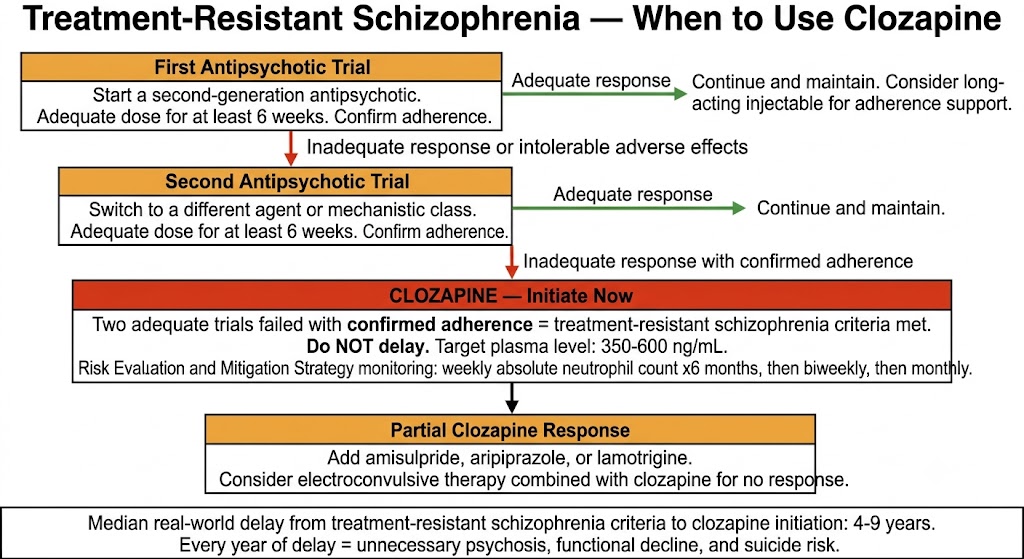
The most widely used operational definition requires failure of at least two antipsychotics from different chemical classes at doses equivalent to at least 600 milligrams per day of chlorpromazine equivalents for at least 6 weeks each, with confirmed medication adherence. The requirement for confirmed adherence is essential — apparent treatment resistance due to non-adherence is common and must be excluded before the treatment-resistant schizophrenia label is applied. Plasma level monitoring, pill counts, and long-acting injectable formulations are all tools for confirming adherence.
Clozapine produces meaningful clinical response in approximately 30 to 60 percent of confirmed treatment-resistant schizophrenia patients — compared with near-zero response rates to further trials of standard antipsychotics in this population. No other agent, strategy, or augmentation has been shown to match clozapine's response rates. Clozapine should be initiated after the second antipsychotic trial failure, not as a last resort after exhausting every other available option. Current evidence consistently shows that the median delay from treatment-resistant schizophrenia criteria being met to clozapine initiation is 4 to 9 years in real-world practice — representing years of unnecessary positive symptom burden, progressive functional decline, and preventable suicide risk.
Plasma clozapine level monitoring, with a target of 350 to 600 nanograms per milliliter, is recommended to confirm therapeutic exposure before declaring clozapine failure. Apparent non-response at a plasma level below 350 nanograms per milliliter represents inadequate dosing rather than true clozapine resistance.
When clozapine at therapeutic plasma levels produces partial but incomplete response, augmentation strategies are employed. The most studied augmentation is adding a second antipsychotic — most commonly amisulpride or aripiprazole — to clozapine. Aripiprazole augmentation of clozapine produces metabolic benefits (weight reduction, improved glucose and lipid profiles) and may provide modest additional antipsychotic effect. Lamotrigine augmentation has some randomized trial evidence for improvement in negative and cognitive symptoms in partial clozapine responders, though effects are modest. Valproate is frequently added for seizure prophylaxis at doses above 600 milligrams per day and for mood stabilization in schizoaffective disorder — carbamazepine remains contraindicated.
A subset of patients fails to respond adequately even to therapeutic clozapine — sometimes termed ultra-treatment-resistant schizophrenia. Electroconvulsive therapy combined with clozapine has the most evidence in this population, with several case series and small trials demonstrating clinically meaningful improvement in patients who had not responded to clozapine alone.
Two adequate antipsychotic trials failed at adequate doses with confirmed adherence = clozapine indication. Not three trials. Not four. Two.
Every year of delay beyond this threshold represents unnecessary psychosis, progressive functional decline, and suicide risk that clozapine could have reduced. The Risk Evaluation and Mitigation Strategy monitoring program is a straightforward administrative process, not a reason to delay initiation. The barrier is clinical inertia, not evidence.
Section 4
Approved antipsychotic indications across the mood disorder spectrum
Antipsychotics have expanded far beyond their original indication of schizophrenia and now represent first-line or adjunctive treatments across multiple mood disorder presentations. The evidence base, approved indications, and practical considerations differ substantially by agent and by specific mood disorder phase.
Multiple antipsychotics are Food and Drug Administration-approved for acute bipolar I mania, including olanzapine, quetiapine, risperidone, aripiprazole, ziprasidone, asenapine, cariprazine, and paliperidone. All have demonstrated superiority over placebo in acute mania trials, with similar efficacy across agents in head-to-head comparisons. The choice among them is therefore driven primarily by adverse effect profile, patient history, and comorbidity rather than differential efficacy. Quetiapine and olanzapine are additionally approved for maintenance treatment of bipolar I disorder following acute manic episodes.
Bipolar depression is the most undertreated phase of bipolar disorder and the phase associated with the greatest functional disability and suicide risk. Three antipsychotics have Food and Drug Administration approval specifically for bipolar depression as monotherapy: quetiapine (supported by the Bipolar Depression trials), lurasidone (supported by the Prevail 1 and 2 trials), and cariprazine (supported by dedicated phase 3 trials). Olanzapine in combination with fluoxetine is also approved for bipolar depression.
The choice between quetiapine, lurasidone, and cariprazine for bipolar depression hinges on metabolic profile (lurasidone and cariprazine substantially more favorable than quetiapine), dosing requirements (lurasidone requires food co-administration; cariprazine has a very long-accumulating active metabolite), and whether negative symptom-like features — anergia, anhedonia, amotivation — are prominent, in which case cariprazine's D3-preferential profile may offer an advantage.
Three antipsychotics are Food and Drug Administration-approved as adjunctive therapy in major depressive disorder when response to antidepressant monotherapy is inadequate: aripiprazole, quetiapine extended-release, and brexpiprazole. Aripiprazole's evidence base for this indication is the most extensive, with multiple large randomized trials demonstrating superiority over placebo added to ongoing antidepressant therapy. The approved doses for major depressive disorder adjunct use are generally lower than antipsychotic doses for schizophrenia — aripiprazole 2 to 15 milligrams per day, quetiapine extended-release 50 to 300 milligrams per day, brexpiprazole 1 to 3 milligrams per day. The metabolic and other adverse effects of antipsychotics apply even at these lower doses and require the same monitoring framework.
Bipolar I Mania
Approved Agents
Bipolar Depression
Approved Agents
Major Depressive Disorder Adjunct
Approved Agents
Section 5
Pharmacological approaches to the most treatment-refractory symptom domain, and evidence-based management of acute agitation
Two clinical challenges in antipsychotic pharmacology warrant dedicated attention at the second-year level: the management of primary negative symptoms — the dimension of schizophrenia for which pharmacological options are most limited — and rapid tranquilization for acute agitation, where drug selection and administration sequence have direct safety implications.
Negative symptoms may be primary — arising from the intrinsic pathophysiology of schizophrenia and reflecting mesocortical dopamine deficiency — or secondary to treatable causes: extrapyramidal side effects producing akinesia and flattened affect, depression, inadequately treated positive symptoms driving social withdrawal, or excessive sedation from medication. The first clinical step in addressing prominent negative symptoms is to exclude secondary causes, because treating extrapyramidal side effects, depression, or medication overload is more effective than adding a negative symptom-targeted pharmacological agent to an unchanged regimen.
For primary negative symptoms, cariprazine has the strongest pharmacological evidence base, supported by the Nemeth et al. 2017 Lancet trial demonstrating superiority over risperidone in a 26-week randomized controlled trial specifically powered for a primary negative symptom endpoint — the only trial of this design for any pharmacological intervention. Lurasidone shows secondary benefits on negative symptom scales, likely through its serotonin 5-HT7 antagonism promoting prefrontal cortex dopamine tone. No other approved antipsychotic has this level of evidence for a primary negative symptom endpoint.
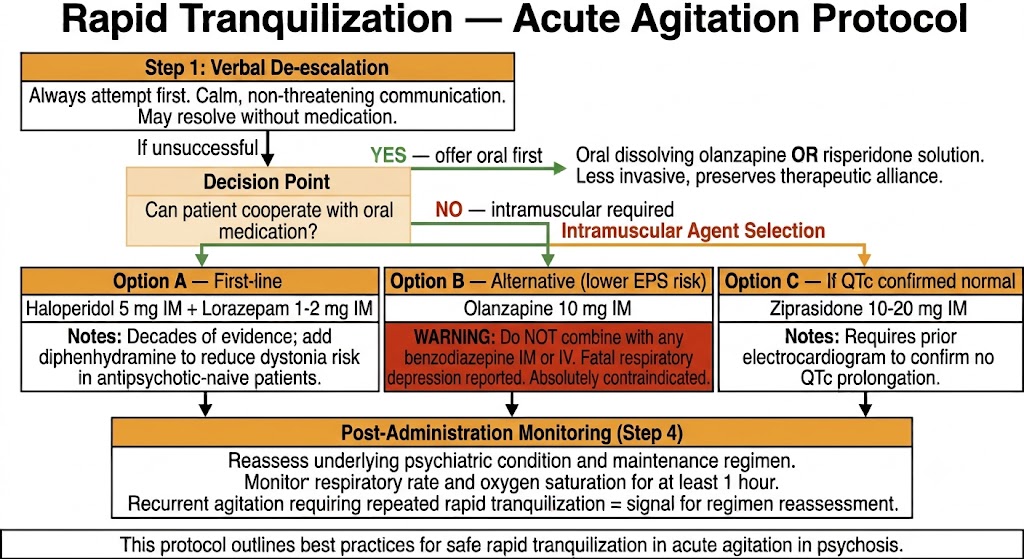
Rapid tranquilization refers to the pharmacological management of acute agitation in the context of psychotic illness, aiming for sufficient behavioral calming to ensure safety without excessive sedation that prevents clinical assessment or creates respiratory risk. The approach follows a structured sequence.
First, attempt verbal de-escalation. If unsuccessful and the patient can cooperate with oral medication, offer oral or sublingual formulations before proceeding to injection — oral dissolving olanzapine and risperidone solution are options. If intramuscular medication is required, the most widely used protocol is intramuscular haloperidol 5 milligrams combined with intramuscular lorazepam 1 to 2 milligrams — decades of clinical experience support its efficacy and safety. Adding diphenhydramine reduces acute dystonia risk in antipsychotic-naive patients.
Intramuscular olanzapine 10 milligrams is an effective alternative with lower extrapyramidal symptom risk than haloperidol. The critical safety rule: intramuscular olanzapine must never be co-administered with intramuscular or intravenous benzodiazepines in the same session — cases of severe respiratory depression and deaths have been reported with this specific combination. This contraindication is absolute regardless of clinical urgency. Intramuscular ziprasidone 10 to 20 milligrams is an option with minimal extrapyramidal symptom risk but requires prior electrocardiogram assessment to confirm absence of QTc prolongation. Inhaled loxapine produces rapid calming (approximately 10 minutes onset) via pulmonary delivery but is restricted to settings where bronchospasm management is available, as it is contraindicated in patients with asthma or chronic obstructive pulmonary disease.
After the acute episode is controlled, monitor respiratory rate and oxygen saturation for at least 1 hour following intramuscular administration. Reassess the underlying psychiatric condition and antipsychotic regimen — recurrent agitation requiring repeated rapid tranquilization may signal inadequate maintenance treatment or treatment resistance requiring systematic escalation.
Section 6
Practical prescribing frameworks for schizophrenia, adherence optimization, and the most consequential algorithm decision
Treatment algorithms for antipsychotic prescribing serve as structured decision frameworks rather than rigid prescriptions. The following synthesizes current guideline recommendations into practical clinical decision rules for the most common scenarios encountered in schizophrenia pharmacotherapy.
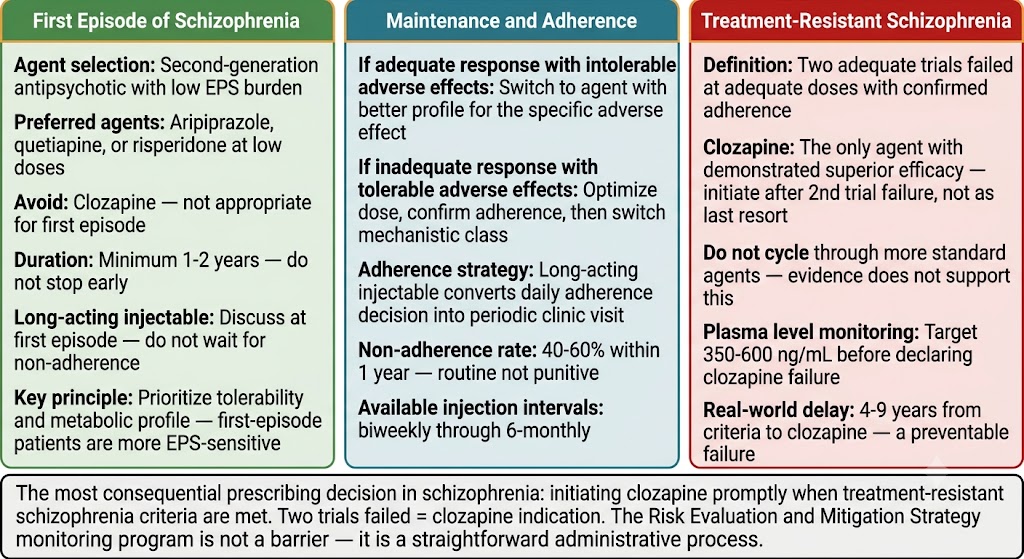
For a patient presenting with a first psychotic episode, antipsychotic selection should prioritize minimizing extrapyramidal symptom burden and metabolic risk, because first-episode patients are more sensitive to extrapyramidal symptoms than chronically treated patients and because the metabolic trajectory established in the first years of treatment has long-term cardiovascular implications. A second-generation antipsychotic with low extrapyramidal symptom burden and intermediate metabolic risk is the appropriate starting point — aripiprazole, quetiapine, or risperidone at low doses are commonly chosen. Clozapine is not appropriate for first-episode treatment given its adverse effect burden relative to alternatives not yet tried.
Long-acting injectable formulations should be discussed at the first episode as a maintenance strategy — not reserved for patients with documented adherence failure. First-episode patients who receive long-acting injectables have substantially better long-term outcomes than those who do not, and introducing the discussion early normalizes it as a standard option rather than a consequence of non-compliance. The minimum duration of antipsychotic treatment after a first episode is 1 to 2 years; discontinuation before this threshold substantially increases relapse risk.
After a first antipsychotic trial, the decision framework at each subsequent step depends on the pattern of response. Adequate response with intolerable adverse effects warrants switching to a different agent with a more favorable adverse effect profile for the specific problem — extrapyramidal symptoms, weight gain, sedation, or prolactin elevation. Inadequate response with tolerable adverse effects warrants dose optimization within the therapeutic range, confirmation of adherence, then switching to a different mechanistic approach. No response despite confirmed therapeutic adherence and adequate plasma levels warrants advancing to clozapine after two failed adequate trials. The sequential switching of antipsychotics without ever reaching clozapine when criteria for treatment-resistant schizophrenia are met is a common clinical error that perpetuates unnecessary morbidity.
Non-adherence to oral antipsychotics is the most common cause of relapse in schizophrenia, occurring in 40 to 60 percent of patients within the first year after hospital discharge. Long-acting injectable antipsychotics eliminate the daily adherence decision and convert non-adherence from a silent failure invisible to the treating clinician into a visible missed injection appointment. Meta-analyses of mirror-image and naturalistic studies consistently demonstrate superior relapse prevention with long-acting injectables compared with oral antipsychotics in patients with prior adherence difficulties.
When offering a long-acting injectable, the specific formulation should be chosen based on the patient's established oral agent (to maintain pharmacological continuity), the desired injection interval (biweekly through 6-monthly options are available), and patient preference for injection site and frequency. The decision to offer a long-acting injectable should be framed as a clinical tool for achieving stable outcomes rather than as a punitive measure for past non-adherence.
The most consequential decision in schizophrenia pharmacotherapy is the timely initiation of clozapine in treatment-resistant patients. Current evidence consistently shows that the median delay from treatment-resistant schizophrenia criteria being met to clozapine initiation is 4 to 9 years in real-world practice.
The algorithm step is simple: two adequate antipsychotic trials failed at adequate doses with confirmed adherence equals clozapine indication. The Risk Evaluation and Mitigation Strategy monitoring program is a straightforward administrative process. Every year of delay represents unnecessary positive symptom burden, progressive functional decline, increased hospitalization costs, and suicide risk that clozapine could have reduced.
| Author / Organization | Title | Source |
|---|---|---|
| Stahl SM | Stahl's Essential Psychopharmacology: Neuroscientific Basis and Practical Applications. 4th ed. | Cambridge University Press; 2013:129–237 |
| Gareri P, De Fazio P, Manfredi VG, De Sarro G | Use and safety of antipsychotics in behavioral disorders in elderly people with dementia | J Clin Psychopharmacol. 2014;34(1):109–123 |
| Schneider LS, Dagerman KS, Insel P | Risk of death with atypical antipsychotic drug treatment for dementia: meta-analysis of randomized placebo-controlled trials | JAMA. 2005;294(15):1934–1943 |
| Gentile S | Antipsychotic therapy during early and late pregnancy: a systematic review | Schizophr Bull. 2010;36(3):518–544 |
| Spina E, de Leon J | Metabolic drug interactions with newer antipsychotics: a comparative review | Basic Clin Pharmacol Toxicol. 2007;100(1):4–22 |
| Kane JM, Agid O, Baldwin ML, et al | Clinical guidance on the identification and management of treatment-resistant schizophrenia | J Clin Psychiatry. 2019;80(2):18com12123 |
| Fleischhacker WW, Heikkinen ME, Olie JP, et al | Effects of adjunctive treatment with aripiprazole on body weight and clinical efficacy in schizophrenia patients treated with clozapine: a randomized, double-blind, placebo-controlled trial | Int J Neuropsychopharmacol. 2010;13(8):1115–1125 |
| Yatham LN, Kennedy SH, Parikh SV, et al | Canadian Network for Mood and Anxiety Treatments and International Society for Bipolar Disorders 2018 guidelines for the management of patients with bipolar disorder | Bipolar Disord. 2018;20(2):97–170 |
| Berman RM, Marcus RN, Swanink R, et al | The efficacy and safety of aripiprazole as adjunctive therapy in major depressive disorder: a multicenter, randomized, double-blind, placebo-controlled study | J Clin Psychiatry. 2007;68(6):843–853 |
| Nemeth G, Laszlovszky I, Czobor P, et al | Cariprazine versus risperidone monotherapy for treatment of predominant negative symptoms in patients with schizophrenia: a randomised, double-blind, controlled trial | Lancet. 2017;389(10074):1103–1113 |
| Citrome L | Inhaled loxapine for agitation revisited: focus on safety data | Expert Opin Drug Saf. 2014;13(8):1115–1123 |
| Kishimoto T, Robenzadeh A, Leucht C, et al | Long-acting injectable vs oral antipsychotics for relapse prevention in schizophrenia: a meta-analysis of randomized trials | Schizophr Bull. 2014;40(1):192–213 |