Introduction to Medical Pharmacology
Vitamin K Antagonists — Warfarin and Clinical Management
Chapter 39 · Module 3 of 6Section 1
Vitamin K-dependent coagulation factors, the carboxylation cycle, and the basis for delayed onset
Warfarin is an oral anticoagulant of the coumarin class that acts by blocking the post-translational modification required to activate vitamin K-dependent coagulation proteins. Its anticoagulant effect is indirect, delayed, and dependent on the natural turnover rates of pre-existing functional clotting factors. Understanding the vitamin K cycle and which proteins warfarin affects is essential to understanding the drug's onset, therapeutic targets, and the hazards of early initiation.
Four vitamin K-dependent procoagulant factors are essential to understand: factor II (prothrombin), factor VII, factor IX, and factor X. Two vitamin K-dependent anticoagulant proteins are also relevant: protein C and protein S. All six require post-translational gamma-carboxylation of specific glutamic acid residues at their amino-terminal domain to become biologically active. Once carboxylated, these proteins bind calcium ions and assemble on phospholipid surfaces on activated platelets. Without gamma-carboxylation, they circulate as inactive precursors.
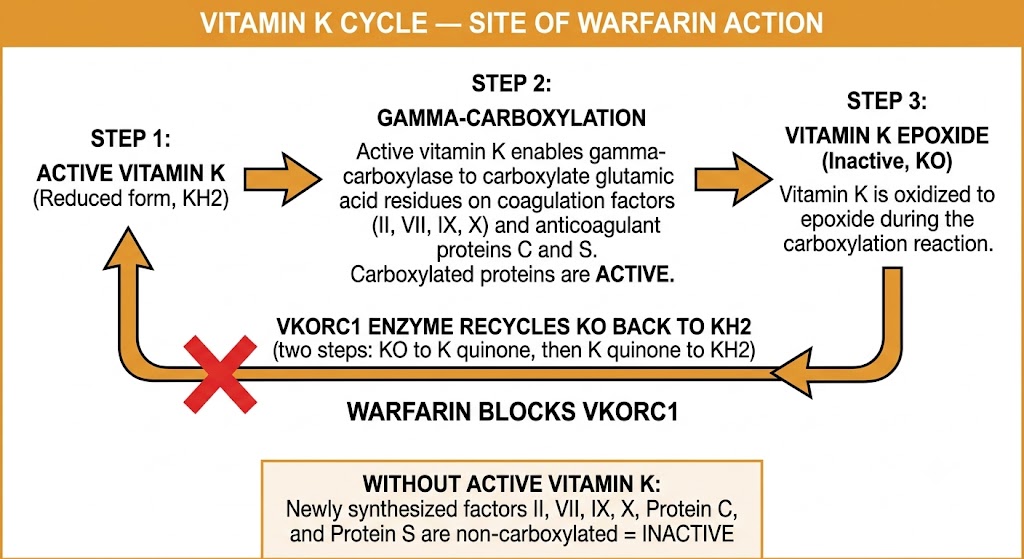
The gamma-carboxylation reaction requires reduced vitamin K (vitamin K hydroquinone) as an obligate cofactor. During the reaction, reduced vitamin K is oxidized to vitamin K epoxide. Regeneration of active reduced vitamin K from vitamin K epoxide occurs in two steps catalyzed by the enzyme vitamin K epoxide reductase complex subunit 1: first converting vitamin K epoxide to vitamin K quinone, then to reduced vitamin K hydroquinone. Warfarin inhibits vitamin K epoxide reductase complex subunit 1, blocking both steps. The consequence is progressive depletion of the reduced vitamin K pool, resulting in accumulation of inactive, non-carboxylated forms of all six vitamin K-dependent proteins as pre-existing functional proteins are catabolized and replaced.
The rate at which warfarin depletes each vitamin K-dependent factor depends on the half-life of the functional protein already in circulation. Factor VII has the shortest half-life at approximately 4 to 6 hours, so the international normalized ratio rises within 24 to 36 hours of starting warfarin as factor VII levels fall — even before clinically effective anticoagulation is established. The half-lives of factor IX (approximately 24 hours), factor X (approximately 40 hours), and prothrombin (approximately 60 to 70 hours) are substantially longer, meaning adequate anticoagulation against thrombosis requires 5 to 7 days of continuous dosing. An early elevated international normalized ratio driven primarily by factor VII depletion does not reflect true anticoagulation and should not be interpreted as therapeutic.
Protein C has a short half-life of approximately 6 to 8 hours, similar to factor VII. It is therefore depleted by warfarin before the procoagulant factors factor X and prothrombin reach subtherapeutic levels. This early selective depletion of protein C creates a transient procoagulable state in the first 24 to 48 hours after warfarin initiation. In patients with underlying hereditary protein C deficiency, this depletion reaches near-zero levels and can precipitate warfarin-induced skin necrosis — microvascular thrombosis and cutaneous infarction, particularly in fatty tissue. This is why warfarin must never be initiated as monotherapy in patients with active thrombosis, and why parenteral anticoagulant overlap is mandatory during initiation.
Vitamin K-Dependent Factor Half-Lives — Clinical Significance
Factor VII: 4 to 6 hours — earliest to fall; drives early international normalized ratio rise (not yet therapeutic). Protein C: 6 to 8 hours — early depletion creates transient procoagulable state; warfarin-induced skin necrosis risk in protein C deficiency. Factor IX: approximately 24 hours. Factor X: approximately 40 hours. Prothrombin (factor II): 60 to 70 hours — last to fall; therapeutic anticoagulation requires 5 to 7 days. Practical rule: overlap parenteral anticoagulant for at least 5 days and until international normalized ratio is therapeutic for 2 consecutive measurements when treating acute venous thromboembolism.
Section 2
S- and R-enantiomers, CYP2C9 and VKORC1 pharmacogenomics, and initiation strategies
Warfarin is a racemic mixture of the S- and R-enantiomers that differ substantially in potency and metabolic pathway. Its highly variable pharmacokinetic-pharmacodynamic profile, driven primarily by genetic polymorphisms in two genes — the metabolizing enzyme cytochrome P450 2C9 and the drug target vitamin K epoxide reductase complex subunit 1 — makes warfarin one of the most challenging drugs to dose in clinical practice.
S-warfarin is approximately 3 to 5 times more potent as a vitamin K epoxide reductase complex subunit 1 inhibitor than R-warfarin and accounts for the majority of the drug's anticoagulant effect despite being present in equal proportion by mass. S-warfarin is metabolized primarily by cytochrome P450 2C9 to inactive 7-hydroxy-warfarin. R-warfarin is metabolized by cytochrome P450 1A2 and 3A4. Drugs that inhibit cytochrome P450 2C9 therefore preferentially elevate S-warfarin levels and produce greater-than-expected international normalized ratio increases, while inducers reduce S-warfarin levels and decrease the international normalized ratio. This asymmetry is the central pharmacokinetic reason why cytochrome P450 2C9 drug interactions with warfarin are clinically so important.
Cytochrome P450 2C9 is highly polymorphic. The CYP2C9*2 variant encodes a protein with approximately 70% reduced activity toward S-warfarin relative to the wild-type allele; the CYP2C9*3 variant encodes a protein with approximately 90 to 95% reduced activity. Patients carrying these variants metabolize S-warfarin much more slowly, require substantially lower warfarin doses to achieve a therapeutic international normalized ratio, and are at significantly higher risk of serious bleeding during initiation when standard empirical doses are used. Both variants are most prevalent in populations of European ancestry.
Vitamin K epoxide reductase complex subunit 1 is the direct target of warfarin. A promoter variant that reduces vitamin K epoxide reductase complex subunit 1 expression makes patients more sensitive to warfarin inhibition and reduces dose requirements. Conversely, the variant associated with higher enzyme expression produces relative warfarin resistance requiring higher doses. Combined genotyping for cytochrome P450 2C9 and vitamin K epoxide reductase complex subunit 1 variants explains approximately 35 to 50% of the interindividual variability in warfarin dose requirement. Population differences in variant frequency account for much of the well-documented difference in average warfarin dose requirements across ethnic groups.
The standard starting dose is 5 mg daily. Lower starting doses of 2.5 mg daily are recommended in patients older than 75 years, those weighing less than 50 kilograms, patients with malnutrition or hepatic impairment, and those with congestive heart failure. Loading doses of 10 mg daily for the first 2 days are now generally discouraged because they increase the risk of supratherapeutic international normalized ratio early in therapy and produce greater protein C depletion without shortening the time to stable therapeutic anticoagulation. The international normalized ratio should be checked on days 3 to 4 and again on days 5 to 7 during initiation.
Section 3
Prothrombin time standardization, therapeutic targets by indication, monitoring frequency, and adjustment principles
The international normalized ratio is the standardized measure of warfarin's anticoagulant effect, designed to correct for inter-laboratory variability in the prothrombin time assay. Effective warfarin management requires understanding what it measures, the therapeutic targets for specific indications, and how to adjust the dose when values fall outside the target range.
The prothrombin time measures clot formation time after addition of thromboplastin and calcium, reflecting activity of the extrinsic and common pathways — specifically factors VII, X, and II. In its raw form, the prothrombin time varies between laboratories because different thromboplastin reagents have different sensitivities to factor depletion. The international normalized ratio corrects for this variability by incorporating the international sensitivity index, a calibration value specific to each laboratory's reagent. The result is comparable values across institutions for patients on stable warfarin therapy. The international normalized ratio is unreliable in patients not on vitamin K antagonists, in patients with liver disease, and in those with lupus anticoagulant.
The standard therapeutic international normalized ratio range for the great majority of warfarin indications is 2.0 to 3.0. This applies to venous thromboembolism treatment and secondary prevention, atrial fibrillation with stroke prevention indication, and most mechanical heart valve prostheses in the aortic position. The higher range of 2.5 to 3.5 applies to mechanical mitral valve prostheses and to mechanical valves of any position in patients who have had systemic embolism on a standard-intensity regimen. An international normalized ratio below 2.0 is subtherapeutic for all standard indications and leaves patients at meaningfully increased thrombotic risk.
During initiation, the international normalized ratio should be checked every 1 to 3 days until two or more consecutive values are in the therapeutic range, then weekly for the first 4 weeks, then at progressively longer intervals. Once stable, monitoring every 4 to 8 weeks is appropriate. The international normalized ratio should be rechecked within 1 to 2 weeks of any change in medications, significant dietary changes (particularly vitamin K intake), changes in health status, or any dose change. Time in therapeutic range — the proportion of international normalized ratio values within target — is the key quality metric; a time in therapeutic range above 70% is associated with clinical outcomes comparable to those seen in randomized trials.
Dose adjustment requires appreciating the delayed pharmacodynamic response: international normalized ratio changes caused by a dose adjustment will not be fully apparent for 5 to 7 days. For values mildly outside the therapeutic range, small adjustments of 5 to 20% of the total weekly dose are appropriate; large single-dose changes produce overshooting and oscillation. For international normalized ratio values above 4.0 without bleeding, hold 1 to 2 doses and reduce the maintenance dose by 10 to 20%; recheck in 1 to 2 days.
Section 4
CYP2C9 inhibitors and inducers, pharmacodynamic interactions, and dietary vitamin K
Warfarin has a broader clinically significant interaction profile than almost any other drug in clinical practice. Interactions arise from pharmacokinetic mechanisms (primarily cytochrome P450 2C9 inhibition or induction affecting S-warfarin metabolism), pharmacodynamic mechanisms (agents that independently affect hemostasis or vitamin K availability), and dietary factors.
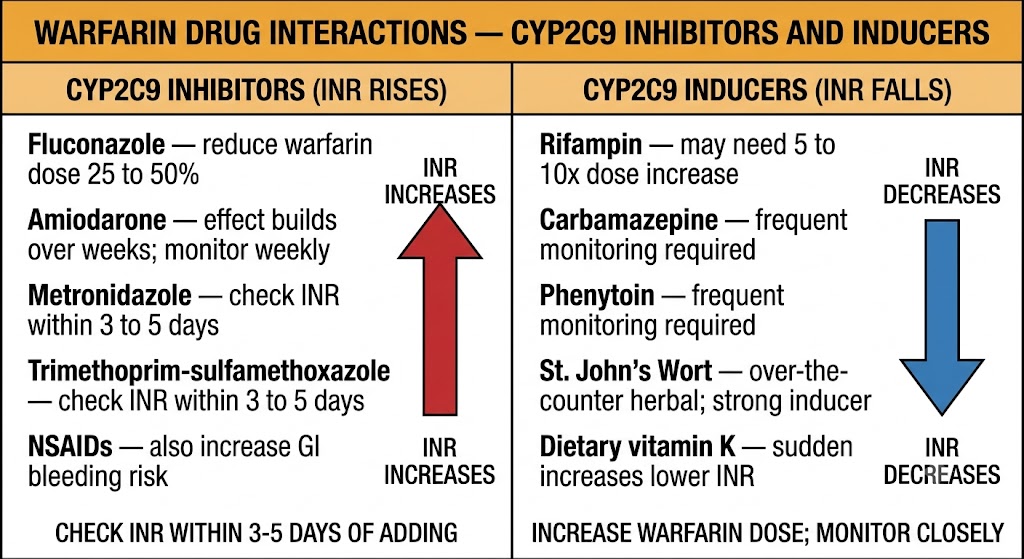
Drugs that inhibit cytochrome P450 2C9 reduce clearance of S-warfarin, raising its plasma levels and potentiating the anticoagulant effect. The most clinically important inhibitors include fluconazole and other azole antifungals (including topical or vaginal miconazole, which is significantly absorbed systemically), amiodarone (whose inhibitory effect on the international normalized ratio builds over weeks to months due to its extremely long half-life and persists for weeks after discontinuation), metronidazole, trimethoprim-sulfamethoxazole, and many selective serotonin reuptake inhibitors, particularly fluvoxamine. Nonsteroidal anti-inflammatory drugs interact through multiple mechanisms — cytochrome P450 2C9 inhibition, independent gastrointestinal bleeding risk, and platelet function inhibition — creating a combination that substantially raises serious bleeding risk. When a strong cytochrome P450 2C9 inhibitor is added to stable warfarin therapy, the international normalized ratio should be monitored within 3 to 5 days and the warfarin dose empirically reduced by 25 to 50% for the most potent inhibitors.
Drugs that induce cytochrome P450 2C9 increase S-warfarin clearance, reducing plasma levels and diminishing the anticoagulant effect with resultant international normalized ratio reduction and increased thrombotic risk. Rifampin is the most potent inducer, reducing warfarin plasma levels by up to 90% and potentially requiring dose increases of 5- to 10-fold; very frequent international normalized ratio monitoring is mandatory during rifampin initiation and tapering. Other important inducers include carbamazepine, phenytoin, and phenobarbital, as well as the herbal supplement St. John's wort, which is a potent cytochrome P450 2C9 inducer available over the counter and often not reported by patients as a medication. Chronic alcohol use induces cytochrome P450 2C9 and reduces warfarin effect; acute intoxication inhibits cytochrome P450 2C9 and can elevate the international normalized ratio — a bidirectional interaction that is a practical clinical problem in patients with variable alcohol use.
Antiplatelet agents (aspirin, P2Y12 inhibitors such as clopidogrel, prasugrel, and ticagrelor) do not affect the international normalized ratio but substantially increase bleeding risk when combined with warfarin, particularly gastrointestinal and intracranial hemorrhage. Thyroid hormone preparations affect warfarin by altering the catabolism rate of vitamin K-dependent factors: hyperthyroidism accelerates factor catabolism and reduces warfarin dose requirement; hypothyroidism slows catabolism and increases dose requirement.
Dietary vitamin K directly competes with warfarin's effect by providing substrate that can restore reduced vitamin K availability despite vitamin K epoxide reductase complex subunit 1 inhibition. Foods with high vitamin K content include green leafy vegetables (spinach, kale, collard greens, broccoli, Brussels sprouts, parsley) and certain plant oils. Patients should be counseled to maintain consistent vitamin K intake from week to week rather than eliminating these foods entirely — sudden increases lower the international normalized ratio, sudden decreases raise it.
CYP2C9 Inhibitors — INR Rises
Monitor INR Within 3 to 5 Days
CYP2C9 Inducers — INR Falls
Dose May Need Major Increase
Section 5
Management of supratherapeutic international normalized ratio, vitamin K1, four-factor prothrombin complex concentrate, and fresh frozen plasma
Bleeding is the principal dose-limiting adverse effect of warfarin. The approach to warfarin-associated bleeding is guided by two variables: clinical severity and degree of international normalized ratio elevation. Reversal agents range from oral or intravenous vitamin K for non-urgent situations to four-factor prothrombin complex concentrate for life-threatening bleeding requiring immediate reversal.
The annual major bleeding rate on warfarin therapy is approximately 1 to 3% per patient-year in carefully monitored trial populations. The most feared complication is intracranial hemorrhage, which occurs in approximately 0.2 to 0.5% of patients per year and carries a mortality rate of 40 to 50%. Risk of intracranial hemorrhage increases sharply at international normalized ratio values above 4.0 and particularly above 5.0. Independent risk factors for warfarin bleeding include age above 75 years, poorly controlled hypertension, prior stroke (especially hemorrhagic), prior gastrointestinal bleeding, concomitant antiplatelet therapy, nonsteroidal anti-inflammatory drug use, excess alcohol use, and labile international normalized ratio.
For international normalized ratio 3.0 to 3.9 (slightly above target in a patient with a 2.0 to 3.0 goal): reduce the weekly dose by 5 to 10% and recheck in 1 to 2 weeks. For international normalized ratio 4.0 to 10.0 without bleeding: hold 1 to 2 doses; low-dose oral vitamin K1 (phytonadione) at 1 to 2.5 mg by mouth may be given to patients at higher bleeding risk; recheck in 1 to 2 days. For international normalized ratio above 10.0 without bleeding: hold warfarin; give oral vitamin K1 2.5 to 5 mg by mouth; recheck within 24 hours. In all cases, identify the underlying cause of international normalized ratio elevation to prevent recurrence.
Phytonadione (vitamin K1) is the standard agent for warfarin reversal. Oral vitamin K1 is absorbed via the lymphatic system and produces peak international normalized ratio effect at 24 to 48 hours. Intravenous vitamin K1 produces a faster response (onset within 6 to 8 hours) and is preferred in urgent situations, but carries a small risk of anaphylaxis and must be infused slowly over 20 to 60 minutes rather than as a rapid bolus. Subcutaneous vitamin K1 is not recommended because absorption is unpredictable. An important consequence: vitamin K1 administration causes warfarin resistance lasting 7 to 14 days by replenishing the vitamin K pool, which must be re-depleted before warfarin can re-establish anticoagulation. Doses above 5 to 10 mg should be avoided when resumption of warfarin therapy is anticipated.
Four-factor prothrombin complex concentrate contains all four vitamin K-dependent procoagulant factors (II, VII, IX, X) plus protein C and protein S in concentrated lyophilized form. It provides immediate correction of warfarin-related coagulopathy within minutes of intravenous infusion. Dosing is weight-based and international normalized ratio-adjusted: 25 units per kilogram for international normalized ratio 2.0 to 3.9, 35 units per kilogram for international normalized ratio 4.0 to 6.0, and 50 units per kilogram for international normalized ratio above 6.0, with a maximum of 5,000 units. Intravenous vitamin K1 (10 mg) should be administered concurrently to prevent international normalized ratio re-elevation as the infused factors are catabolized. Four-factor prothrombin complex concentrate is the preferred agent for life-threatening warfarin-associated bleeding, including intracranial hemorrhage and major gastrointestinal bleeding.
Fresh frozen plasma contains all coagulation factors and can reverse vitamin K antagonist coagulopathy but requires large volumes (approximately 15 mL per kilogram), blood group compatibility testing, and 30 to 45 minutes for thawing. Large-volume infusion carries risks of transfusion-associated circulatory overload and transfusion-related acute lung injury. Fresh frozen plasma is reserved for situations where four-factor prothrombin complex concentrate is unavailable or when replacement of non-vitamin K-dependent factors is also needed.
Warfarin Reversal — Action by Severity
International normalized ratio 3.0 to 3.9, no bleeding: reduce weekly dose 5 to 10%, recheck in 1 to 2 weeks. International normalized ratio 4.0 to 10.0, no bleeding: hold 1 to 2 doses; consider oral vitamin K1 1 to 2.5 mg; recheck in 1 to 2 days. International normalized ratio above 10.0, no bleeding: hold warfarin; oral vitamin K1 2.5 to 5 mg; recheck in 24 hours. Life-threatening bleeding (intracranial hemorrhage, major gastrointestinal bleeding, hemodynamic compromise): four-factor prothrombin complex concentrate (weight- and international normalized ratio-adjusted dose) plus intravenous vitamin K1 10 mg slow infusion — do not wait for fresh frozen plasma.
Section 6
Mechanical heart valves, atrial fibrillation, venous thromboembolism, and the warfarin versus direct oral anticoagulant decision
Warfarin was the only oral anticoagulant available for over five decades and remains the drug of choice in specific clinical settings where direct oral anticoagulants are contraindicated, less effective, or inadequately studied. Understanding the indications where warfarin retains first-line status — and those where direct oral anticoagulants have superseded it — is essential to evidence-based prescribing.
Mechanical heart valves represent the single most important remaining indication where warfarin cannot be substituted by a direct oral anticoagulant. A pivotal randomized trial of dabigatran in mechanical heart valve patients was terminated early due to a significantly higher rate of thromboembolic and bleeding events with dabigatran compared to warfarin. No direct oral anticoagulant has demonstrated non-inferiority to warfarin in patients with mechanical prosthetic valves. The anticoagulation target depends on valve type and position: aortic bileaflet valves require a target international normalized ratio of 2.0 to 3.0 in low-risk patients; mechanical mitral valves require 2.5 to 3.5; and higher targets apply to patients with prior thromboembolism on standard therapy, older-generation valves, or multiple prostheses. Low-dose aspirin is added to warfarin for mechanical valve patients at low bleeding risk.
For most patients with non-valvular atrial fibrillation requiring stroke prevention, direct oral anticoagulants (apixaban, rivaroxaban, dabigatran, edoxaban) are now guideline-preferred over warfarin because of equivalent or superior efficacy with a more favorable safety profile, particularly for intracranial hemorrhage. Warfarin retains a specific role in atrial fibrillation patients with moderate-to-severe mitral stenosis, where direct oral anticoagulants have not been adequately studied. Warfarin also remains an acceptable choice for patients who have been highly stable on it with consistently high time in therapeutic range, or in whom direct oral anticoagulant access or cost is prohibitive.
For venous thromboembolism, direct oral anticoagulants have largely displaced warfarin for uncomplicated cases in patients without contraindications, offering equivalent efficacy, lower bleeding risk, and no international normalized ratio monitoring requirement. Warfarin retains a role in venous thromboembolism associated with antiphospholipid syndrome, where a randomized trial comparing rivaroxaban with warfarin in triple-positive antiphospholipid syndrome patients demonstrated inferior outcomes with rivaroxaban. Warfarin is also used in venous thromboembolism with severe renal impairment where direct oral anticoagulant pharmacokinetic data are limited.
Warfarin Remains First-Line
Indications Where DOACs Cannot Substitute
DOACs Now Preferred
Where Warfarin Has Been Superseded
| Author / Organization | Title | Source |
|---|---|---|
| Ageno W, Gallus AS, Wittkowsky A, Crowther M, Hylek EM, Palareti G | Oral anticoagulant therapy: antithrombotic therapy and prevention of thrombosis, 9th ed: ACCP Evidence-Based Clinical Practice Guidelines | Chest. 2012;141(2 Suppl):e44S-e88S. |
| Stafford DW | The vitamin K cycle | J Thromb Haemost. 2005;3(8):1873-1878. |
| Holbrook AM, Pereira JA, Labiris R, et al. | Systematic overview of warfarin and its drug and food interactions | Arch Intern Med. 2005;165(10):1095-1106. |
| Srinivasan AF, Rice L, Bartholomew JR, et al. | Warfarin-induced skin necrosis and venous limb gangrene in the setting of heparin-induced thrombocytopenia | Arch Intern Med. 2004;164(1):66-70. |
| Rettie AE, Tai G | The pharmacogenomics of warfarin: closing in on personalized medicine for an old drug | Mol Interv. 2006;6(4):223-227. |
| International Warfarin Pharmacogenomics Consortium; Klein TE, Altman RB, Eriksson N, et al. | Estimation of the warfarin dose with clinical and pharmacogenomic data | N Engl J Med. 2009;360(8):753-764. |
| Kimmel SE, French B, Kasner SE, et al. | A pharmacogenetic versus a clinical algorithm for warfarin dosing | N Engl J Med. 2013;369(24):2283-2293. |
| Holbrook A, Schulman S, Witt DM, et al. | Evidence-based management of anticoagulant therapy: antithrombotic therapy and prevention of thrombosis, 9th ed: ACCP Evidence-Based Clinical Practice Guidelines | Chest. 2012;141(2 Suppl):e152S-e184S. |
| Kearon C, Akl EA, Ornelas J, et al. | Antithrombotic therapy for VTE disease: CHEST guideline and expert panel report | Chest. 2016;149(2):315-352. |
| Wells PS, Holbrook AM, Crowther NR, Hirsh J | Interactions of warfarin with drugs and food | Ann Intern Med. 1994;121(9):676-683. |
| Sarode R, Milling TJ Jr, Refaai MA, et al. | Efficacy and safety of a 4-factor prothrombin complex concentrate in patients on vitamin K antagonists presenting with major bleeding | Circulation. 2013;128(11):1234-1243. |
| Goldstein JN, Refaai MA, Milling TJ Jr, et al. | Four-factor prothrombin complex concentrate versus plasma for rapid vitamin K antagonist reversal in patients needing urgent surgical or invasive interventions | Lancet. 2015;385(9982):2077-2087. |
| Nishimura RA, Otto CM, Bonow RO, et al. | 2014 AHA/ACC guideline for the management of patients with valvular heart disease | J Am Coll Cardiol. 2014;63(22):e57-e185. |
| Pengo V, Denas G, Zoppellaro G, et al. | Rivaroxaban vs warfarin in high-risk patients with antiphospholipid syndrome | Blood. 2018;132(13):1365-1371. |