CHAPTER 39  ·  COAGULATION

Introduction to Medical Pharmacology

Pharmacological Management of Coagulation

Direct Oral Anticoagulants — Mechanisms, Clinical Use, and Reversal

Chapter 39  ·  Module 4 of 6

Section 1

Mechanisms of Action

Direct factor Xa inhibition, direct thrombin inhibition, and mechanistic advantages over older anticoagulants

The direct oral anticoagulants inhibit specific activated coagulation proteases at fixed binding sites without requiring a cofactor such as antithrombin III. This mechanistic distinction from heparins and warfarin confers predictable dose-response kinetics and eliminates the need for routine coagulation monitoring in most clinical settings. Four agents are approved in the United States: three direct factor Xa inhibitors (rivaroxaban, apixaban, edoxaban) and one direct thrombin inhibitor (dabigatran).

Direct Factor Xa Inhibition

Rivaroxaban, apixaban, and edoxaban are selective, reversible, competitive inhibitors of factor Xa. They bind directly to the active site of factor Xa, blocking substrate (prothrombin) access and preventing thrombin generation. A key feature is that they inhibit both free plasma factor Xa and factor Xa incorporated within the prothrombinase complex — the catalytically active form responsible for the vast majority of thrombin generation on activated platelet surfaces. By contrast, indirect factor Xa inhibitors such as fondaparinux and low-molecular-weight heparins require antithrombin III as an obligate cofactor and cannot efficiently inhibit factor Xa already incorporated within the prothrombinase complex.

By preventing conversion of prothrombin to thrombin, direct factor Xa inhibitors also reduce thrombin-mediated activation of factors V, VIII, and XI (the feedback amplification loops) and inhibit platelet activation through protease-activated receptor 1. The pharmacological leverage is substantial: inhibiting one molecule of factor Xa prevents generation of approximately 1,000 molecules of thrombin through the prothrombinase complex, explaining why relatively low drug doses produce effective anticoagulation.
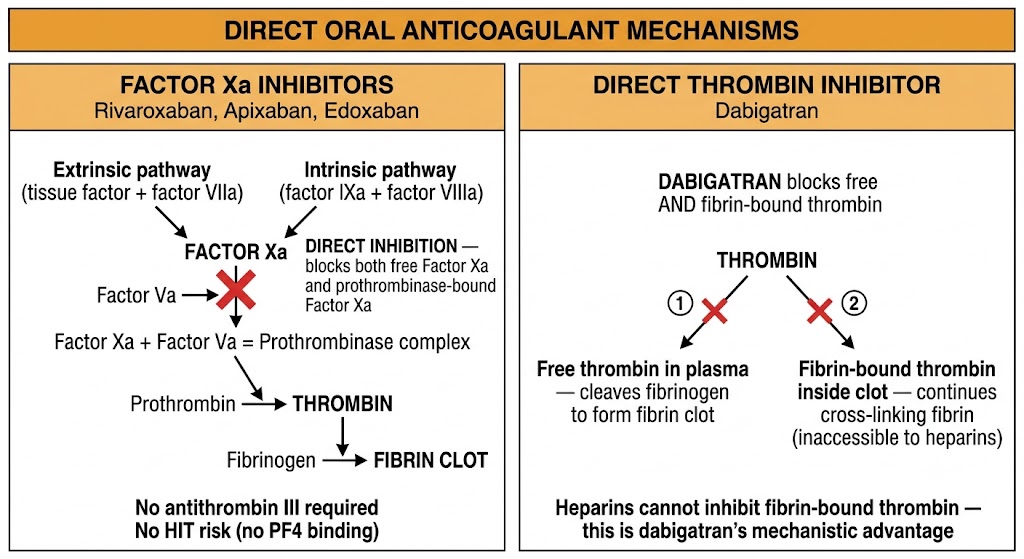
Two-panel diagram of direct oral anticoagulant mechanisms. Left panel shows the coagulation cascade converging at factor Xa, with rivaroxaban, apixaban, and edoxaban blocking both free factor Xa and prothrombinase-bound factor Xa, preventing thrombin generation and fibrin clot formation; labels note no antithrombin III required and no heparin-induced thrombocytopenia risk. Right panel shows dabigatran blocking both free thrombin in plasma and fibrin-bound thrombin inside the clot, with the label that heparins cannot inhibit fibrin-bound thrombin — dabigatran's mechanistic advantage.
Direct oral anticoagulant mechanisms — factor Xa inhibitors block thrombin generation; dabigatran inhibits both free and fibrin-bound thrombin, including thrombin inaccessible to heparins. Figure generated for Introduction to Medical Pharmacology, Chapter 39.

Direct Thrombin Inhibition — Dabigatran

Dabigatran, as its active form following oral administration of the prodrug dabigatran etexilate, is a selective, reversible, competitive inhibitor of both free thrombin and fibrin-bound thrombin. The ability to inhibit fibrin-bound thrombin is clinically significant: thrombin incorporated within a fibrin clot remains catalytically active and can mediate local thrombus propagation and fibrin cross-linking, yet it is inaccessible to antithrombin III-mediated inhibition by heparins, which cannot penetrate the fibrin matrix. In addition to cleaving fibrinogen, thrombin activates factors V, VIII, XI, and XIII and stimulates platelets via protease-activated receptors 1 and 4; dabigatran inhibits all of these thrombin-mediated functions.

Mechanistic Advantages Over Warfarin and Heparins

Direct oral anticoagulants offer several important mechanistic advantages over their predecessors. Unlike warfarin, they do not deplete functional coagulation factors and therefore do not produce the delayed onset, the protein C paradox, or the warfarin-induced skin necrosis risk associated with vitamin K antagonist initiation. Unlike heparins, they do not bind platelet factor 4 and cannot trigger heparin-induced thrombocytopenia. They do not require antithrombin III as a cofactor, so their efficacy is not compromised by antithrombin III deficiency. They have predictable oral bioavailability, fixed dosing, and linear pharmacokinetics without the nonlinear dose-response of unfractionated heparin. The principal limitations are renal clearance dependence (particularly for dabigatran and edoxaban), lack of data in extreme clinical situations such as mechanical heart valves and antiphospholipid syndrome, and — until recently — the absence of specific reversal agents.

Section 2

Pharmacokinetics, Renal Dosing, and Drug Interactions

Agent-specific absorption, clearance, renal dose adjustment, and high-alert drug interactions

The four direct oral anticoagulants have substantially different pharmacokinetic profiles that govern their clinical behavior, dosing requirements, and interaction profiles. Dabigatran etexilate is unique as a prodrug requiring esterase activation and is predominantly renally eliminated, making it the most renal-sensitive agent. The factor Xa inhibitors have varying degrees of hepatic cytochrome P450 3A4 metabolism and P-glycoprotein efflux transport, creating distinct interaction profiles.

Dabigatran

Dabigatran etexilate is an oral prodrug converted by intestinal and plasma esterases to the active form, dabigatran. The prodrug strategy was necessary because dabigatran itself is not orally bioavailable; oral bioavailability of the prodrug is approximately 6 to 7%, which requires the capsule formulation to remain intact — crushing or opening the capsule is contraindicated. Dabigatran is approximately 35% protein-bound and 80% eliminated renally as unchanged drug, making it the most renal-sensitive direct oral anticoagulant with a half-life of 12 to 17 hours in normal renal function. P-glycoprotein transporters mediate dabigatran efflux in the intestinal wall; P-glycoprotein inhibitors (dronedarone, ketoconazole, amiodarone, verapamil, clarithromycin) increase dabigatran exposure, while P-glycoprotein inducers (rifampin, St. John's wort, carbamazepine) reduce absorption. Cytochrome P450 enzyme interactions are not clinically relevant for dabigatran. Because of its low protein binding, approximately 65% of dabigatran can be removed by hemodialysis over 4 hours — an important reversal option when idarucizumab is unavailable.

Rivaroxaban, Apixaban, and Edoxaban

Rivaroxaban has oral bioavailability of approximately 60 to 80% for the 10 mg tablet but the 15 mg and 20 mg doses require food for complete absorption and must always be taken with the evening meal. Metabolism is dual: approximately one-third is excreted unchanged renally; the remainder undergoes hepatic cytochrome P450 3A4 and cytochrome P450 2J2 metabolism. Because rivaroxaban is both a cytochrome P450 3A4 and a P-glycoprotein substrate, drugs that inhibit both simultaneously (azole antifungals, human immunodeficiency virus protease inhibitors) can substantially increase rivaroxaban exposure and should be avoided.

Apixaban has approximately 50% oral bioavailability unaffected by food and undergoes multi-pathway elimination — approximately 27% renal excretion unchanged, the remainder hepatic cytochrome P450 3A4 metabolism and intestinal/biliary excretion. This multi-pathway profile makes apixaban the least renal-sensitive factor Xa inhibitor; significant dose reduction is generally required only when at least two of three criteria are met: age above 80 years, weight at or below 60 kilograms, or serum creatinine at or above 1.5 mg per deciliter.

Edoxaban has approximately 62% oral bioavailability with approximately 50% renal elimination. A clinically important and unique feature is its paradoxical reduced efficacy in patients with creatinine clearance above 95 milliliters per minute: higher renal clearance reduces plasma exposure sufficiently to compromise efficacy for atrial fibrillation stroke prevention, and edoxaban is not recommended for atrial fibrillation patients with creatinine clearance above 95 milliliters per minute.

Direct Thrombin Inhibitor

Dabigatran

  • Prodrug; esterase activation
  • 80% renal elimination
  • Do not crush capsule
  • P-glycoprotein interactions (not cytochrome P450)
  • Dialyzable (~65%)

Factor Xa Inhibitor

Rivaroxaban

  • 15/20 mg must be taken with food
  • ~33% renal; ~67% hepatic (cytochrome P450 3A4)
  • Avoid combined cytochrome P450 3A4 + P-glycoprotein inhibitors
  • Half-life 5 to 13 hours

Factor Xa Inhibitor

Apixaban

  • Multi-pathway elimination; least renal-sensitive
  • Dose reduce if ≥2 of 3: age >80, weight ≤60 kg, creatinine ≥1.5
  • Preferred in renal impairment and dialysis
  • Half-life 8 to 15 hours

Factor Xa Inhibitor

Edoxaban

  • ~50% renal elimination
  • Not recommended for atrial fibrillation: creatinine clearance >95 mL/min (reduced exposure)
  • Dose reduce: creatinine clearance 15 to 50 mL/min
  • P-glycoprotein interactions primary

Section 3

Clinical Indications

Atrial fibrillation, venous thromboembolism treatment and prevention, and dose selection

All four direct oral anticoagulants have been evaluated in large randomized controlled trials against warfarin for the major anticoagulation indications. As a class they have demonstrated non-inferior or superior efficacy with consistently lower rates of intracranial hemorrhage compared to dose-adjusted warfarin — the most clinically impactful safety advantage of the class.

Atrial Fibrillation

All four agents are approved for stroke prevention in non-valvular atrial fibrillation. The landmark trials established the class benefit: dabigatran at 150 mg twice daily reduced stroke and systemic embolism by 34% compared to warfarin and significantly reduced intracranial hemorrhage, while the 110 mg twice-daily dose was non-inferior with lower major bleeding. Rivaroxaban 20 mg once daily was non-inferior to warfarin with significantly less intracranial hemorrhage. Apixaban 5 mg twice daily was superior to warfarin in reducing stroke and systemic embolism with significantly less major bleeding and intracranial hemorrhage — the only pivotal trial showing superiority on both efficacy and safety endpoints. Edoxaban 60 mg once daily was non-inferior to warfarin for stroke prevention with significantly less bleeding, but is not recommended when creatinine clearance exceeds 95 milliliters per minute. Meta-analyses of the four trials show a 40 to 50% relative reduction in intracranial hemorrhage with direct oral anticoagulants versus warfarin.

Venous Thromboembolism Treatment and Prevention

All four agents are approved for acute deep vein thrombosis and pulmonary embolism treatment and for secondary prevention. Rivaroxaban and apixaban support an oral-only treatment strategy without initial parenteral lead-in. Rivaroxaban uses a higher initial dose (15 mg twice daily with food) for the first 21 days, then transitions to 10 mg once daily for ongoing treatment. Apixaban uses 10 mg twice daily for the first 7 days, then 5 mg twice daily. Dabigatran and edoxaban require an initial 5 to 10 days of parenteral anticoagulation before oral therapy initiation and are therefore used in patients transitioning from heparin.

For extended secondary prevention beyond 6 months, rivaroxaban 10 mg once daily and apixaban 2.5 mg twice daily (reduced doses) have demonstrated significant reduction in venous thromboembolism recurrence versus placebo without meaningfully increased major bleeding. For cancer-associated venous thromboembolism, direct oral anticoagulants (particularly apixaban and rivaroxaban) are now guideline-endorsed over low-molecular-weight heparin for most cancers, with the exception of high luminal gastrointestinal or genitourinary bleeding risk cancers where low-molecular-weight heparin may be preferred.

Contraindications — Where DOACs Cannot Be Used

Mechanical prosthetic heart valves: all direct oral anticoagulants contraindicated; dabigatran was proven inferior to warfarin in randomized trial with excess thromboembolic and bleeding events. Triple-positive antiphospholipid syndrome: warfarin superior; rivaroxaban demonstrated inferior outcomes. Severe hepatic impairment (Child-Pugh C): all direct oral anticoagulants contraindicated. Pregnancy: all direct oral anticoagulants contraindicated — cross the placenta; transition to low-molecular-weight heparin. Severe renal impairment: dabigatran contraindicated when creatinine clearance is below 15 milliliters per minute; fondaparinux also contraindicated; apixaban generally preferred in advanced chronic kidney disease.


Section 4

Reversal Agents

Idarucizumab for dabigatran, andexanet alfa for factor Xa inhibitors, and four-factor prothrombin complex concentrate

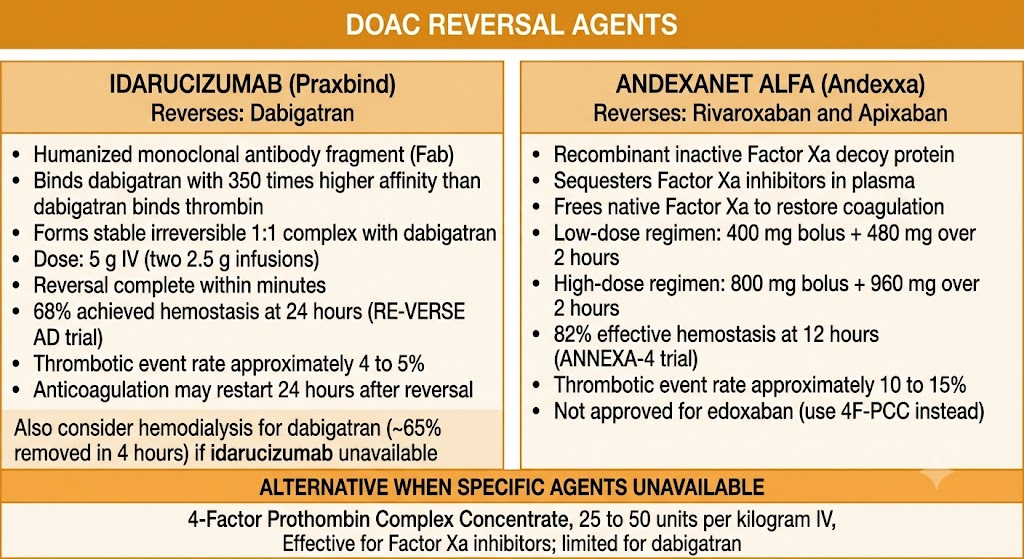
The availability of specific reversal agents for direct oral anticoagulants has substantially changed the risk calculus of their use compared to warfarin. Two specific reversal agents are currently approved in the United States: idarucizumab for dabigatran and andexanet alfa for rivaroxaban and apixaban. Four-factor prothrombin complex concentrate remains important when specific agents are unavailable or in situations they do not cover.

Two-panel comparison of direct oral anticoagulant reversal agents. Left panel shows idarucizumab (Praxbind) for dabigatran reversal: humanized monoclonal antibody fragment binding dabigatran with 350 times higher affinity than thrombin, dosed as 5 g intravenously, reversing anticoagulation within minutes, with 68% hemostasis at 24 hours and 4 to 5% thrombotic event rate. Right panel shows andexanet alfa (Andexxa) for rivaroxaban and apixaban reversal: recombinant inactive factor Xa decoy sequestering factor Xa inhibitors, with low-dose and high-dose regimens, 82% effective hemostasis at 12 hours, and 10 to 15% thrombotic event rate. A shared bottom box identifies four-factor prothrombin complex concentrate 25 to 50 units per kilogram as the alternative when specific agents are unavailable.
Direct oral anticoagulant reversal agents — idarucizumab for dabigatran; andexanet alfa for rivaroxaban and apixaban; four-factor prothrombin complex concentrate when specific agents are unavailable. Figure generated for Introduction to Medical Pharmacology, Chapter 39.

Idarucizumab — Dabigatran Reversal

Idarucizumab is a humanized monoclonal antibody fragment that binds dabigatran with approximately 350 times higher affinity than dabigatran binds thrombin. It forms a stable, irreversible 1:1 complex with dabigatran and its active metabolites, rapidly neutralizing the anticoagulant effect within minutes. The dose is 5 g intravenously given as two consecutive 2.5 g infusions over 5 to 10 minutes each. A phase 3 study demonstrated complete reversal of dabigatran anticoagulation within minutes in patients with life-threatening bleeding or requiring emergency surgery; 68% achieved hemostasis at 24 hours in the uncontrolled bleeding cohort. Re-administration of a second 5 g dose is permitted if dabigatran re-appears from tissue redistribution. Anticoagulation may be reinstituted 24 hours after idarucizumab if clinically appropriate. Thrombotic events occurred in approximately 4 to 5% of patients, likely reflecting the underlying thrombotic risk of the clinical situation.

Andexanet Alfa — Factor Xa Inhibitor Reversal

Andexanet alfa is a recombinant catalytically inactive modified factor Xa decoy protein that retains high-affinity binding to factor Xa inhibitors including rivaroxaban, apixaban, and edoxaban. By acting as a competitive factor Xa decoy, it sequesters the inhibitor in plasma, freeing native factor Xa to participate in coagulation. It is approved for reversal of rivaroxaban and apixaban in life-threatening or uncontrolled bleeding. Dosing depends on the agent and timing of last dose: a low-dose regimen (400 mg intravenous bolus followed by 480 mg over 2 hours) applies for lower doses or when the last dose was more than 8 hours prior; a high-dose regimen (800 mg bolus followed by 960 mg over 2 hours) applies for higher doses within 8 hours.

The pivotal trial demonstrated 82% effective hemostasis at 12 hours. The most significant safety concern is a thrombotic event rate of approximately 10 to 15% within 30 days, including stroke, myocardial infarction, deep vein thrombosis, and pulmonary embolism; anticoagulation should therefore be resumed as soon as clinically safe after administration. Andexanet alfa is not approved for edoxaban reversal despite mechanistic activity against edoxaban factor Xa inhibition.

Four-Factor Prothrombin Complex Concentrate

When specific reversal agents are unavailable, four-factor prothrombin complex concentrate at 25 to 50 units per kilogram provides concentrated procoagulant factors that can partially overcome factor Xa inhibition by providing excess substrate. For rivaroxaban and apixaban, observational data support four-factor prothrombin complex concentrate as an effective hemostatic strategy, and some centers use it as first-line given lower cost and availability compared to andexanet alfa. For dabigatran, four-factor prothrombin complex concentrate has limited utility because it does not neutralize the direct thrombin inhibitor — idarucizumab is strongly preferred. Hemodialysis can remove approximately 65% of dabigatran over 4 hours, providing an additional option for dabigatran-related bleeding in patients already on dialysis; factor Xa inhibitors are not dialyzable due to high protein binding.

Reversal Agent Selection

Life-threatening bleeding on dabigatran: idarucizumab 5 g intravenously (two 2.5 g infusions) — first choice; four-factor prothrombin complex concentrate 25 to 50 units per kilogram if idarucizumab unavailable; consider hemodialysis if patient is on dialysis. Life-threatening bleeding on rivaroxaban or apixaban: andexanet alfa (dose per timing and dose of last direct oral anticoagulant) if available; four-factor prothrombin complex concentrate 25 to 50 units per kilogram as alternative. Life-threatening bleeding on edoxaban: four-factor prothrombin complex concentrate (no approved specific agent). All agents: delay direct oral anticoagulant resumption minimum 24 hours after reversal.


Section 5

Peri-procedural Management and Special Populations

Interruption strategies, bridging anticoagulation, resumption timing, and use in renal impairment, obesity, hepatic disease, and pregnancy

Peri-procedural management of direct oral anticoagulants is more straightforward than warfarin management in most situations because their predictable pharmacokinetics and short half-lives eliminate the need for international normalized ratio monitoring and remove the principal rationale for bridging anticoagulation. Several patient populations require individualized prescribing decisions that deviate from standard label dosing.

Interruption and Resumption

The short half-life of direct oral anticoagulants (8 to 17 hours for most agents) means that 2 to 3 half-lives of drug-free interval eliminates most anticoagulant activity. For standard bleeding-risk procedures, withholding 1 to 2 doses (24 to 48 hours) is typically sufficient. For high-bleeding-risk procedures (major surgery, neurosurgery, spinal surgery, kidney biopsy), a 48 to 72-hour drug-free interval is recommended to ensure near-complete washout. Dabigatran in patients with creatinine clearance 30 to 50 milliliters per minute requires an extended pre-procedural hold of 3 to 4 days due to its renal clearance dependence.

Bridging anticoagulation with low-molecular-weight heparin or unfractionated heparin during direct oral anticoagulant interruption is not recommended for most patients. Unlike warfarin, direct oral anticoagulants reach therapeutic levels within 1 to 3 hours of the first post-operative dose, eliminating the window of inadequate anticoagulation that necessitated bridging. Resumption timing after a procedure is governed by adequacy of surgical hemostasis: same evening or next morning for minor procedures with excellent hemostasis; 24 hours post-procedure for moderate bleeding-risk procedures; 48 to 72 hours for major or high-bleeding-risk procedures.

Chronic Kidney Disease, Obesity, Hepatic Impairment, and Pregnancy

In chronic kidney disease, the degree of renal sensitivity differs substantially across agents. Dabigatran (80% renal elimination) is contraindicated when creatinine clearance is below 15 milliliters per minute and requires dose reduction at 15 to 30 milliliters per minute. Apixaban has the most favorable chronic kidney disease profile — its multi-pathway elimination means even creatinine clearance below 25 milliliters per minute produces only modest increases in drug exposure, and it is the preferred agent in patients on hemodialysis. Renal function should be reassessed at least annually in stable patients and whenever acute illness, dehydration, or nephrotoxic medication exposure occurs.

In patients with body weight above 120 kilograms or body mass index above 40, there is concern that fixed direct oral anticoagulant doses may produce subtherapeutic concentrations. Drug-specific peak and trough concentration measurement is recommended above these thresholds to confirm adequate exposure.

All four direct oral anticoagulants are contraindicated in severe hepatic impairment (Child-Pugh C); low-molecular-weight heparin or unfractionated heparin is the preferred approach in this population. All direct oral anticoagulants are contraindicated in pregnancy because they cross the placenta and are embryotoxic in animal studies; women who become pregnant while taking a direct oral anticoagulant should discontinue immediately and transition to low-molecular-weight heparin. Direct oral anticoagulants are also excreted in breast milk and should be avoided during breastfeeding.


Suggested References
Author / Organization Title Source
Weitz JI, Fredenburgh JC, Eikelboom JW A test in context: D-dimer J Am Coll Cardiol. 2017;70(19):2411-2420.
Perzborn E, Roehrig S, Straub A, Kubitza D, Mueck W, Laux V Rivaroxaban: a new oral factor Xa inhibitor Arterioscler Thromb Vasc Biol. 2010;30(3):376-381.
Stangier J, Rathgen K, Stahle H, Gansser D, Roth W The pharmacokinetics, pharmacodynamics and tolerability of dabigatran etexilate, a new oral direct thrombin inhibitor, in healthy male subjects Br J Clin Pharmacol. 2007;64(3):292-303.
Heidbuchel H, Verhamme P, Alings M, et al. Updated European Heart Rhythm Association practical guide on the use of non-vitamin K antagonist anticoagulants in patients with non-valvular atrial fibrillation Europace. 2015;17(10):1467-1507.
Steffel J, Collins R, Antz M, et al. 2021 European Heart Rhythm Association practical guide on the use of non-vitamin K antagonist oral anticoagulants in patients with atrial fibrillation Europace. 2021;23(10):1612-1676.
Granger CB, Alexander JH, McMurray JJ, et al. Apixaban versus warfarin in patients with atrial fibrillation N Engl J Med. 2011;365(11):981-992.
Giugliano RP, Ruff CT, Braunwald E, et al. Edoxaban versus warfarin in patients with atrial fibrillation N Engl J Med. 2013;369(22):2093-2104.
Kearon C, Akl EA, Ornelas J, et al. Antithrombotic therapy for VTE disease: CHEST guideline and expert panel report Chest. 2016;149(2):315-352.
January CT, Wann LS, Calkins H, et al. 2019 AHA/ACC/HRS focused update of the 2014 guideline for management of patients with atrial fibrillation J Am Coll Cardiol. 2019;74(1):104-132.
Agnelli G, Buller HR, Cohen A, et al. Oral apixaban for the treatment of acute venous thromboembolism N Engl J Med. 2013;369(9):799-808.
Pollack CV Jr, Reilly PA, van Ryn J, et al. Idarucizumab for dabigatran reversal — full cohort analysis N Engl J Med. 2017;377(5):431-441.
Connolly SJ, Crowther M, Eikelboom JW, et al. Full study report of andexanet alfa for bleeding associated with factor Xa inhibitors N Engl J Med. 2019;380(14):1326-1335.
Milling TJ Jr, Kaatz S Preclinical and clinical data for factor Xa and "universal" reversal agents Am J Med. 2016;129(11S):S80-S88.
Douketis JD, Spyropoulos AC, Duncan J, et al. Perioperative management of patients with atrial fibrillation receiving a direct oral anticoagulant JAMA Intern Med. 2019;179(11):1469-1478.
Martin K, Beyer-Westendorf J, Davidson BL, Huisman MV, Sandset PM, Moll S Use of the direct oral anticoagulants in obese patients: guidance from the SSC of the ISTH J Thromb Haemost. 2016;14(6):1308-1313.