CHAPTER 39  ·  COAGULATION

Introduction to Medical Pharmacology

Pharmacological Management of Coagulation

Antiplatelet Therapy — From Aspirin to Novel Agents

Chapter 39  ·  Module 5 of 6

Section 1

Aspirin and P2Y12 Inhibitors

Mechanisms, pharmacokinetics, pharmacogenomics, and landmark trial evidence

Antiplatelet agents target specific steps in the platelet activation cascade. Aspirin irreversibly blocks thromboxane A2 synthesis via cyclooxygenase-1 inhibition. P2Y12 inhibitors block adenosine diphosphate-mediated amplification of platelet activation. These two classes form the basis of dual antiplatelet therapy, the cornerstone of treatment after acute coronary syndrome and coronary stenting.

Aspirin — Irreversible COX-1 Acetylation

Aspirin covalently acetylates a specific serine residue (Ser529) in the active site of cyclooxygenase-1, rendering it permanently inactive. Because platelets are anucleate and cannot synthesize new cyclooxygenase-1 protein, once their cyclooxygenase-1 is acetylated they remain permanently inhibited for the remainder of their lifespan (approximately 7 to 10 days). Cyclooxygenase-1 catalyzes the conversion of arachidonic acid to prostaglandin H2, the precursor for thromboxane A2 synthesis. By eliminating cyclooxygenase-1 activity, aspirin abolishes thromboxane A2 production and the thromboxane A2-mediated amplification of platelet activation. Aspirin does not block adenosine diphosphate-mediated (P2Y12) activation, thrombin (protease-activated receptor 1/4) activation, or glycoprotein IIb/IIIa-dependent aggregation — its antiplatelet effect is confined to the thromboxane A2 pathway, which is why it is combined with a P2Y12 inhibitor in high-risk settings.

At low doses (75 to 100 mg per day), aspirin produces near-complete suppression of platelet thromboxane A2 (greater than 95% inhibition) with relatively sparing of vascular endothelial prostacyclin synthesis. This selectivity is lost at higher doses (325 mg or above), where endothelial prostacyclin production is also substantially inhibited. A meta-analysis of over 100,000 patients demonstrated that low-dose aspirin is as effective as higher doses for secondary prevention of vascular events while producing less gastrointestinal bleeding. For acute settings such as acute coronary syndrome, an initial loading dose of 162 to 325 mg achieves rapid cyclooxygenase-1 inhibition before transitioning to low-dose maintenance.
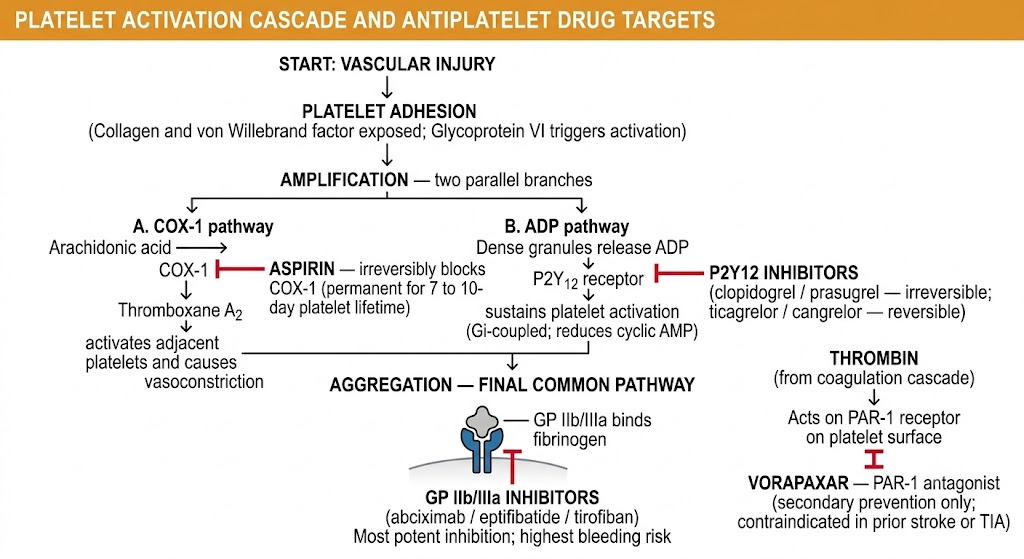
Flow diagram of the platelet activation cascade from vascular injury through platelet adhesion and amplification to aggregation, showing four antiplatelet drug targets: aspirin blocking COX-1 and thromboxane A2 synthesis in Branch A; P2Y12 inhibitors (clopidogrel, prasugrel, ticagrelor, cangrelor) blocking ADP receptor signaling in Branch B; glycoprotein IIb/IIIa inhibitors (abciximab, eptifibatide, tirofiban) blocking the final common aggregation pathway; and vorapaxar blocking the PAR-1 thrombin receptor.
Platelet activation cascade and antiplatelet drug targets — aspirin, P2Y12 inhibitors, glycoprotein IIb/IIIa inhibitors, and vorapaxar act at distinct nodes. Figure generated for Introduction to Medical Pharmacology, Chapter 39.

P2Y12 Inhibitors — Comparative Pharmacology

Clopidogrel is a thienopyridine prodrug requiring two-step hepatic cytochrome P450 biotransformation to generate an active thiol metabolite that irreversibly binds the P2Y12 receptor by forming a disulfide bond with cysteine residues in the receptor extracellular domain. Only approximately 15% of an absorbed clopidogrel dose undergoes productive bioactivation; the remainder is hydrolyzed to an inactive metabolite. This inefficient bioactivation pathway makes clopidogrel's antiplatelet effect highly dependent on cytochrome P450 2C19 activity. The standard maintenance dose is 75 mg once daily; loading doses of 300 mg or 600 mg are used when rapid platelet inhibition is needed.

Cytochrome P450 2C19 is highly polymorphic. Patients carrying loss-of-function alleles (particularly CYP2C19*2 and CYP2C19*3) are intermediate or poor metabolizers who demonstrate substantially reduced active metabolite exposure and platelet inhibition. Multiple retrospective analyses and prospective substudies demonstrated that cytochrome P450 2C19 poor and intermediate metabolizers have significantly higher rates of major adverse cardiovascular events including stent thrombosis when treated with clopidogrel after percutaneous coronary intervention. The US Food and Drug Administration issued a boxed warning for clopidogrel regarding poor metabolizer status.

Prasugrel is a third-generation thienopyridine prodrug with faster, more efficient, and less cytochrome P450 2C19-dependent bioactivation than clopidogrel. Onset of platelet inhibition is faster (approximately 30 minutes versus 2 to 4 hours for a 600 mg clopidogrel load), and the degree of inhibition is greater and less variable. A randomized trial (TRITON-TIMI 38, n = 13,608) demonstrated prasugrel reduced the primary composite endpoint by 19% compared to clopidogrel in acute coronary syndrome patients undergoing percutaneous coronary intervention, but with significantly more major bleeding. Prasugrel is contraindicated in patients with prior stroke or transient ischemic attack, and generally avoided in patients aged 75 or older and those weighing less than 60 kilograms.

Ticagrelor is a direct-acting, reversible P2Y12 antagonist that does not require metabolic activation. It binds an allosteric site distinct from the adenosine diphosphate binding site. Onset of action is faster than prasugrel (peak platelet inhibition within 2 hours), and the offset is also faster due to reversible binding, with platelet function recovering within 24 to 48 hours of the last dose. A large randomized trial (PLATO, n = 18,624) demonstrated ticagrelor 90 mg twice daily reduced the composite of cardiovascular death, myocardial infarction, or stroke by 16% compared to clopidogrel in acute coronary syndrome, with a significant reduction in cardiovascular mortality. Unique adverse effects include dyspnea (in approximately 13 to 15% of patients, attributed to adenosine reuptake inhibition) and ventricular pauses on Holter monitoring.

Cangrelor is an intravenous adenosine triphosphate analogue that directly and reversibly inhibits P2Y12 with virtually immediate onset and rapid offset (platelet function returns to baseline within 60 to 90 minutes of stopping the infusion). Its clinical niche is achieving potent, titratable, rapidly reversible P2Y12 inhibition during percutaneous coronary intervention in patients who have not been pre-loaded with an oral P2Y12 inhibitor. When transitioning from cangrelor to oral agents, clopidogrel and prasugrel must be given after the cangrelor infusion ends (not during, because cangrelor occupies P2Y12 and blocks thienopyridine metabolite binding), whereas ticagrelor can be given during the infusion.

Thienopyridine Prodrug

Clopidogrel

  • Irreversible; CYP2C19-dependent
  • 300 to 600 mg load / 75 mg daily
  • Onset 2 to 8 hours
  • Avoid omeprazole/esomeprazole (CYP2C19 competition)
  • Use when bleeding risk high or CYP2C19 genotype normal

Thienopyridine Prodrug

Prasugrel

  • Irreversible; less CYP2C19-dependent
  • 60 mg load / 10 mg daily
  • Onset 30 minutes
  • Contraindicated: prior stroke or TIA; avoid: age ≥75, weight <60 kg

Direct-Acting Reversible

Ticagrelor

  • Reversible; no prodrug activation
  • 180 mg load / 90 mg twice daily (ACS); 60 mg twice daily (secondary prevention)
  • Dyspnea in 13 to 15%
  • Preferred in most ACS without contraindications

Intravenous Reversible

Cangrelor

  • Intravenous; direct-acting; reversible
  • 30 mcg/kg bolus + 4 mcg/kg/min infusion
  • Offset 60 to 90 minutes
  • Niche: procedural bridging when no oral pre-loading
Section 2

Glycoprotein IIb/IIIa Inhibitors

Abciximab, eptifibatide, tirofiban — mechanisms, indications, and thrombocytopenia

The glycoprotein IIb/IIIa inhibitors block integrin alpha IIb beta 3, the final common pathway for platelet aggregation, producing the most complete inhibition of platelet aggregation achievable pharmacologically. Their potency is matched by higher bleeding risk, and their contemporary role has narrowed substantially with the emergence of potent oral P2Y12 inhibitors.

Three Agents, Three Mechanisms

Abciximab is a chimeric human-murine monoclonal antibody fragment that binds with very high affinity to activated glycoprotein IIb/IIIa, producing functionally irreversible inhibition during clinical use. Platelet-bound abciximab remains detectable for up to 14 to 21 days as drug redistributes among newly released platelets, but platelet function returns to approximately 50% of baseline within 12 hours of stopping the infusion through this dilution mechanism. For reversal of bleeding, platelet transfusion is effective because transfused platelets bind abciximab from plasma.

Eptifibatide is a cyclic heptapeptide that mimics the arginine-glycine-aspartic acid sequence of fibrinogen that normally occupies the glycoprotein IIb/IIIa binding site. Binding is competitive and reversible with a plasma half-life of approximately 2.5 hours. Because it is renally eliminated, dose reduction is required when creatinine clearance is 10 to 50 milliliters per minute, and it is contraindicated when creatinine clearance is below 10 milliliters per minute. Platelet function returns to approximately 50% of baseline within 4 hours of stopping the infusion.

Tirofiban is a non-peptide tyrosine derivative that competitively and reversibly inhibits glycoprotein IIb/IIIa with a plasma half-life of approximately 2 hours and primarily renal elimination. Dose reduction to 50% of the normal infusion rate is required when creatinine clearance is below 30 milliliters per minute. Current indications are largely limited to bail-out percutaneous coronary intervention use when large thrombus burden is encountered unexpectedly, or in high-risk non-ST-elevation myocardial infarction patients not pre-loaded with a potent P2Y12 inhibitor.

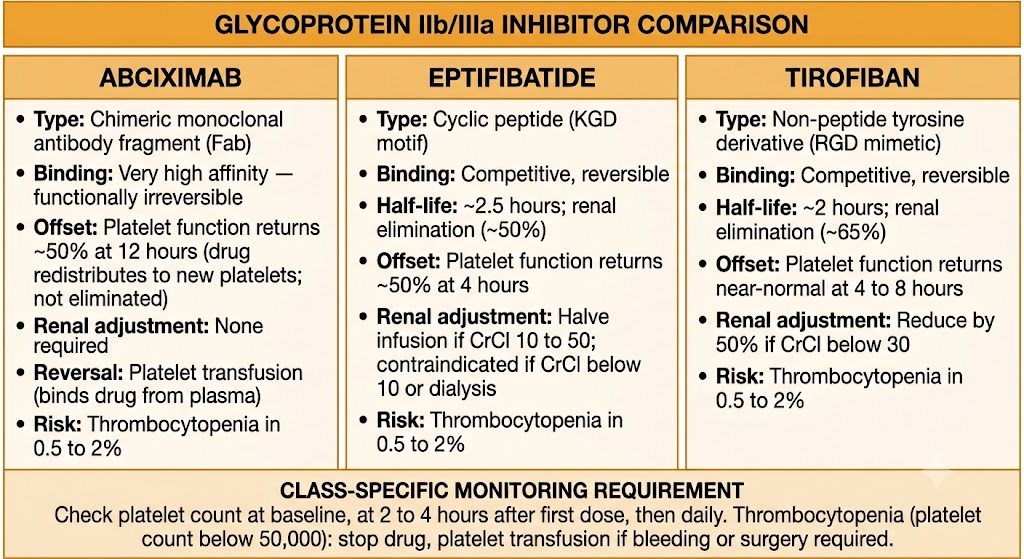
Three-panel comparison of glycoprotein IIb/IIIa inhibitors. Abciximab: chimeric monoclonal antibody fragment, functionally irreversible, offset 50% at 12 hours via redistribution, no renal adjustment, reversal by platelet transfusion, thrombocytopenia risk 0.5 to 2%. Eptifibatide: cyclic peptide, competitive reversible, half-life 2.5 hours, renal elimination 50%, offset 50% at 4 hours, halve infusion if creatinine clearance 10 to 50, contraindicated below 10 or dialysis. Tirofiban: non-peptide tyrosine derivative, competitive reversible, half-life 2 hours, renal elimination 65%, offset near-normal at 4 to 8 hours, reduce by 50% if creatinine clearance below 30. Shared monitoring box: check platelet count at baseline, 2 to 4 hours after first dose, then daily; stop drug and transfuse platelets if count falls below 50,000.
Glycoprotein IIb/IIIa inhibitor comparison — abciximab, eptifibatide, and tirofiban differ in binding reversibility, offset kinetics, and renal dose adjustment requirements. Figure generated for Introduction to Medical Pharmacology, Chapter 39.

Thrombocytopenia — Class-Specific Adverse Effect

Acute profound thrombocytopenia (platelet count below 50,000 per microliter) is a serious class-specific complication occurring in approximately 0.5 to 2% of patients. The mechanism involves naturally occurring antibodies that recognize neoepitopes on glycoprotein IIb/IIIa exposed only when the inhibitor is bound to the receptor, triggering antibody-mediated platelet destruction. This is distinct from heparin-induced thrombocytopenia. Thrombocytopenia typically develops within 2 to 24 hours of drug initiation and is generally reversible within 2 to 5 days of stopping the drug. Management includes immediate discontinuation, platelet transfusion if serious bleeding or surgery is required, and avoidance of the specific agent on future administrations. A baseline platelet count should be obtained before initiating any glycoprotein IIb/IIIa inhibitor, with a repeat count 2 to 4 hours after initiation and daily during therapy.


Section 3

Dual Antiplatelet Therapy — Duration, Risk Scoring, and De-escalation

DAPT duration after PCI and ACS, bleeding versus thrombotic risk, and P2Y12 monotherapy strategies

Dual antiplatelet therapy — the combination of aspirin with a P2Y12 inhibitor — is the cornerstone of treatment after acute coronary syndrome and after coronary stent implantation. The central clinical challenge is determining how long to continue combination therapy: longer dual antiplatelet therapy reduces ischemic events including stent thrombosis but increases bleeding risk, while shorter therapy reduces bleeding but may increase late stent thrombosis risk.

Standard Duration Guidelines

For patients who receive a drug-eluting stent after acute coronary syndrome (whether ST-elevation myocardial infarction or non-ST-elevation myocardial infarction), at least 12 months of dual antiplatelet therapy with aspirin plus a P2Y12 inhibitor is recommended. Prolonged dual antiplatelet therapy beyond 12 months is considered in patients who have tolerated therapy without bleeding complications and have high ischemic and low bleeding risk. For elective percutaneous coronary intervention with drug-eluting stent implantation, the minimum recommended duration is 6 months, with shorter durations of 1 to 3 months acceptable in patients at high bleeding risk who received new-generation stents. The minimum duration rationale is prevention of stent thrombosis — a catastrophic complication with 20 to 45% mortality that occurs most commonly within 30 days of stent implantation.

De-escalation — P2Y12 Monotherapy

A series of randomized trials has established P2Y12 monotherapy after a brief dual antiplatelet therapy period as a viable alternative to aspirin-based dual antiplatelet therapy in selected patients undergoing percutaneous coronary intervention. The conceptual basis is that aspirin contributes disproportionately to gastrointestinal bleeding risk relative to ischemic protection in the maintenance phase following the initial high-risk post-stent period, while P2Y12 inhibition provides more relevant protection against stent thrombosis. A randomized trial (TWILIGHT, n = high-risk percutaneous coronary intervention patients) demonstrated that ticagrelor plus placebo versus ticagrelor plus aspirin after 3 months of dual antiplatelet therapy reduced clinically relevant bleeding by 44% without increasing the composite ischemic endpoint at 1 year. Current practice favors aspirin discontinuation while maintaining the P2Y12 inhibitor as the preferred de-escalation sequence.

Dual Antiplatelet Therapy Duration Decision Framework

Acute coronary syndrome plus drug-eluting stent: 12 months minimum; extend beyond 12 months if high ischemic risk and no bleeding complications. Elective percutaneous coronary intervention plus drug-eluting stent: 6 months standard; 1 to 3 months acceptable in high bleeding-risk patients with new-generation stents. After 3 months: consider P2Y12 monotherapy (ticagrelor preferred based on TWILIGHT) in patients with high bleeding risk. De-escalation sequence: discontinue aspirin first while maintaining P2Y12 inhibitor. Do not stop both agents simultaneously. Triple therapy (oral anticoagulant plus dual antiplatelet therapy): transition to oral anticoagulant plus P2Y12 inhibitor (without aspirin) after 1 to 4 weeks in most atrial fibrillation-percutaneous coronary intervention patients; prefer direct oral anticoagulant over vitamin K antagonist.


Section 4

Additional Antiplatelet Agents and Special Populations

Vorapaxar, cilostazol, dipyridamole, chronic kidney disease, perioperative management, and triple therapy

Beyond aspirin and P2Y12 inhibitors, several antiplatelet agents occupy specific clinical niches. Antiplatelet decision-making in patients with chronic kidney disease, those requiring surgery, and those on concurrent anticoagulation introduces additional complexity requiring integration of organ function, procedural timing, and concurrent drug use.

Vorapaxar, Cilostazol, and Dipyridamole

Vorapaxar is a protease-activated receptor 1 (the principal thrombin receptor on platelets) antagonist with functionally irreversible binding. It is approved at 2.5 mg daily for secondary prevention in patients with prior myocardial infarction or peripheral arterial disease, in combination with aspirin or dual antiplatelet therapy. A large randomized trial (TRA 2°P-TIMI 50) demonstrated a 13% reduction in the composite of cardiovascular death, myocardial infarction, or stroke versus placebo, but with significantly increased intracranial hemorrhage. Vorapaxar is absolutely contraindicated in patients with prior stroke or transient ischemic attack.

Cilostazol is a selective phosphodiesterase type 3 inhibitor that increases intracellular cyclic adenosine monophosphate in platelets and vascular smooth muscle cells, producing both antiplatelet and vasodilatory effects. It is approved for intermittent claudication in peripheral arterial disease. Cilostazol is absolutely contraindicated in heart failure of any severity — inhibition of phosphodiesterase type 3 in cardiac myocytes has been associated with increased mortality in chronic heart failure.

Dipyridamole inhibits platelet aggregation by inhibiting phosphodiesterase (raising platelet cyclic guanosine monophosphate) and by blocking adenosine reuptake. Its primary clinical use is in the extended-release dipyridamole plus aspirin fixed-dose combination (Aggrenox) for secondary prevention after non-cardioembolic ischemic stroke or transient ischemic attack, where it is guideline-preferred along with clopidogrel over aspirin monotherapy. Common adverse effects include headache (from adenosine-mediated vasodilation) and gastrointestinal symptoms.

Perioperative Management and Renal Impairment

Perioperative antiplatelet hold times reflect the irreversibility and duration of action of each agent: aspirin is generally continued for cardiac and neurological procedures and held 7 to 10 days before high-bleeding-risk elective surgery; clopidogrel is held 5 days pre-operatively; prasugrel is held 7 days; ticagrelor is held 5 days. Cangrelor is the only agent available for perioperative bridging with a 60 to 90-minute offset allowing administration close to surgical incision. Elective surgery should be deferred until dual antiplatelet therapy can be safely completed when feasible.

In chronic kidney disease, aspirin is generally continued at standard secondary prevention doses, though absolute bleeding risk is higher in advanced chronic kidney disease. Clopidogrel is generally preferred over prasugrel in patients with chronic kidney disease and acute coronary syndrome given prasugrel's greater bleeding risk. Glycoprotein IIb/IIIa inhibitor dosing requires specific adjustment: eptifibatide infusion is halved at creatinine clearance 10 to 50 milliliters per minute and is contraindicated in dialysis patients; tirofiban also requires dose reduction at creatinine clearance below 30 milliliters per minute; abciximab does not require renal dose adjustment.

Critical Contraindications

Agent-Specific Absolute Limits

  • Prasugrel: contraindicated in prior stroke or transient ischemic attack (net harm in randomized trial); generally avoided age 75 or older and weight less than 60 kg
  • Vorapaxar: absolutely contraindicated in any history of stroke or transient ischemic attack
  • Cilostazol: absolutely contraindicated in any severity of heart failure
  • Eptifibatide and tirofiban: contraindicated in dialysis patients

Preferred Agents

Indication-Specific Selections

  • Most acute coronary syndrome: ticagrelor preferred over clopidogrel (mortality reduction in PLATO)
  • Acute coronary syndrome in chronic kidney disease: clopidogrel over prasugrel
  • Non-cardioembolic stroke or transient ischemic attack: extended-release dipyridamole plus aspirin or clopidogrel
  • Intermittent claudication: cilostazol (if no heart failure)
  • Atrial fibrillation plus percutaneous coronary intervention: direct oral anticoagulant plus clopidogrel (no aspirin after initial period)

Suggested References
Author / Organization Title Source
Vane JR Inhibition of prostaglandin synthesis as a mechanism of action for aspirin-like drugs Nat New Biol. 1971;231(25):232-235.
Antithrombotic Trialists Collaboration Collaborative meta-analysis of randomised trials of antiplatelet therapy for prevention of death, myocardial infarction, and stroke in high risk patients BMJ. 2002;324(7329):71-86.
Yusuf S, Zhao F, Mehta SR, et al. (CURE) Effects of clopidogrel in addition to aspirin in patients with acute coronary syndromes without ST-segment elevation N Engl J Med. 2001;345(7):494-502.
Wiviott SD, Braunwald E, McCabe CH, et al. (TRITON-TIMI 38) Prasugrel versus clopidogrel in patients with acute coronary syndromes N Engl J Med. 2007;357(20):2001-2015.
Wallentin L, Becker RC, Budaj A, et al. (PLATO) Ticagrelor versus clopidogrel in patients with acute coronary syndromes N Engl J Med. 2009;361(11):1045-1057.
Mehta SR, Tanguay JF, Eikelboom JW, et al. (CURRENT-OASIS 7) Double-dose versus standard-dose clopidogrel and high-dose versus low-dose aspirin in individuals undergoing percutaneous coronary intervention for acute coronary syndromes N Engl J Med. 2010;363(10):930-942.
Bhatt DL, Fox KAA, Hacke W, et al. (CHARISMA) Clopidogrel and aspirin versus aspirin alone for the prevention of atherothrombotic events N Engl J Med. 2006;354(16):1706-1717.
Levine GN, Bates ER, Bittl JA, et al. 2016 ACC/AHA guideline focused update on duration of dual antiplatelet therapy in patients with coronary artery disease J Am Coll Cardiol. 2016;68(10):1082-1115.
Vranckx P, Valgimigli M, Juni P, et al. (GLOBAL LEADERS) Ticagrelor plus aspirin for 1 month, followed by ticagrelor monotherapy for 23 months, vs aspirin plus clopidogrel or ticagrelor for 12 months after drug-eluting stent implantation Lancet. 2018;392(10151):940-949.
Mehran R, Baber U, Sharma SK, et al. (TWILIGHT) Ticagrelor with or without aspirin in high-risk patients after PCI N Engl J Med. 2019;381(21):2032-2042.
Morrow DA, Braunwald E, Bonaca MP, et al. (TRA 2 degrees P-TIMI 50) Vorapaxar in the secondary prevention of atherothrombotic events N Engl J Med. 2012;366(15):1404-1413.
Schupke S, Neumann FJ, Menichelli M, et al. (ISAR-REACT 5) Ticagrelor or prasugrel in patients with acute coronary syndromes N Engl J Med. 2019;381(16):1524-1534.
Watanabe H, Domei T, Morimoto T, et al. (STOPDAPT-2) Effect of 1-month dual antiplatelet therapy followed by clopidogrel vs 12-month dual antiplatelet therapy on cardiovascular and bleeding events in patients receiving PCI JAMA. 2019;321(24):2414-2427.
Sibbing D, Aradi D, Alexopoulos D, et al. Updated expert consensus statement on platelet function and genetic testing for guiding P2Y12 receptor inhibitor treatment in percutaneous coronary intervention JACC Cardiovasc Interv. 2019;12(16):1521-1537.
Angiolillo DJ, Rollini F, Storey RF, et al. International expert consensus on switching platelet P2Y12 receptor-inhibiting therapies Circulation. 2017;136(20):1955-1975.