Mineralocorticoid Pharmacology, Adrenal Insufficiency, Congenital Adrenal Hyperplasia, and Cushing Syndrome
Aldosterone receptor mechanisms, fludrocortisone, mineralocorticoid receptor antagonists, adrenal insufficiency replacement, congenital adrenal hyperplasia management, and Cushing syndrome drug targets
Chapter 28 · Module 4 of 4
Section 01
Mineralocorticoid Receptor Pharmacology
Aldosterone genomic signaling in the distal nephron, cortisol as an endogenous mineralocorticoid receptor agonist, 11-beta-hydroxysteroid dehydrogenase type 2 as the gating mechanism, and non-epithelial mineralocorticoid receptor activation in the heart and kidney
Aldosterone acts through the mineralocorticoid receptor to regulate sodium and potassium homeostasis in the renal collecting duct. However, the mineralocorticoid receptor is also expressed in the heart, vasculature, and kidney mesangial cells, where its activation drives fibrosis, inflammation, and end-organ damage independent of the sodium-retaining renal effect. This dual biology explains why mineralocorticoid receptor antagonists have proven beneficial in heart failure and diabetic kidney disease beyond their diuretic and antihypertensive effects.
Renal Mineralocorticoid Receptor Signaling
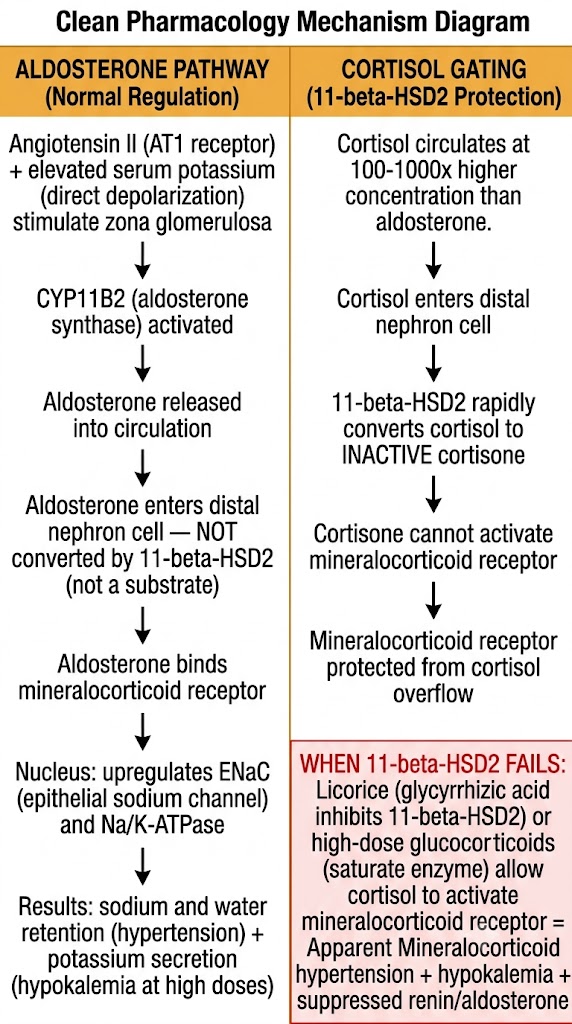
In the distal nephron and collecting duct, aldosterone binds the mineralocorticoid receptor and drives transcription of epithelial sodium channel (ENaC) subunits and the sodium-potassium ATPase. The resulting increase in apical ENaC expression drives sodium reabsorption from the tubular lumen into the interstitium, with potassium secreted as the counterion — producing sodium and water retention (raising blood pressure) and potassium loss (hypokalemia at pharmacological aldosterone concentrations). Aldosterone secretion from the zona glomerulosa is regulated by angiotensin II (acting through AT1 receptors) and directly by serum potassium, which depolarizes glomerulosa cells and increases aldosterone synthase (CYP11B2) activity — not by adrenocorticotropic hormone.
The 11-Beta-HSD2 Gating Mechanism
Cortisol binds the mineralocorticoid receptor with affinity equal to or greater than aldosterone. Under physiological conditions, the enzyme 11-beta-hydroxysteroid dehydrogenase type 2, co-expressed with the mineralocorticoid receptor in aldosterone-sensitive distal nephron cells, rapidly converts cortisol to inactive cortisone before it can activate the mineralocorticoid receptor. This enzyme creates a protected compartment in which aldosterone — not a substrate for 11-beta-hydroxysteroid dehydrogenase type 2 — can selectively activate the mineralocorticoid receptor despite circulating cortisol concentrations 100- to 1000-fold higher. When this gating fails, cortisol activates renal mineralocorticoid receptors and produces apparent mineralocorticoid excess: hypertension, hypokalemia, and suppressed renin/aldosterone. Acquired apparent mineralocorticoid excess occurs with licorice ingestion (glycyrrhizic acid inhibits 11-beta-hydroxysteroid dehydrogenase type 2) and with high-dose glucocorticoid therapy saturating the enzyme.
In the heart, mineralocorticoid receptor activation promotes cardiac fibrosis through collagen synthesis upregulation and macrophage-driven inflammation. In the vasculature, it impairs endothelial function by reducing nitric oxide bioavailability. In podocytes and mesangial cells, mineralocorticoid receptor activation drives glomerular inflammation and proteinuria, contributing to progression of diabetic kidney disease independently of blood pressure. These non-epithelial effects provide the pharmacological rationale for mineralocorticoid receptor antagonists as cardiorenal protective agents in heart failure and diabetic kidney disease.
Figure 1. Mineralocorticoid receptor signaling in the distal nephron. The enzyme 11-beta-hydroxysteroid dehydrogenase type 2 converts cortisol to inactive cortisone, protecting the mineralocorticoid receptor from cortisol activation. Failure of this gating produces apparent mineralocorticoid excess.
Section 02
Fludrocortisone and Mineralocorticoid Receptor Antagonists
Fludrocortisone as mineralocorticoid replacement, comparative pharmacology of spironolactone, eplerenone, and finerenone, and their evidence-based indications
Drugs acting at the mineralocorticoid receptor span a pharmacological range from potent agonist (fludrocortisone) to selective antagonists (spironolactone, eplerenone, finerenone). Their clinical applications reflect distinct mineralocorticoid receptor biology across tissues and the differing selectivity profiles of each agent.
Fludrocortisone
Fludrocortisone acetate is a synthetic fluorinated mineralocorticoid with approximately 125-fold greater mineralocorticoid potency than hydrocortisone and the only oral mineralocorticoid replacement agent in clinical use. The standard replacement dose is 50 to 200 micrograms per day, adjusted to achieve mid-normal plasma renin activity, normal serum sodium and potassium, and absence of postural hypotension or over-replacement signs (edema, hypertension). Fludrocortisone is also used at 100 to 300 micrograms per day for orthostatic hypotension in autonomic failure and postural orthostatic tachycardia syndrome. Adverse effects are predictable from its mechanism: sodium retention, hypertension, edema, and hypokalemia.
Mineralocorticoid Receptor Antagonists
Spironolactone vs. Eplerenone vs. Finerenone
Spironolactone — steroidal; potent mineralocorticoid receptor antagonist; off-target androgen receptor antagonism causes gynecomastia, sexual side effects in men, menstrual irregularities in women at doses above 50–100 mg/day; active metabolite canrenone (half-life 14–20 h); indications: heart failure with reduced ejection fraction (RALES trial — mortality benefit), primary hyperaldosteronism, ascites from cirrhosis, resistant hypertension, acne/hirsutism in women
Eplerenone — steroidal; selective mineralocorticoid receptor antagonist (no androgen/progesterone/glucocorticoid receptor cross-reactivity); 60-fold less potent than spironolactone at mineralocorticoid receptor; no gynecomastia or sexual side effects; indications: heart failure with reduced ejection fraction (EMPHASIS-HF trial), post-MI left ventricular dysfunction (EPHESUS trial); twice-daily dosing; higher cost
Finerenone — non-steroidal; high mineralocorticoid receptor selectivity; balanced heart/kidney tissue distribution; shorter half-life (2–3 h) may reduce hyperkalemia risk; indication: diabetic kidney disease with type 2 diabetes and elevated albuminuria on maximum renin-angiotensin-aldosterone system blockade (FIDELIO-DKD, FIGARO-DKD trials); first mineralocorticoid receptor antagonist approved for cardiorenal protection in diabetic kidney disease
All mineralocorticoid receptor antagonists — monitor serum potassium; hyperkalemia is the major dose-limiting adverse effect, especially with estimated glomerular filtration rate below 60 mL/min/1.73 m² or concurrent renin-angiotensin-aldosterone system blockade
Section 03
Primary and Secondary Adrenal Insufficiency: Replacement Therapy and Crisis Management
Pharmacological distinction between primary and secondary adrenal insufficiency, hydrocortisone replacement principles, fludrocortisone in primary adrenal insufficiency, adrenal crisis emergency management, and sick-day rules
Adrenal insufficiency requires lifelong hormone replacement. The pharmacological distinction between primary and secondary adrenal insufficiency is clinically essential: only primary adrenal insufficiency requires mineralocorticoid replacement, because the zona glomerulosa remains responsive to the renin-angiotensin-aldosterone system in secondary adrenal insufficiency where the pituitary rather than the adrenal gland is the site of failure.
Primary vs. Secondary Adrenal Insufficiency
Primary adrenal insufficiency (most commonly autoimmune adrenalitis — Addison disease) destroys all three cortical zones, producing combined glucocorticoid and mineralocorticoid deficiency. The hallmark is elevated plasma adrenocorticotropic hormone (because cortisol deficiency removes negative feedback, driving adrenocorticotropic hormone hypersecretion), which co-secretes melanocyte-stimulating hormone causing hyperpigmentation. Biochemical features include hyperkalemia and hyponatremia from mineralocorticoid deficiency.
Secondary adrenal insufficiency results from pituitary adrenocorticotropic hormone deficiency; the zona glomerulosa retains renin-angiotensin-aldosterone system-driven aldosterone production, so mineralocorticoid deficiency and hyperkalemia do not occur. Adrenocorticotropic hormone is low or inappropriately normal. No hyperpigmentation. The most common cause in clinical practice is glucocorticoid-induced hypothalamic-pituitary-adrenal axis suppression.
Glucocorticoid Replacement
Hydrocortisone is preferred for replacement in both primary and secondary adrenal insufficiency: identical to endogenous cortisol, short plasma half-life of approximately 1.5 hours, no prolonged hypothalamic-pituitary-adrenal suppression. The target dose is 15 to 25 mg per day in divided doses mimicking the physiological diurnal rhythm: largest dose (typically 10 mg) on waking, smaller doses (5 mg each) at mid-morning and early afternoon but not at bedtime. Prednisolone 3 to 5 mg or dexamethasone 0.25 to 0.5 mg once daily are alternatives for compliance issues but cannot replicate the physiological diurnal pattern.
Mineralocorticoid Replacement and Adrenal Crisis
Fludrocortisone 50 to 200 micrograms per day is mandatory in primary adrenal insufficiency. Adequacy is monitored by plasma renin activity (target: mid-normal range), serum electrolytes, and lying-to-standing blood pressure. Under-replacement causes sodium wasting, hyperkalemia, and postural hypotension; over-replacement causes hypertension, edema, and hypokalemia.
Adrenal crisis requires immediate treatment: hydrocortisone 100 mg intravenous bolus, then 200 mg per day by continuous infusion or 50 mg intravenous every 6 hours, plus aggressive normal saline resuscitation. Draw random cortisol and adrenocorticotropic hormone before the dose when logistically possible, but never delay treatment for laboratory results. Hemodynamic improvement within 30 to 60 minutes of hydrocortisone confirms the diagnosis. All patients must receive explicit sick-day rules: double or triple oral hydrocortisone for febrile illness; use intramuscular hydrocortisone 100 mg if unable to take oral medication.
21-Hydroxylase deficiency pathophysiology, glucocorticoid agent and dose selection by age, fludrocortisone in salt-wasting congenital adrenal hyperplasia, and monitoring targets for 17-hydroxyprogesterone and renin
Congenital adrenal hyperplasia due to 21-hydroxylase (CYP21A2) deficiency requires glucocorticoid therapy to suppress adrenocorticotropic hormone-driven androgen precursor overproduction. The pharmacological goal is suppression of excess androgenic precursors using the smallest dose that avoids glucocorticoid adverse effects — not normalization of cortisol.
Pathophysiology of 21-Hydroxylase Deficiency
CYP21A2 deficiency impairs conversion of 17-hydroxyprogesterone to 11-deoxycortisol (glucocorticoid pathway) and progesterone to deoxycorticosterone (mineralocorticoid pathway). Cortisol deficiency removes negative feedback, driving adrenocorticotropic hormone hypersecretion and bilateral adrenocortical hyperplasia. The adrenocorticotropic hormone excess drives accumulation of substrates proximal to the block — principally 17-hydroxyprogesterone — which are shunted via CYP17A1 into androgen synthesis, producing dehydroepiandrosterone and androstenedione excess. The salt-wasting form (approximately 75% of classic cases, less than 1% residual CYP21A2 activity) produces combined cortisol and aldosterone deficiency with neonatal adrenal crisis risk. The simple virilizing form (approximately 25%) maintains enough aldosterone production to prevent salt wasting but not enough cortisol to suppress adrenocorticotropic hormone.
Glucocorticoid Therapy by Age
In children, hydrocortisone 10 to 15 mg per square meter per day in three divided doses is the agent of choice. The short half-life minimizes suppression of the nocturnal growth hormone surge and linear bone growth compared with longer-acting synthetic glucocorticoids. Divided dosing is essential: a single daily dose would leave prolonged periods of inadequate adrenocorticotropic hormone suppression during which androgens accumulate. The pharmacological challenge is that doses sufficient to normalize androgen precursors often approach doses causing growth impairment — making monitoring of both androgen control and growth velocity essential.
In adults, prednisolone 2 to 4 mg per day in one or two divided doses provides more sustained nocturnal adrenocorticotropic hormone suppression than hydrocortisone. Dexamethasone 0.25 to 0.5 mg at bedtime has been used to suppress the nocturnal adrenocorticotropic hormone surge but carries higher risk of metabolic adverse effects from its potency and long half-life; it should be reserved for patients inadequately controlled on hydrocortisone or prednisolone.
Congenital Adrenal Hyperplasia Monitoring
Targets for Glucocorticoid and Mineralocorticoid Adequacy
17-hydroxyprogesterone (morning fasting) — target 300–1000 nmol/L; normalization often requires glucocorticoid excess and is not the goal; very high (>3000 nmol/L) = under-treatment; suppressed (<1 nmol/L) = over-treatment
Androstenedione — target within or slightly above age- and sex-specific normal range; persistently elevated despite adequate 17-hydroxyprogesterone suppression suggests non-compliance or adrenal rest tumor
Plasma renin activity (salt-wasting form) — target mid-normal on fludrocortisone; elevated = mineralocorticoid under-replacement; suppressed may indicate over-replacement of either fludrocortisone or glucocorticoid
Growth velocity (children) — monitor at every visit; consistently below 25th percentile for height-age warrants dose reduction even if androgen markers are not optimally controlled, because glucocorticoid-induced growth impairment is irreversible once epiphyses fuse
Section 05
Cushing Syndrome Pharmacotherapy
Steroidogenesis inhibitors (metyrapone, osilodrostat, ketoconazole, etomidate), the glucocorticoid receptor antagonist mifepristone, pasireotide for Cushing disease, and mitotane for adrenocortical carcinoma
Cushing syndrome pharmacotherapy targets excess cortisol production or action at different nodes of the hypothalamic-pituitary-adrenal axis and adrenal steroidogenesis pathway. Agent selection depends on etiology: pituitary adenoma (approximately 70% — Cushing disease), adrenal adenoma or carcinoma (approximately 20%), or ectopic adrenocorticotropic hormone secretion (approximately 10%).
Steroidogenesis Inhibitors
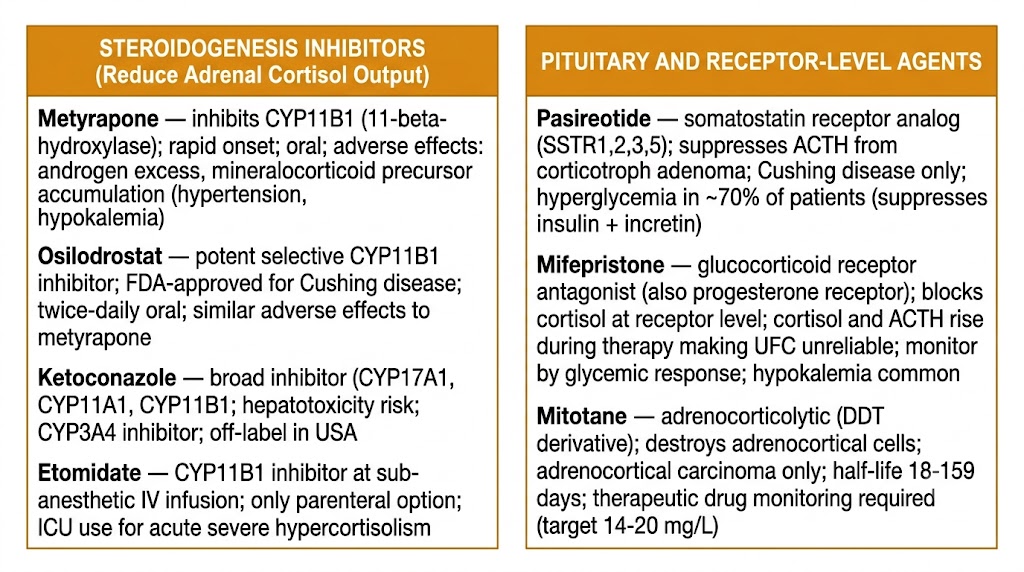
Metyrapone inhibits CYP11B1 (11-beta-hydroxylase), blocking the final conversion of 11-deoxycortisol to cortisol. It rapidly reduces cortisol production within hours and is one of the fastest-acting agents for controlling severe hypercortisolism. Precursor accumulation proximal to the block (11-deoxycortisol and deoxycorticosterone) provides biochemical confirmation of drug effect and drives the adverse effects: deoxycorticosterone has mineralocorticoid activity, causing sodium retention and hypertension; adrenocorticotropic hormone-stimulated precursors shunted to androgen synthesis cause acne, hirsutism, and menstrual irregularities in women. Used orally for short-term control before surgery, perioperative management, and long-term therapy in surgical non-candidates.
Osilodrostat is a potent, selective CYP11B1 inhibitor approved in 2020 for Cushing disease not amenable to surgery or with persistent disease after surgery. It has higher potency and selectivity than metyrapone, with modest CYP11B2 (aldosterone synthase) inhibition at higher doses that may partially offset mineralocorticoid precursor accumulation. Phase 3 trials demonstrated urinary free cortisol normalization in approximately 50 to 70% of patients. Adverse effects parallel metyrapone: adrenal insufficiency (dose-dependent), androgen excess, and potential hypertension from mineralocorticoid precursors. Twice-daily oral dosing.
Ketoconazole inhibits multiple steroidogenic enzymes (CYP17A1, CYP11A1, CYP11B1), producing broad steroidogenesis suppression. Significant hepatotoxicity risk (rare acute liver failure) requires baseline liver function tests and monthly monitoring; not FDA-approved for Cushing syndrome in the United States but widely used off-label and approved in Europe. Potent CYP3A4 inhibitor — multiple drug interactions. Used in countries where osilodrostat or metyrapone are unavailable.
Etomidate is the only parenteral steroidogenesis inhibitor available. At sub-anesthetic intravenous infusion doses (0.03 to 0.1 mg per kilogram per hour), it inhibits CYP11B1 and allows rapid, titratable cortisol suppression in critically ill patients with severe Cushing syndrome unable to take oral medications. Used in intensive care unit settings for acute severe hypercortisolism from ectopic adrenocorticotropic hormone syndrome awaiting surgery.
Receptor-Level and Pituitary-Directed Agents
Mifepristone is a competitive glucocorticoid receptor and progesterone receptor antagonist approved for hyperglycemia associated with endogenous Cushing syndrome in adults with type 2 diabetes or impaired glucose tolerance not candidates for surgery. Because it blocks glucocorticoid receptor negative feedback at the pituitary and hypothalamus, cortisol and adrenocorticotropic hormone levels rise substantially during therapy, making urinary free cortisol and late-night salivary cortisol unreliable monitors — clinical and glycemic parameters are the efficacy endpoints. Hypokalemia is common (cortisol activates mineralocorticoid receptor when glucocorticoid receptor is blocked). Progesterone receptor antagonism causes endometrial thickening and vaginal bleeding in premenopausal women.
Pasireotide is a somatostatin receptor analog preferentially binding somatostatin receptor subtypes 1, 2, 3, and 5 — including subtype 5 expressed at high density on corticotroph adenoma cells. It directly suppresses adrenocorticotropic hormone secretion from the adenoma, reducing cortisol production. Phase 3 trial demonstrated urinary free cortisol normalization in approximately 25 to 30% of patients with Cushing disease. Major limitation: hyperglycemia in approximately 70% of patients (somatostatin receptor activation in pancreatic islets suppresses both insulin and incretin secretion). Available as subcutaneous twice-daily (short-acting) or intramuscular monthly (long-acting release) formulation.
Mitotane is an adrenocorticolytic agent (derivative of the insecticide DDT) used primarily for adrenocortical carcinoma. It produces selective cytotoxic damage to adrenocortical mitochondria and inhibits multiple steroidogenic enzymes, causing progressive adrenocortical destruction with dual antitumor and cortisol-lowering effects. Highly lipophilic; half-life 18 to 159 days from adipose accumulation — months to reach steady-state, and prolonged adrenal insufficiency persists long after discontinuation. All patients require glucocorticoid replacement at two to three times normal replacement doses (mitotane induces CYP3A4, accelerating glucocorticoid metabolism, and increases corticosteroid-binding globulin, reducing free cortisol). Therapeutic drug monitoring (target plasma level 14 to 20 mg per liter): below 14 mg per liter reduces antitumor efficacy; above 20 mg per liter causes severe neurological toxicity (cerebellar ataxia, confusion, peripheral neuropathy).
Matching Drug to Cushing Syndrome Etiology
Cushing disease (pituitary adenoma): pituitary surgery is first-line. Medical therapy for failures: pasireotide targets pituitary directly; steroidogenesis inhibitors (metyrapone, osilodrostat) reduce adrenal output; mifepristone blocks glucocorticoid receptor peripherally when hyperglycemia dominates.
Adrenal adenoma: surgery is curative; medical therapy is pre-operative bridging only.
Ectopic adrenocorticotropic hormone: control primary tumor when possible; metyrapone or osilodrostat for rapid cortisol reduction; etomidate for acute severe hypercortisolism in the intensive care unit.
Adrenocortical carcinoma: mitotane is the primary pharmacological agent; combine with steroidogenesis inhibitors for cortisol control while awaiting adrenocorticolytic effect.
Figure 2. Cushing syndrome pharmacotherapy by mechanism. Steroidogenesis inhibitors (left) reduce cortisol production at the adrenal level. Pituitary-directed and receptor-level agents (right) target the hypothalamic-pituitary-adrenal axis or peripheral glucocorticoid receptor action.
Suggested References
Author / Organization
Title
Source
Funder JW et al.
The Management of Primary Aldosteronism: Endocrine Society Clinical Practice Guideline
J Clin Endocrinol Metab. 2016;101(5):1889–1916
Quinkler M, Stewart PM
Hypertension and the cortisol-cortisone shuttle
J Clin Endocrinol Metab. 2003;88(6):2384–2392
Pitt B et al.
The effect of spironolactone on morbidity and mortality in patients with severe heart failure (RALES)
N Engl J Med. 1999;341(10):709–717
Arlt W, Allolio B
Adrenal insufficiency
Lancet. 2003;361(9372):1881–1893
Zannad F et al.
Eplerenone in patients with systolic heart failure and mild symptoms (EMPHASIS-HF)
N Engl J Med. 2011;364(1):11–21
Bakris GL et al.
Effect of finerenone on chronic kidney disease outcomes in type 2 diabetes (FIDELIO-DKD)
N Engl J Med. 2020;383(23):2219–2229
Bornstein SR et al.
Diagnosis and Treatment of Primary Adrenal Insufficiency: Endocrine Society Guideline
J Clin Endocrinol Metab. 2016;101(2):364–389
Speiser PW et al.
Congenital Adrenal Hyperplasia Due to 21-Hydroxylase Deficiency: Endocrine Society Guideline
J Clin Endocrinol Metab. 2010;95(9):4133–4160
Feelders RA et al.
Advances in the medical treatment of Cushing syndrome
Lancet Diabetes Endocrinol. 2019;7(4):300–312
Nieman LK et al.
Treatment of Cushing Syndrome: Endocrine Society Clinical Practice Guideline
J Clin Endocrinol Metab. 2015;100(8):2807–2831
Fleseriu M et al.
Mifepristone, a glucocorticoid receptor antagonist, produces clinical and metabolic benefits in Cushing syndrome
J Clin Endocrinol Metab. 2012;97(6):2039–2049
Colao A et al.
A 12-month phase 3 study of pasireotide in Cushing disease
N Engl J Med. 2012;366(10):914–924
Terzolo M et al.
Adjuvant mitotane treatment for adrenocortical carcinoma