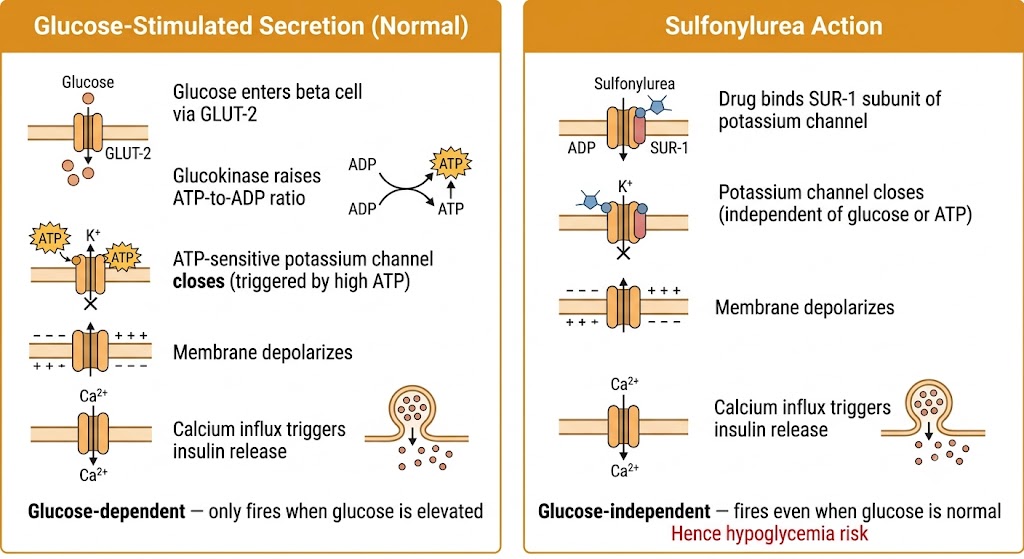
Sulfonylureas were the first oral antihyperglycemic agents and remain widely used because of their low cost and reliable glucose-lowering efficacy. They act by closing adenosine triphosphate-sensitive potassium channels in pancreatic beta cells, stimulating insulin secretion independent of blood glucose — which is both their mechanism of action and the explanation for their most important adverse effect.
Sulfonylureas bind to the sulfonylurea receptor 1 subunit of the adenosine triphosphate-sensitive potassium channel complex in beta cells, closing the channel and triggering the same downstream cascade as glucose — membrane depolarization, calcium influx, and insulin granule exocytosis. Because this occurs regardless of the prevailing blood glucose level, insulin is secreted even when glucose is already normal or low, making hypoglycemia an intrinsic pharmacological risk rather than a dose error.
First-generation sulfonylureas (tolbutamide, chlorpropamide) have largely been replaced by second-generation agents. Second-generation sulfonylureas in clinical use include glipizide, glyburide (glibenclamide), and glimepiride. Glimepiride and glipizide are generally preferred over glyburide in older adults because glyburide has active metabolites that accumulate in renal impairment, substantially increasing hypoglycemia risk. Glimepiride has the lowest hypoglycemia incidence among the class and some evidence of insulin-sensitizing effects at peripheral tissues.
The primary adverse effect is hypoglycemia, which can be severe and prolonged, particularly with glyburide in elderly patients or those with chronic kidney disease. Weight gain of 2 to 5 kg is common due to the anabolic effects of the additional insulin secreted. Secondary failure — diminishing efficacy over time as beta cell reserve further declines — occurs in a substantial proportion of patients over 5 to 10 years.
Type 1 diabetes mellitus: no beta cell function to stimulate — ineffective and potentially harmful. Chronic kidney disease (estimated glomerular filtration rate below 30 mL/min): accumulation of active metabolites, particularly with glyburide — avoid. Elderly patients: glyburide specifically is on the Beers Criteria as a potentially inappropriate medication due to prolonged hypoglycemia risk. Pregnancy: not recommended; insulin is the standard of care.
Meglitinides (repaglinide, nateglinide) share the sulfonylurea mechanism of closing adenosine triphosphate-sensitive potassium channels but differ in their binding site and pharmacokinetics. Their very rapid onset and short duration make them meal-targeted agents, taken immediately before each meal to cover postprandial glucose excursions.
Repaglinide and nateglinide bind to the sulfonylurea receptor 1 at a site overlapping with but distinct from the sulfonylurea binding site, producing rapid channel closure. Because they are rapidly absorbed and short-acting (duration 2 to 4 hours), their insulin secretory effect is tightly coupled to meal timing. Patients who skip a meal skip the dose, substantially reducing between-meal hypoglycemia compared with sulfonylureas. This makes meglitinides particularly useful for patients with erratic meal schedules.
Both agents are metabolized by cytochrome P450 3A4, making drug interactions an important consideration — strong cytochrome P450 3A4 inhibitors (azole antifungals, certain macrolide antibiotics) increase meglitinide exposure and hypoglycemia risk. Repaglinide is also a substrate of cytochrome P450 2C8; gemfibrozil inhibits this pathway and markedly elevates repaglinide levels, a clinically significant interaction. Both meglitinides are primarily hepatically metabolized and can be used in mild-to-moderate renal impairment, an advantage over glyburide.
Both close adenosine triphosphate-sensitive potassium channels. Key differences: meglitinides act faster and shorter (taken with each meal), sulfonylureas act longer (once or twice daily). Meglitinides have less between-meal hypoglycemia; sulfonylureas are simpler and cheaper. Neither class is preferred over metformin as initial therapy.
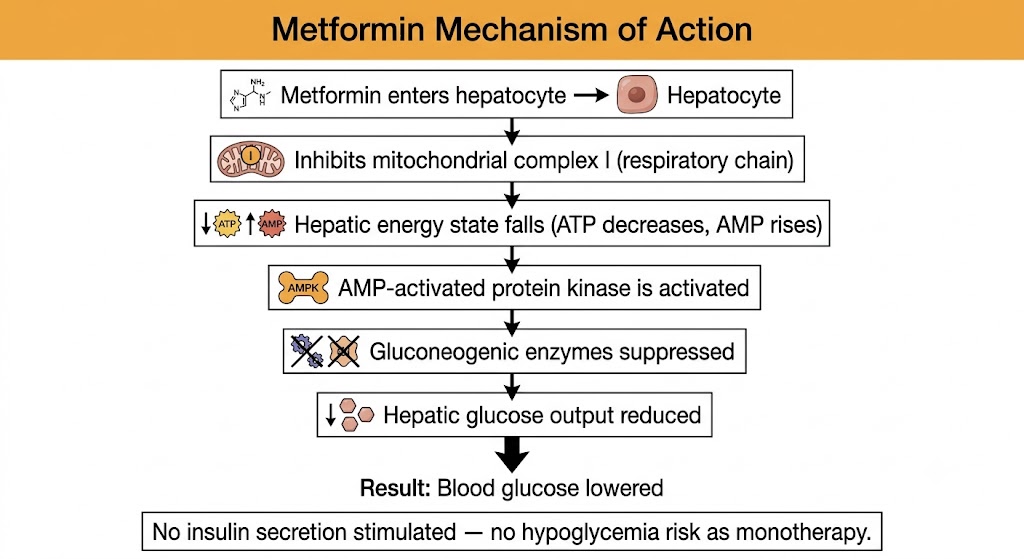
Metformin is the first-line oral agent for type 2 diabetes mellitus in all major guidelines. It lowers blood glucose primarily by reducing hepatic glucose output, does not stimulate insulin secretion, and carries no intrinsic hypoglycemia risk when used as monotherapy. Its weight-neutral to weight-reducing profile and decades of safety data make it the backbone of most type 2 diabetes mellitus regimens.
Metformin's primary action is suppression of hepatic gluconeogenesis. The molecular mechanism involves inhibition of mitochondrial complex I of the respiratory chain, reducing hepatic energy state and activating adenosine monophosphate-activated protein kinase. Activated adenosine monophosphate-activated protein kinase phosphorylates and inactivates key gluconeogenic enzymes and transcription factors, reducing glucose output from the liver. Metformin also improves peripheral insulin sensitivity in muscle, though the hepatic effect is dominant.
Metformin is not metabolized and is excreted unchanged by the kidneys. It is not protein bound and does not interact with cytochrome P450 enzymes, giving it a clean drug interaction profile. It is taken with meals to reduce gastrointestinal adverse effects. The extended-release formulation improves gastrointestinal tolerability for patients who experience nausea or diarrhea with immediate-release tablets.
Metformin is one of the few antihyperglycemic agents with evidence of cardiovascular benefit independent of glucose lowering. The United Kingdom Prospective Diabetes Study showed that metformin-treated overweight patients with type 2 diabetes mellitus had significant reductions in myocardial infarction and all-cause mortality compared with conventional treatment — findings not seen with sulfonylureas or insulin at equivalent glycemic control, suggesting a glucose-independent benefit.
The primary safety concern is lactic acidosis, a rare but potentially fatal adverse effect. Metformin inhibits hepatic lactate metabolism; under conditions of tissue hypoperfusion or reduced renal clearance, lactate accumulates. The contraindication threshold is an estimated glomerular filtration rate below 30 mL/min, where renal accumulation of metformin increases lactic acidosis risk. Between estimated glomerular filtration rate 30 and 45 mL/min, metformin is used with caution and dose reduction. Above 45 mL/min, it is generally safe. Other conditions that increase lactic acidosis risk include acute heart failure, acute myocardial infarction, and intravenous contrast administration in patients with pre-existing renal impairment — historically leading to a practice of holding metformin pericontract, now refined to holding only in patients with estimated glomerular filtration rate below 30 mL/min or those at high risk.
Gastrointestinal side effects — nausea, diarrhea, abdominal discomfort — are the most common reason for discontinuation and affect approximately 20 to 30 percent of patients. They are reduced by starting at a low dose, titrating slowly, and taking with food. Long-term metformin use is associated with reduced absorption of vitamin B12 (through interference with intrinsic factor-mediated ileal absorption), and periodic monitoring of vitamin B12 levels is recommended in patients on chronic therapy, particularly those with neuropathy symptoms.
Estimated glomerular filtration rate above 45: continue at standard dose.
Estimated glomerular filtration rate 30–45: reduce dose, increase monitoring frequency.
Estimated glomerular filtration rate below 30: contraindicated — stop metformin.
At the time of contrast administration: hold if estimated glomerular filtration rate below 30 or high risk; reassess renal function 48 hours after procedure before restarting.
Current guidelines from the American Diabetes Association position metformin as the preferred initial pharmacological agent for type 2 diabetes mellitus in patients without cardiovascular disease, chronic kidney disease, or heart failure (for whom glucagon-like peptide-1 receptor agonists or sodium-glucose cotransporter-2 inhibitors may be preferred first-line regardless of glycated hemoglobin). Sulfonylureas remain a common second agent when cost is a concern.
When metformin alone is insufficient, the choice of add-on agent is driven by patient-specific factors: presence of atherosclerotic cardiovascular disease or chronic kidney disease (favoring glucagon-like peptide-1 receptor agonists or sodium-glucose cotransporter-2 inhibitors with outcome trial data), hypoglycemia risk (favoring agents that do not stimulate insulin secretion), weight considerations (favoring glucagon-like peptide-1 receptor agonists or sodium-glucose cotransporter-2 inhibitors over sulfonylureas), and cost (favoring sulfonylureas or neutral protamine Hagedorn insulin). Sulfonylureas are effective add-on agents when glycated hemoglobin reduction is the primary goal and hypoglycemia risk is acceptable.
Metformin: first-line, no hypoglycemia risk, weight neutral, cardiovascular outcome benefit in UKPDS, contraindicated in severe renal impairment.
Sulfonylureas: effective, inexpensive, hypoglycemia risk, weight gain, secondary failure over time, avoid glyburide in elderly and chronic kidney disease.
Meglitinides: meal-targeted, less between-meal hypoglycemia than sulfonylureas, useful with erratic meal timing, more expensive than sulfonylureas.
| Author / Organization | Title | Source |
|---|---|---|
| Ashcroft FM, Rorsman P | K(ATP) channels and islet hormone secretion: new insights and controversies | Nat Rev Endocrinol. 2013;9(11):660–669 |
| Shorr RI et al | Individual sulfonylureas and serious hypoglycemia in older people | J Am Geriatr Soc. 1996;44(7):751–755 |
| Rosenstock J et al (CAROLINA) | Effect of linagliptin vs glimepiride on major adverse cardiovascular outcomes in patients with type 2 diabetes | JAMA. 2019;322(12):1155–1166 |
| Fuhlendorff J et al | Stimulation of insulin release by repaglinide and glibenclamide involves both common and distinct processes | Diabetes. 1998;47(3):345–351 |
| Zhou G et al | Role of AMP-activated protein kinase in mechanism of metformin action | J Clin Invest. 2001;108(8):1167–1174 |
| Foretz M et al | Metformin inhibits hepatic gluconeogenesis in mice independently of the LKB1/AMPK pathway via a decrease in hepatic energy state | J Clin Invest. 2010;120(7):2355–2369 |
| Duca FA et al | Metformin activates a duodenal Ampk-dependent pathway to lower hepatic glucose production in rats | Nat Med. 2015;21(5):506–511 |
| Graham GG et al | Clinical pharmacokinetics of metformin | Clin Pharmacokinet. 2011;50(2):81–98 |
| UK Prospective Diabetes Study Group (UKPDS 34) | Effect of intensive blood-glucose control with metformin on complications in overweight patients with type 2 diabetes | Lancet. 1998;352(9131):854–865 |
| Salpeter SR et al | Risk of fatal and nonfatal lactic acidosis with metformin use in type 2 diabetes mellitus | Cochrane Database Syst Rev. 2010;(4):CD002967 |
| de Jager J et al | Long term treatment with metformin in patients with type 2 diabetes and risk of vitamin B-12 deficiency | BMJ. 2010;340:c2181 |
| American Diabetes Association | Standards of Care in Diabetes—2024 | Diabetes Care. 2024;47(Suppl 1):S1–S321 |
| Inzucchi SE et al | Metformin in patients with type 2 diabetes and kidney disease: a systematic review | JAMA. 2014;312(24):2668–2675 |
| Holman RR et al | 10-year follow-up of intensive glucose control in type 2 diabetes | N Engl J Med. 2008;359(15):1577–1589 |