CHAPTER 23  ·  ERGOT ALKALOID PHARMACOLOGY
Section 1

Ergotamine in Acute Migraine

Mechanism of action at serotonin receptors, the role of caffeine in the combination formulation, and how ergotamine compares to the triptans it predates

Ergotamine was the first specific antimigraine drug and remained the standard of care for acute migraine for decades before triptans became available. Understanding its mechanism illuminates why triptans were developed as a more selective alternative — and why ergotamine still has a clinical role for a narrow subset of patients.

Mechanism of Action

Ergotamine produces its antimigraine effect primarily through agonist activity at serotonin type 1B and serotonin type 1D receptors located on the walls of meningeal blood vessels and on trigeminal nerve terminals. Activation of serotonin type 1B receptors on meningeal vessel walls causes vasoconstriction, reducing the abnormal dilation of these vessels that contributes to migraine pain. Activation of serotonin type 1D receptors on trigeminal nerve terminals inhibits the release of inflammatory neuropeptides — particularly calcitonin gene-related peptide — that drive neurogenic inflammation in the meninges.

This is the same dual mechanism used by the triptans. The critical difference is selectivity. Triptans are highly selective for serotonin type 1B and 1D receptors. Ergotamine also binds serotonin type 2 receptors, alpha-adrenergic receptors, and dopamine receptors simultaneously. This broader receptor engagement is the source of most of ergotamine's adverse effects and contraindications.

Routes of Administration

Ergotamine is available for oral, sublingual, and rectal administration. Oral bioavailability is highly variable and generally low due to extensive first-pass hepatic metabolism — a patient may absorb very little of an oral dose on one occasion and a substantially larger fraction on another. Rectal administration bypasses first-pass metabolism and provides more consistent absorption, which is why the rectal formulation is used when rapid, reliable drug delivery is needed in a patient with severe nausea who cannot take oral medication.

The sublingual route offers faster onset than oral administration but still suffers from significant variability. In clinical practice, the combination tablet formulation — ergotamine tartrate with caffeine, available as Cafergot — is the most commonly used oral preparation. Caffeine serves two purposes in this combination: it enhances ergotamine absorption from the gastrointestinal tract and may contribute independently to vasoconstriction.
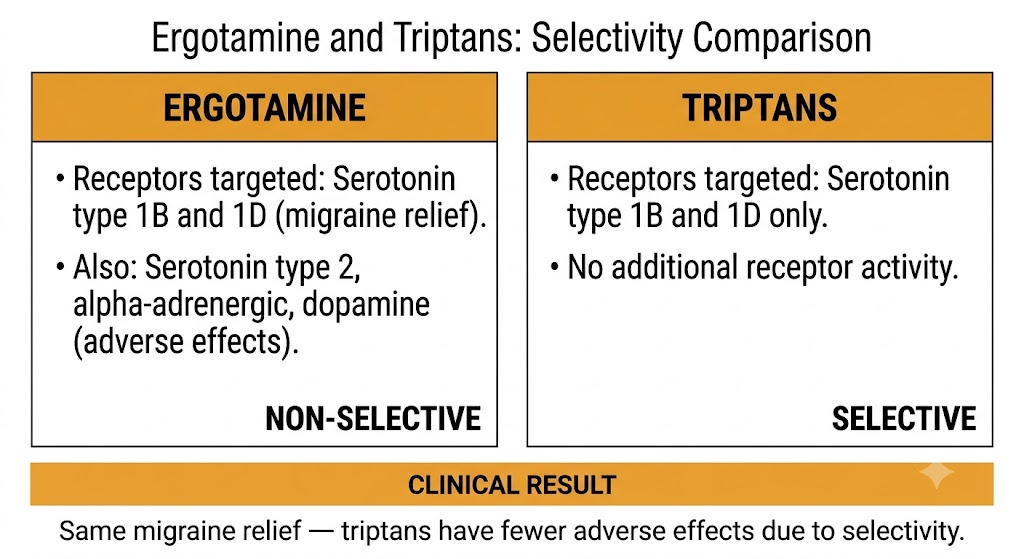
Two-panel diagram comparing ergotamine as a non-selective agent targeting multiple receptor families versus triptans as selective serotonin type 1B and 1D agonists.
Ergotamine versus triptans: receptor selectivity comparison. Figure generated by Gemini AI.
Ergotamine Versus Triptans

Triptans displaced ergotamine as the preferred acute migraine treatment because they are more selective, more predictable in their effects, and better tolerated. The non-selectivity of ergotamine means that a patient taking it for a migraine is also receiving alpha-adrenergic stimulation, serotonin type 2 receptor stimulation, and dopaminergic stimulation throughout the body — producing peripheral vasoconstriction, nausea, and other effects that triptans largely avoid.

Ergotamine retains a clinical role primarily for patients with prolonged migraine attacks lasting more than 48 hours, where its longer duration of pharmacodynamic effect compared to triptans may be an advantage, and for patients who have failed triptan therapy. For most patients with acute migraine, triptans are the preferred specific therapy.

Mechanism Summary

Ergotamine acts at serotonin type 1B receptors (meningeal vasoconstriction) and serotonin type 1D receptors (inhibits trigeminal neuropeptide release) — the same targets as triptans. Its additional activity at serotonin type 2, alpha-adrenergic, and dopamine receptors produces the adverse effects and contraindications that distinguish it from the more selective triptans.
Section 2

Dihydroergotamine

How semi-synthetic modification improves the therapeutic ratio, the routes available for emergency use, and when dihydroergotamine is preferred over ergotamine or triptans

Dihydroergotamine is a semi-synthetic ergot derivative produced by hydrogenation of ergotamine. This structural modification reduces peripheral vasoconstrictive potency while preserving activity at the cranial serotonin receptors responsible for migraine relief. The result is a drug with a better clinical profile than ergotamine for patients who need parenteral antimigraine therapy.

Pharmacological Differences from Ergotamine

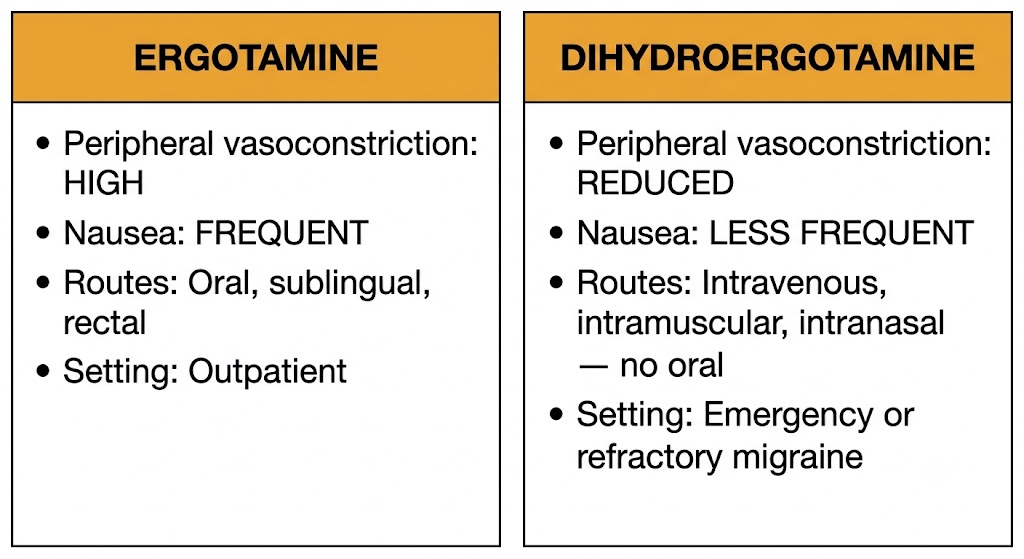
The hydrogenation of ergotamine reduces its affinity for alpha-adrenergic receptors and serotonin type 2 receptors on peripheral blood vessels. This means dihydroergotamine produces substantially less peripheral vasoconstriction than ergotamine at therapeutic doses, lowering the risk of extremity ischemia. Nausea is also considerably less frequent with dihydroergotamine than with ergotamine, which matters when the drug is being administered to a patient already experiencing the nausea that accompanies a severe migraine attack.

Crucially, dihydroergotamine retains its potency at serotonin type 1B and 1D receptors — the targets responsible for meningeal vasoconstriction and trigeminal inhibition. The selectivity ratio of cranial therapeutic effect to peripheral vasoconstrictive risk is therefore more favorable with dihydroergotamine than with ergotamine, though it remains less selective than the triptans.

Routes of Administration and Clinical Setting

Dihydroergotamine is available for intravenous, intramuscular, and intranasal administration. There is no oral formulation because oral bioavailability is negligible. The intravenous route provides the most rapid and reliable onset and is used in emergency department and inpatient settings for patients with severe refractory migraine or status migrainosus — a migraine attack lasting more than 72 hours that has not responded to standard outpatient therapy.

The intranasal formulation allows self-administration by patients outside of a clinical setting. It has better and more consistent bioavailability than oral ergotamine, though it is slower in onset than intravenous administration. Intramuscular administration is used when intravenous access is not available and rapid effect is needed.

Two-panel comparison of ergotamine and dihydroergotamine showing differences in peripheral vasoconstriction, nausea, available routes, and clinical setting.
Ergotamine versus dihydroergotamine: clinical comparison. Figure generated by Gemini AI.
Clinical Role: Refractory and Status Migrainosus

Dihydroergotamine occupies a specific clinical niche: the treatment of migraine attacks that have not responded to triptans or that are too severe and prolonged for outpatient triptan therapy to be appropriate. Repetitive intravenous dihydroergotamine administered over several days in an inpatient or infusion center setting is an established protocol for breaking status migrainosus and is sometimes called the Raskin protocol after the neurologist who described it.

This clinical positioning means dihydroergotamine is not a first-line drug — it is a rescue and bridge therapy for the subset of migraine patients whose disease is refractory to more selective agents. Understanding this role is important for Step 1 because questions about dihydroergotamine often test whether a student knows when it is appropriate to use it rather than a triptan.


Section 3

Contraindications and the 24-Hour Rule

Absolute contraindications shared with triptans, the mandatory separation interval when both drug classes are used, and medication overuse headache from frequent ergotamine use

The contraindication profile of migraine ergot alkaloids follows directly from their vasoconstrictive mechanism. Several of these contraindications are shared with the triptans, and the combination of an ergot with a triptan is specifically prohibited by a time-based rule that is frequently tested on Step 1.

Absolute Contraindications

Coronary artery disease is an absolute contraindication to both ergotamine and dihydroergotamine. Vasospasm of the coronary arteries from alpha-adrenergic and serotonin type 2 receptor activation can precipitate myocardial ischemia or infarction in a patient with already-compromised coronary blood flow. Peripheral vascular disease is contraindicated for the same reason — ergot-induced vasoconstriction reduces blood flow in vessels that are already narrowed.

Uncontrolled hypertension is a contraindication because ergot-induced systemic vasoconstriction raises blood pressure further. Pregnancy is an absolute contraindication because the uterotonic activity of ergotamine can induce uterine contractions and threaten the pregnancy — the same mechanism that makes methylergonovine useful in obstetrics is dangerous in a pregnant migraine patient.

The 24-Hour Rule: Ergots and Triptans

Ergot alkaloids and triptans must not be used within 24 hours of each other. Both drug classes constrict meningeal blood vessels through serotonin type 1B receptor agonism, and combining them within the same 24-hour period risks additive vasoconstriction that can extend to coronary and peripheral arteries. This additive vasospasm has caused myocardial infarction and stroke in patients who received both within a short interval.

The 24-hour rule applies in both directions: a patient who has taken ergotamine must wait 24 hours before taking a triptan, and a patient who has taken a triptan must wait 24 hours before taking ergotamine. This interval is based on the prolonged pharmacodynamic effect of ergotamine, which persists well beyond its plasma half-life due to tight receptor binding in vascular smooth muscle.

24-Hour Separation Rule

Ergot alkaloid + triptan within 24 hours = risk of additive coronary and peripheral vasospasm. This combination is contraindicated. The rule applies in both directions: 24 hours must elapse after either drug before the other is given. This is a classic Step 1 drug interaction concept.

Medication Overuse Headache

Frequent use of ergotamine — generally defined as use on ten or more days per month — leads to medication overuse headache, also called rebound headache. The mechanism involves changes in central pain processing that result from repeated exposure to acute antimigraine medication. As the drug wears off, headache returns and the patient takes another dose, creating a cycle of increasing medication use and worsening baseline headache frequency.

Ergotamine has a higher risk of producing medication overuse headache than triptans, likely because of its longer duration of pharmacodynamic effect and its broader receptor activity. Management requires withdrawal of the overused medication, which initially worsens headache before it improves. Recognizing medication overuse headache as a complication of frequent ergotamine use — and distinguishing it from treatment-refractory migraine — is an important clinical concept at the second-year level.


Section 4

Cytochrome P450 3A4 Drug Interactions

The enzyme inhibition mechanism that converts therapeutic ergot doses into toxic ones, the specific drug classes responsible, and why this interaction is a classic Step 1 question trigger

The cytochrome P450 3A4 drug interaction with ergot alkaloids is one of the most clinically dangerous and most frequently tested drug interactions in pharmacology. It applies to ergotamine, dihydroergotamine, and methylergonovine equally, and the mechanism is the same in all cases: inhibition of the enzyme responsible for ergot metabolism allows plasma concentrations to rise to levels that produce severe, life-threatening vasoconstriction.

Mechanism of the Interaction

Ergot alkaloids are metabolized almost exclusively by cytochrome P450 3A4 in the liver. At therapeutic doses, this enzyme efficiently converts ergot alkaloids to inactive metabolites, keeping plasma concentrations within the therapeutic range. When cytochrome P450 3A4 is inhibited by another drug, this metabolic pathway is blocked. The ergot alkaloid accumulates in plasma because it cannot be cleared at the normal rate, and concentrations rise until they reach the toxic range — sometimes ten times or more above the therapeutic concentration.

The elevated plasma concentration produces the same pharmacological effects as an overdose: intense, sustained vasoconstriction of peripheral, mesenteric, and coronary arteries. The clinical picture is ergotism — cold, pulseless extremities, severe pain, and potentially gangrene if the vasoconstriction is not reversed. This can occur even when the patient is taking a dose of ergotamine that had been well tolerated before the cytochrome P450 3A4 inhibitor was added.

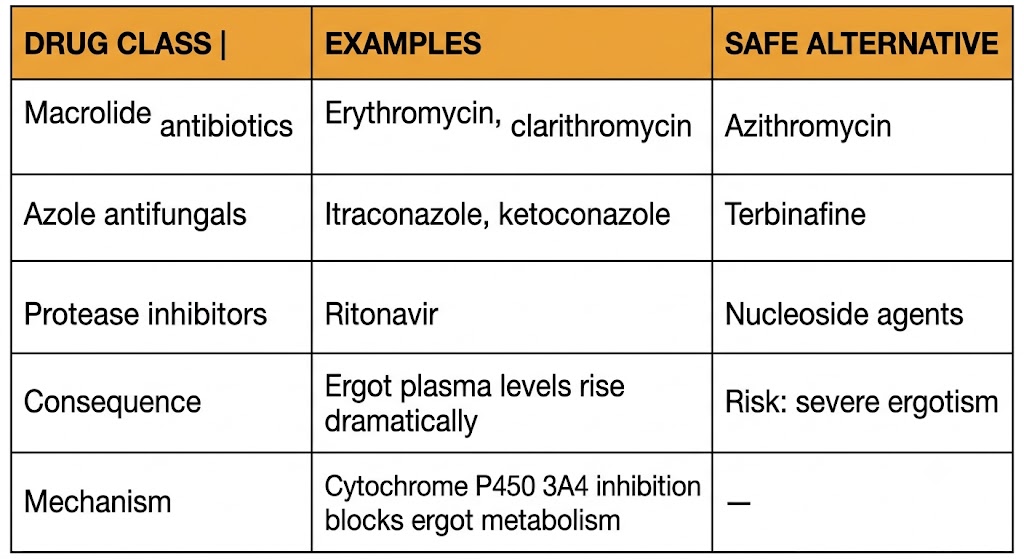
Reference table listing drug classes that inhibit cytochrome P450 3A4, specific examples, safe alternatives, and the consequence of co-administration with ergot alkaloids.
Cytochrome P450 3A4 inhibitors and ergot alkaloid toxicity risk. Figure generated by Gemini AI.
Drug Classes That Cause This Interaction

Three drug classes account for most clinically significant cytochrome P450 3A4 inhibition in patients taking ergot alkaloids. Macrolide antibiotics — specifically erythromycin and clarithromycin — are potent cytochrome P450 3A4 inhibitors. Azithromycin, another macrolide, does not significantly inhibit this enzyme and is the safe alternative. Azole antifungal agents — including itraconazole, ketoconazole, and fluconazole — are potent inhibitors and are absolutely contraindicated with ergot alkaloids. Human immunodeficiency virus protease inhibitors, particularly ritonavir, are among the most potent cytochrome P450 3A4 inhibitors known and create extreme risk of ergot toxicity.

The reason this interaction is such a reliable Step 1 question trigger is that it involves common drugs prescribed for common infections in patients who may also be taking ergotamine. A patient with a migraine disorder who develops a respiratory infection and is prescribed erythromycin by a provider who is unaware of the interaction is at genuine risk of life-threatening ergotism. The clinical lesson is simple: always check for cytochrome P450 3A4 inhibitors before prescribing or continuing any ergot alkaloid.

Contraindicated Combinations
Cytochrome P450 3A4 Inhibitors
  • Erythromycin — macrolide antibiotic
  • Clarithromycin — macrolide antibiotic
  • Itraconazole — azole antifungal
  • Ketoconazole — azole antifungal
  • Ritonavir — protease inhibitor
Safe Alternatives
Agents That Do Not Inhibit
  • Azithromycin — macrolide that does not inhibit cytochrome P450 3A4
  • Terbinafine — antifungal with different metabolic profile
  • Nucleoside reverse transcriptase inhibitors — no cytochrome P450 3A4 inhibition
Classic Step 1 Drug Interaction

Ergot alkaloid + cytochrome P450 3A4 inhibitor = severe ergotism risk. The interaction elevates ergot plasma concentrations dramatically, converting a therapeutic dose to a toxic one. Macrolides (erythromycin, clarithromycin), azole antifungals (itraconazole, ketoconazole), and protease inhibitors (ritonavir) are the primary offenders. Azithromycin is the safe macrolide alternative.


Suggested References
Author / Organization Title Source
Goadsby PJ, Holland PR, Martins-Oliveira M, Hoffmann J, Schankin C, Akerman S Pathophysiology of migraine: a disorder of sensory processing Physiol Rev. 2017;97(2):553–622
Silberstein SD, McCrory DC Ergotamine and dihydroergotamine: history, pharmacology, and efficacy Headache. 2003;43(2):144–166
Tfelt-Hansen P, Saxena PR, Dahlof C, et al Ergotamine in the acute treatment of migraine: a review and European consensus Brain. 2000;123(1):9–18
Raskin NH Repetitive intravenous dihydroergotamine as therapy for intractable migraine Neurology. 1986;36(7):995–997
Ferrari MD, Roon KI, Lipton RB, Goadsby PJ Oral triptans (serotonin 5-HT1B/1D agonists) in acute migraine treatment: a meta-analysis of 53 trials Lancet. 2001;358(9294):1668–1675
Diener HC, Limmroth V Medication-overuse headache: a worldwide problem Lancet Neurol. 2004;3(8):475–483
Dresser GK, Spence JD, Bailey DG Pharmacokinetic-pharmacodynamic consequences and clinical relevance of cytochrome P450 3A4 inhibition Clin Pharmacokinet. 2000;38(1):41–57
Westphal JF Macrolide-induced clinically relevant drug interactions with cytochrome P450 3A4: an update focused on clarithromycin, azithromycin and dirithromycin Br J Clin Pharmacol. 2000;50(4):285–295
Moskowitz MA Neurogenic versus vascular mechanisms of sumatriptan and ergot alkaloids in migraine Trends Pharmacol Sci. 1992;13(8):307–311
Ibraheem JJ, Paalzow L, Tfelt-Hansen P Low bioavailability of ergotamine tartrate after oral and rectal administration in migraine sufferers Br J Clin Pharmacol. 1983;16(6):695–699
Schiff PL Ergot and its alkaloids Am J Pharm Educ. 2006;70(5):98
Matossian MK Poisons of the Past: Molds, Epidemics, and History Yale University Press; 1989
Vaglio A, Salvarani C, Buzio C Retroperitoneal fibrosis Lancet. 2006;367(9506):241–251