How bromocriptine differs from other ergot alkaloids, its selective dopamine type 2 receptor agonism, and the mechanism of prolactin suppression
Bromocriptine occupies a unique position within the ergot alkaloid class. While ergotamine and methylergonovine are primarily vasoconstrictor drugs whose ergot structure produces unwanted dopaminergic side effects, bromocriptine is the reverse — its therapeutic effects are entirely dopaminergic, and the residual vasoconstrictor activity of its ergot backbone is the source of its adverse effects. This inversion of emphasis makes bromocriptine pharmacologically distinct from the rest of the class.
Bromocriptine is classified as a dopamine type 2 receptor agonist. It binds selectively to dopamine type 2 receptors and activates them, mimicking the effect of endogenous dopamine at those receptors. This distinguishes it from most other ergot alkaloids, which engage dopamine receptors as a secondary pharmacological property rather than as their primary mechanism.
The selectivity of bromocriptine for dopamine type 2 receptors is relative rather than absolute — it also has some serotonergic and alpha-adrenergic activity, as all ergot alkaloids do. However, at clinical doses, the dopaminergic effect dominates, and the other receptor activities are of secondary importance compared to the drugs discussed in Modules 2 and 3.
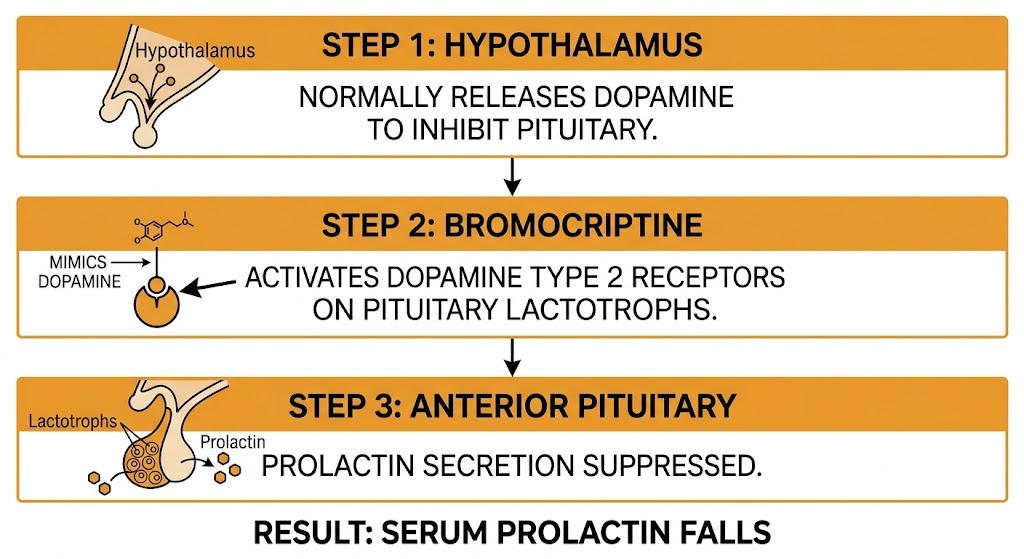
The most clinically important application of bromocriptine’s dopamine type 2 receptor agonism is suppression of prolactin secretion. In the anterior pituitary, a specialized population of cells called lactotrophs secretes prolactin. Dopamine released from the hypothalamus acts as a tonic inhibitor of lactotroph function — it continuously suppresses prolactin release by activating dopamine type 2 receptors on these cells. When hypothalamic dopamine release is reduced or blocked, prolactin secretion rises.
Bromocriptine mimics the inhibitory action of hypothalamic dopamine on pituitary lactotrophs. By activating dopamine type 2 receptors on lactotrophs, it suppresses prolactin secretion regardless of the state of endogenous hypothalamic dopamine release. This makes it an effective treatment for conditions in which prolactin is elevated either because of insufficient hypothalamic dopamine or because of a prolactin-secreting tumor.
Bromocriptine activates dopamine type 2 receptors on anterior pituitary lactotrophs → suppresses prolactin secretion. Mechanism mirrors endogenous hypothalamic dopamine inhibition of the pituitary. Same dopamine type 2 receptor agonism in the basal ganglia underlies its use in Parkinson’s disease.
Hyperprolactinemia, prolactinoma, Parkinson’s disease, and additional indications — each arising from the same dopamine type 2 receptor agonist mechanism
The clinical applications of bromocriptine are diverse, but they all follow from a single mechanism: dopamine type 2 receptor agonism. Whether the target is a hyperfunctioning pituitary lactotroph, a dopamine-depleted basal ganglia circuit, or a growth hormone-secreting pituitary tumor, bromocriptine acts by activating the same receptor in different tissues.
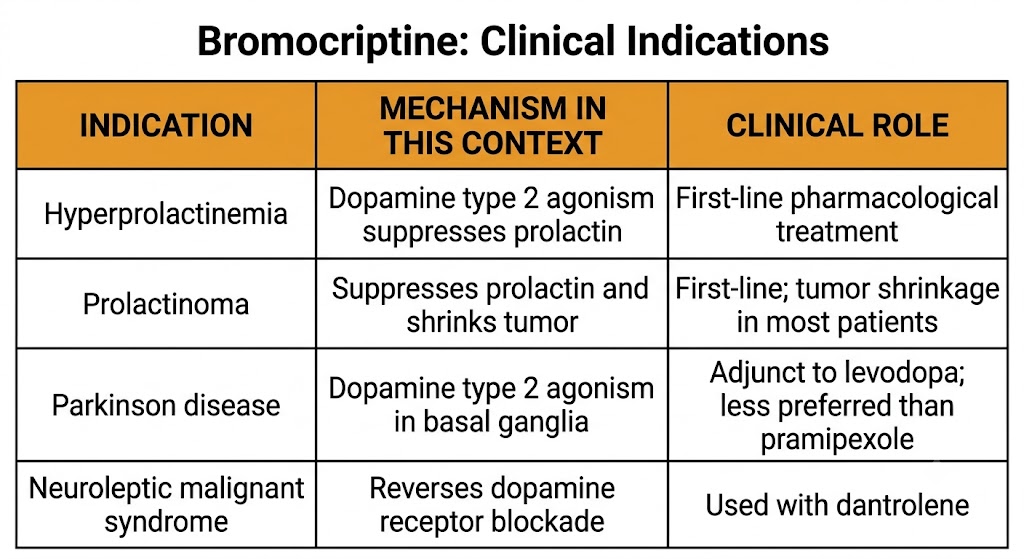
Hyperprolactinemia — elevated serum prolactin — presents clinically as galactorrhea (inappropriate milk production), amenorrhea, and infertility in women, and as hypogonadism and sexual dysfunction in men. The most common causes are prolactin-secreting pituitary adenomas and medications that block dopamine receptors (antipsychotic drugs, metoclopramide). Bromocriptine is first-line pharmacological therapy for symptomatic hyperprolactinemia from any cause.
At standard doses, bromocriptine normalizes serum prolactin, restores menstrual cycles, and resolves galactorrhea in most patients. In patients with a prolactin-secreting pituitary adenoma (prolactinoma), bromocriptine not only suppresses prolactin secretion but also shrinks the tumor itself in many cases — a property that distinguishes dopamine agonist therapy from most endocrine tumor treatments. Tumor shrinkage occurs because dopamine type 2 receptor activation inhibits both the secretory and proliferative functions of lactotroph cells.
In Parkinson’s disease, degeneration of dopaminergic neurons in the substantia nigra depletes dopamine signaling in the striatum, producing the characteristic motor features of the disease. Bromocriptine acts as a dopamine agonist in the basal ganglia, directly stimulating dopamine type 2 receptors on striatal neurons and partially compensating for the loss of endogenous dopamine. It is used as an adjunct to levodopa therapy in patients whose motor control is not adequately managed by levodopa alone, and as an early monotherapy in patients for whom levodopa initiation is being delayed.
Bromocriptine is less effective in Parkinson’s disease than the newer, more selective dopamine agonists such as pramipexole and ropinirole, which have largely replaced it in this indication. Its use in Parkinson’s disease is now relatively uncommon in current clinical practice, though it remains a tested concept at the second-year level.
In acromegaly — growth hormone excess from a pituitary somatotroph adenoma — bromocriptine reduces growth hormone secretion through dopamine type 2 receptor agonism on somatotroph cells. This effect is paradoxical in the context of normal physiology, where dopamine stimulates growth hormone release, but in somatotroph adenoma cells the receptor pharmacology is reversed. Bromocriptine is considerably less effective for acromegaly than somatostatin analogs such as octreotide and is used only when those agents are not tolerated or are unavailable.
A cycloset formulation of bromocriptine is approved for type 2 diabetes management. The mechanism in this context relates to resetting circadian dopamine rhythms in the hypothalamus to improve insulin sensitivity, but this indication is less well understood mechanistically and is not a high-yield Step 1 concept compared to the hyperprolactinemia and Parkinson’s disease indications.
Why dopamine receptor blockade produces this life-threatening syndrome, and how bromocriptine restores dopaminergic tone as part of treatment
Neuroleptic malignant syndrome is a rare but life-threatening reaction to dopamine receptor blocking agents — primarily antipsychotic drugs. Bromocriptine is one of two pharmacological treatments for this syndrome, and understanding its role requires understanding the mechanism by which the syndrome arises.
Neuroleptic malignant syndrome results from abrupt, widespread blockade of dopamine receptors in the brain and spinal cord. This occurs most commonly after initiation or dose escalation of antipsychotic drugs, which are dopamine type 2 receptor antagonists. The clinical picture is a tetrad: hyperthermia (often exceeding 40 degrees Celsius), severe muscle rigidity, altered mental status, and autonomic instability (blood pressure fluctuations, tachycardia, diaphoresis).
The hyperthermia is generated by the intense muscle rigidity, which produces heat through continuous isometric muscle contraction. The rigidity itself results from loss of dopaminergic inhibition of motor circuits in the basal ganglia and spinal cord. Autonomic instability reflects dopamine receptor blockade in the hypothalamus and brainstem, where dopamine normally participates in cardiovascular and temperature regulation.
Bromocriptine treats neuroleptic malignant syndrome by restoring dopaminergic tone at the receptors blocked by the offending antipsychotic drug. As a dopamine type 2 receptor agonist, it competes with the blocking drug for receptor occupancy and partially reverses the dopamine receptor blockade that drives the syndrome. This reduces muscle rigidity, which in turn reduces heat generation and lowers body temperature.
Bromocriptine is used in combination with dantrolene in severe cases. Dantrolene acts by a completely different mechanism — it blocks calcium release from the sarcoplasmic reticulum in skeletal muscle, directly reducing muscle contraction and heat production regardless of the neurological cause of the rigidity. The combination addresses the syndrome at two levels simultaneously: bromocriptine at the dopamine receptor and dantrolene at the muscle.
Step 1: Discontinue the offending antipsychotic drug immediately. Step 2: Bromocriptine — restores dopaminergic tone by activating dopamine type 2 receptors blocked by the antipsychotic. Step 3: Dantrolene — reduces skeletal muscle rigidity and heat production by blocking sarcoplasmic reticulum calcium release. Supportive care including cooling and hydration throughout.
The dose-dependent adverse effect profile of bromocriptine and cabergoline, cardiac valvulopathy as a class concern for dopaminergic ergots, and the distinction from the vasoconstrictor ergots
The adverse effects of bromocriptine reflect its dual pharmacological nature: dopamine type 2 receptor agonism produces the desired therapeutic effects but also causes predictable dopaminergic adverse effects, while the residual ergot backbone activity produces vasoconstrictive and fibrotic effects that are not shared by non-ergot dopamine agonists.
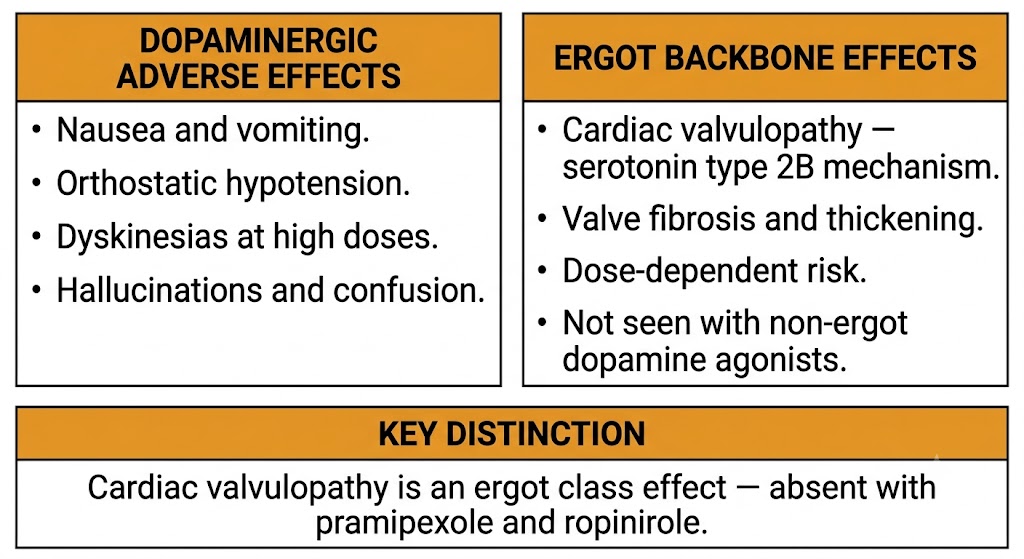
Nausea and vomiting are the most common adverse effects of bromocriptine and result from dopamine type 2 receptor activation in the chemoreceptor trigger zone of the medulla — the same zone that detects emetic stimuli. Starting at low doses and titrating slowly reduces but does not eliminate this problem. Orthostatic hypotension occurs because dopamine type 2 receptor activation in the cardiovascular system reduces sympathetic tone, leading to a drop in blood pressure upon standing.
At the higher doses used in Parkinson’s disease, bromocriptine can produce dyskinesias — involuntary movements that resemble those caused by levodopa excess — as well as psychiatric effects including hallucinations and confusion. These neuropsychiatric effects reflect excessive dopaminergic stimulation in limbic circuits and are the primary dose-limiting adverse effects in Parkinson’s disease management. Patients with dementia are particularly vulnerable and may experience severe psychiatric symptoms at doses that are well tolerated in cognitively intact patients.
Dopaminergic ergot alkaloids — bromocriptine, cabergoline, and the now-withdrawn pergolide — share a class risk of cardiac valve fibrosis that is not present with non-ergot dopamine agonists such as pramipexole or ropinirole. The mechanism involves serotonin type 2B receptor agonism on cardiac valve interstitial cells, stimulating fibroblast proliferation and collagen deposition that thickens and stiffens the valve leaflets.
This risk is dose-dependent and is most clinically significant with cabergoline used at the high doses required for Parkinson’s disease — doses substantially higher than those used for hyperprolactinemia. At hyperprolactinemia doses, the cardiac risk is considered low and routine echocardiographic monitoring is generally not required. At Parkinson’s disease doses, periodic echocardiography is recommended to detect early valve changes before they become symptomatic. Pergolide was withdrawn from the United States market in 2007 specifically because of this valvulopathy risk, which was judged unacceptable given the availability of safer alternatives.
Cabergoline has largely replaced bromocriptine as the preferred dopaminergic ergot for hyperprolactinemia. It has a much longer half-life than bromocriptine — allowing twice-weekly rather than daily dosing — and is better tolerated, with significantly less nausea and orthostatic hypotension at the doses used for prolactin suppression. Efficacy for prolactinoma shrinkage is comparable or superior. The cardiac valvulopathy risk at hyperprolactinemia doses is low for both agents, but cabergoline’s tolerability advantage has made it the clinical standard in most settings.
| Author / Organization | Title | Source |
|---|---|---|
| Missale C, Nash SR, Robinson SW, Jaber M, Caron MG | Dopamine receptors: from structure to function | Physiol Rev. 1998;78(1):189–225 |
| Melmed S, Casanueva FF, Hoffman AR, et al | Diagnosis and treatment of hyperprolactinemia: an Endocrine Society clinical practice guideline | J Clin Endocrinol Metab. 2011;96(2):273–288 |
| Vance ML, Evans WS, Thorner MO | Bromocriptine | Ann Intern Med. 1984;100(1):78–91 |
| Webster J, Piscitelli G, Polli A, Ferrari CI, Ismail I, Scanlon MF | A comparison of cabergoline and bromocriptine in the treatment of hyperprolactinemic amenorrhea | N Engl J Med. 1994;331(14):904–909 |
| Roth BL | Drugs and valvular heart disease | N Engl J Med. 2007;356(1):6–9 |
| Zanettini R, Antonini A, Gatto G, Gentile R, Tesei S, Pezzoli G | Valvular heart disease and the use of dopamine agonists for Parkinson’s disease | N Engl J Med. 2007;356(1):39–46 |
| Antonini A, Poewe W | Fibrotic heart-valve reactions to dopamine-agonist treatment in Parkinson’s disease | Lancet Neurol. 2007;6(9):826–829 |
| Rabinak CA, Nirenberg MJ | Dopamine agonist withdrawal syndrome in Parkinson disease | Arch Neurol. 2010;67(1):58–63 |
| Scranton RE, Gaziano JM, Rutty D, Ezrokhi M, Cincotta A | A randomized, placebo-controlled trial to assess safety and tolerability during treatment of type 2 diabetes with usual diabetes therapy and either Cycloset or placebo | BMC Endocr Disord. 2007;7:3 |